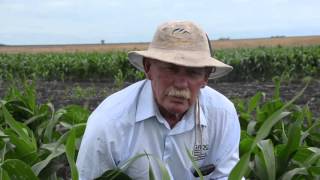
Rob Taylor discusses how root lesion nematodes damage crops in northern grain regions. A GRDC-funded trial tested nematode and crown rot effects on different varieties and management practices to help growers protect yields.
Chapters
Root lesion nematodes have become a hidden hindrance to northern grain growers, slashing crop productivity and forcing a rethink of traditional cropping rotations each year across the northern cropping belt. Intolerant wheat and chickpea varieties are impacted by nematodes with estimated yield losses of up to 50% and 20% respectively.
Probably hard to quantify, but if you had a crop doing say 3 tonne a hectare where you had nematodes, you could be down to a tonne a hectare. Especially when they take out the whole paddock when they're spread. Sometimes it's only patchy, but yeah, they are. And the other interesting finding now is the tie in with crown rot and how much damage the two combined together can cause us. Crown rot's just endemic on the plain. We just don't seem to be able to get rid of it. The nematodes, we've got half the farm from the late war till the 70s. Before we took it over, all it did was grow wheat, so it's riddled with nematodes. So wheat's really a once in 10 year crop for us.
Rob Taylor is hosting a research trial that's being conducted by the GRDC funded Northern Grower alliance on his 2000 hectare mixed winter and summer cropping property, Curroweena in the central Darling Downs. The trial that's been run by NGA Chief Executive Richard Daniel and is evaluating three main the impact from increased nematode populations on variety yield, the impact from varieties and crops on nematode buildup, and the impact from management practices on yield losses and nematode buildup. With crown rot analysis also being undertaken as part of the trial, Mr. Taylor is interested in seeing the results of the interaction between crown rot and nematodes.
The other thing I'm hoping that comes out of the MGA trial is the time of planning, especially for wheat. If we can go early, does the plant compensate for those two pests? Because why it's looking if we have a late plant in winter, wheat's just out of the question. Again, if we go back and say, okay, if we've grown a variety of barley, what are the nematode counts afterwards, whether we've lowered them or raised them. Same with chickies. And again on the wheat varieties. And also what varieties do hold handle high nematode numbers, that will give us thought to what we can plant. Not just going out and saying, okay, that looks like a good variety, let's whack it in. But for me, having the trial of my own farm gives me a pretty good insight of what does perform here.
In the northern cropping regions. Nematode numbers at 2 per gram of soil anywhere in the profile is considered a damaging population. The NGA's trial activity at Karowena started in 2013 in a paddock with an existing natural population of 6 per gram of soil.
We'll go back three winters into where the trial is. We had planted 18 metre strips of one of Streslecki wheat and the other one of Caperoi durum. The Streslecki lifted the nematode numbers where the caporoi held them about where they are if going on the soil test. Even where the Caparoi was was still high nematodes. But yeah, this will give us very high to high of what different varieties will come out of it.
Mr. Taylor, who is a former GRDC Northern Region panel member, has seen a dramatic rise in industry awareness about root lesion nematodes and their potential impact on crop productivity.
I'll go back to when I started on panel. There was a lot of people growing old wheat varieties and we couldn't work out why and why haven't they moved on to these newer varieties which are coming through in NVT saying they should be better. But I think that's really when people started to realise the nematode problem, how widespread it was and started testing and saying okay, we've got nematodes, what can we do about it? The NGA type model is set up that it gets money in growers pockets in one to three years. So this is going to have the information that comes out of this trial even after one sort of time will give information to growers that they can improve their practices or improve their choice of variety straight away. It's a huge issue. Yes, GRDC especially the northern panel is invested heavily in nematodes and crown rot. So big trial work but just not looking at the variety. But there is breeding hopefully coming on.
Mr. Taylor stressed that regular monitoring of populations using the DNA based soil testing service Predictor B was critical to maximising crop yield and farming system profitability.
I think people eventually get to go and test and find out especially if they see a paddock that performs poorly or patches in it aren't up to speed. Go and get a predictor beak but don't just do nematodes, do a crown rot before planting and have a good think about what the results are.