What to do with profit: repay debt, expand or invest? - Mark Gardner
Mark Gardner argues there's no single answer to what farms should do with profit: repay debt, expand, or invest off-farm. It depends on each farm's unique situation. He recommends measuring profit as a 10-year rolling average and aligning spending with succession plans and long-term goals.
Questions this video answers
6.1% per year (average over 20 years, cited from Rural Bank report).
Core debt about $2.4 million; cash surplus about $40,000 per year (implying ~61 years to repay at that surplus level).
Chapters
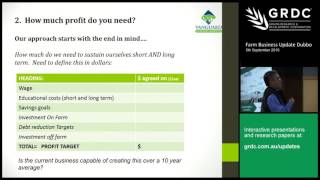
I'm fairly relaxed about how we'll go through this. So if you've got any questions while we're going through the talk, stick your hand up and we'll get, we'll get some on the go. Okay, so what to do with the profit? Look, our business is a little bit different to some of the other businesses. We work a lot with mixed farming businesses which are pastoralists, cropping, grazing and a few sort of businesses that earn most of their income from cropping. But that's not our main deal. We work pretty much statewide and we manage a lot of projects for Australian Wool Innovation, Meat and Livestock Australia. And our little business is actually a partner in the Sheep CRC Cooperative Research Centre. So we have a lot to do with industry extension, but particularly in the livestock industries. The other thing that we do is a lot of succession planning and I think it's really interesting that James Smith, whose talk is in the notes there is a financial planner from Tamworth and he's giving the talk up that way. And we prepared our talk separately and then we had a good yarn and swapped presentations. And it's just fascinating the overlap in some of the, the outcomes coming from totally different viewpoints. But what I want to do is really paint the picture that what to do with the profits is intimately linked with the way that you see the future of your business. And succession planning has to be part of that. I haven't written a 10 page referenced academic paper. It will be coming around if it's not around. It's a summary of what the talk is and the slides are there too. So if you have any questions. A lot of this stuff is very individual. So if you have any questions about your own business, I'll be around at lunchtime or give us a buzz afterwards or drop me an email if you like, if you want to talk your own specific issues. But off we go. Shoes, have a look at your shoes. Shoes are very enlightening about a lot of different things. Who's got size 12 or more? So you guys, has anyone got size 13? 14. About size 14. Okay, so that's the biggest shoe size we've got. Who's got size six ladies? Seven. Six or seven? Eight. Okay, a few. Eight. So what we've got in the room is we've got a range in shoe sizes from size 14 to size 8. Now what would happen if the size 8 person gave her shoes to the size 14 person? How would that feel? Tight. You mightn't even get them on and they wouldn't be a Good fit, would they? And likewise, if we gave your size 14 to size 8, how would they be? Not so good. Very uncomfortable, you know. And your farm business is very similar, isn't it? Your farm business is a unique fit for you. And it doesn't have to fit with anyone else, does it? It has to fit with you. You have a unique aspect in relation to your soils and your climate. The people in your business are unique. Your aspirations and your hopes for the future may well be unique. Your needs for profit, well, be unique. So with a lot of the stuff that we're talking about now, there are some general principles, but the specifics are unique to your shoe size. Does that make sense? Good. So therefore, I can give you a very simple and quick answer of what to do with a profit. Grab your pen, write it down, because here it is. It depends. It depends on your shoe size, doesn't it? It depends what you're trying to achieve into the future. It depends where you are in your business, depends where you're going. It depends on who might be coming back and who may not be coming back, who might be leaving. It depends. So a lot of what we talk about, and you'll see in James Presentation too, is this is very individual. And it depends on you guys sitting down with the people that are involved in your business and defining the way that you see the future so that you can actually clarify very clearly what that is for you, what the best use of that profit is in your business. And it might be different to the person sitting next to you. That's okay, isn't it? They might have a different shoe size, but let's look at some of the things that go into answering and teasing out. It depends. So I think the first thing to think about is, you know, what to do with the profits is very much dependent on the level of profit that you're achieving in the business, isn't it? And we've seen from the Agripath folks that there's quite a range in profitability in any group, and this region is no different, that there's a significant variation in profitability. So what to do with the profits depends on, A, are you creating profits in your business? And B, what level of profit is that? So that's an important aspect. What to do with the profits and profitability, I think that depends on your land capability. I think it depends on the enterprises that you're running and what I'm just going to float as the financial mastery that you have within each of the enterprise. Now, that's different. To yield level, which I'll tease apart a little bit later on. It's the financial mastery that you have within the enterprise. I think it also does depend a little bit on location, that profitability, particularly if you've been up the northwest of the state. We get variations in profit based on regions, so that's a big factor. The other thing that I want to talk about a little bit is about risk and the risk profile of your business and your long term aspects related to the regeneration focus of your land, the soil health and things like herbicide resistance, soil structure, carbon. All of those things are very important if you're thinking long term in your business. One of the things that I want to explore and float with you today is not just looking at your product profit on a year by year basis, but looking at your profit over a decade. Most businesses that we work with are farm families and they're in it for the long term. So it makes sense to have a look at the profit over the long term, not just year by year. It makes sense to look at enterprise performance not just year by year, but be thinking about what is the 10 year return from that enterprise. And I think sometimes you get different perspectives, taking out the ups and downs average, what is it over a 10 year period. I'll explore some of these topics a bit more. If the level of farm business profit is low, then the choices of what to do with the profit are limited. If the farm business profit is higher, you've got a whole range of opportunities. So therefore farm business profit is obviously very important to answering that question. And one of the other things that I want to leave you with is that we don't want to assume that the level of business profit that is being achieved historically or now is set in stone of what it has to be into the future. As you get into this, there are enormous opportunities for improving farm business profit, if that's something that you want to do. But the key question or the key aspect of that is do you have an inquiring mind? And the more work that we do, I think that there's a correlation in farm business profit with a human characteristic or a family characteristic called an inquiring mind. Now a lot of folks have a really good inquiring mind for farm operations, finding better ways of growing crops and rotations and things like that. And now it's about using those skills to have an inquiring mind about your level of profitability and being open to different things. So what to do with a profit? I think the first question is how much profit do you need? Has anyone thought about that? So the way that we would tend to work with a lot of our farming clients is to actually answer this question and sit down with them and do a table a bit like that. How much profit do you need? Now folks, here's a different way of thinking of profit. You know, profit is incredibly important. Profit is the thing that renovates kitchens or extends a family room in a house, or educates kids, or can be reinvested back on the farm in terms of improvements or, or machinery or buys the neighbour. That is all done through profit. So profit is very important. And profit is so important that we don't want to leave it to chance of saying if we get a good season, if we get good prices, if we can contain our costs, then profit will dribble out the end. Okay, so what we'll be saying as we work with our clients is how much profit do you need? And created on something like that. And the next question is, is your business capable of achieving that level of profit over a 10 year type average? So it's an interesting question that if that's the level of profit you need to sustain yourselves as a family, short and long term, you've built it up from basics. Is your business capable of achieving that profitability? Has it done it over the last 10 years? Is it possible that it's going to do it over the next 10 years? So therefore we create a profit motivation, if you like, of how hard do we need to start to look at the business to achieve the level of profit that we must have? If we don't achieve this level of profit average over a 10 year period, then we compromise these things. And what compromises are you prepared to make in those headings? Not many. So profit is very important and that's why we need to be looking at what is our profit target and is our business shaped to create that profit target over how many years out of 10? In the local farm case study that we were talking about before in that sort of model farm, it's really important to think about the core debt is around about 2.4 million. And the cash surplus created out of that business after drawings and livings and tax and all that, is about $40,000 a year. So I've just got my calculator and divided by 2.4 million divided by 40,000 and it's going to take 61 years to pay that debt off, which is probably two generations, isn't it? Now that's assuming that profit is 40,000 every year and it may not be okay. So I think that the average farm put up in that model has some thought to do, you know, what is its profit target, what is its level of profitability and capability and what is the level of risk it has in that business. And risk is about prices, seasons, interest rates and humans. So if you have a business that has a net worth approaching $9 million, that creates $40,000 free cash from it, that's a fairly risky business, isn't it? Okay, so risk now I want to leave out with you is, is a really key determinant in your farm operations, which I'll get to a little bit more too. And I think a lot of folks can relate to this sort of quandary and this sort of situation. So what to do with that? I think the first thing is to get an independent person into your business to have a look and to help you understand your past levels of performance in terms of financial performance, where the people are at in the business and the physical performance and where you're at with your soils and a whole lot of things. I think you need to look at the past, I think you need to look at where you're at now. But importantly, I think you need to have a good think about, about where you want to go into the future. I think short term planning is 5 years, medium term is 10, and longer term is a generation. So I think it's that sort of time frame when we start to think about what to do with the profits. We need to start to think on that time frame basis, not next crop or next planting. I think if you look at that challenge of profit being X as an expectation or requirement, capability being why. And the difference is tension or profit motivation as we call it. If your expectation is there, your capability is there, don't worry, it's about closing the gap. And what you might need to do though is to think differently. And that's where that inquiring mind comes in. And ultimately you're going to need to plan to get from where you are now to where you need to be in 5, 10 and 20 years time. And that sort of approach will help you answer what to do with the profits. If you don't have a structured or planned approach, the danger is you look back in five years, 10 years or 20 years and say, where did it go? Now we don't want to do that. We want to invest in line with our big picture, long term perspective and we need to sit down with our family and actually talk about that. And therefore I Want to draw a clear distinction between the operations that happen on your farm, day to day growing of the crop. The agronomics I want to draw a distinction between. What I'm talking about is farm business management. Okay? So I don't want to be offensive to any agronomists. Some of them are my mates. But I used to be an agronomist many years ago and I've lost all my agronomy skills as I've picked up other skills. I don't provide agronomy advice anymore because I don't feel I'm expert anymore. And I think the field of what I'm talking about is a different field than farm agronomy or a technical sales role. So if you're in that situation of looking at your profit needs and, and knowing what your capability is, and if there's a gap in between, that is a role for a profession called a farm business management consultant, not an agronomist and not a technical sales rep. And I want to explore that a little bit more as we go on through this presentation. Can I encourage you to actually look at your farm business profit, to actually calculate it every year? Now, farm business profit is best looked at, I reckon, over a 10 year period. And this is what we're starting to do with our clients looking at a sort of a rolling average because it takes out the booms and busts that inevitably goes on. And we're starting to look at what is the profit over a 10 year period. Now farm business profit over a 10 year period is not the same as the best profit ever, is it? It's not the same as the best year or the best yield year we ever had. You know, if we made heaps of money in that year, we don't say that's our farm business profit. We need to average it through the boom and bust cycle. It's not the same as the best yield we ever achieved. Of course you have to sell that to get income and you have to take off costs, direct cost, overhead cost. It's not the same as a taxable income figure. So the last thing you want to do is look at your tax return and say that was your result for the year. Because accountants do smoke and mirrors. And Tom's smiling up there, he knows. And the job of your accountant is to minimise your taxable profit. So you don't want to look at that. You want a management estimate of profit and you won't find it in your accountant financial statements. Your accountants can prepare it for you quite easily. Okay? So the first thing is what level of profit are you actually achieving in your business management? And look at that. What are the trends over time and what are the average over time and how does that compare to your needs? Okay. This is all about understanding your business and getting a good handle on where you're at, where you've come from in order to plan where to go into the future. Now, the other aspect that I want to talk about, just to seed out a few ideas, is that most folks in farm businesses actually run two businesses, the business of the land. And I'm just pulling this out of this report here, which is done by the Rural Bank a couple of months ago. So it's pretty current. Most folks run two businesses. One is the business of owning the land. And the average return on farmland, I think it was over a 20 year period. Is it or. Yeah, over a 20 year period, the average return on farmland, it depreciates on average 6.1% a year over 20 years. What to do? The profits to invest in farmland is a reasonably sound decision on its own. The question is, does that move you where you want to go long term, Big picture, But farmland is a reasonably sound investment. However, the second business is probably what we need to look at, and that is the operational business of what you do with that land. Whether you run livestock, whether you crop it or a combination or lease it or whatever you do, that is where the action is because that actually is a high risk business that over the long term, averages depend what business and where you are around about 2% return. That is where the action is in terms of improving your level of profit. Okay. And I just want to reframe where a lot of farm businesses are at. They are negatively geared property investors, some would say speculators. Okay. And that's what has created a lot of wealth in agriculture, not the actual return from the business. But I think we can look at that differently if we have an inquiring mind. Now, has anyone gone down the Murray river on a houseboat? You come across these things called locks. Has anyone seen those? You know, and they're big barriers and you have to put your houseboat in there and then they change the level of the river, don't they? And in between the locks you have these things called weir pools, which are pools of water. So what I want to do here today is just freshen up the weir pool and introduce a little bit of new knowledge for you to start to think about. And it's good to get knowledge from other industries because it freshens the Weir pool of intellectual thought and discussion in the grains industry. I'll just pull out of this report here. This was a report done by the DPI last year about 14 months ago, which looks at, in this instance, the sheep industry. But in order to do that, that's a bit hard, isn't it? In order to do that, it looked at a 15 year analysis of a range of different enterprises. It looked at that looked a lot better on my computer screen. It looked at the range of profit from prime lamb. So each one of those columns is farm. Prof. Over each of the years. And there's about 16 years in that section. The same 16 years for dual purpose sheep, same for wool, same for beef. And you can just see cropping down the end here. This is very important information if you are generating a significant amount of income percentage wise, from cropping. Because what it looks at, it looks at the level of farm profit from different enterprises, but not just profit on its own. It looks at, to me, the risk profile. Because what you can look at here is cropping is down here. And you can see the risk profile is there's some pretty big negative years in there, okay? And there's some reasonable years and there's some gun years. If you generate a significant amount of your income from a cropping enterprise, you have a different profile in your business than a livestock. Or if you're a mixed farmer, you have a different profile of profitability in your business. Now one of the things we've found through our analysis in this region is that now this is where it gets a little bit. You just allow me permission to dump a little bit of water into the. One of the things that's really important I think, to understand in a business that's generating a lot of income from cropping, particularly in this neck of the woods, is the risk profile of that business has changed dramatically over the last 10 years, 15 years, it becomes a risky business through the booms and busts. Simon might talk a little bit more about this through their benchmarking, but certainly through our benchmarking it's getting to a situation in some areas where it's taking three years of profit to claw back the one year of loss. Now, I want you to think about what that means in your business, what to do with the profits and what profile that business has. Some of the latest thoughts in farm business management, is that the way we should be looking at farm business management going forward may not necessarily be maximising profit. It might be more about minimising loss. Has everyone got A handle on that one, which is sort of another way of looking at it, isn't it? Okay. Because the profit margins are thinner, it's taking many years to claw back big losses. Okay? So it might be more about minimising the losses in a big year more than maximising the upside in a boom year. So I'll just leave that with you as something to think through because I think that has a big impact on the way that your thinking is and the way that you're structuring your farm business. Now, what to do with the profits also depends on where you're at in your business, the stage, the life cycle. Businesses are dynamic. They're living things. They go through the birth, death and marriage cycle the same as livestock, the same as everything. So if you look at this model of a new business, its growth and its development, its maturity, every business will be at that point, at some point of time where a decision needs to be made. Either it goes the next stage, maybe that's a new generation comes in, it stays on its own and someone dies in the saddle, so as to speak, or it declines. Now, what everyone knows here in this room is that you will have a point of decision making. Everyone in this room in your business will have a decision point. Everyone in this room can have a rough estimate when it could be 5, 10, 20, 30 years, 40 years. What to do with the profits to me is about thinking about that point there and what do the people want at that point of time? How do you want your business to be at that point of time? And your land and some of those physical and natural resource aspects. When you're clear about that big picture, long term view at that point of time, what to do with the profits is simply about investing in line with that, isn't it? If you're not clear about that, then the decision of what to do with the profits becomes less strategic. So we need to be very clear and strategic. So certainly in the first stages, as your business is growing and developing, it makes sense to grow and develop the business with profits, doesn't it? To invest in productivity enhancement and efficiencies and those sort of things. Plant equipment makes definite sense. As your business gets a little bit mature, maybe it might stay at the top of this curve here and here. Maybe it makes sense to really start to invest the profits for the long term. Maybe that's off. Farm investing, which is very important if you're thinking about maybe a next generation might want to come in, but having that big picture long term plan becomes very important. Particularly at that stage to guide strategic decisions so that at that point of time when the big decisions need to be made, you're well set up for it and it can happen smoothly. And it's also you've had to discuss things with your family members to get the big picture long term goal. And you have a level of harmony and skill within your family to be able to talk through things. The last thing you want to do is to get to that point and say we're there and sit down at a table in half a day and have to work it out. We don't want to do that. That's not best practice. So what to do with a profit is invest in relation to your long term big picture goal. What is your 10 year level of profit in your business and do you actually have profits to invest? What are the needs of the people now and into the future? What are the needs of the business? What business phase are you in? What level of risk and what's your attitude to risk and sleepability at night with debt? If you're thinking about another generation coming in then off farm investments can be incredibly useful and James has touched on that in his paper that farm as for super is not a really great strategy for assisting the next generation in. So your off farm investments can assist you there. Or it might be on farm investments by starting a value added business. We have lots of clients that have bought family members back by starting another business on that land base. Get the team together, start talking about it. I think your team has been spoken about. Your accountant, your financial planner and maybe a solicitor generate options. You must have a big picture long term goal in mind and invest in relation to that. Each decision, does it move you towards that big picture long term goal or does it move you away from it? And if you don't have that big picture long term goal, it becomes difficult to know what to do with the profits. And point six I think is very important is don't invest in anything that you don't understand. And if you don't understand it, go and find out how to understand it. Okay, I think that's off farm investment. On farm investment, new businesses understand what you're investing in and don't subcontract that role to someone else. Because what we're trying to create is obviously happy families. And profit is such an important thing about creating happy families. It's not the only thing, but it is an important thing. So Penny, I reckon that's about my time if anyone's got any question.
More from Gerri







GRDC National Variety Trials (NVT) Case Study: Helping Oat growers make informed variety decisions



Managing rhizoctonia in wheat and barley: Impact in low and medium rainfall zones 🌾🌾
