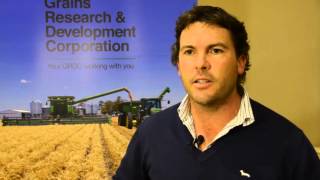
Jack Williamson, a farmer and consultant from Gundiwindi, discusses starting his second term on the Northern Panel. He emphasizes management changes in farming (herbicide resistance, nematodes, crown rot), the importance of water capture and use efficiency, and the role of RD&E and the Northern Panel in ensuring timely, relevant research that delivers value to growers.
Chapters
My name is Jack Williamson, second term on the Northern Panel. Role in the industries, I guess, is two pronged. Farmer and also a consultant based at Gundiwindi. I guess I've been on and off the farm a little bit. I've always been in the area, but had roles away from the farm as well. So I guess in total I'd be. For the last 10 years, in terms of things, we've seen change. I suppose it's been more management tactics than anything. And the big players in the game are always going to be herbicide resistance. How we manage that, new issues arising, like nematodes, crown rot's always going to be there. So I suppose it's management systems that have changed more than anything. We're in the business of turning water into money via a production system, I guess. So the way things are at the moment, with longer dry spells and shorter, more intense wet periods, we have to learn how to capture, store and use that water more effectively. So, I mean, things like herbicide resistance and disease, they're all part of the system and how you manage that. RD and E is vital to the GR industry. As I mentioned before, success is something that's always going to be there or chasing success. I think we always want to keep improving and if growers are going to remain financially stable, unless there's a paradigm shift in commodity prices, we're going to get it through yield and water use efficiency and RD and E is at the forefront of that. I chose to reapply for another term on the Northern Panel. I felt that I probably had a bit more to give on the panel. There was more left in me. I still wanted to be that stepping stone between growers and research and to ensure that it goes both ways. Be a contact for my region and entire Northern region, I guess, but more specifically my region also. Pretty excited to see how the new GRDC model is going to go. So I wanted to be around for that. And I think it's going to be a really positive thing that we've got regional offices in key areas where growers can interact face to face with not only the panel members, but also GRDC staff. For me, I think the most important role of the Northern Panel, we're an advisory panel. We're there to ensure, I suppose we're sort of gatekeepers, I guess. We're there to ensure that research that's being done is being done to the best of their ability. Best bang for buck for grower levees. And I suppose the first three rules of farming is timing, timing timing. So we want research there that's timely, first up, relevant and realistic. So I suppose ensuring that is the key to any advisory panel, especially in the North.