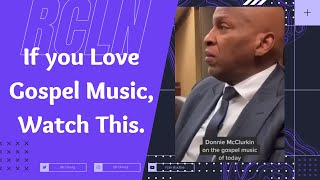
In this reaction video, host Speaker A introduces a clip of gospel legend Donnie McClurkin delivering a passionate critique of today’s gospel music industry. McClurkin argues that gospel has become overly commercialized, driven by awards, television exposure, and secular party culture, noting that award shows now feature open bars and non‑gospel music. He warns that this focus on popularity has led to a “carnal” foundation built atop gospel, causing believers to live in ways contrary to biblical holiness. Drawing on 2 Corinthians, he urges listeners to seek true sanctification, to separate themselves from worldly influences, and to let Jesus be the Savior who makes them holy. Speaker C asks McClurkin for advice to younger generations, to which he emphasizes learning sanctification, living apart from sin, and submitting to God’s fatherhood. Speaker A expands on these points, stressing the need for music ministers to be rooted in Scripture, to seek counsel from elders, and to avoid the temptation to equate talent with doctrinal authority. He cautions that popularity can grant a false platform for teaching doctrine, and that without solid theological grounding, ministers may lead others astray. The video concludes with a call for humility, reverence for historic church fathers, and a collective return to holiness in worship and ministry.
Chapters
What's good, everybody? Uh, this is a video that could not wait. It's, it's just, I was scrolling through YouTube, I saw it, and I'm like, I have to do what I can with this content. Um, Donnie McClurkin is just dropping some gems, some knowledge as it relates to gospel music and worship. So without further ado, let's, let's get into this video.
The industry called gospel music today, you see that a lot of it is solely for the aggrandizement. It is for the awards, it is for the popularity, and we use gospel as, as the, as the foundation, gospel music, but we're building all of this carnality on top of it. Who can get an award and who can get the television spot and who's going to be on the televised award show and the like. And that becomes the goal. You go to the award shows now and you platform all of the gospel artists and all the new gospel music and then you go to the reception afterwards and it's drinking and secular music.
Yeah, now I don't know if this is, uh, an indirect response to what's been happening with the BET Awards and, you know, Maverick City and all the like, but everything he's saying right now is just facts. Like, I, I could not— and this is coming from an OG, so let's, let's— when a father speak, children listen. Let's, let's pay attention.
Open bar, they playing nothing but secular music at a gospel award show. So this has become the norm because we've let down the guard. The guardians have let down the standard, and now there's another standard raised where it's all according to what you think is right. And the Bible said there's a way that seemeth right unto a man, but the end of those ways are the ways of death. So that's where we find ourselves. We're singing a great message But we're not living a great life.
So the word to those who look up to you, respect you, who believe in you, that may not know the way, like you say, the generation of today, so that they can, if they're on that path, what would you say to them to abort that mission?
Oh man, there's so much to say because there's so much to institute and there's so much to dismantle. In this generation that's risen up that doesn't know God really in that sense. There's a lot to say. The first and foremost thing that I could tell anybody in the multiple generations that are underneath me is let Jesus Christ really be the Savior. Let him really be the one who sanctifies us. Yeah, let's learn what sanctification really is. Let's come out from among them and be separate from them and not touch the unclean thing. And he said, everybody says, you know, God is every— we're all God's children, we're all God's children. That's not what 2 Corinthians says. He says only when you come out from among them, and only when you're separate from them, he said, and then I will be a father to you.
Like, music ministers that are in the word do so much more than play sounds. And sing melodies. Like, I think the foundation to any ministry has to be rooted in the word. It has to be rooted in the book, in the Bible, in the word of God. And you can see that outside of his abilities to sing, his, his passion is the word of God, and he's referencing it in how he conducts himself and how he thinks the generation now and to come should conduct themselves.
It's conditional. And then I will be a father to you, and then you will be my sons and daughters, because you've come out from sin. You are living like me now in holiness. So we gotta get back to holiness, live like God, and stop making excuses for the carnality that we've held on to, that we wanted.
Stop making excuses for the carnality. Now This is something that I think about all the time when I'm trying to grow myself and I'm talking to other ministers, I'm talking to music ministers, and I have a special place in my heart for worship. It is wise to take counsel from elders, and I think that's something that is gravely missing in a lot of places today. That's a council of elders. We've come into a situation where we think because we have a talent, we have the ability that gives us the authority to set doctrine standards, like Pastor Donnie said, to raise standards and to forego all the things that have come before us. But that's not the way that it should be, right? There's a path that's been set by the fathers of old, the fathers in the faith, as it relates to ministry, pastoring, as it relates to doctrine and theology. But we've come to a place where we've become so full of ourselves that we don't think that we can reference— we could neglect and ignore everything the fathers have said, everything that the apostles have said, right? We think that we can just forget all of that. God has given you a new revelation that negates his previous and prior revelations, and now you are the authority. You are the one that's able to dictate how you should act, how you should conduct themselves, and this should not be so, right? I think the biggest takeaway from all of this is that we have to be very careful in terms of who we follow, who we listen to, right? Who we take our theology from. Because honestly speaking, just because somebody can preach well doesn't mean that he's theologically sound. Just because somebody can pray well, just because somebody, somebody can sing well, they can play the drums or the piano well doesn't mean that they're theologically sound. But we've come into the world where, where you have a talent, the world will lift you up, they will boast you up, they will give you a platform. Millions of people will follow you. And just because millions of people are following you, now all of a sudden you have authority, you have the ability to dispel doctrine. And the problem is, if you're not properly rooted, if you're not properly in the word, if you have not come out from amongst the world, then you will be sending people on a very dark path. And anybody that causes any one of these little children to sin, woe to them. It is better that a stone mill be tied around you and you cast into the sea. So please, worship ministers, pastors, up-and-coming people, young people, my generation, let us, let us not be too wise. Let us not be too wise to take correction from counsel. Let us seek elders. Let us seek people that have done it, people that have come before us. Let us pay homage. Let us pay dues. And let us be humble. Humble enough to know that we don't know everything. Humble enough to go to somebody and say, help me, teach me. May God help us all. Peace.