ADU: The Future of Multifamily Investing?!
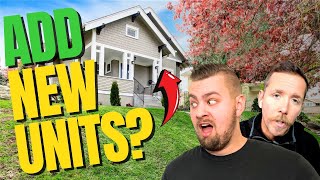
In this interview, host Christian Osgood talks with Derek, known as "That ADU Guy," about accessory dwelling units (ADUs) and their role in multifamily investing. Derek recounts how he first built an ADU in high school through a woodshop class, giving him a 20‑year head start on a strategy that has only recently gained mainstream attention. He explains what ADUs are—accessory units attached to or detached from a primary single‑family home, including attic, garage, basement, and detached conversions—and clarifies how they differ from traditional multifamily developments. Derek highlights recent legislative tailwinds on the West Coast (Oregon, California, Washington, Montana) and emerging markets like Austin and Florida that have adopted permissive ADU codes, positioning ADUs as a solution to the housing crisis by infilling existing single‑family lots rather than expanding urban sprawl. The conversation shifts to the business mindset: Derek stresses perseverance, rejecting the Instagram‑styled "quick‑rich" narrative, and advises aspiring entrepreneurs to stay patient, focus on fundamentals (simple math, grit), and avoid giving up. He also warns of future challenges, such as a looming labor shortage and the rise of 3D‑printed, modular, and container housing, which may reshape the market. Finally, Derek promotes his free educational resources—Instagram (@thataduguy) and a YouTube channel with hundreds of how‑to playlists—encouraging viewers to take action and reach out for mentorship.
Chapters
The only way we fail at this business, no matter what your strategy is, is if you give up or die. It's that simple.
Hey, welcome back to the channel. I'm Christian, joined today by That ADU Guy, Mr. Derek. Derek, welcome to the channel.
Glad to be here. Thanks for having me, guys.
Absolutely. Now, Derek, I've actually met you at a couple of events. I was where I first ran into you with Michael Zuber over in Fresno. I've seen you speak all over the place. But as per your branding, That ADU Guy, Derek does some really cool stuff in ADUs. How long have you been doing the additional dwelling unit strategy?
So the first ADU project I worked on was in 1995 as a high school senior— or excuse me, a high school freshman. We had a woodshop teacher that took a bunch of misfit kids and said, we're going to teach you a skill.
That's awesome. And for those who aren't familiar with what an ADU is or just general like residential infill, Those are all words where people are like, what is that in layman's terms? What is it that you primarily do in your business? What's an ADU? Why ADUs? Talk a little bit about that for sure.
So the ADU strategy is by taking a single-family house and adding another unit, it could be attached, it could be detached, it could be an attic conversion, a garage conversion, a basement conversion. But what we're thinking of clearly is the A. That's the one part that people get confused the most. So the A stands for accessory, which means there has to be a primary house. And this isn't to be confused with building lots of small houses on one lot. That's usually a multifamily development. This strategy is looking specifically for single-family houses in an area that's zoned for single-family housing. And we're going to add 1 or 2 or 3 or 4 additional units that are accessory to the primary structure. So there basically has to be a single-family house there for this strategy to really work by code and by legislation. They're known in different areas by different things. They could be called the casita or a mother-in-law cottage or a granny flat or a carriage house depending on where you're at in the world. We like to look at them as a product that can give capitalism with compassion. We're looking to build housing. We call it infill because traditionally, these single-family lots are fairly large. There might be a house in the front yard, and then the backyard is a big open area that somebody's been mowing for, for decades. And now we're going to put housing there. So the infill is, if you could just picture in your mind an aerial map of a house with a big backyard, we might put a driveway into the backyard and build 2 or 3 little houses that are going to be accessory to that primary dwelling. Dwellings.
That is insane. And you said you started in high school. So, so you basically like, this is just what you've always done. And in the '90s, I mean, there weren't a lot of people. It's become popular recently, especially on the West Coast, like the ADU strategy has become very popular. You were doing this way before it was popular. What made you find this first project? Like, how did you get into this originally, especially that young?
Yeah, so it was just by chance, you know, we were in this small southern Oregon town that happened to have a legal accessory residential unit. They called it an ARU at the time, an accessory residential unit code that allowed people to build these small guest houses in their backyard. And part of that construction technology class that our woodshop teacher handpicked the misfit kids for, we built an ADU for another one of our teachers. So the first ADU build was during the '95-'96 school year when I was in high school, and it was this really cool cutting-edge thing at the time. And we just happened to be by luck about 20-ish years ahead of most legislation that would eventually come out. So I tell people I've been talking about the same thing, doing the same thing, shouting this strategy from the rooftop for 27 and a half years, and only the last 2 or 3 years people care. And that's because it's getting a huge tailwind. We've got West Coast cities and states, Oregon, California, Washington, Montana, big markets like Austin, Texas, and some cities in Florida where we're adopting amazing code. Those first states that I mentioned have overarching state law that allows these. So it's becoming mainstream for two reasons. One, we need more housing for our people. Zoning and planning officials, by no real fault of their own, have done a crappy job the last 50 years managing land and managing housing. And what's come of that is we have what's known as a housing crisis in some areas where there's a higher demand, more people want to live there than there are housing units. So this legislation in these areas is allowing us to use more of this land that already has infrastructure. So as opposed to urban sprawl, which is expanding your city limits or your urban growth boundaries, we're going to just infill these big lots that already have sidewalks and fire departments and streetlights. And it's kind of flipping the market on its head. So first, it's providing housing, and it's also providing a lot of opportunity for investors to, to build that because housing doesn't just create itself. You know, some city councilors think it does. But the fact is, somebody has to actually develop it and build it.
Yeah, well, it makes so much sense to in areas on this coast with the, with the urban sprawl when you're building the already developed areas. Like if you're in Seattle, you're pinched between the water and the mountains. There's— you really— it's very difficult to expand out. But if you can expand in and provide housing, I think you nailed this, uh, it's compassionate housing. You're coming in and you're actually offering a service that is needed. You're taking use— it's all about highest and best use. And in areas especially where it's higher density and harder to expand outwards, those are areas where you can actually do a lot of good for communities doing exactly what you're doing.
Yeah, for sure. And a good way to put it real quickly is just tighter and taller. And infill housing is just tighter and taller development, a little, little bit higher density.
So for those who haven't seen you on Instagram yet, you're ThatADU on Instagram. Everyone seriously follow him. He does great videos. And you do a really good job too on the educational content. Your stuff's fun to watch. There's a good variety of stuff. So those who haven't seen it yet, check Derek out there. Did you grow up with a background in construction? Because, you know, you started super young. Is your family in building, or did you just pick up all these skills as you went?
You know, I just picked up these skills as I went. I had a pretty much a full-time job in the summer from when I was 10 years old on, and I was always just drawn to a construction site, whether it was swinging a hammer or operating equipment or learning basic design or how to read a tape measure. I would just naturally was directed in that direction. You know, school wasn't super easy for me. Math was my worst subject. It's funny now, that's how I make a living. But I never have had problem doing simple addition and subtraction and multiplication and division. And that's all you really need to become a real estate investor. Honestly, if you can do those 4 things, you'll never lose money in theory. So it just happened to be where I was naturally attracted. And then I had the opportunity and then there was a lot of luck as well. I just had some early on really good mentors. That woodshop teacher, John Weston, who I mentioned, very influential. And then, I just met some people in the industry that took me under their wing. If you're motivated and you work hard and you actually care, good leaders will see that in you and they'll bring you in and they'll want to teach you. So, a lot of luck, a lot of people helped me along the way.
[Speaker:TYLER_FOWLER] Oh, that's awesome. And that's every success story. When we were building our portfolio, it was the same thing. It's like, hey, we met with the people who've done what we want to do. And while it's a lot of luck, I'm guessing this is how it was for you. You had a vision and I'd imagine for a lot of this you make your own luck, right? You're around the people and you see the opportunities and you just invest heavily in those people. I've noticed that there's a lot of people who set goals like, hey, I want to own X or I want to do Y, but they focus so narrowly on like, well, I want it to look like this. I'm going to do just this house hack. I'm only looking at this strategy. You looked at your pieces from what I'm hearing and you went, hey, I have this teacher who can help me with some of the construction stuff. I'm good enough at math to do this. I found a project and the— like, I don't know, I'm guessing before that you didn't specifically sit down and go, I'm going to focus on ADUs, I'm going to be that ADU guy. I'm guessing that wasn't you in high school. You found the opportunity and in many ways you make your own luck.
Yeah, yeah. It's really close to that with the, like, the slight deviation that I knew in high school that that's kind of what I was going to do. I have a really good friend, still a friend of mine today, and I remember we were eating lunch just like my sophomore year. This is, I mean, almost 30 years ago. And I was telling him about this cottage we were building and how there was, there was a demand for this product and I could see it really working. And he threw his head back laughing, just saying, oh, you're going to be a cottage builder. And that's always kind of stuck with me, not as a negative, but as a motivational thing. So I knew really early on that I was going to be a professional with my hands. And that I was going to provide housing. And, you know, I got into an apprenticeship program right after high school and met an amazing teacher who, again, one of those mentors that took me under his wing and showed me the ropes. And I ended up following him for years until we had originally or eventually partnered together. But yeah, it was really clear for me. That's the luck. It's not as much of the— that I didn't work hard and put myself into positions to be successful. I just got lucky with people that were able to teach me. And nowadays, I am really concerned for, for our kids, for our products, for housing as a future asset class, because there's less and less people that are being taught how to build it, or less and less people that are interested in learning how to create housing. And there's a lot of chatter right now in the market with 3D-printed houses and modular and container and this and that. And eventually those two are going to collide. And I think that will be— there will be more of a solution. But My, my forecast in the next 5 to 15 years is going to be a big challenge for our market as people leave labor. But that's a whole nother episode.
Yeah. Yes, it is. All right. So you had, you had luck, you had the right people, you had a vision really early, which— and that really does help. Cody, my partner on this channel, he started really young. It took me 10 years to figure out what I wanted to do. I got out of college and like, I like real estate and it took me 10 years to define like what that meant. And so that's— I love stories like that where you're like, hey, I know what I wanted to do and that's just what I did. If you had one piece of advice for other entrepreneurs who are starting young, so let's go back to high school Derek. You have a vision, you have a business, you have a couple connections. And your friends think that you have some friends who are like, "Huh, you have a funny idea and good luck, buddy." What advice would you give to that young entrepreneur, that young Derek starting your career after an almost 30-year career where you're at now?
I think the advice I would give a younger me would just be to not give up. I see so many people with so much potential, so much natural ability, so much great leadership and mentorship. Support around them that want instant gratification. And real estate does not work like that. Contrary to what we're seeing on Instagram, all your friends that have Lamborghinis, all the stuff that you see, all the private jets, like most of that stuff is fake. Like what you don't see is the grind or somebody waking up in the middle of the night just wondering how they're going to pay their next bill or the calls we get or the fact that our minds never, ever turn off. Like this is a hard business. It doesn't matter if you're buying strip malls, you're building laundromats, you're doing what Cody and Christian do with multifamily through seller finance. It doesn't matter. You can't give up. So many people I see give up too soon, like they quit, you know, right before the miracle is kind of the saying I have. So the advice I would give is this is not an easy business to be in. It's going to be hard. But if you don't quit, you cannot help but be successful. The only way we fail at this business, no matter what your strategy is, is if you give up or die. It's that simple. And so many people don't have the grit or really just the patience to ride it out to get to success because they think everybody else is getting rich quick and they're missing the boat.
I love that. And I can say so. I've— I'm only— amazingly, we're still only 3 years really into Cody, my partnership. I've been investing for a little over 4 now. So, I'm still a baby in the industry. But the amount of work that goes in and the amount of liquidity you have when you're getting started, there is a long build phase to real estate where you acquire the stuff, then you have to stabilize it, which is hard and expensive. And then, really just start paying down your debts and refinancing. You have an optimization phase. And so, yeah, at some point, theoretically, you get rich in real estate. I know a lot of people who've been playing the game 20, 30 years who have a ludicrous amount of money. It doesn't happen overnight. There are no— at least I haven't met them. I've never met anyone successful in real estate who's held a portfolio who was an overnight success where they're just rich, they're liquid, they can afford this stuff. I've seen lots of people buy the Lamborghinis. Those are all the people who went bankrupt 2 years later. You spend the money on the cars, you're going to lose. I love that advice. Be patient. If you have a vision, Simple stuff works in real estate, and that's what I love about the ADU strategy. It's simple, it's fun. Right now it's trendy, but through most of your career it wasn't sexy. It's a good time right now, but it's simple, it's stable. You stick with what you know and, uh, it pays off over time. So again, uh, Derek, thanks for joining us today, by the way. I appreciate this a ton. What you've done is amazing. We're gonna have one more episode next week with Derek. So stay tuned. We're going to be talking about some of the actual details of this strategy, what makes the difference between being successful or unsuccessful in the real estate space in general. So Derek, thanks for joining us one more time. Where do people find you if they want to learn more about you and your strategy?
For sure. Follow me on Instagram, @thataduguy, and check out my YouTube channel. I do long-form video there. There's playlists for everything you can think of. I've got 400 videos and all those videos are from people like you that ask me questions. So if you want to do a garage conversion, you don't know where to start, go watch the garage conversion playlist. If you want to do an ADU above your garage, go watch that playlist. All that information out there should probably be in a course that was a high-ticket item, and I figured I could help more people if I gave it away. So follow me on, on YouTube and then Instagram. If you reach out to me, it's me that gets back to you. All I ask is if you do contact me and you do take my time, be ready to take action because I'll be ready to help.
Ooh, that's a good trade. All right. I don't endorse a lot of people on this channel, but seriously, I believe that Derek is the best person in this space. So give his YouTube a follow. If you have any questions, reach out on Instagram and we will see you all on the next episode.
More from Christian


What Investors Want in Every Pitch: Property, Business Plan & Team #RealEstate #Pitch




Speak with authority to turn broker rejections into deals - boost your confidence #RealEstate

Turn Broker Objections into Closed Deals - CRE Negotiation Tactics #RealEstate #Negotiation

How to Get Multifamily Deals Under Contract Without Having All the Cash | Objection Series Ep. 1

How I Scaled 500 Apartments in One Texas Market in 12 Months #RealEstate #Multifamily


Turning a $12.2M, 200-unit mess into profit - live multifamily turnaround update #Investing