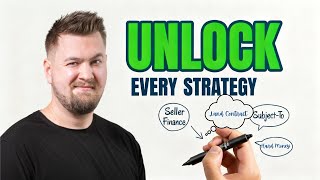
In this instructional video, Christian Osgood shares his top creative real‑estate financing methods, explaining how each works, when to use them, and the associated risks. He begins with seller financing, describing how the seller acts as the lender, allowing the buyer to set price, terms, and balloon payments while often requiring little or no down payment. He then covers land contracts (contract‑for‑deed), detailing the split between legal and equitable title and how the buyer gains income and equity while the seller retains title until the contract is fulfilled. Osgood introduces the “subject‑to” clause—a variation of a land contract where the buyer takes over the seller’s existing mortgage without notifying the bank—highlighting its danger due to due‑on‑sale clauses and recent bank aggressiveness. He advises caution and outlines escape strategies such as refinancing or selling. Next, he showcases private capital, illustrating a high‑return RV‑park deal where a 13.5% private loan enabled a 200% LTV purchase, a rapid refinance, and a $500k profit on essentially zero cash. He emphasizes that private money can bridge to other financing types. Throughout, Osgood stresses the importance of relationships with sellers, brokers, and community members to secure favorable terms and reduce down‑payment demands. He concludes by offering a free Skool community with calculators, deal flow, and peer support for creative finance practitioners.
Chapters
Creative finance is not just one strategy, and so many marketers try to brand the one thing that will save you. There are so many different ways, but many of them are very, very simple. I'm going to list the best ones, the safest ones that you can use, and a couple that you should probably avoid. First, let's start with the obvious: seller financing. By the way, welcome back to the channel. My name is Christian Osgood. I'm your channel host. I have hundreds of rentals. The first 17 deals— 17, I did with creative finance. Today, I still continue to use creative finance to close so many deals and negotiate deals that many other people could not do because they don't have the basic tools in their arsenal. They only try to knock everything out conventionally. I have fun playing both sides of the fence today. I've bought enough real estate and moved far enough through my career where conventional or creative, we can still use our creativity to close anything. Here's my top picks for creative finance structures, how they work, and how you can apply this to your portfolio. First of all, let's start with seller financing. Very simple. The seller is the bank. It is the exact same thing. Instead of the bank giving you a loan, the seller, if they have high equity in the property, which means they don't owe a lot of money on it, they can lend on anything they own. So if you have a million-dollar property, the seller's paid off this million-dollar property, you're purchasing it for a million dollars. They simply say, awesome. Pay me in payments over time, and often there's going to be a balloon. Here's what I love about seller financing. You choose the price, the terms, the balloon length. So when the note is due, the interest rate, and you can negotiate any special clause you want. In fact, I'll list a couple of them at the end of this video that I absolutely love. But we go through this very, very simple. My favorite piece, you're automatically approved because you negotiate all the financing upfront. So there's no approval process, credit checks, none of it. When you sign the purchase and sale agreement, that money is already lined up. Now, there's a down payment, you can either have it or you can get creative on the equity side as well. But for a majority of your money on seller financing, oftentimes you negotiate these right, you can get these no to low money down. Now let's talk about the cousin to seller financing. We call this the land contract. Now, It's easiest if you never heard of this before to picture it like buying a car from a dealership. The bank holds the title of the car on a sales contract until that contract is completed. At the completion of your contract, they then give you title to the car. This is very much how a land contract works, or also known as contract for deed. It is a sales contract in most states. Both The seller and the buyer, you show up on title. One has legal title, which is the seller of the property. You have equitable title. That means you have the rights to all of the rental income, the future value, all of the economic value is yours. You have the exclusive right on this contract to purchase and complete the transaction. You are the owner of the property on contract for deed. However, You have not removed them completely for, from title. Now this opens up a few pieces of creativity on how you can actually do the title work or take on additional debt. But the main use for contract for deed on the seller's end is it is easier for them to take back the property should you fail on a sales contract in contract for deed than if you had defaulted on a loan. The foreclosure process is nonjudicial. It is traditionally less struggle for an owner to take back the property if you have a failed transaction from a buyer to you on a land contract. Land contracts also open up a third play, which many have marketed as a strategy in and of itself, but really it's just a clause on a land contract that we call subject to, or abbreviated, some call sub-to. So what is subject to? Subject to is subject to the existing debt. So you buy on a land contract, a sales contract, subject to their existing debt. What does this mean? This means the seller continues to pay their mortgage to their bank under their name. They do not inform the bank that they have transferred the property. You now pay them their mortgage amount, often more than their mortgage amount. They make the delta and they cover their expenses. Now you can set this up all sorts of different ways so that you are paying their mortgage. You can make sure that it's paid every month, but at the end of the day, this is a strategy I would stay away from if at all possible. Why? If you are building your financial freedom on these type of notes where the bank is not informed that's traded hands, you are rolling the dice. The bank finds out and they call the note due. Almost every single note from a bank has what's called a due-on-sale clause. You are flirting with danger if you buy an entire portfolio based on subject-to properties. Can you do it? Yes. Are there other ways out? Yes. You can refinance, you can sell, but you don't want to be in that position. I have seen people who bought massive portfolios subject to, and they got 20%, 30% of their portfolio called. It is not that hard for the bank to audit. In fact, I used to work for the CoStar Group. There are searches that I could run on CoStar, which most banks have, that says, hey, show me properties that have had significant changes to title over the past X amount of years. You can literally plug in your portfolio as a bank. You can save all the addresses. I can get alerts if there are title changes. And if I see a title change, I go, wait a second. The person showing up here isn't on our bank note. We should investigate this. And voilà, they get called. Now, this doesn't usually happen when you have decreasing interest rates because bank has a higher interest rate note. Why would they want to call that? They're making great money. But in our current environment where we saw rates go from 3, 4% all the way up to the 8s, today I think we're sitting at like 6.5. If I have a note sitting out there at 3% and I'm the bank and I find out, wait a second, we can call this money back and then we can replace that at 6.5%. It now makes a heck of a lot of business sense to start calling properties due, and we've seen a huge uptick over the last few years for exactly this reason. Subject to is a piece of creative finance. It is a clause on your land contract. However, subject to the existing debt is a dangerous game. When would I use subject to? One, if it's subject to a seller finance note that doesn't have a due-on-sale clause. No due-on-sale, no problem, perfectly transferable. Or if you have enough cash to go ahead and pay off that note. I actually have a $70,000 sub-2 note that was part of a portfolio sale. I bought $4.5 million of properties. One of those properties had a $70,000 note. Now, I have in my contract, if that note gets called, the seller has to pay it off. If they don't do that, I still maintain in the operating account of that company $70,000. So that my financial freedom is in no way dependent on a subject-to note. If you have these time bombs in your portfolio, I recommend you find a way to sell or refinance your way out. Underrated piece of creative finance that has its place in your portfolio if used right: private capital. People don't realize how custom they are. I have actually used private capital to buy one of the best deals I ever did in my life, an RV park in Washington State. One of the only deals I've ever sold. I'm not a fan of selling real estate, but we made a ton of money doing it. I bought an RV park for $300,000. It needed a new clubhouse with laundry machine, and it needed a new septic system. Not just a new septic system, a full new drain field. We're talking digging out all of the septic, about a $150,000 project. My loan was private money at a ludicrously high rate of 13.5% interest. I bought it for $300,000 purchase price. They gave me 200% loan to value. I got paid $300,000 to buy it. That $300,000 went back to the property, we then went ahead and refinanced it. My new loan was at $704,000, which means I got to cash out $104,000 on a $0 investment that had a holding cost of 13.5%. That holding budget was part of the capital raise. We didn't spend all $300,000 on the property. We spent about $250,000. When I refinanced, I got paid $104,000 back on my $0 investment. We later sold it for $1.1 million, meaning I made an additional $400,000 on top of the $100,000 I already cashed out of the property. A half million dollars on a $0 investment in less than a year and a half. If you look at the average income of a lot of high-paid jobs, many people don't make that in a year, and we did it on one transaction. Now, I average 6 to 8 transactions per year. So if you think about that, if you just do this on occasion and it's the right deal for this, and we're talking high value add and excellent price, private capital can be a bridge into another type of financing. Could be conventional, could be seller finance, could be a land contract. There's actually multiple ways you can structure this. I've actually done bridge debt and then got a loan from the seller, which is crazy. It's called a seller re. Finance. There's so many different ways you can structure these though. But the big ones that you need to know: seller financing, land contract, know to avoid subject-to or use it correctly, private capital. If you just know those, you can start knocking out so many deals. And there's so many other types of creative finance, but those are the big ones. If you were to start there, you could close 99% of the deals in front of you. I'll give you one more freebie that will unlock all these for you. If you're getting stuck on creative finance deals where it's seller finance, the sellers are asking for these down payments, 50% down, relationships are going to take you the rest of the way. If they want a lot of money down because they don't trust you, get to know owners, get to know brokers, build your brand, build relationships with people. If you focus on the relationship before the deal, all these opportunities become infinitely easier. If you want to learn more about creative finance or how to execute this, or just join a community of thousands of people doing the same thing, I got a gift for you. Click the free link below to our school community. We have calculators there, community regional leads, conversations, creative finance deals that are literally posted there. There is deal flow. There is community, people who you can ask questions for and connect for in your own market and markets all around the country. Join the conversation there. It's free. It's on Skool, S-K-O-O-L, Multifamily Strategy Community. Would love to see you there. I'm active on it every single day. I hope you are too. That's a free resource that I want to give to you so we can bring more people into the creative finance community. Again, I'm Christian Osgood, your channel host. I'll see you on the next episode. Like, subscribe. Adios.