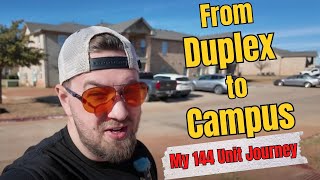
In this video Christian Osgood walks viewers through the closing of his largest real‑estate transaction to date: a 144‑unit multifamily campus in Abilene, Texas purchased for about $8.5 million. He details the $3.2 million equity raise—the biggest he’s ever done—explaining why a syndication structure was chosen over a joint‑venture for a raise of this size. The property is a Low‑Income Housing Tax Credit (LIHTC) asset with rent restrictions, a 5.38 % 7‑year loan, and projected 10 % cash‑on‑cash returns. Occupancy is 142 of 144 units at closing, and a 4,500 sq ft retail space offers an additional $60‑75 k of annual rent after a $45 k renovation. Osgood highlights the strategic location near a massive OpenAI data center and an expanding Air Force base, which he expects to double Abilene’s population and boost rental demand. He describes the on‑site staff model, amenities (gym, pool, playground), and how scaling to large portfolios creates true passive income by delegating management to a team. He also shares a risk anecdote—a duplex fire—illustrating the importance of diversification. Finally, he promotes his free multifamily strategy community and mentorship program, noting that mentees have closed $100 million in deals in 2025, and encourages viewers that they can replicate this success.
Chapters
We closed. We just closed a 144-unit deal. My biggest deal yet by far. Now, to date, the largest deal I've ever done is a 76-unit, which was earlier this year. We also closed a 44-unit and I bought a little 9-plex I added to my Washington State portfolio. This deal was crazy and the capital raise was $3.2 million to close this bad boy out. That is the most I've raised by a lot. In fact, the most I'd raised to date was $2 million, and before that $1 million. We'd never actually seen how much we can raise. And what I found is that may have been very close to my limit because that's about as much as we were able to bring in. We finished our capital raise about a week and a half ago. It's been a 100-day project, but as always for every single deal, we have a fantastic opportunity. I'm going to share some of the numbers with you here on today's video. Fantastic opportunity. We have officially closed it, and now I can finally say I've done a $3 million raise and an over 100-unit transaction, first one in 5 years. Here's how it all went down. So first of all, my very good friend Caleb Hommel called me and said, hey, I have a deal we have to do. I love deals that are sub-100 units. I like less than 100-unit transactions because there's a whole lot less competition. You have less institutional money competing with you. This one happened to be LIHTC. Now LIHTC is Low Income Housing Tax Credit. Essentially, there are rent restrictions and we have to lease to people who make 60% or less of the area median income. In layman's terms, that's what LIHTC is for this property. We also have some other restrictions and things that we have to do, such as provide a gym in office, provide computer lab and some other features and amenities. But overall, we just have a rent-restricted property here in Texas. The income on the property, it actually cash flows quite well, will be about 10% cash on cash. We got a loan for 5.38% interest, which is a fantastic debt product and allowed us to really increase the cash flow on this. We have a 7-year note. So we have the very entry level of long-term debt and we have a plan to extend and refinance at the end of our LIHTC contract here. So how this was found is we did some smaller deals and of those smaller deals is really the 44-unit LIHTC deal in Stephenville, Texas, that had the same broker reach out and say, hey, I have a deal. He calls my buddy Caleb, Caleb calls me and said, Christian, it's going to be the biggest raise we've ever done, but we have to do it. The deal's too good. $8.5 million for 144 units. That look like this, by the way, it is an excellent, excellent problem to have. So we drive down here, we walk the property, we find everything is pretty much beautiful, minus the fact there's a lot of trash on the ground. We're going to be fixing that here within the next week. But we went ahead and wrote the offer and went under contract. Now, raising capital for a good deal is not actually a hard thing to do. Why? Because there's lots of people who want to make money in real estate and there's not enough people who have fantastic deals. So we always follow our normal trend. Deal first, then line up the debt, then line up the equity. We talked to our lender. Our lender said, hey, you're going to come in sub-5.5% interest. It's like, well, that's great. So we underwrote a little bit on the high end. We factored for about 5.6% interest, and again, we're at 5.38% is where we ended up. So a little bit better than expected. We were told occupancy is about 90%. Turns out we actually have 142 of 144 units leased. So our income day one is going to be notably higher. And we learned after we went under contract, oh, we forgot to tell you, there's a 4,500-square-foot retail space on campus that needs about $45,000 to get renovated and back up online, which we are getting back online here immediately. So renovations are starting on that in 5 days, and that should rent for an additional roughly $60,000 to $75,000 per year, which is gonna be awesome. That's just bonus income beyond what we originally factored. So we have a property that produces income day one that has significant upside and is already in very great condition with very little deferred maintenance. So we put this all into a little 15-slide pitch deck. We talk about the deal. We filed this particular one as a syndication. Now, I've said many times on the channel, I prefer joint ventures, and I still do. I love investing with other people, but at the end of the day, people are variables just like debt, and we don't want a lot of variables in our portfolio. So on a sub-million-dollar raise, I'd probably bring in 3 people at $300,000 each and call that a capital raise. On a $3 million raise, we didn't have anyone who wanted to bring the full amount. It is a lot of money to just be sitting on liquid, so we did a syndication. This is where you bring more than 5 total partners into a deal. We put together an offer that was fantastic for them. It's a blend of cash flow and future upside, as the light tech project doesn't actually last forever. We're on the back end of the contract, so this will become a market rate property. We have investors who the profile is, hey, I want to get paid to wait for this building to worth a whole heck of a lot more. And we're starting at a basis where we're already at a really good position with a really good valuation. In addition, we're on Old Anson Road here in Abilene. You go a little farther down the road, OpenAI's data center, the OpenAI headquarters called Stargate. It is a 500 billion— yes, you heard me right— 500 billion square foot data center. Phase 1 just completed, added 10,000 jobs. They're adding 15 more of those. The population of Abilene is going to almost double when we are done with all the projects that are coming in. And the air base— we have an Air Force base right down the road as well— that's expanding with another $100 million project. They're building almost no new housing out here. So I'm not super good at math, but if you have about the same amount of housing but twice as many people, what does that do to supply and demand? I believe that means demand is way up and supply stays the same. It typically means good things for landlords who own rentals. So we're snagging a lot of this. We're also buying the 81-unit right down the road, but $8.5 million purchase coming in just under $60,000 per unit. We basically stole this campus. Has a beautiful office, gym, playground, a really nasty pool that we are restoring here. Should take about 2 weeks to get that thing back up and running. Just desperately needs to be cleaned but is otherwise operational. This is the type of real estate that is really exciting to own. If you told me, Christian, back in 2020 when I owned my first duplex, hey, you're going to be buying deals like this in 5 years or less, that would have been insane. We're right at the 5-year mark. I mean, we're almost to the day at the 5-year mark when I bought my first technically multifamily property, 2 units in Bremerton, Washington. Here we are, not that far in the future, half a decade down the road, at a campus like this. It is ludicrously exciting. I just met some of our on-site staff who's gonna be working for us here, but we have an actual— like, it's a building with a gym and a pool and staff that work in the office. This property by itself is just an independent company with its own on-site staff. We got maintenance, we got leasing all in one spot. This is as close as you actually get to passive income. Which is the last lesson I want to share here. Passivity is actually done through scale. Passive income is just a tax designation. It's a lot of work, especially if you're going to start in small single-family or multifamily properties. If you want to scale up, I'm not saying start with 100 units, but start with that 12-plex. Start with a 25-unit building. Only a few successes a year, 1, 2, 3, maybe 4 deals a year, and you move forward substantially. Before you know it, you're adding 100 to 200 units into your portfolio every year. And when you have properties like this where you actually have on-site staff and maintenance, your input becomes less important and you can't run everything yourself. So you have to build a team. But in that team, I have found that managing the team is actually a much more passive event than trying to manage every building. On my drive over here, so I've been told in the morning, hey, you're going to own 144 more units today. On the drive over to Abilene from Dallas, I get a call, hey, one of your duplexes burned down last night. Everyone's safe. But a tenant lit a whole bunch of candles and burned down a building. So stepping up 44, I'm up 144 and I'm down 2. That's not great. Luckily, again, everyone's safe. That's the first thing that matters. But on a little duplex, that could have uprooted my entire business. If I was buying small and I had like 5 or 6 duplexes, some people think that's financial freedom. That's a disaster waiting to happen. There's too much that can happen in real estate. You mitigate a lot of that and add a lot of passivity. Through scale. Today I manage a fantastic team of people who I love working with. And yes, I still go on-site to the properties. Yes, I still enjoy what I do. I get in the field because I love real estate. But this is not actually all that hard. And I can tell you what, I do make a lot more money. This deal will be worth about double by the end. This should get about a $15 million valuation once it's at market rate, which again is several years in the future. But when we actually go to our exit or our refinance of this deal, we bought this thing basically at half price for where it's going to be, which is an exciting place to be. So welcome to Abilene. Welcome to the 144-unit. We closed. Anyone can do the same thing, including you. And if you don't know how, join our free school community. Link is below. S-K-O-O-L. It's Multifamily Strategy Community if you're just Googling it online, or just again, click the link below. Community of thousands of people doing the same thing. And mentees in our mentorship program closed $100 million of deals in 2025. That's insane. If you count what I closed this year, add another $15 to $20 million to it. That's not a half bad year. Anyone can do this in any market, any area of the country, any background, and that includes you. Hope you enjoy this video. I'll see you guys back in Dallas.