How to buy any property in 3 steps - Deal Debt Equity
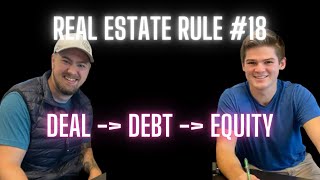
Christian Osgood and Cody explain how to buy property by finding the deal first, then securing debt, then bringing in equity. They show how a 38-unit building was purchased with zero down using seller financing, and warn that chasing cash before finding a deal creates unrealistic promises and bad returns.
Chapters
Hey YouTube, Cody and Christian for Monday Real Estate Principles. And today we're talking about getting things in order of deal, debt, and equity. A ton of people out there are worried about all the money first. Here to share with you, money is the least important part of any given deal. It almost doesn't matter. And people put it at the forefront. It is the least important part. That is the equity piece of the equation. It's why we put it last. Now, Christian, let's talk about deal, debt, and equity. Why? Is the deal first?
Well, a lot of the questions we get end up being, okay, how am I going to put together the equity, uh, questions about partnership, LLC structure. The reason none of that matters is because that all comes into play specific to the deal you have, especially when you're doing relational real estate and relational sales. When you're meeting people, different people have different goals, and different deals line up to other people's objectives and different goals. The structure will not be the same for every opportunity. So, if you go after a certain deal structure first, you're gonna limit yourself to the number of opportunities that you can line up to that structure. If you start with the deal, the creativity is infinite.
That's awesome. And then we shift into the debt, because a lot of people wanna focus and then they get the deal and they're like, okay, now I need to make sure I get my cash. Well, you don't need any cash unless you can get the debt, 'cause if you can't get the debt, you don't need any money 'cause you're not gonna be able to buy the deal unless you're gonna Dave Ramsey this thing. And write a check. And most of us, especially if we're doing creative finance, keyword finance, are not writing a massive check for 100% of the purchase price. So you need to figure out the debt second. And a lot of people get this out of order. They go cash, then debt, then deal. Instead, you should do deal, then find the debt. Because if you don't have a deal, you don't need debt. And if you don't have a deal, you don't need cash. If you don't have the debt, you don't need cash because you can't even buy the property. So That's why we love seller financing. It's all private, all made up. The terms are whatever you want, and sometimes you don't even need cash. And that allows us to buy stuff zero money down. Yet so many people are focusing on the cash opposed to figuring out, okay, what's the actual opportunity? What is here for us? What can we actually go do? How much impact can we create on this little property? Like the 38-unit that we bought was a terrible property with a great location. A lot of opportunity for impact that allowed us to come up with cash after we had negotiated the seller finance debt. Now, if we didn't get it seller financed, we'd have to write a check or get hard money, and that'd be harder to get the cash because we don't actually— like, we can't go get that debt and we can't write the check. So we had to first find the deal, figure out what's the opportunity, which really comes down to, okay, what's the impact we can create on the community? What's the change that we can spark on the deal? And then when we got the seller finance note, it was really easy to come up with the cash because we've got a great story. Story's always worth more than the real estate. We've talked about that on this channel. Then we found the debt seller financed. Money was just made up out of thin air, just promissory note, deed of trust. And then when it came down for the cash, it was really easy to find. We made 4 phone calls and got all the cash we needed. Yep.
3 yeses because the deal was the right deal for the people that we were calling.
It's just that. It is just that simple. Instead of calling up the people that we needed money from, hey, I need $300,000. For what? Uh, I don't know.
It's going to be a deal. And that's one of the reasons we don't syndicate. Something that syndicators will do is they'll put together a fund sometimes before they even have a deal.
Yeah, they'll do the fake deal presentation and, you know, that's good for building confidence, but it's not super great for actually getting commitments.
That's not to say that there aren't syndicators who do a much better job, but I see a lot of that where people market for dollars and go, hey, we're going to put together this fund, we're going to crowdsource everything, and then we're going to place it in real estate. And when you don't know what the deal is, it's really hard to make all these promises on what is the yield going to be. And you put yourself in a box where now you have to find a deal to place the capital.
Yeah, not a good place to be. When you find an actual opportunity and you know you can get the debt— that's why I love seller financing. With banks, we had a bank cancel on us the day of closing because they didn't know how to underwrite seller financing. They don't understand how loans work, I guess. It's amazing you can be a lender for x amount of years and not understand how 30-year fully amortized loans work with no balloon. It's crazy, but they didn't get it. With traditional seller financing, it's very cut and dry. There's a lot less approval process. Like if the seller says yes, it's boom. So if you have the debt, you can just get the deal done. You just need the money, a lot less variables. And that makes it super easy when you're putting together a deal like this. It's why we structure it the way we do. When you share that with a potential partner, potential investor, you can say, hey, this is our fixed cost, this is our variable cost, this is our income, and we can close this. We don't have any underwriters underwriting the loan. We will get this done. Super simple. And now that's, you know, we find the deal, we structure the debt to where we know it's going to get closed. When you go to pitch for the equity, whether it's a partner or a loan from a second lender, All of a sudden it gets really simple, and we like simplicity. Everybody on this channel, if you've been following us for a little bit, you know that we keep it so simple no one believes how we actually did it. That's why we get so many haters, and we love it because you boost our videos.
Now, in the interest of making this really, really simple and easy, if you are starting in this game and you're learning the rules, this is one of the most important ones you can learn. I want to break down the pieces for you really quickly. So the deal isn't just, hey, I found a piece of real estate. The deal is I have a relationship with the owner, or if it's listed, the broker who's representing it. You understand the price, and if you're doing anything creative financing-wise, you have a lot more negotiable pieces.
You have the term, the balloon, and if it's amortized— wow, I pulled a Christian Osgood on that one—
if it's amortized or if it's interest only, you have a whole bunch of different things. And then you have other clauses you can add for additional creativity. But that is your actual deal, and you start there, and then you line it up with debt, then equity. The reason that it goes debt first, then equity, is equity is usually going to in the long run cost you a lot more than debt. When you're buying real estate— and Cody and I are huge on this— the goal is to own real estate. If you give up equity, you give up ownership. It's usually much more expensive to buy them out in the future than it is the day that you buy it, which is why people will join you on the deal. Now, with debt, there's one thing that you need. Most debt has monthly payments occasionally. I've seen it done quarterly, and yeah, there's different schedules you can do, but generally speaking, you have to cash flow on a regular basis the debt. If you find a deal that is phenomenal, a lot of upside, but your day one cash flow is lower than you want it to be, you're likely going to need to bring in partners who can wait, not take a monthly distribution. It'll be a bigger buyout on the back end. But when you can use debt, we prefer to because we want to give up typically as little ownership as we possibly can, if any.
And that's why it's, it's senior to equity, because if we can structure it with 100% debt like I did on my first deals, you just keep more of the real estate. Now, does it hurt cash flow day one? Yeah, I barely cash flowed. I mean, I made $800 a month on my first zero-down deal, and some people are like, oh, $800 a month, that's great, let's just keep doing those deals. But eventually that'll catch up with you if you don't build out reserves, and that's where it gets really painful. If I had given up equity, it would have been easier day one. I would have had a lot less debt payments. However, today I wouldn't get as much cash flow. So you have to be able to balance that act. But if you can load up on debt and get to cash flow without giving up any equity, you will make more money in the long term. You just have to make sure you can service your debt with a little bit of remainder cash flow so you can build up reserves. Because when you run out of reserves and cash flow on bad months, Your real estate leaves you. It's not around for the long term in that case. And how do you buy it? How do you never lose it? If you can't answer that second question, then you're in trouble.
And by the way, if you're new to this channel, when we use the term equity, we're just talking about the percent of ownership in the deals and cash.
I mean, equity is a cash position and a piece of real estate. So if we have like our 38-unit that appraised at $3.41 million, we owe $1,670,000. Somehow that lender couldn't get it done. That's okay.
There's a lot of lenders lined up to do that now.
Yeah, we're getting that closed out. However, uh, that cash position, if we were to sell it, that is equity. Now, if we sold it today and someone wanted to assume our seller finance note, they would have to bridge the $1.7 million cash position. And that is what's considered equity, whether it's their own cash or they bring in an equity partner, meaning they bring in a cash partner, someone that actually brings in cash to deal. That's it.
If you're looking to simplify buying real estate, that is all you have to figure out. When you figure out deal, and that is always senior, then the debt, then the equity, you figured out how you're going to purchase the property. It's going to either be a blend of the two or one or the other. You put together the whole opportunity, you close the transaction, and you find the next deal. You go after the next opportunity, which we cover a ton on this channel of how to do. It's all relationships. Not going to go deep into that in this video because it's all over our channel, but that is exactly how you play this game. Follow it. 3 steps: deal, debt, equity. Deal, debt, equity. Deal, debt, equity.
Don't get it out of order.
The only thing you're not allowed to sacrifice when you're figuring out debt and equity is cash flow. If you run up to debt that's too high and it doesn't cash flow anymore, don't do the deal. Yeah, or move on to equity if you have enough upside and how you're going to raise the rents, but you cannot lose cash flow. So keep those in mind.
Well, you can't, you can't afford.
Yeah, you can't afford to. That's the— you're breaking the rules of the game if you buy a deal that doesn't cash flow.
Yeah, it's cool to buy for equity growth, but if you can't service the debt when stuff goes wrong, you're going to lose it. And that's not where you want to be. It's fun to build, but if you want to be like all the people online that have their secondary rebuild story because they lost everything, go for it. However, we're going to share with you, you can skip that whole phase If you buy based on solid principles, you buy for positive cash flow, and you build out your reserves from that cash flow.
So that's what we have for you today. If you found this valuable or you know anyone who would appreciate a simple model to move forward in real estate very consistently, very quickly, share this video, like, subscribe, and we will see you guys on Wednesday for our Creative Finance Live.
More from Christian


What Investors Want in Every Pitch: Property, Business Plan & Team #RealEstate #Pitch




Speak with authority to turn broker rejections into deals - boost your confidence #RealEstate

Turn Broker Objections into Closed Deals - CRE Negotiation Tactics #RealEstate #Negotiation

How to Get Multifamily Deals Under Contract Without Having All the Cash | Objection Series Ep. 1

How I Scaled 500 Apartments in One Texas Market in 12 Months #RealEstate #Multifamily


Turning a $12.2M, 200-unit mess into profit - live multifamily turnaround update #Investing