Masters of Out of State Investing w/ Caleb, Chuck & Millennial Mike!
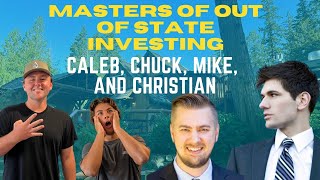
In this YouTube conversation hosted by Christian Osgood, he sits down with young real‑estate investors Caleb, Chuck, and Millennial Mike to discuss how they built sizable multi‑unit portfolios while still in their teens and twenties. The group shares the markets they target (Texas cities, Washington State, Gary Indiana, Fresno, etc.), why they avoid high‑cost areas like San Diego, and how they use creative financing—especially seller‑financing and long‑time‑on‑market deals—to acquire properties. They emphasize the importance of networking, finding local mentors, and building a team of property managers, brokers, and inspectors. The conversation also delves into personal mindset, highlighting limiting beliefs, the need to take action despite inexperience, and the value of early ownership for generational wealth. Practical advice includes focusing on duplexes and small multi‑units, leveraging relationships to source deals, and scaling portfolios by adding units each year. The tone is conversational, enthusiastic, and motivational, with a mix of anecdotal storytelling and actionable tips for aspiring investors.
Chapters
Hello YouTube, it's Christian. I am here with Caleb, Chuck, and Millennial Mike. That is his only name. That is his first name is Millennial, last name Mike.
That's it.
No, but seriously, if you haven't followed his channel yet, you should. If you haven't followed their channel, you should. It's Caleb and Chuck, or Millennial Mike, or Cody and Christian Multi-Family Strategy. We're all here today doing a collaboration. We're actually at the Robinson Village Resort. We're at the adjacent property Cody and I bought recently, mid-renovation. So welcome to the very corner of our building. Today we are talking about short-term rentals and investing at a young age. I'm not nearly as young as these two, hence Millennial Mike and Millennial Christian Osgoodood. Not Gen Z. Yeah, but we wanted to share what it's like to be investing early, financial freedom at an earlier age, and really dive into the out-of-market thing. Caleb, where are you and Chuck investing right now?
Yeah, we're primarily looking all over Texas right now. We're in McAllen, Laredo, and Houston so far.
Awesome. And Chuck, where do you guys live right now?
We're living in San Diego right now.
Okay, well, I don't think we need to go too deep into why you're not buying there right now. Yeah. Which plays right into Mike's strategy. Mike, where are you investing?
I invest in Gary, Indiana, which is in the Midwest, and I live in the Seattle, Washington area. Pretty close to you, actually.
Also self-explanatory. Now, for the YouTube algorithm, we can't get into anything remotely political. That being said, there are certain states that are a little bit more expensive to invest in. Now, I actually like some things about those states. I invest in Washington State very heavily, and I like the fact that when I find a cash-flowing deal, we get a lot of appreciation because we actually don't support things like development or housing or reasonable standards. And all those things create more competition for rental units. It drives up prices and actually increases appreciation. Where you struggle is finding cash flow. Now we've done this through creative finance. The other way to do it is you find markets that are friendlier to running properties and to cash flow. If you're trying to invest in San Diego, good luck. I mean, yeah, we'd still be looking for number one. Yeah, yeah. Now, um, Michael Zuber, who we talk about often— and Mike, you do a lot with Mike.
Yes, I got videos scheduled with him tomorrow morning.
I got to record.
I'm gonna do it from your guys' property.
Oh, there we go. Yes. Thank you for the plug in advance. Um, but Mike and Mike, like Mike Zuber, invested Fresno, California. You can invest in California, you can invest in Washington. However, you're going to have a harder time, you're going to have less opportunities. Starting in Texas, Caleb and Chuck, you guys are how old?
19.
Had you on the channel a couple times, but if you guys don't know, teenagers. How many units?
28 units.
28 units. So you have duds You combined your years of life exactly equal to your units. I do like the math there.
I think that might be drunk math.
Yeah, I think 19 times 2 is 38. They're buying a 10-plex, right? I haven't told you yet.
Yeah, this is the first mention of the 10-plex, but it's a deal.
Yeah, they buy 10-plexes all the time. You guys bought what, 2 now? Yeah, 2 10-plexes. They're buying a third. Um, yeah, that is bad math, isn't it?
You look great.
Did anyone notice Cody's not in this video? My job is not that. But when you guys are, when you guys are looking for the right market, I mean, you guys are new to the game. What drew you to Texas as opposed to San Diego?
Yeah, first thing is just legislation and then population growth along with inventory there.
It's pretty—
keep it that simple.
Now there's a lot of people rushed into Texas. How's competition down there?
Not for the seller finance deals, not a lot of competition because we're looking on stuff that's just sitting on the market.
So yeah, same strategy as you guys. Turns out stuff sitting on the market for 150+ days, everybody's taking a stab at it and nobody knows how to buy it.
See, that's really smart. That's a lot of people— granted, we share this on our channel all the time. We love the direct owner relationship model. So I work with a lot of very affluent people who've won the game. I learned their strategy. We work very, very close with them, and that lends itself to seller financing. When you work with people who don't need money, turns out your options do increase. However, the other thing that Cody and I do a lot is deals that have sat on market for a long time especially in a market like— there's a long time when we started buying, time on market average was like 10 days.
I mean, it was really quick for a while.
It's listed, it's gone. It's listed, it's gone. When you find something in a hot market like Texas, it's been on market for 100+ days. Everyone who would buy conventionally has looked at it, and their sisters looked at it, their dogs looked at it, and everyone, everyone's seen it. I love that strategy when you're doing that in that market. So you're looking for the things that have been on forever. How many deals are you looking at regularly? How many offers do you actually put together to do a deal that way?
Yeah, I don't know about a numerical value, but we do throw a lot of offers out just to see, like seller financing. It's like, then people would come back a lot more and previously like, hey, we don't want to finance. But now that the market's shifting, people are definitely opening up to it a lot more. But we're putting in a pretty good amount of offers each week.
I love that. And it's worked. You guys, I mean, gosh, offers every week. That sounds like a lot of work. I've had, Cody and I have written an offer that didn't get accepted, but they countered their offer. They told us what to offer, we offered it, and then they countered their own offer. That doesn't fly.
You guys are too easy, now we're gonna beat 'em up more.
He's like, what if we did this? I was like, okay, write it up. And we wrote it up and he's like, you know what? I like the deal more if it's a million and a half higher price.
Turns out everybody does. Yeah, right.
So instead we bought this resort and here we are. Also seller finance for you guys. I mean, it is a lot of work, but you guys weren't in a position when you started where you can just fly to Texas for every opportunity, right?
Yeah, that was really tough.
Just like the owner meeting route, like you can drive like, hey, you want to take a coffee? It's like we asked somebody for coffee and they're like, okay. It's like, all right, we need to book a flight for both of us. Instead of doing that, we just go the inspection route. Once we are under contract with the brokers, we use that money instead of And that's the key, is building the right team.
That's something I wish Cody and I did. We did so much building our own property management company, our own boots on the ground, my own employees, we have W-2s, 1099s. I bought myself a, granted, high-paying, but I bought myself a job. We're very, very busy and we can't be passive until we add even more employees and more systems. I love what you guys built because you have the property management, you have the brokers, You have the systems when you find the right opportunity and the inspectors. You get all this stuff done and it's just done. Mike, same question about Indiana. Why Gary, Indiana?
Yeah, that's a good question. And I've talked about it on my channel a whole bunch. Gary, Indiana's been dubbed America's most miserable city. It's got 3 times the national crime rate, 3 times the national poverty rate, 1/3 of all houses in Gary, Indiana are abandoned. So why would anybody ever want to invest someplace that's dangerous as Gary. Just one Google search and you're gonna like feel gross typing it into your computer. And the reason that I got started with Gary was because I had a team. And so the first person that I think anyone should have in an out-of-state market that they're looking at is a network of other investors. With you guys, it sounds like you've looked at other owners, people who own properties, they're already investing successfully in that market, and you want to befriend those people and learn their their tricks and their tips, and then eventually, hopefully, buy properties from them. Now me, I went and found successful investors investing in Gary, and then I started asking them their recommendations, their referrals, their tips and tricks. And so rather than start from the ground up on Google, what's a good property manager, who's a good plumber, and getting burned by bad contractors, I went to my network of investors who aren't trying to sell me anything, who don't want anything from me, who just like to chat with me, talk about real estate, And I said, who do you use for a manager? Who do you use as an agent? Who are your wholesalers? And when they make those referrals to you, those are the people you start with. That's— then you get a start light years ahead of everybody else. So because I was able to find the other investors and then put together a team, that's why I picked Gary. If I had not had those investors there but I had them in some other city like Birmingham, Alabama, then I would have gone to Birmingham. You can be be successful in any market and you can be unsuccessful in any market. So you just need to copy people who are doing it right. If I wanted to learn how to invest in Moses Lake, Washington, I know the two biggest landlords in Moses Lake, Washington. That's Cody and Christian Osgood. I want to learn more about Texas, Chuck and Caleb have it down. So that's who I would go to to figure— or Fresno, go to Michael Zuber. That's who you talk to. You talk to people who already have all the answers. You don't go searching for them in a little game of hide and go seek and hope you get lucky.
And that's really what I've found has happened is we found the 1 or 2 people in Moses Lake when we decided, hey, this is the area we're gonna go. Grant County, there's a guy named Paul who owns the city of Quincy. I mean, seriously, if you— after this call, I can share on the MLS. You type in his last name, half the city lights up. It's insane. There's 2 or 3 people in Moses Lake who own most of the town. You don't have to— now, we have networked with all of them, but you don't have to be friends with every single one. You need one person to take an interest in who you are, the significance behind what you're doing, and just form a basic relationship. Like, what we do is, like, you find some relatable point, which conveniently is usually real estate. You talk about your journey, what you're trying to do, and then if there's some reason that's important, you get there. Like, you just start the relationship. And deals start happening. Now I know it works a little bit because you guys went heavy with brokers. It's a little bit different the way you play brokers. I'm actually curious for you, Mike. You've done conventional and seller financing. Cody and I just got our first bank loan thanks to, uh, Matt Hawkins really helped connect us with the right people to start moving that thing along. But we've only bought creative finance, almost all relationship-based. You've done a blend of both, right? Yeah. Uh, how are you finding conventional deals? And more importantly, How did your seller finance deals come together?
Sure. So with larger properties like yours, there almost isn't as many conventional options, right? Like you kind of have to structure all of your deals seller financing. So, you know, by necessity, you guys learned that strategy. A lot of people who are interested in getting started in rentals do single-family homes or small multi-unit properties, 4 units or less, which means you qualify for traditional fixed-rate 30-year debt through a regular lender, Fannie Freddie loans that anybody can qualify for. So that's what most people do. And when over the last, since the Great Recession, since 2007, you've been able to get an interest rate on your 30-year fixed rate debt with a 3 or a 4 on it, there was never any need to be particularly creative with the financing, 'cause you could get fantastic terms from the government. And so, yeah, I just went to the MLS and said, all right, using 30-year fixed rate debt at this interest rate, It's gonna cash flow this many dollars per month. I can do this deal like that. But the way that the seller finance deals came together for me, it's always about networking, which is kind of what I hear you guys talk about. It's always who you know matters most, so you need to know as many people as you possibly can. So my property manager doesn't just manage for me. She manages for hundreds of people, and she manages thousands of units. That means she knows more landlords than I do. And all I did was say, who do you know that's selling, trying to get out of the game? Who owns a bunch of properties that wants to get rid of some? So me and my mentor who helped me get started, and Gary, were doing the same thing. And this guy named Joe, in his 70s, was looking to sell off 50 of his 500. So he just released the list. Yeah, 50 of his 500 single-family homes. And he released the list, and he was willing to do seller financing because as an investor, he understands passive income. He understands that, um, what seller financing is because he's done it in the past. He's the easiest person to sell on that deal. And so it was just, it came down to the network and then coming to a price and terms that we could agree on that would provide positive cash flow, which sounds exactly like what you guys talk about, just on a much bigger scale.
So he's doing 50 homes. How many units do you own today?
I own 10 units right now.
What kept you from buying all 50? I'm curious.
That's a great question. So honestly, I think a lot of it, and this is something I talk about constantly, limiting beliefs. You know, we all have some limiting beliefs for ourself. Like if I told you right now, do you think you could climb Mount Everest? Well, you might say, oh dude, I'm not in good enough shape to climb Mount Everest right now. But like, you could get there. You could get there, any of us could. So for me, like, well, I can't do that big of a deal, that's too big. First of all, maybe I don't have the systems in place to handle that much of an uptake in my rental properties. What if I don't have the reserves in place to handle that much of an uptick in potential repairs? Not knowing that, well, but what if I have all that extra cash flow? Can I just live off of the cash flow to fund the repairs? Possibly. And so my own limiting beliefs and constraints I placed on myself caused me to not think big enough. And so that's like self-reflection on myself. And it makes me jealous of these guys who are 19 years old because they're braver than me. They were willing to do something that I didn't, or Cody, or even you. You're younger than me, even though we're the two old guys right now. But like, we all have our own limiting beliefs of, you know, I shouldn't do that, it's too risky, it's dangerous. And if instead you say, I'm gonna do it and I will figure it out along the way, instead of, I don't want to do it, I'm just going to take it nice and easy. So now I'm jumping into bigger projects, and everybody does have different risk tolerances. I now have a nice foundation of 10 units cash flowing really well. To manage some of these bigger projects. It helps me feel more comfortable. And I got a kid I gotta provide for.
Yes, and that's a huge factor.
Right.
So, but you know, truthfully, if I look at myself, could I have tried to get all 50? Yeah, I probably could have tried to swing something. I could have— maybe I couldn't have gotten all 50, but maybe I could have gotten 20 instead of just the 3 units that I picked up from him. My mentor got 9. Maybe I could have done a different deal, but I just didn't think big enough at the time.
That's really interesting. One of the things, and this was one of my biggest takeaways in investing, Cody, I had this what-if moment when we were driving to Moses Lake. There's an owner there, he has a couple hundred units, about 1,000 self-storage units, and then a bunch of houses. I mean, he has a lot of stuff. He also owns miles and miles of railroad for no apparent reason. Interesting. It's like, I'm out of stuff to invest in. He's won the game. When we met with them, we were going to talk about a second transaction. They had already said, hey, we want to keep working with you guys and drive over there. We're like, okay, what would happen if they actually sold us everything? Like, is there— the only way to be the biggest owners of most, like, is to buy the portfolio, right, of the existing biggest person. They've accumulated too much, right? When we got there, and granted I overpitched it and Cody will always make fun of me because I'm nervous, it's a big ask, but the ask was What if you sold us everything on a contract? The whole entire— I mean, we cannot reconstruct what you have made. We want to be the next generation who wants to do this. Which is how I should have worded it. I added a lot of sentences to that.
Much prettier now that you've thought about it for 6 months or whatever.
Yeah, here we are 10 months later. It could have just been, what you've built is incredible. I want to be you. Right. That could have been enough. However, he paused for a second and his answer was, "Well, that is exactly what I want to do." In a much deeper voice than that. He has a very big voice. I'm like, "Wow, you can just make a pitch for— you've built this over 55 years, you've built a portfolio that kicks out hundreds of thousands of dollars of cash flow, and then you paid it off." They have no debt. He just wants to turn it to notes. And as we've got to know him better, he's like, yeah, my kids don't want the real estate. If I had a bunch of cash, they'll blow all the cash. If I handle a bunch of notes, they just have fixed income. I actually get to pass something tangible to them that they're not going to blow, right? And that makes a huge difference. That's the things that I start thinking about when I'm like, man, now they want to do this over 10 years so that I'm not doing one transaction, right?
Right.
But that opened my eyes to like, these are out there. You need to meet that one or two people. The guy who has 50 units, you did 3 deals. That's not nothing. I mean, that's super significant. There's people like that in every single market who have 100, 200, 1,000. There's only a few people, especially in small town America, which is where I invest, that is where you guys invest, or somewhere— you guys got a Houston deal now, but McAllen, Texas, Laredo, Texas.
They're starting to get a little bigger, but yeah, I know it's definitely not the huge MSAs that most people like to look at.
Yeah, those areas all have just a few big players, then a bunch of little players, and maybe one institutional organization that has some of the big multifamily. But you can do ridiculous deals with some of these people. You just need to find one of them. Mike, how old were you when you got your first deal?
I was. I had just turned 28 years old. Hey! And I thought—
You invested before I did.
I thought, you know what? I'm doing pretty good. I'm pretty young. 28 years old and I got my first duplex house hack in the Seattle area. I'm killing it. And then I learned about Cody. And then Cody told me about these guys. And now I just want to kill myself. Yep.
Caleb, you're 19. Chuck, by my original math, that makes you 9.
Right?
Right?
For 29 units? Oh, but no, they're both 19. I lost the 10 there. It's late at night here, if you guys can't tell from the background. We've had a long event day. I can actually do addition. I promise. But like, what you guys have done is incredible. Cody was really cool. Like, 30 units by 21. 81 units by 21. Like, Cody's stuff was incredible. I partnered with him when he was early 21. That was a big piece that— our 38 Plex together was a big old chunk of that. I am not aware of anyone else investing in as a teenager with your guys' unit count. Yeah, who didn't inherit it?
I don't know anybody.
Yeah, I've got no clue.
We might be with the youngest two investors of your size in the country. In the country, definitely the youngest two publicly. Yeah, that is insane.
It's pretty cool.
That is absolutely the same.
Realization.
Yeah, you started at 28. I started right before I turned 29, so I was also 28, but I was very back end. It was December of the last year. I have a February birthday, so I mean, I had months. I got a duplex. What did you start with? A duplex. Oh, there we go. House hacked a duplex. Okay, we were basically the same thing. I house hacked a duplex. I may or may not have forgot to move into it, but I house hacked it.
Maybe, maybe not.
I actually was allowed to. I switched jobs right in the middle and I made a major life change that was accepted and I wrote a letter.
It's all on the up and up.
It is all on the up and up, but the intent of my purchase was in fact to house hack a duplex. That was the reason I bought it. For you guys, what was your first deal you ever did? Unit count.
10-unit account.
And those were all duplexes, right?
Yeah, we actually almost—
we have 10 duplexes.
Most of the portfolio is duplexes.
We have 1 8-unit and 10 duplexes.
They said, you know, Mike and I started with one duplex, you guys started with 10. That is insane. Yeah. All right, apparently we'll also have a cat in this video. This is gonna be the least professional video on the YouTube channel.
You're gonna go sniff the camera.
I'm gonna have to steal you away from that. We have, we, we have done suspicious math and we have a cat. Everyone, this is my cat Zazz. She's also joining us for the video. She owns more real estate than the majority of people watching this video. So welcome to Zach. He has 107 or 108 units depending on who you ask.
Impressive.
One of my units is technically not a unit. It's a closet.
But it does count in New York.
I inherited a tenant who lives in said closet. We're working on that too. But any, any parting words? I think the message I want to see here, everyone see here is that you're gonna mess up. Like 28, was young. And it better be young because that's when I invested and I think it was pretty cool. 10 years younger than me. You guys started at 18 when you started your journey. You closed at 19. But a decade younger, you can do it in your teens. You can do it conventionally, you can do it creatively. We've all done creative deals. Everything is possible in this space. The biggest piece of advice I have to impart, and we'll just go down the line here. Chuck's the least talkative, so I'm going to give him the most time. We're going to go straight down the line. But my biggest piece of advice is you can't be an investor unless you buy a piece of real estate. And you can do that whether you're— I actually met a girl in Moses Lake. She's— I want to say she's 14, she might be 16. She's 14 or 16. She just bought her second house. Now she's working with her parents, they're helping her, but they make her find the deals, negotiate the deals, and she has to come up with a large chunk of the down payment. They basically go like, you have to empty your bank account and we will lend you the rest. Which is super cool. And anyone who gets weird about, oh, they have parents' help— everyone wants to do this for generational wealth. The dream is to pass this to your kids. The fact that she has a mom who did that, yeah, good for her. That's what everyone wants to do. But you can do this when you're a young teenager, you can do this at 19, you can do this at 28. You can't do it if you don't buy a piece of real estate. So buy the real estate and own the real estate. Caleb, number one piece of advice to any investor?
Yeah, I think I'd piggyback what he's talking about earlier, the limiting beliefs. And it's just everybody thinks they need to know everything before they even take a step off the boat. It's just application of information. Once again, just go out there and buy something and take action. You learn by doing, not by watching a million YouTube videos and reading a million books. You gotta go actually do something, with the exception of these YouTube videos.
Continue to watch. Caleb and Chuck and Millennium Man.
Yeah, I think Caleb's right. Never ever ever be the person that tells yourself no. If you want to do something, go try to do it. Go ask, go apply for the job, go make the phone call. Make somebody else tell you no. And then if they do tell you no, tell them to pound sand and ask somebody else the same question. Because it took 10 years for me to overcome the limiting belief that it took him probably 6 months to do. So, I could've started much younger but I didn't because I told myself no. Don't be like me. Make someone else tell you no.
Yeah, I would say just play with the pieces that you have. Like, we didn't have money, we didn't have experience, but we did have the fact that we were 19. Like, we went to go raise money. I mean, we're not the most experienced, right? We haven't done a lot of deals. We haven't done one at that point.
Yeah, yeah.
We haven't done any deals. But we went to go raise money. Caleb's dad's friend actually just wanted to help us out because he hadn't done anything like that, or when he was that age. Nobody wanted to help him out. So he wanted to give us a chance.
Everybody's got different pieces on the board.
That's so awesome. The reason that most people would say you can't do a deal is because you are a teenager who hasn't done a deal. And the reason you got the deal is you went, what's the piece I have? I'm a teenager and I haven't done a deal. I have a dream and I need someone to help me realize it. I believe in this deal. This is why. And you guys were able to pitch well enough. This is what I see in the deal. Someone helped you guys out because you're inexperienced and 19.
It wasn't even a meaningful amount of money for them, but they're just like, we want to see these guys succeed.
That's crazy. That's all I have for today. I mean, we covered the whole thing.
Yeah.
YouTube, if you haven't yet, subscribe to every channel. We'll link it below. I'm not going to name all of them again. Um, we appreciate your time. Thank you. Like, subscribe to all, and we will see you guys on the next episode of Caleb Truck Cody Christian Mike.
See you later.
More from Christian


What Investors Want in Every Pitch: Property, Business Plan & Team #RealEstate #Pitch




Speak with authority to turn broker rejections into deals - boost your confidence #RealEstate

Turn Broker Objections into Closed Deals - CRE Negotiation Tactics #RealEstate #Negotiation

How to Get Multifamily Deals Under Contract Without Having All the Cash | Objection Series Ep. 1

How I Scaled 500 Apartments in One Texas Market in 12 Months #RealEstate #Multifamily


Turning a $12.2M, 200-unit mess into profit - live multifamily turnaround update #Investing