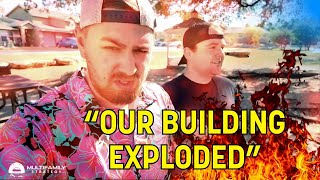
In this on‑site video, Christian Osgood and Caleb tour a 76‑unit, 13‑acre multifamily property in Stephenville, Texas. They start by describing a minor garage fire caused by a possibly miswired outlet, estimating $15‑20k in repairs, and using the incident to illustrate how “passive” real‑estate income is rarely truly passive during the build phase. The conversation shifts to how Caleb, at 22, has amassed roughly 200‑plus rental contracts and aims for 320 by year‑end, leveraging low‑income housing tax credits (LIHTC) and Section 8 to secure stable, cash‑flow‑positive deals. They discuss finding competitive advantages—local market knowledge, relationships, and expertise in low‑income housing—to acquire Class B/C properties at favorable prices. The duo then offers advice for young entrepreneurs, emphasizing fearlessness, a “ready‑fire‑aim” mindset, mentorship, and the importance of taking action over perfection. A substantial portion of the dialogue focuses on hiring and firing: building an A‑team, moving people into the right roles, and quickly letting go of underperformers, with Caleb sharing recent firing numbers and both stressing honesty and work ethic over credentials. The video concludes with a rallying call to get active in business, embrace calculated risks, fail fast, and learn from mistakes.
Chapters
We're here at the 76th unit. Caleb and I just drove down. We got a call— well, specifically I got a call at 3 in the morning saying, hey, there's a massive fire at your property. You've lost the building. It hit the gas line and there was an explosion. So of course, like a responsible owner and passive real estate, Caleb and I hopped in the truck. We drove down here bright and early in the morning and turns out— Caleb, how bad was this fire actually?
On a scale of 1 to 10, I'm gonna say about a 2 tops.
I might call it a 2.5. The garage— there was an outlet in the garage that was miswired. It caught fire and burned up against the fire retardant wall.
And on that note, it was miswired. It's actually not confirmed if it was miswired or not. We genuinely have no idea, but all it did was burn up a garage a little bit.
Yep, it looks like they lost their cat food, their fridge, and we will have to do some rewiring. We're gonna have to replace the drywall, do the smoke remediation. Overall, best guess at this point, $15,000 to $20,000 of damage. Now, when you're told, hey, you lost the building in an explosion, $15,000 to $20,000, not the worst thing that can happen. But a great illustration, how passive is the passive income? Caleb, you have what, about 200 rentals right now under contract for another roughly 200 rentals?
Yeah, exactly. I'm about 189, should be passing about 320 by the end of the year.
Which is phenomenal, by the way, at 22 years old. Freak of nature. But as you've built this, how passive would you say this business has been during the build phase?
If we're going off the 1 to 10 scale again, um, it's going to be about a 0 out of 10, um, 10 being completely passive, 0 being not passive at all.
So passive income is a beautiful tax designation that has a whole bunch of benefits to it. However, building and stabilizing a portfolio is a massive undertaking. I think a lot of people, you fall into the online guru sucker thing of, Oh, look at all these passive rentals. People pay me, I go to the mailbox. You can get there, like you can in any business, but it's important to remember when you're buying apartment complexes, you're buying rentals. By the way, really quick, look at this. This is 76 units we're on. This is a 13-acre campus. We're not gonna make it all the way around the campus just filming this video. Crazy acquisition. Caleb, you actually were the one who found this deal. You found this when you were 21. How did this deal come about? Actually, maybe you just turned 22.
It was actually, um, it was actually 21 is when I originally found it. Took some time negotiating it. This came from a prior relationship on a deal I had made an attempt at, or we'd made an attempt at about 6 months beforehand. Nothing came to fruition. Broker reached out, it's like, hey, I'm selling a portfolio, would you like this one? And it turns out we would.
Yes. And when you're buying properties, it turns out you can actually buy buildings that are big buildings. You can buy big buildings in nice locations, excellent markets. We're here in Stephenville, Texas, one of our favorite places to own. We own 186 units in this town, and 25, 26, 76, 44. We have been scaling, scaling, scaling. You can do this in absolutely any market, but this type of stuff that we like to buy— Kayla, how do you find these deals where they cash flow day one? Because that is a hard trick on nice real estate.
Yeah, a big way we're doing this lately is through LIHTC, low-income housing tax credits. We found these deals to be, one, incredibly stable— not passive, but incredibly stable, and two, have great cash flow day one. We're buying them at reasonable prices because we can, one, qualify as the buyer, and two, come in and perform a qualified contract where we make a ton of money on the back end as well.
Yes, really what it comes down to is finding where you have a competitive advantage. Exactly. I love entry-level housing. I love the consistency of Class C, Class B properties. This is a true Class B. Got pool, clubhouse, park. You have all the amenities, nice buildings, but it's not by any means a new build. It's a lower-income property. This type of stuff is really fun, but we found a niche. We found something that we had a unique advantage of. I've done enough Section 8, Caleb's done enough Section 8 where we're able to qualify to buy these LIHTC deals. So now we can compete on pricing that other people can't, hence the competitive advantage. You can have a ton of different competitive advantage, one of them being your location. If you live in the market, you're close to the property, you have an advantage. You have friends, families, relationships, brokers, you have a competitive advantage. You are a great contractor or electrician, use it to your advantage, but figure out ways that you can push value in a way that others can't. For us, it's been LIHTC, it's been Section 8, it's been low-income housing because of the demographic that we are passionate about serving and the experience that we have.
Exactly.
Caleb, advice to someone getting started young. I talk on this channel a lot, but I'm 33. I don't get to be the young guy in real estate anymore. You've taken up up the mantle. As a young, truly young entrepreneur, you never went to college. Well, you did, um, 6 months. 6 months of college. Uh, so you never really did the college thing. You graduated high school. You've never really had a job outside of DoorDash. You've started a very successful sales and marketing company, a huge real estate portfolio. Young people getting started. So let's, let's gear this towards the high schooler getting out of high school or the young professional just exiting college. If you're looking at being an entrepreneur, what does it take to be an entrepreneur?
I think the biggest thing for me, one of them is the lack of a fear of failure. And I'm not saying it shouldn't be there. I think as a hyper, I guess, competitive person, it's always there. But that, and then two, not being afraid to go for it. Kind of in that same vein, the ready, fire, aim approach, realizing you're not gonna do anything perfect. Before we got in this video on the sales marketing company, I'm just beating myself up about Things I'm not doing perfect, but ready, fire, aim, taking action, adjusting after the fact is one of the— is probably the biggest one. Number 2, get somebody who's already done it before or somebody to go through it with. I don't think everybody needs a partner, but having a mentor has been crucial for me in my journey.
Uh, I appreciate that a lot, and having the privilege to be that mentor, I think it's so important when you're just a few steps ahead of someone else, bringing other people up with you. Not only is it super fun and rewarding Uh, but we accidentally built this giant community called Multifamily Strategy just by sharing the journey with enough people. And it's become an amazing thing and my biggest passion project. Switching gears, I noticed as we were passing the courtyard, there's a bunch of trash in the middle of our courtyard. Uh, I don't know if you saw that, but there's bottles, uh, there's water bottles, candy wrappers. This doesn't quite look exactly like I want it to. Now the landscaping looks really good.
Phenomenal.
We've come a long way. We're here today on a special mission, and I'll be posting this video after we execute on this because it's our project in about 15 minutes. Hiring and firing. Caleb, you can't build an A-team, you can't win the championship with a team full of B-players. That's been my experience thus far. I'm gonna turn around and get away from this motorcycle that's coming at us, and I'll switch hands.
That's how you know it's in the field day.
Yes, we're on field day. So you cannot have an A team with B players or C players or F players, correct? Sometimes you make some hires and sometimes you can move people around seats. Sometimes you actually have a pretty good player but they're in the wrong seat. We have ran into a situation where we've made some hires and one or two of them are the wrong people on our bus. They're not just in the wrong seats, they're unable to complete the project as designed. So as part of today's mission, we're going to be letting go of some employees, which is never a fun thing to do.
Nope.
But I found that the best way to build business, especially when you're young, you got to learn this skill quick. Hire fast, fire fast. People always lie on the interview, so do your best to bring in the best people. But if you're finding they're not working, the speed in which you can get them back out of your org is critical. Caleb, How many firings have you done this year, roughly? How many people do you think you've let go of?
We could talk about in the last like 30 days, probably 5 at least. I don't know about the whole year, but last 30 days at least 5 to 10.
At 22 years old, hiring people, many of them your age, many of them older than you.
Yeah, mostly older.
How does it feel letting people go?
It never feels good is the short answer. And in the end, I don't mean this in a manipulative way at all, but you actually are doing these people a favor, especially in commission-based jobs where it's like incentive-based. If you hit X performance or make X much, you get rewarded. If you're not making enough money to support yourself, it generally is a lot easier for a conversation, at least on the commission end. It can be like, hey, I need you to be able to take care of yourself and your family. Here's why this is not working currently. It's, it's never a fun conversation, but I think just leading with honesty and just not going in there so worried about somebody else thinks— like Christian mentioned, people lie on the application. You're doing your very best. Credentials don't always tell the full story. Somebody could qualify on paper to the best of their ability, or somebody could be a 22-year-old with no college education and come in and outwork them and have zero qualifications on paper.
You know, I, I've absolutely found that that's true. I'll take someone who has the drive over someone who has the experience. If they have some experience and some drive, that's always preferred.
And then caveat to that, depends on the role. If we're hiring a CPA or an EA, obviously yes. But if you're hiring for salesperson, on-site property management employee, maintenance tech, That is 100% work ethic over experience or qualifications any day of the week.
Yeah, so if you're getting started on this, my advice to you, having done a lot of hiring and firing over the last years— right now we maintain about 40 people in our organization. I've unfortunately hired rooms of 25 people and fired them all on the same day before. So I mean, I have had the— I've had all the ups and downs of this. Your first mission is knowing yourself and the role that you take on the bus. Some of you, like me, me or Caleb for our respective companies, you're going to be the driver of the bus. You're going to be the one who's the visionary. You're going to be the one organizing. You're going to be the one steering. Some of you guys, you know you're a great supportive player, and the best thing you can do is find that visionary, that driving person, and work with them to build the biggest company you can. So knowing yourself is going to be the first thing. Second thing, stack your bench full of A-players. Get all the right players on the bus. Then You try to move them around the right seats. We actually had a player in one of our companies who was an A player for us. We switched roles, they started failing, we reconfigured their position, they're back to being an A+ player. It's getting the right people on the bus, getting those people in the right roles, making sure that people can thrive. And if it's not the right person for your bus, even if they're an A player, fire them and give them the opportunity to get on the right bus where they can go farther.
I think that might be the biggest point. There are people, especially in my org, that once were A players who have slid. There are people who like, man, you're really a C player, and switch roles, and they're an A. One rule, funny if I heard this from Elon, and I think Hermosi said it as well, if you have to go out and create new rules around employees doing certain things, that's a pretty easy indication they're not an A player. An example would be you have to be clocked on during the 9 to 5 in the schedule you work, and you have to start adding all these other things like I need proof you're working, all this stuff. If you're adding extra headaches to yourself, they're probably not an A player, and that's when you know you need to— hey, it's time to cut the rope and move on.
So YouTube, these are words from the field from Caleb and Christian. Good luck Christian titling this video because we've talked about fires, buying a 76-unit, hiring and firing. The core message here is get out and actually get active in your business. If you're getting started, go out and do cool stuff. Make mistakes, get some wins. Caleb and I have respectively each made millions of dollars making the decision to go ahead and take the risks that we have. Calculated risks.
We've also had failures too. Cost ourselves a lot of money, but you're never gonna move anywhere if you don't take steps towards action.
And you're not gonna learn anything if you don't fail, so fail fast, fail early, fail often, and don't make the same mistakes twice. YouTube, I'll see you on the next episode.