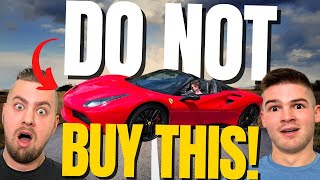
In this YouTube episode, two real‑estate investors discuss the financial discipline required before purchasing a sports or luxury car. They argue that merely having cash is insufficient; true wealth for such purchases consists of three pillars: cash (liquid reserves), cash flow (ongoing positive income from assets), and equity (net worth built through real‑estate ownership). The hosts explain how equity boosts net‑worth and loan eligibility, while cash flow sustains operations and protects against variable expenses. They stress the importance of eliminating variable‑rate debt and personal liabilities before considering a high‑ticket vehicle, recommending that any car purchase be funded either with cash or through financing that does not jeopardize cash flow. Practical thresholds are offered—e.g., a $5,000 monthly cash‑flow car cost is too risky unless the investor consistently generates $25‑30k per month in excess cash flow. The video also critiques social‑media hype and simplistic “Rich Dad Poor Dad” budgeting advice, urging viewers to build sustainable businesses before indulging in luxury toys. The episode concludes with a call to action to follow the channel and visit multifamilystrategy.com for deeper learning.
Chapters
Hey, cool car, man! Hey, cool car! What do you do for a living?
I buy real estate with no money. When is it time to buy the sports car? How did we get into this Miata? We're going to talk about that today on our channel.
This is our Ford Mustang. You can tell by the way it is.
Mustang.
Today we are talking about when should you buy the supercar? Because with 200 rental apartments, we've got the Robin Hood Village Resort down in Union, we've got a couple different businesses. We're still not buying cars like these. Everyone online says you become a millionaire and you can just drive around whatever you want. That's not how it works.
A lot of what you're seeing on social media, people drive around the sports cars. We have a whole bunch of friends who do this. They buy the sports car. They run around town, they put everything on social media, and they don't really own anything. At the end of the day, they have the same $0 they started with. We're actually starting to stack some liquidity. There's a few metrics that you need to actually be wealthy in real estate. I know we've talked about this on the channel before, but there's 3 main things. Number 1, cash, which we have never had until very recently. Notice we still don't actually own this. This is a rental. However, we start with some cash. If you have some cash in the bank, that is a metric that allows you to do a whole lot of things. And pay your bills whether you're cash flow negative, positive. You have more flexibility when you have cash.
Now, more important than cash is resource number 2, cash flow.
Yes.
Now, once you've built up some cash flow, you accumulate cash, but over time in real estate, the third piece is equity. Whether you're doing that in business or in real estate, you need equity, cash, and cash flow to be considered rich and to even consider buying some Honda Civic like this. You don't want to do that until you have all 3 resources on lockdown.
Yeah, now before you buy this Audi, let's break down the 3 pieces. So let's talk, talk about equity. So equity is the piece where you actually are invested in real estate that grows over time, and that always grows over long periods of time.
And that is how you quantify your net worth. You have your assets less your liabilities.
Mm-hmm. Now that equity in real estate is going to help you on your balance sheet. It's going to help you qualify for loans. That equity is actually very important. While people like to focus on the money, which is going to be that cash flow, the income, and the liquidity, the actual cash, your equity in real estate is ultimately what is going to make you insanely high net worth. And so you do want to focus on keeping a very high equity position in your portfolio. There are strategies like syndication where you can buy huge assets and you can get a bunch of cash and potentially a good deal of cash flow, but you usually take a very, very small equity stake.
Which means you're not rich.
Exactly. You want to maximize the equity in your portfolio. If you're going to own it, you need to actually own it. Now let's talk about cash flow because that is really the lifeblood of any business.
Equity is cool, but it doesn't matter how much upside you have in a project if you can't get to the end of the project. The way that you finance everything is through cash flow or cash, but cash will go away. Cash flow will stay. You got to remember that. So if you're building a huge project where you get a whole bunch of net worth, a whole bunch of equity, If you don't have the cash flow to get you all the way to the end, you will lose it.
Now, when you are building cash flow, you need to make sure that you maintain cash flow. So if you're using debt, you want to make sure that you have a fixed rate product. One of the only projects that we've had really run away from us on expenses is one that was hospitality, because that has variable expenses. You want to fix almost every expense you can. The debt is the most important one to lock down because it's usually your biggest piece. On our resort, it's a perfect example. While the expenses were higher than we originally estimated, if we had a variable rate loan on that, we'd be screwed. Borrowing $3.5 million from the seller, if it went to market rates today where it went from, I think we're 4.25%, it went all the way up to 7%, we get dangerously close to doubling the cost of debt. And when you're borrowing $3.5 million, that could absolutely eat you alive. So on cash flow, you find deals that are cash flow positive. They pay you every month to hold them while that equity grows. And you continue to protect that cash flow at all costs.
Now, all that to be said, when do you buy the car? When you have those 3 resources on lockdown and you've removed the variables from your business.
Yes.
You get rid of all your variable rate mortgages, you get rid of your personal debt, and when you can buy these and it doesn't impact your cash flow, you get— Yep.
The real estate needs to buy these. You don't have to write a check for them in cash. In fact, I like the model of cash or financing them out of your cash flow, preserve your liquidity. However, in my opinion, you should have the liquid net worth to buy this vehicle when you buy it, whether you rent it or not, or whether you lease it or finance it, or however you put together your financing on the car. You should be able to write a check for it if you wanted to. I think that's the metric that matters.
When you get your first $5,000 a month in cash flow and you see that the car costs $5,000 a month to buy it, don't buy the car. Make sure that you have $25,000, $30,000 a month coming every single month so that this is just a blip in your universe.
I see a whole bunch of people, and I think it comes from the Rich Dad Poor Dad book, where it's like, how could you buy it? How could you buy it? People budget to exactly what they could afford. They go, my goal isn't sustainability, it's I want to drive a fast car. They get to exactly $5,000 a month in passive income, and they spend exactly $5,000 a month in passive income on the car. You need to think beyond that. Build a business that is sustainable And if you want to do things that are absolutely excess like this BMW, you need to have excess in your business. Make sure that cash flow covers your cost of living, covers your more important goals, and out of the excess cash flow, you can afford luxury items such as this.
Don't be a guru and don't be a goober. Don't buy these too early. Make sure you build a business that's sustainable so that these toys can come into play later and they won't affect you personally.
Now, if you want to learn how to build that business, Follow this channel, like and subscribe. If you want to take a deeper dive, check out multifamilystrategy.com. There's a link below. But thank you so much for watching.
And if you want to rent a Lamborghini like this, we'll give you the directions to the rental car.