Así explico a mi cliente como tomar decisiones en los anuncios de su tienda online

Pate walks through how to read ad metrics like ROAS and CPA, when to increase budgets by 20%, and when to pause underperforming creatives. He emphasizes measuring trends over short windows and tying decisions to your store's break-even CPA, with concrete examples from participants on allowed first-purchase spend and common overspend mistakes.
Questions this video answers
Increase budgets by 20% (typical rule-of-thumb mentioned).
Compare last 7 days vs last 4 days (and inspect last 2 days for short-term trend).
Break-even CPA = €28; allowed first-purchase spend = 28 × 1.5 ≈ €40.
Ursula let the creative spend €71 (allowed ≈ €40).
ROAS (to see overall campaign profitability), then cost per acquisition (CPA) when budget and CPA constraints matter.
Chapters
In this video, you'll see how I help my clients make decisions about their ads, getting into their campaigns, analyzing creatives by creative, when to increase the budget, when to decrease it, and when to turn off a creative. This is a session from my Consulting A little bit where I explain to online store founders, one on one in group classes, how to scale their online store to €20,000, €30,000, 40. €40,000 per month in sales. And I don't leave those calls until all the questions are answered. In case you don't know me, my name is Pate and I help private label online store founders make a lot more money without depending on agencies or freelancers, just the founder making money with their store. If you want some specific resources that will help you make a lot more money with your store, in the first link in the description below, click you have a drive folder with conversion calculators for your website. What flows do you need to do to recover shopping carts? How to create creatives with artificial intelligence, how to make decisions in ads. Like many resources that will help you earn a lot of money or even more money with your online store. I'll leave you with the consulting that is paid for now.
Ah, let's see about the ads. I have two questions in each campaign. Okay. Uh, I've analyzed the campaigns and they all give me room to increase, which is what I did this morning. I've increased the ROAS and increased the budget for all of them by 20%. Okay. Okay. Within each campaign I have questions because I see that there are.
What questions?
Ah, well, in the sales campaign.
Have you had a haircut?
Have you had a haircut?
Yes, I've already touched it.
How pretty you are.
Hey, thanks. Really, it was time for me to change the look that I didn't. Well, it was time for me. Thanks. Okay, let's see. I have doubts about each campaign, but for example, in the retargeting campaign with no audience, in that one, for example, I think two ads are dead. Or do I think.
So? Let's see.
Okay, I appreciate it. Do you see this one from August and the Tradescantia sale? That one from Tradescantia Sale, because it hasn't produced. Okay. And it's been up since the 17th and we're on the 21st. Okay. And then the one from August 25th has burned out. Because of course, if I take it from seven days, it tells me one thing. And of course, if I take it from four days, it tells me something else. If I take it from seven days, it hasn't burned Out. If I take it from four days, it has.
Sure, but it's not. No, you don't have to compare seven and four. But with the last seven days and the last four, we can see the trend. The trend is upward. Exactly. So this one hasn't burned because in the last four days it has a higher roas than the last seven. So the trend is positive.
Okay, so we have to look at why. Let's see. When I review the ads, I do several things. First, I look first, what I measure is the set of campaigns. Are all the campaigns profitable for me in seven and in how many days? Okay, I see that they are.
But what are you looking at? The total of all the campaigns. You look at the total of all the campaigns, Right?
I do several things. The first thing I do is to see how I'm doing. I look at the entire set of campaigns. I say, okay, it looks like we're going up. And then I look at each campaign. Uh, the retarget campaign, the sales campaign. Uh, I look at it, I look at the seven day and four day roas. Okay, I see that it's gone up. So I see that I have to increase the budget. And then I look at each ad. But I didn't look at the roas of each ad per se. Okay.
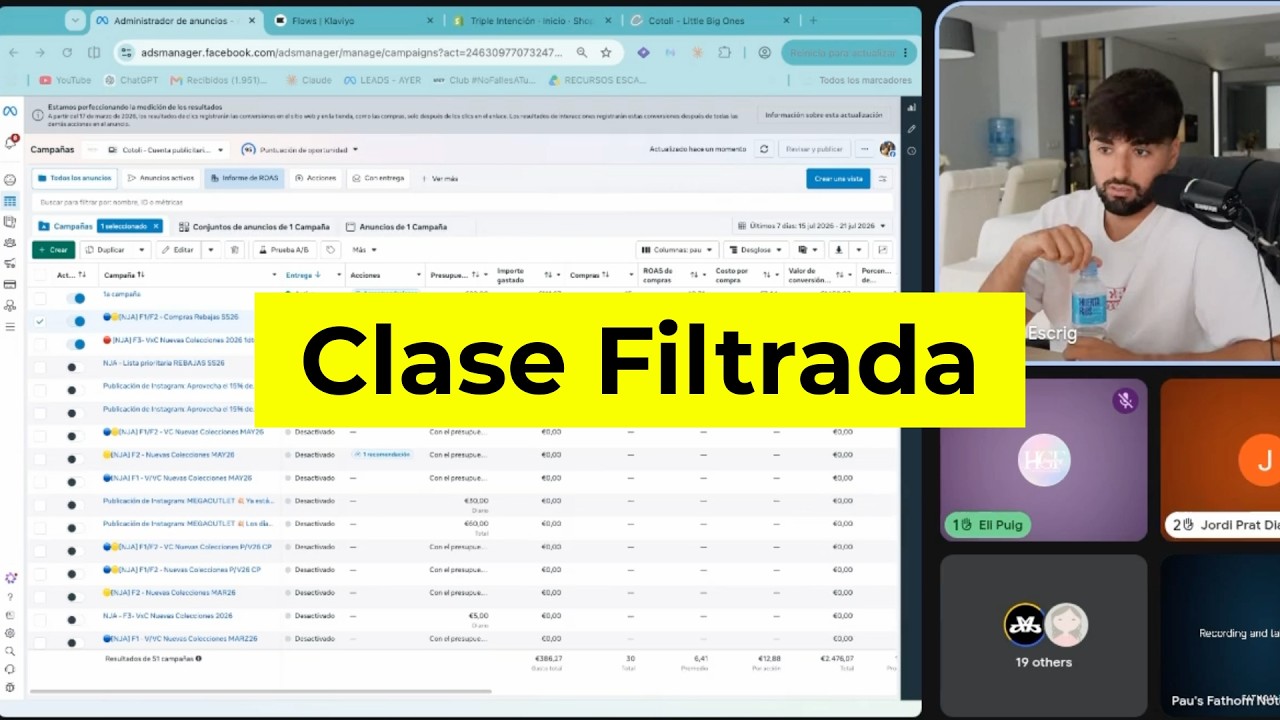
Of course, at the ad level, look, I'm going to show you that I see a few hands raised. I'm going to expand and I'm going to do exactly what I would do if I were you, making decisions.
Okay.
A step by step. So I come here and I always start from the last seven days. From the attention level, that is, it's at the campaign ad set level. And then at the ad level there are two. Why do campaign and ad set levels go together? Because that's where we're going to look at the roas. And depending on whether they are or cbo that is testing or scaling, we'll look at one thing or another. We'll look at the campaign ad set depending on where the budget is cover. One that worked for you.
There's one that if you go into retargeting for sales without an audience, there's one with some aglaonema leaves in red. This sales 908. That one work for me. You would upload that to a scaled one, for example?
No, I would upload which one? Which creative do you mean?
This one worked for me. I think that one worked for me.
This one only brought you one sale.
Don't worry. Well, then it wasn't that one.
Yes. You must have confused yourself. But I would always include creatives that are working well for you today in scaling.
Okay. And in. In this case. But I would include one about sales. Yes, it could be. Okay.
Well, let's go back then. That's it. Does anyone have any questions? Tell me. Excuse me. It's Yoli. I asked you. It's just that I hadn't seen if that creative had made any sales. No, not that one. So we give it to them.
So why do you give them the opportunity? Because. I mean, many times the question is, you ask me how much time I have to give a creative to bring me a sale. And we don't talk about time. Because for example, here is Lee from Mim Mok. She sells jewelry. Wait, Yoli, I'll answer you, but I'll mute you, okay? Because there's background noise.
Oh.
If you have any more questions or want to talk about the subject, she'll answer you later. You open the microphone. For example, Lee from Mim Mok sells jewelry for 1,100 2,000. So how much time has to pass for the creative to be valued? It doesn't make any sense. So then for us, our order of measurement is the budget spent. Because the budget and the opportunity we have to give to a pair of €40 shoes are not the same as for €120 sweatshirt. On top of that, people have different margins. Each store has its own world. So that's why we calculate very carefully what our break even points are. Our roas and our cost per acquisition. And based on that, we make decisions. In this case, Ursula had her break even CPA. That is what she can afford for a client is 28. But we have already said that for the first purchase, what we allow that creative is to spend a little more. Because we want her to get volume. So we don't give her 28. We give her 28 1.5, which is more or less 40. So the opportunity we give a creative to bring us the first purchase is not even three days. It is not exactly €40 for Ursula from Plan to Decorate. If she doesn't bring us €40 before, she's out of business.
But I saw that you also looked at. The first thing you looked at was the roas. I never looked at that until now. Like the ROAS too. I mean, I look at the roas to know if I have to increase or decrease my budget. Why? Because sometimes with the same cpa, there are creatives who bring you people who buy more. And there are creatives who bring you people who buy less. So one client, that is two clients. Two clients have cost you €20 and €20 cost per purchase of €20. Cost per purchase of €20. But if this client has spent €100, the ROAS is 5. And if this client has spent €40, the ROAS is 2.
That's why I look at the Roas first.
Yeah, that's why I was telling you if you could see it with mine, because that's the analysis that you've done. We don't do it first. Go into the campaign and see the ro, and then go into the ad and see the amount.
Of course, at the point you're at.
It'S not necessary yet.
Exactly. What I look at the most is cost per acquisition.
Okay?
If the budget is met, if the CPA breaks even. If it doesn't.
Okay, okay, okay.
Ursula, what happens is that she has a higher sales volume and that's why I look at those things. Okay, okay. This is it. Okay. And how do I know for my store if I give her that opportunity and not through this Excel, which is what we always look at before making ads. Profitable clients that I have another one. Let's see. But anyway, it's basically this one. I have an improved one on a tablet. Let's see if this one comes up. This one, this one, Sure. I look at that all the time. So I like this one a little bit better. It's simpler. So here you put your metrics, that is your address value data, such as your costs. And you just have to look at this gross margin, average cost per acquisition. And here I've put the opportunity amount spent that we'll give to the first sale of a creative. The opportunity amount spent that we'll give so that a creative will. Well, here I explain it a little more poorly so that a creative can bring us the first sale. More questions. I mean, you understand that, Yoli?
Well, I don't know. Now. I think I got confused. If I tell you the truth, I mean, what point don't you understand? I mean, you. You are clear about your ROAS and your CP break even. Yes, yes, yes, yes. I have also I do it for each campaign because each product is different.
For the same reason.
I mean, of course I have, for example, 13 perlay suits, and then the maximum opportunity is 19.5. But I give that to them when there's a sale. When they bring a sale to that creative, that's when I give them up to that. If not, that's not why. I just got confused. Forgive me.
No, it's okay. So for your first sale, so that a creative can bring you the first sale, you give them the opportunity of, in the amount spent, 19, which gets us the first, the. From the second, third, fourth sale. Well, the 19th. Well, those 15. Those 13. Those 14 from cpien.
But why ursula? If she hadn't brought him any sales, why did you give him that opportunity? Let's see. I might have stopped there. I got the wrong idea and I didn't have it. I got distracted and I shouldn't have given him that opportunity.
Of course. I mean, she.
Ah. Oh, okay. She gave it to him. Ah. Okay, okay, okay.
Now. Now is when I'm going to tell Ursula off.
Oh, for God's sake.
Yes. No, no. Yes, yes. You snitched. You're a snitch. Yes, yes. Sorry, Ursula, but she. She got distracted and should have turned it off in 40. Okay, okay, now. Yes, she did. But she let him spend 50. Well, 71. Ursula, I swear in God. So for her, that's a mistake because you've already given her a fair chance. And those extra €20 or €30 could have been spent on something more profitable. For example, on the other creative who is at €550, which is her cost per purchase. This is important. This is important. I mean, Ursula, I don't want to beat you up, but I want you to see the importance of making decisions every day which don't cost anything. And Ursula, I know firsthand that she's the most attentive, one of those who asks me the most questions, and that we all make mistakes. But she should have only given her a chance of €40 and she spent €71 until we've turned it off now. And those €30 could have been spent on this creative who is getting you clients at €10. In other words, Ursula would have had three more clients. That's why it's so important to give a fair chance according to your store, your margins and your product. And then not be emotional and say, I'll cut it off here. When? Just like when you watch Red Flags, when you're getting to know a girl or a boy. No, you're not going to be my boyfriend. You're not going to bring me sales when I want. Okay, let's see. Even everyone has figured out how to make decisions.
I'll rewatch the class tomorrow. When you upload it, I'll finish it. Okay. Like. But it's clearer to me, huh?
Great. Since there's only Ulvera left, let's continue with.
No, no, I Have more questions.
No, no. You know, I'm done with the questions. Ursula. No more for you. No, we'll look at it now. But we're going to finish looking at all the campaigns because I'm sure we'll come up with some cases.
Yes, yes, yes. Finish looking, finish. Because I have mine.
Yes, you got that one wrong. There will be some more.
So we've only seen if anyone has any more questions, raise your hand and we'll look at it. Okay, but I'm going to elaborate. We've already made the decision on this one. We've said we're going to upload budget. Ursula increased it today. Let's go back to the last seven days. Ah, we've already checked this one. It's already checked. We said we were going to increase the budget and we've seen who is to blame for not having a higher roas.
Okay, the next one.
Let's move on to the next ones. For example, this one for retargeting. We don't make decisions here because it's really at the ad set level. So in the same campaign there can be more ad sets. There's only one. Okay. Because it's for testing. So. And it's for retargeting. So retargeting. What does hot traffic mean? People who have visited our website are on Instagram have not left their card. Ro is a.
Tell you the truth. I mean, what point don't you understand? I mean you. You are clear about your roas and your CP break even. Yes, yes, you. Yes, yes, I have also. I do it for each campaign because.
Each product is different for the same reason.
I mean, of course I have for example 13 perlay suits and then the maximum opportunity is 19.5. But I give that to them when there is a sale. When they bring a sale to that creative, that's when I give them up to that. If not, that's not why. I just got confused. Forgive me.
No, it's okay. So for your first sale, so that a creative can bring you the first sale, you give them the opportunity of in the amount spent, 19. Which gets us the first, the from the second, third, fourth sale. Well, the 19th. Well, those 15. Those 13. Those 14 from CPIEN.
But why Ursula? If she hadn't brought him any sales, why did you give him that opportunity? Let's see. I might have stopped there. I got the wrong idea and I didn't have it. I got distracted and I shouldn't have given him that opportunity.
Of course.
I mean she, ah, okay, she gave it to him. Ah. Okay, okay, okay.
Now. Now is when I'm going to tell Ursula off.
Oh, for God's sake.
Yes. No, no. Yes, yes. You snitched. You're a snitch. Yes, yes. Sorry, Ursula, but she. She got distracted and should have turned it off in 40. Okay, okay, now. Yes, she did. But she let him spend 50. Well, 71. Ursula, I swear in God. So for her, that's a mistake, because you've already given her a fair chance. And those extra €20 or €30 could have been spent on something more profitable. For example, on the other creative who is at €550, which is her cost per purchase. This is important. This is important. I mean, Ursula, I don't want to beat you up, but I want you to see the importance of making decisions every day which don't cost anything. And Ursula, I know firsthand that she's the most attentive, one of those who asks me the most questions, and that we all make mistakes. But she should have only given her a chance of €40 and she spent €71 until we've turned it off now. And those €30 could have been spent on this creative who is getting you clients at €10. In other words, Ursula would have had three more clients. That's why it's so important to give a fair chance according to your store, your margins and your product. And then not be emotional and say, I'll cut it off here. When? Just like when you watch Red Flags when you're getting to know a girl or a boy. No, you're not going to be my boyfriend. You're not going to bring me sales when I want. Okay, let's see. Even everyone has figured out how to make decisions.
I'll rewatch the class tomorrow. When you upload it, I'll finish it. Okay. Like. But it's clearer to me, huh?
Great. Since there's only Alvara left, let's continue with.
No, no, I have more questions.
No, no. You know, I'm done with the questions. Ursula, no more for you. No, we'll look at it now. But we're going to finish looking at all the campaigns, because I'm sure we'll come up with some cases.
Yes, yes, yes. Finish looking.
Fin. Finish.
Because I have mine.
Yes, you got that one wrong. There will be some more.
So we've only seen. If anyone has any more questions, raise your hand and we'll look at it. Okay, but I'm going to elaborate. We've already made the decision on this one. We've said we're going to upload budget. Ursula increased it today. Let's go back to the last seven days. Ah, we've already checked this one. It's already checked. We said we were going to increase the budget and we've seen who is to blame for not having a higher roas.
Okay, the next one.
Let's move on to the next ones. For example, this one for retargeting. We don't make decisions here because it's really at the ad set level. So in the same campaign there can be more ad sets. There's only one. Okay. Because it's for testing. So. And it's for retargeting. So retargeting. What does hot traffic mean? People who have visited our website are on Instagram, have not left their cart. Roas is profitable, but not very high. So what do I look at the last seven and the last four? The trend is positive. Why do we care about the trend more? So we're going to increase the budget. But retargeting has the. What's it called? The addition or I don't know, I can't remember the word that. We have to look at the frequency. Why? Because the audience is not broad, but rather limited. Which are the people who know us. That is those who have visited our website, seen our Instagram and are on our Facebook page in the last 180 days. It is not everyone. It is that audience. So if we increase the budget and the audience does not grow at the same rate, it burns out. That is understood there by the chat.
Yes. At least I do.
Okay, top. Yes. Okay. So we have to look at the frequency. The frequency does not have to be greater than 45. It is with 254 in the last four days. Last seven, three. So can we increase the budget? This has increased.
Yes, yes, yes, they are all increased.
Great. Well done. Very well done. And then we will see if there is any creative who is being too clever. Look, last seven days. Ah, okay. See, this is off. This is off. And I suppose you would turn it off when it was because it brought you sales, but profitability was falling. Very good. So let's last seven days here. I'm going to look at more days and more and more. A longer period of time because I want to check that what happened before was done well. But if you do it every day, I can tell you that you know exactly what you did in previous days. That's why it takes five or ten minutes every day to make decisions. So for me everything is done well here. I mean, this One is off, this one is off. And these are fine. Perfect. You don't have to turn anything off. Any questions about this one? Wait a moment. My doorbell is ringing. Oh my gosh. The wallet tells me and says, but there's no package for you. It's for you to open it for me. So doubts about this last one we've seen. Has anyone not figured something out or something? Let's continue. No, but pay attention, sons of. Because this. This is the most important thing of all. Right? I mean, making decisions every day. Ah, okay. Yes, yes, yes. Give me feedback, otherwise I'll feel like I'm talking to a wall. Okay, then I'll continue. I'll keep going. Next campaign, the testing one. The most important ones. So testing at the campaign level, we don't look at this. Why? Because here there are two. There were two sets of ads and we make decisions here. Here, for example, with Ursula, we did a test that pitted plants against products. So we saw that the plants work much better than the products. It's also a bit biased because the plants are on sale. So we did a bit of a standby and. Not standby. No, we paused it. We left the product testing on standby and we pressed on plants. So.
And I sent them the budget to reduce it.
Exactly. Very good. Last seven days, ROAS four. It looks like we're going to go up. Last four days, ROAS six. We could even go up a little more than 20% in this case. But hey, just to avoid confusing you, it's always 20%. No problem. Let's see if there's someone guilty of a murder. There isn't. It doesn't look like there is. You turned these off back then, and these are fine. Here. I probably wanted to put more creatives here because at this budget level, it gives you the ability to test more creatives. Instead of three more creatives. Yes. At an average of more or less. €5 and 80 cents per creative. So with 24, you could have four active creatives, five active creatives, six active creatives. Perfectly. Okay. Do you have doubts about this one? Has anyone not made sense? Nothing, really. Right. And then the last one, listen. How. Why does it put the. Those numbers in blue with that arrow that I. This. This. Don't pay attention to.
These are meta things. Don't pay attention to this.
We make decisions based on what we know. That meta says to duplicate and screw up with C bands. Plus don't pay attention to it. Opportunity score. Don't pay attention to it. It's just that. Don't pay attention to it. Then the retargeting is there are more things here, you see, there are more things here. So it's at the ad set level. There's only one ad set. Here's something I'm telling you for when you want to delete things. Let's see what to review and publish. Here you have drafts. Be careful. Here you can discard drafts if you have something in draft that you don't know what it is or what it is. But hey, I. I'm not going to touch it. Just in case.
Drafts. Do you see that? I have drafts? Because I don't see them.
No, me neither. Because here it says unpublished changes. But then I don't see ads, so I wouldn't delete it either. Let's see if we delete the ad set. But sometimes that's what that creative is active.
And if I click republish.
No, leave it, Leave it. When the sales are over, we'll discard drafts. Then we go back to the last seven days. 1.63. We're not profitable there. So it looks like we're going to lower the budget. We're at 40. We'll probably go down. We see the last four days, 225. Here come the nuances. Here comes the fun part. Because the other decisions were very simple. This is when you usually ask me at first why your head is spinning. In this case, I would keep looking at the trend, for example, the last two days, and we see that it's going up. So in this case, I wouldn't lower the budget. I would simply look for the culprit who killed grandma. And if we look at the last seven days, hey, the last seven days are because of these two. Because of this 28 that was robbed 80. This one that was at as 148. This one that was at as 199. So we're going to make the decision of which one to turn off. So we look at the last four and we see that this one is improving. Right? It's even getting worse, right? No, this one is improving.
And I think that one has actually sold today.
Exactly. So the one I would think about turning off is this one. I would turn this one off, which you have in fact done great. And this one, let's see the last four. This one. And I would look at the trend a little bit today.
There are already metrics from that start.
Ah, okay. It's saved, it's saved, it's saved.
But look at the 21st because there are already metrics.
Yes, this one has been saved.
It has brought me three sales today. Which one? Or in these days between yesterday and today? This one. Yes, of course.
Well, then that's why it's so good for you to make decisions about your business, because you know it inside out.
The 21st. If you only mark the 21st. Okay. That one brought me that ad. It brought me sales. Ah, no. Well, then it would be yesterday.
Of course. I don't like to look at today because between the time it takes to attribute and that doesn't make much sense. Because if you're only going to look at it for 12 hours, it doesn't make much sense.
Right. I only looked the day before.
We do that very rarely, either with very high budgets or on Black Friday days. Okay. So I would be careful with this one because it has €17 without bringing in any sales. In fact, I'm going to change that one. Sure. This one has already been at €20. So I would leave these two and take a look at this one and give it more rotation. I would add another creative. Why? Because it looks like these aren't going to support much more of a budget if they're there. Okay.
Okay. And you, for example, what type of ad would you make now? Because there are several types of ads. There's one that's a photograph, and I've tried photographs of ads like the Anthorium sales one, which is an anthorium leaf with sales. There you go. I don't think that ad has any more value look. Than the St. John's Wort sales one, the Hypericum sales one. That one was a photograph, but that one didn't bring me anything. And I think that's because it says 50% off. And I don't know, I think my people don't understand me.
Your people don't understand. Right. Well, look, what I would do.
I don't think so. With how cool that photo is.
What I would do is make variations of this one because it's the one that has performed best and has brought you the most purchases by far. Oh, sorry, sorry, sorry, sorry. Not this one. Not this one.
Huh?
This one. This one that has brought you seven sales.
Okay, win. But do you know why it seems to me that it has brought that sales? Why? Because there are flowers in thee, in thee, in thee, in thee, in thee, in thee, in thee, in thee, in thee, in thee, in thee, in thee, in thee, in thee, in thee, in thee, in thee, in thee, in thee, in thee, in thee, in thee, in thee, in thee, in thee, in thee. In thee, in thee, in thee, in thee, in thee, in thee, in thee and thee. In thee, in thee, in thee. In the flowers in the next. In thee and thee and thee and thee and the.
Flowers in the next. In the.
But which one? You're telling me this one?
Yes. You can make variations like this one. Okay, but when you say variations with the same ad, do you mean removing, for example, the type of font, changing it to, for example, the bottom corner? Well, those are already adjustments. But what I would do is, for example, instead of 50% off, put 50% off or even 50% off. Then you can also try it with that same creative. With this same creative, you can also swap.
Change what I say at the beginning.
Change what you say. By changing what you say at the beginning, you can change the sequences of.
The flowers that appear here. Change their order.
Order. Damn. Look, that. That hadn't occurred to me.
Sure. Then you can put in another type of plants. I don't know. You can do many things. You can use CHG GPT and tell it. This is the creative that has worked best for me. Make variations with a CHG GPT that you have here in the program.
Yes, but let's see, it's like there are several more of those ads, okay. The ones with a cover and then different types of plants that I have up here. I did one with outdoor plants, one with indoor plants, another with different types of leaves. Okay. Those that would attract more attention. Like there are green leaves, yellow leaves, red leaves, pink leaves. I did it with different types of leaves. Okay. And that was the one that worked the most. And then I said that one works because there are flowers. I mean, I don't know either. I. I don't know why. Of course. And that's what we're going to test. So you take that ad in Ceteris paribus. That is everything is constant. Yes. It's a piece of crap that I remembered from the little economics. I learned in college that when you do economic studies, you can't change too many variables. Because if something works, which variable worked? If we've changed three or four, then you keep everything stable. That is the same order of plants. The same plants. But what are you going to change? Everything is exactly the same, but instead of 50% off, you're going to put 50% discount.
Exactly. Then you're going to leave it 150 off and everything is the same. But you're going to put outdoor plants, you're going to leave everything the same, but you're going to put indoor Plants. You're going to put everything the same, but instead of flowers at the beginning, which you say you think is why you. You're going to put plants. Everything, plants, not flowers. And then we'll know what worked in that ad.
Okay. I tell you that I follow up on that type of ads.
Okay.
Okay. And I've already tested things.
Okay, what things?
Of course, what I haven't done is more or less with the same ad, but with the same ad model of putting something striking at the beginning and then different ones. I've already tested that. I mean. I mean, I've tried to draw conclusions.
Okay. And what I'm most inclined to do is because there are flowers.
Well, the fact that there are flowers caught my attention.
So make flowers.
Okay. Do you think that same ad could work if I redo it by changing the order of the.
Yes, I think it could work. It would work.
It's a variation of that ad. For example, the market won't say so putting discounts. Exactly. Of course. Well, I'm going to redo that ad.
Very good.
Okay, great. I have another question that has nothing to do with this. Let's see. Okay. Uh, I have to make several changes. Well, some changes to the website, to the products. And I need an app, an application that helps me with some kits that I have created. But what happens is that it doesn't discount the kit. It discounts the product when I sell a kit, but it doesn't discount it if I sell it individually. You know, that same product is sold individually and sold in that kit. Okay. Okay. When they buy a kit from me, they discount the kit. But then of course, they. It messes up the stock because if I sell part of that kit as a unit, it won't discount it. So I need an app where I can put that product, a pot, so that it can be sold individually and then it becomes part of a kit. But of course, when I sell a unit or a kit, it will discount the general stock. If I have 12, it will be discounted from that 12. Right. Not having two different stocks, one for MACA and one for Endo. I understand. Remind me on WhatsApp and I'll ask GPT. And then another thing, an app that I don't know if it can be the same or not. For when I make a volume sale, if you buy one pot, it's at one price. And if you buy three pots, it's another better price. If you buy five pots, another better price. M.