Automotive Industry Sustainability: Insights from Arnulfo Salazar, Corporate Sustainability Director
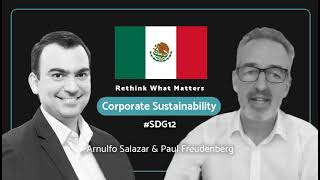
In this Rethink What Matters podcast, host Paul Freudenberg interviews Arnulfo Salazar, the former Corporate Sustainability Director of AGP Group, a tier‑1 automotive supplier that produces skylights, windshields, and side‑lights for electric vehicles. Salazar explains how the company’s sustainability agenda is driven by top‑down commitment from CEOs and investors, and by OEM demands for carbon‑neutral supply chains by 2030. He describes the concrete steps taken at AGP’s Lima, Peru plant to source 100% renewable electricity from a hydro‑solar mix with Enel, and the broader challenge of securing affordable green power across the company’s global footprint of roughly 4,000 employees. Salazar outlines the development of a company‑wide ESG strategy that integrates environmental, social, and governance dimensions, lifecycle assessments for each component, GRI‑based sustainability reporting, and alignment with UN Sustainable Development Goal 9. He discusses the cultural and operational hurdles of change management, resistance from production and engineering functions, and the need for cross‑functional lobbying and awareness‑building. Cost and supply constraints of renewable energy, the necessity of improving energy efficiency before adding renewables, and the complexity of meeting divergent regulations in the US, China, Europe, and South America are highlighted as major barriers. Social initiatives such as a human‑rights policy and grievance mechanism are presented as essential for worker safety and ethical conduct. Salazar also reflects on his experience with green‑washing, emphasizing the importance of genuine ESG understanding and treating sustainability as an investment rather than an expense. The conversation concludes with a call for alignment across all organizational levels—from investors to shop‑floor workers—to embed sustainability into the core business model.
Chapters
Because I think there is where everything starts. You have to have the commitment of, of the top management, the CEOs, the investors to push for those type of policies and requirements and way of doing business.
Hello and welcome to Rethink What Matters, the podcast dedicated to aligning the economy with the ecology and everyone for improved business performance, stronger families, and a greener, cooler planet. And today I'm joined by Arnulfo Salazar, who was until May the Corporate Sustainability Director at AGP Group in Monterrey, Mexico. Mexico, and we're going to be discussing corporate sustainability.
So it's great to speak with you today, Arnulfo, because, you know, as the corporate sustainability director at AGP Group, I know that would have been a big job. I'm keen to learn more about AGP Group and what they do and what your role was there. Sure.
They are a tier 1 supplier for the OEM in the automotive industry. They build skylights, windshields, and sidelights, mostly for electric vehicles.
Okay, and who would be their customers?
We have, for instance, Tesla, Lucid, Canoo, Rivian, Polestar, Volvo, Volkswagen, BMW. Practically all the car manufacturers are part of the customer base of the company.
That's an impressive customer base, it has to be said.
Yep.
So, so what was driving then in your role as Corporate Sustainability Director? I noticed you had a drive there towards, um, renewable energy sources. What, what was the driver for that, if we could just start there?
Sure. For instance, as, as you know, uh, this whole, uh, uh, transition to decarbonize, uh, all the industries Of course, mainly the automotive industry, it's playing a huge role here. So part of the goals of the OEMs is to become carbon neutral by 2030. So in order to do that, the entire supplier base needs also to become neutral. So in that regard, we needed to start looking for how to source green energy for our operations. The product, it's quite huge demand on energy because of the type of process to develop the product. So an important thing to do in order to decarbonize the company's operation was to go directly to green energy sources. Which we kind of accomplish at the moment in one of the facilities, which is the Lima plant.
Right. Okay. Okay. And so what was the green source? Was it solar energy? Was it wind or—
In this case for Lima, Peru, there's a mix of hydro and solar energy. I don't remember right now the percentage precisely, but we partner there with Enel. Peru, in order to source entirely our consumption for the plant from green energy.
Okay. Okay. And if you could tell us a little bit more then about what does it mean to be a corporate sustainability director at a company like AGP? What did that—
Well, it's a huge, huge responsibility. And part of my role was to develop the strategy and the processes and the tools in order to go in that sustainability journey, starting from the decarbonization part. As you know, I mean, sustainability is not only about environmental issues. We also have the social ones and the corporate governance. So I was putting together the whole strategy in order to tackle those requirements, not only from the regulation side for whatever we were operating, but also from the requirements of the OEMs, which most of the time are higher right now than the ones in the regulations. So again, for instance, to go 100% green energy by 2030. So we are 6 years far from that and it's a huge transition. And now not in all countries is enough supply of green energy. Everybody wants to do that transition, or mostly all the heavy industries, and there's not enough source of green energy, which that translates in higher prices in some of the countries. So that is the main barrier right now, the cost. That sometimes we need to transfer that to the customer and the customer will transfer that to the end user. So I think that is, that is one of the main challenges that the entire world faces right now, how to make more accessible in terms of the cost, the green energy.
Right. Absolutely. And how many staff are there at AGP Group that you had to include in this?
How many what?
Sorry, how many staff, how many employees are there?
Um, should be something around, uh, 4,000 employees worldwide.
4,000. Okay. And did you have to bring them along with you on your corporate sustainability journey?
Sure. I mean, you have to align the entire workforce. It's not only about the one or two people effort. It's everybody needs to be on board. It has to be clear in the entire company, what are the goals and how are we going to fulfill them in order to have a better result?
Right. Sure. Absolutely. And do you find any resistance? I mean, that's always the biggest challenge with these.
That is an epic challenge. I think in the change management theories, resistance is by default. You will always you find resistance. So you have to manage it. And yeah, for sure, in every kind of new project, new initiative, in this case, in my area of expertise, there's not enough knowledge or understanding of what sustainability means. So you need to start from there to build up the proper awareness in the people to understand and let them have a clear idea of what are the challenges that we as humans and also as companies are facing, so they can understand how they can contribute to, to build up and, and fulfill those objectives.
Right.
Okay.
Okay. And I'm just curious, did you get involved in how green the product was itself in terms of its manufacture?
Yeah, actually, um, every year there's a, there's an exercise that every OEM, uh, runs, which the lifecycle assessments of their products. So as a supplier of those products that I just mentioned, we needed to run our own lifecycle assessments to understand what were the carbon footprint of those products that we develop. So every single product needs to go through a specific analysis to understand the different process steps, how much energy do we consume to produce those parts? We need to go back to our own supplier base to request the same. So whenever we build up the entire product, we have a better understanding of the total carbon footprint of that single piece that we produce. And that's quite a challenge because you have to go every step of the process understanding how much energy do we consume, how many parts did we produce, so we can translate that into the energy per piece and then the CO2 equivalent for that piece. Again, when you have the opportunity to have 100% green energy in your process, in your product, that makes things very easy because the carbon footprint practically practically goes to zero. I mean, you have to add the other components and take those in consideration, but makes things— when your main product, it's, it's being produced in a green energy-based facility, it, it, it all makes easier to determine the, the carbon footprint of that piece.
So reporting is a big— you know, reporting and transparency is a large part of it, isn't it?
And Yeah, and actually that was another of my milestones to develop a sustainability report, uh, where, where based on the Global Reporting Initiative, uh, in order to make more transparent and start having, uh, uh, of course that door open for our customers and also our suppliers that we were, uh, in that path in terms of being sustainable is not only just to say it, you have to show results on that. So the different indicators and metrics that are related to those reports, we were starting to build up that to deliver for next year our first sustainability report in terms of based on GRI criteria.
I mean, have you got anything you can share with us about the challenges, you know, Yeah, well, there are different things.
Uh, from, from one, uh, point of view is, uh, the, the spread of, of, of these, uh, challenge. You know, you need to take care not only of a single country requirements, you gotta go to US, China, Europe, uh, South America. So that's the main, the main, uh, challenge, uh, how to, to make sure you have the proper understanding of the different requirements in every country. And from there, then having understand the gap that you have, starting to prioritize. You can close or you cannot tackle everything at once. Sometimes you require some investment, so you need to plan that into the budget. And if you are a long way from that to happen in terms of the year, then you have to minimize the risk to come up with mitigation plans. So at the end of the day, it comes to the priority to make sure you are tackling the proper gap with the proper actions until you close them all. And sometimes also Yeah, you need to bring some specialties to support you. If you don't have the full subject matter expert, let me, let me call it like that.
Yeah.
In your team, you need to bring outside support to make sure you have a proper understanding of the gap. What are the implications? How, what is the risk appetite of the company to, to not tackle one specific issue and go for another one. In the meantime, you have the full capacity of closing them all.
So did you have any stories to tell about, you know, things that frustrated you at all in the process, in the journey of reaching your HSE compliance?
I think sometimes it's the willingness of other departments to support. You know, for us, I mean, it's natural. You have it clear as an HSE professional, you have to solve those type of issues, but that is not the same priority for production, for instance, or engineering or quality. So in order to make sure everybody is on board, you have to do a lot of lobbying with those areas and again, build up the proper awareness because they will— I mean, your first priority won't be theirs. So you need to make sure how to put them on board. And sometimes you don't— I mean, there are other forces stronger than yours, like production or deliveries, and you have to fight that. And sometimes that is very frustrating because you don't feel and you don't see the same importance level in all the departments.
Okay.
Okay.
And some of the sustainability development goals, you know, the United Nations Sustainable Development Goals is something which, you know, we like to talk about at Awardaroo. And I think you are quite closely aligned with SDG 9, industry innovation and infrastructure.
Exactly. Exactly. Yeah. At the end of the day, it's part of what we influence a lot. We use the SDGs as part of our framework. Network to, to see how can we contribute to the fulfillment of those, of those development goals. And SDG 9, it's one of the ones that we influence the most because of, of the industry we work.
Right. So with ESG, there's environmental, social, and governance. And quite often we can talk a lot about the environmental side of things. Um, but what about the social side of there in Mexico and your role there as Corporate Sustainability Director at AGP Group?
Sure, that's a very important factor because in the social part you need to make sure you have to, you have to take care of, of the people, the workers, the employees. You have to provide the proper work environment, safe, secure, And sometimes we don't take that into much of consideration. So it's important and was part of also my goals to develop a standalone human rights policy for the company in order to take care of those topics. Also developing the grievance mechanism to have a transparent and anonymous way to report whatever misconduct you can have in the work environment, which is right now an important thing for many companies because there's many situations that in the day-to-day work you cannot take care of everything. And when something comes up, you need to have a way to be aware of those situations. If you don't have a proper channel to communicate with your workforce or they don't have a proper channel to escalate any situation, then becomes part of a bad environment of the company. So it's very important. I encourage every company to have those type of mechanisms in place to let people report whatever misconduct may happen in your work environment.
Were you involved in the social side of things as well in Peru and Brazil and China?
Sure. Yes. And that multicultural environment, you have to be cautious because sometimes something that is a good practice in one country may not be that good in another one. So yeah. You have to have always a proper understanding of how things work in every country. So you be fair. If you establish a policy or a rule, you make sure you establish something that applies all across the countries you operate and you are not out of whatever specific law or requirement in that country that may not be the proper solution. Right.
I mean, did you find it challenging, you know, the compromises you must have to make when you're trying to implement the requirements of the OEMs, maybe the governments where you're operating versus your own interests as well? Was that a challenge?
Yeah, a big one, because sometimes there's a coming requirement like this one in terms of green energy and you don't find— I didn't find enough echo within the company.
And so did that mean that you, you'd have to work alongside operations and productivity and efficiency to, to ensure that, you know, the, the, um, that the margins and the revenues are being generated?
Actually, I'm glad you asked because that's one of the first steps before you want to go green. In this case, you, you have to be efficient enough because it, it is, is, it won't work just if you start putting panels at home, but you're still consuming the same amount of energy coming from not a very efficient equipment. The first step and the first smart step is to reduce your consumption by having more efficient equipment or more efficient maintenance of them, more efficient usage. Whenever you're not using something, you turn it off and you save money. Then you go the second step to become green in that regard. So yeah, that's a very important point. And sure, I was participating in the initiative of cost reduction related to energy consumption. There was a big project to re-engineer a furnace that was having not the proper levels of efficiency. There was also an issue in terms of regulation that we have to cover. So we started to re-engineer that piece of equipment to make it more efficient before we go to renewable energy topics.
That's interesting how the corporate sustainability director then does need to get involved in the efficiency and the productivity of the company as well.
Yeah, I think sustainability touches every single area of the company. Not only horizontally speaking, but also vertically. Because again, you have to align the whole force, the whole workforce, because if someone in the shop floor is going home at the end of the shift and is not turning off the equipment, it is affecting the whole company. So that way you have to build up that proper awareness in all levels of the organization to, to really, uh, uh, get, get, uh, to the objectives you are setting, to the efficiencies that you're looking for.
Yeah. And then, you know, coming to the, the last— I find this with ESG, we do it backwards, don't we? We go environmental, we do social, we have to do governance first, really. But in terms of governance, then, you know, um, these are your bosses, I guess, you know, these are the people that are paying your salary. So yeah, yeah. And I think, does that get to be a little bit tricky?
It is. And it's, I think from my point of view, my humble and personal opinion, the one that is being taken care of the less because I think there is where everything starts. You have to have the commitment of the top management, the CEOs, the investors to push for those type of policies and requirements. And way of doing business, starting for developing the proper policies and procedures, having proper follow-up of, like, for instance, developing a code of conduct or ethics that covers the whole purpose of sustainability. We have to be an ethical company. To be ethic with the people, to be ethic with the society and with the environment. If we don't have that in our mindset, if we don't take care in the first steps, and we have a saying here in Mexico, the ladder or the stair, I mean, the stair have to be swept top down. You need to start from the top. And sometimes we see the CEO as the top, but may not be the case because on top of the CEO you have the investors, you have the stockholders. So everything has to be aligned and the government has to be aligned so you have a clear path of where you want to go. Everybody needs to be in the same channel. And I think that's what you are trying to aim with this podcast that you recently started, to build up that awareness and start aligning things to, to that goal.
Absolutely, just that. You know, we need to get everybody aligned, you know, top, top to bottom, left and right. And, uh, well, you know, this may not— this might not be the case at AGP Group, but I can imagine in some instances corporate sustainability directors being employed for greenwashing maybe, or, you know, a PR exercise rather than how do we actually improve our operations to become greener. I mean, I don't know if you, you know, if you've got a view on that.
Sure. That's, that's a very important thing to mention because I've been part of greenwashing situations in the past, not only I mean, in several companies or with other suppliers that claim to be green and they are not. But I want to say that sometimes it's lack of awareness, not intentional. They are not doing greenwashing or bluewashing for the social part unintentionally. It's just because they really don't understand the concept. And that's what I've been most worried about. Part of my personal goal is to develop the proper knowledge and skill in the company I work with to really understand what ESG or sustainability means and not saying we are green just by saying we are green because we want to comply with what the customer is required. But yeah. To understand that's the proper way to do things. That's to become the, to make that the purpose of the company. Because at the end of the day, it will be resulting in good business if we do it the right way. Sometimes still people think that because in order to be sustainable, you have to spend a lot of money. Again, I don't like to see this as an expense. I like to see this as an investment.
Absolutely, definitely is. That's been fascinating, really fascinating. I appreciate your time so much, um, on this podcast, Adolfo, and, and sharing with us your knowledge of as, as Corporate Sustainability Director at AGP Group and what that involved. I think we've really learned a lot about what that means, um, and the challenges that you had to face there.
Thank you, thank you very much.
Yeah, thanks, Adolfo.
More from Paul







ROCE: Your Business Is Growing — So Why Does It Feel Like You're Going Backwards?



