Jon Bishop, CEO of Envest, on Microfinance, Poverty Alleviation, and Sustainable Development
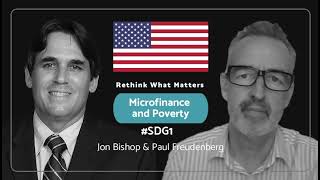
In this Rethink What Matters podcast, host Paul Freudenberg interviews John Bishop, CEO of Envest, about the role of microfinance in tackling poverty and advancing sustainable development. Bishop explains his journey from ecology and an MBA to founding Envest, a for‑profit, market‑based fund that invests in micro‑finance institutions (MFIs) across 12 countries, primarily in Africa. He clarifies what microfinance entails—small loans, savings, and insurance for low‑income entrepreneurs—and why Envest funds MFIs rather than end borrowers, emphasizing local knowledge and risk mitigation. The conversation covers lending models (group versus individual, collateral evolution), repayment handling, and the importance of non‑financial services such as numeracy, marketing, and gender‑rights training. Bishop shares concrete impact stories, including a Nicaraguan shop that boosted sales after financing a solar panel and a Ugandan seamstress who creates apprenticeships. He highlights Envest’s focus on renewable‑technology financing (solar panels, efficient cookstoves), its investor base (87 investors seeking near‑market returns with a modest concession for impact), and the broader systemic benefits of strengthening MFIs, which can evolve into banks and support multiple SDGs, especially SDG 1 (no poverty), SDG 7 (affordable clean energy), and SDG 16 (peace, justice, strong institutions). The interview underscores the synergy between environmental sustainability and poverty alleviation, positioning microfinance as a catalyst for economic growth, education, health, and climate‑friendly development.
Chapters
A great loan to make to enable somebody to buy a solar panel, especially in Africa, if it's going to deliver electricity and then whatever they can do with that electricity.
Yeah, when they get that electricity, Paul, one of the first things they see is that the performance in school goes up because the kids can read at night. They also see fewer respiratory problems because people aren't breathing kerosene fumes.
Hello and welcome to Rethink What Matters, the podcast dedicated to aligning the economy with the ecology and everyone for improved business performance, stronger families, and a greener, cooler planet. And today I'm joined by John Bishop, CEO at Envest in Madison, Wisconsin, US of A. and we're going to be discussing microfinance and poverty.
Good afternoon, Paul. Good to be with you.
And, uh, you know, it's a great podcast to be doing, microfinance and poverty, because I think microfinance can probably help with nearly all of the United Nations' 17 Sustainable Development Goals, not just SDG 1, poverty.
Certainly the first 6 or may have a very strong case, and even the next 2 or 3, uh, and then all the others are impossible with widespread abject poverty. So I think you're right, it really does influence about half of them directly and all of them in some way or another, right? Yeah.
So if you could— if we could please start off with, uh, how you became interested in microfinance and your journey to creating Envest.
I'd be delighted. My educational background is in evolution and ecology, and I was a, and remain, a very strong environmentalist. And after I left the biology world, I became very, very interested in sustainable development. And I came to realize by living in rural Panama that poverty was a major threat to the environment, especially to an environmentally sustainable economy. And so I realized that social issues and environmental issues were not separated as they often are. That they were one and the same thing. That if you don't take care of the people, they can't take care of the planet because the incentives are just all wrong. So I became interested in microfinance really because I was an environmentalist and I was looking at a sustainable way of addressing poverty. And so I went back to business school and got an MBA, and microfinance was among the things that I was interested in. The others could be summarized pretty nicely by looking at your podcast page. You've interviewed folks who are doing a lot of the other things I was really interested in. So that's— I came to microfinance through my environmental aspirations and hopes.
Would you like to talk a little bit more about setting up Envest and that journey?
Absolutely. I, after completing an MBA, or I have mine as a Master's in International Management from Thunderbird in Arizona, uh, my, fortunately, my first job out of business school was managing a microfinance fund here in Madison, Wisconsin, which is why I moved to Wisconsin and been here ever since. It was a, it was a wonderful opportunity. I was working at that point with a fund in Nicaragua, and I loved what we were doing. We were a nonprofit, and the one thing that I thought was missing was a more market-based approach. We ran on some revenue but also there was a fair donative element to it and we were raising donations and it seemed to me that to be truly sustainable, it had to be a true business endeavor and I thought that was absolutely possible in microfinance. And so I eventually set off to establish my own fund, which I wanted to be very market-based. I wanted it to be a for-profit, but with the mission and the values of a nonprofit. Because I think for-profits, and Paul, this resonates with you, for-profits can be every bit as moral as nonprofits. Any other mission-based organization. And that's what we seek to create at, at InVEST, that we are a for-profit market-based business that is as concerned with the well-being of people on the planet as any nonprofit ever would be.
Could you explain what microfinance is?
Of course. Microfinance at the very simplest level is small loans and other financial services, savings and insurance, generally to very low-income residents who have needs for credit but lack access to credit. In many countries, especially outside of the West, banking simply isn't available to a lot of low-income, very creditworthy people. That situation is improving, but not fast enough. In microfinance, a typical microfinance institution institution. This could be either a nonprofit or a for-profit. They tend to lend to very low-income folks who the local banks won't serve, and they have figured out that these people are excellent credit risks. It's often, but not exclusively, for entrepreneurial ventures. Think somebody working in a— who has a stall in a marketplace in a large city or a fairly small village anywhere in the developing world. They sell a few products. They need some working capital to buy those products, buy the inventory that they sell. They need a stand. They need a little bit of equipment. Equipment. If they're repairing anything, they need the tools and a little bit of infrastructure. If they're small-scale farmers, they need the inputs, they may need the land. So it's the need for small amounts of money, just like a business in the West would need, just with fewer zeros on the a dollar amount or euro amount depending on the part of the world you're from, or pound. And so these institutions are very often founded by local folks, and so they understand the business culture, the social environment in a way that I never could. I will never understand the social the people and business culture of Uganda in a way that I would need to, to lend there. But by lending to an institution in Uganda, I strengthen them and rely on their knowledge of the area. So it's folks who need access to credit so that they can pave their own pathway out of poverty and to to create a dignified existence.
Okay. So you're lending to institutions. You're not actually lending to the end user of the money, if you will.
That's exactly right. We lend, at present we lend to about 20 institutions in 12 countries. And then those institutions lend to the local folks who need it. We, we We do not lend to end borrowers. That's just not our core competence. And we don't want to get in there and compete with local folks who are doing that. We want to support their efforts, not compete with them.
And are those institutions set up specifically to work with you? I mean, do you create those institutions or do they already exist?
They already exist. They are sovereign, independent institutions. In most cases, they've been operating for years and years before we come on the scene. They're borrowing from several different lenders like us from both domestically and all over the— well, not all over the world, but for the most part, Europe and maybe a few North American lenders.
So does the borrower need to have access to the internet to access these funds?
It depends on the institution. For most of them, no. Phone banking and cell phone payments are becoming more and more common, especially as cell phone ownership increases even at the very lowest end of the economy. Economic spectrum. And so we're seeing more and more payments by mobile money, which usually requires an internet connection. But there are certainly a lot of end borrowers of these institutions who do not have internet access.
Okay, but there is still— they need to have some kind of technology to be able to use this, don't they? I mean, They're going to need a phone. I suppose everybody has a phone now, even in the poorest places of the world. Would that be true? I mean, I really don't know. Yeah, yeah.
It's really— and again, some of our partner institutions do work with people who have no phone, no nothing. And so it really is organization-specific. Specific. It really depends on their products. But yeah, even at the very lower end of the economic spectrum, people have phones. I remember one time I was being taken to see some borrowers in Nicaragua and we were crossing a bridge in the car and there were women down in the river washing their clothes on rocks. And I saw one of them put her clothes down on a rock and pull a phone out and answer it. And I thought, Oh my God, the women washing clothes in the river are answering their cell phones. This was quite a while ago. I didn't have a cell phone yet. So that was kind of the impetus for me to buy a cell phone. Yeah.
What is a Grameen Bank? Is that related to what you're doing?
It's very much what we're doing. Muhammad Yunus founded the Grameen Bank back in 1974 in Bangladesh. And he was one of the early leaders in microfinance. He and Finca and Acción, and it sprouted up independently in quite a few places. And a lot of people consider Muhammad Yunus to be the father of microfinance. I think microfinance is one of those things that actually has quite a few fathers. But yeah, he figured out He, along with a lot of other people, figured out the group lending idea that people who didn't have physical assets that could serve as collateral could co-sign on each other's loan. And so if one person doesn't pay, the rest of the group has to pay it. And so there were quite a few things in that that were really kind of brilliant. One is that you really reduce the risk because one person doesn't pay, the loan still gets repaid. But it's a lot more profound than that in that when they're forming up the groups, people have to choose their groups. And if everybody wants to be in Rosa's lending group, that tells you a little something about Rosa. She's probably a pretty good lending risk. If nobody wants to be in Enrique's Lending Group. It tells you a little bit about Enrique, and maybe you don't want your money in his hands. Lots of people know Enrique.
That's a great idea.
Just want to put that in there. But it was a way of doing due diligence on people you didn't know, but you could tap into village knowledge. And also when people are getting a little bit behind, the other people in the group will come over and say, hey, you know, it'll be— there'll be a bit of pressure, there'll be some help. And so the group lending model, it's getting less used, but it's still quite popular, and especially in Africa. And that was one of the real breakthroughs in microfinance back in the in the early '70s was to figure out how to lend to very, very low-income people who had nothing to offer as collateral.
Right, okay. But that's not the only type of microfinance that exists then. It's possible to lend differently, not just to groups.
Certainly, and especially as there's economic advancement Once people do have some assets, then asset-backed loans in a lot of ways are really more efficient. A lot of people start in group lending situations and then they graduate to individual loans once they have something that will serve as collateral. A television set is often the first piece of collateral. Land can do it. If you have a beauty salon, the mirrors and equipment for the beauty salon often can serve as collateral. So when you can match what they use for their business to collateral, they can get away from the group loans. But the group loans are still a wonderful place to start for folks who are just too far down the economic spectrum to be able to do that. Many of our partners have both individual and group lending. Okay. Or not all of them. Some do only individual, some do only group, but a lot of them have a mix of the two products.
And if they fail to repay the loan, what happens then?
So if it's in a group situation, the rest of the group has to to pay, if it's in an individual, what happens depends on the organization, also depends on the circumstances. All of our partners, as I kind of think down our list, really the first question they ask is, are they not repaying because they can't or because they won't? If they can but they won't, then it usually goes to judicial action. After it goes to collection and then to something judicial. What's more common is that people absolutely acknowledge that they need to pay, they want to, but they can't. And then there's usually a workout, there's restructuring. The loan may eventually get lost, But there's— it's a much more collaborative approach if something happens. Give it just a final cap on that question. What happens if they don't repay? They don't get any more loans. And that's a huge incentive. That if you repay your loans, you'll get additional loans and for a greater amount. And so you're actually in in most situations, you're in better shape if you repay your loan than if you don't repay your loan because you're never getting a loan again.
I'm thinking they, I'd imagine they all want to repay it, but they probably don't get a lot of support maybe in helping to run their businesses. And so I was just thinking the risk might be a lot higher and, you know, they're already, already in a difficult position to then find themselves in an even more difficult position, you know, could, could make things worse for them.
That is one side of the coin. The other side of the coin is that if you're in a, um, especially in a fairly small village, uh, and you're selling some fairly basic product, at least at a very small scale, you likely don't have much competition, right? And so while the, the part of their business opportunity is precisely because of the lack of infrastructure. And so what a lot of these loans are doing is they're going to finance the provision of this infrastructure that a lot of businesses— business services become available because they get financing to provide them. Before cell phones became so prevalent One of the major activities for lending was for people to go around through villages with a phone and sell phone calls. That was— the Grameen Bank did a lot of that in the late '90s and early 2000s. That's been supplanted, but that gives you the kind of— an idea of the kind of thing that was actually a business service. Service that was available if there wasn't a payphone in the village. So the lack of infrastructure often results in the business opportunity itself. Okay.
And can you share some stories, some success stories that you've seen through the lending that you're doing?
Well, I'm glad this is a 3-hour podcast because I can't—
Yeah, you know, just maybe one, one or two, just, you know, good news stories because we need a lot of— we need more good news stories on, you know, to share, don't we? Because, you know, the challenges that we have in the 21st century, we want to know that we're making progress as well.
I've got several. I visited a store in rural Nicaragua one time. They sold clothing and food items and stuff. And there are a lot of people in the village could only come at night and they didn't want to buy clothes at night because it was dark. When they borrowed money to buy a solar panel, they had light and their clothing sales just skyrocketed as a result of getting this solar panel financed with a loan. The other thing is that that house now had a workable television set in the evening, and so it was the only TV set working in the evening, and so everybody came and watched it and would buy a bag of chips while they were there. And so their business just skyrocketed as a result of buying this solar panel. Another more recent one, one of my colleagues, our East Africa rep, was just visiting a person in South Central Uganda who took out loans because she's a seamstress and she can— she needed to buy a sewing machine and cloth and tools and so she could she could buy more cloth and just turn out projects more quickly. She also trains local kids who don't have, who can't afford the school fees to be tailors as well. And so in addition to running her own business, she's a very civic-minded person and she's able to bring them in as apprentices and then they can go off and set up a shop somewhere else. And so a lot of people would look at these kids as competition, but she just sees it as, as giving back. And this is somebody who lives a very simple life, but she still is able to give back because she has access to credit. And so a lot of people are getting a useful skill because this one woman, her name is Naomi, has access to credit. And when, when our representative told me that story, it was like something I've seen so many times, but it was just one of those things that reminds me why I do what I do.
I really like that story. So how often are you seeing that through the lending that you're doing that you're creating jobs?
It's constant. It's— so we— what we're really providing is access to credit, which is obviously providing livelihoods. About 15,000 people are getting access to credit because of our activities. I wish that— I would love to put 3 more zeros on that. Number and then another couple of zeros after that. But as we grow, that's really what we look at is access to credit, because when you give access to credit, you're providing a livelihood to that person and very likely a job or two or three around that person, and they're becoming a, a part of the financial ecosystem in their their community. They, they're now able to buy more products for their business, and that's supporting some other entrepreneur. And so you get a real financial ecosystem.
So you're lending the money to sort of entrepreneurs, uh, people who already have some idea, or they have an idea, or a group of people have an idea. So they're not, they're not completely on their uppers, these people. They have got food, they've got, you know, they're not, they're not complete poverty by the sounds of it, the people that you're helping here. Would that be fair? I mean, how low down the spectrum of poverty are we able to go with microfinance to help poor people?
Yeah, good point. It's getting pretty far down the economic spectrum. It is, to your point, the people who have absolutely nothing and have no way of putting together a business are going to be hard-pressed to take advantage of this. But even then, there are stories— this isn't one of ours, but I remember reading about a woman who bought a barrel of toothpaste and started selling toothpaste by the spoonful in the market. And she, you know, there was no skill other than being able to take a spoon and dip it in there. But what she had was the the intelligence and the foresight to realize that people didn't have toothpaste and they couldn't afford tubes of toothpaste. And so even people pretty far down the economic spectrum can very often figure out some financially lucrative activity that they could do if they could just buy the barrel of toothpaste.
And the institutions that you work with, are they also delivering education awareness programs that there is this credit available? And if they have got a bright idea about toothpaste, you know, here's a way of accessing it because oftentimes people just don't know this sort of thing exists.
Yeah. So the one thing that I think is— I do want to be clear about most microfinance institutions require 6 months to a year of experience. Experience with the business in question. So this isn't startup capital, and it often gets presented as that, and I just want to make sure that we're clear that it usually is to people who have a going concern.
Okay.
Very often they don't have much of a going concern, but they are already doing whatever this is, and they could be doing more of it if they could buy, you know, some tools. I've if they just had a hammer or something like that. And also, I want to make it clear, we're generally not talking about $20 loans. The average loan size in our portfolio is about $800. Still, that's a fairly small amount of money that can keep a family going. As to the kinds of educational opportunities that the institutions give, a lot of our partners have basic numeracy training programs. They have marketing. They have, they call it commercialization, how to get your product to market. In a few cases, especially in the agriculturally dependent ones, they help them get their product to market. And so the institution often serves kind of as a cooperative, a receiving co-op, so that they can get better market prices and they can get them bulk rates and things like that. That's not the norm, but we do have a few partners who do that. Gender rights training programs are fairly common. These things are getting a little less prevalent as the competition gets greater, but they still do have those, those kinds of things. And so there usually are some sort of training opportunities. Usually having to do with marketing and basic numbers and basic accounting.
So it'd be great to see that, you know, through this microfinance that's being delivered to these entrepreneurs, that they are creating jobs, you know, they're increasing the local economy, and then that would filter through to improved, you know, healthcare an education so that everybody benefits from it. I mean, are the investors there? Are there sufficient numbers of investors, you know, who want to invest in these sorts of funds?
We have 87 investors right now. Uh, we hope to improve that. The real challenge is just to find ones that— there are a lot of people who would love to invest, but they don't meet the the net worth requirements.
And do these, do these investors have to be very philanthropic and altruistic in, in their investments ideology? Would they be going somewhere else where they get a higher return?
Our, our return is near market. If you compared it to, to something at the same level of perceived risk, it probably doesn't perform up to that, but it's not heavily concessional. And that's really part of the, the goal and the vision of Invest is to deliver near market to market rates of return because that's when it becomes sustainable. As far as the investors, some have a fairly philanthropic mindset, but most of them need to make a market rate of return and they're willing to take a very slight haircut for the mission, but they won't take, you know, they won't go for a 0% or a 1% return. They need a near market return. And so I would say that describes 90% of our investors.
And do you put any restrictions on the types of businesses or borrowers that you'll lend to?
We vet the institution. We make sure that their values and what they're lending for is consistent with what we do. One thing that I'm particularly interested in is supporting renewable technology, solar panels, efficient cookstoves. We are particularly interested in lending to microfinance institutions that have solar lending products. That's a lot more prevalent in Africa than it is in other parts of the world. And our main source of growth right now is Africa.
Seems like a great loan to make to enable somebody to buy a solar panel, especially in Africa, if it's going to deliver electricity and then whatever they can do with that electricity.
Yeah, when they get that electricity, Paul, one of the first things they see is that the performance in school goes up because the kids can read at night. Okay. One of the first things they see. They also see fewer respiratory problems because people aren't breathing kerosene fumes.
That's brilliant. And I heard a little while back, actually, that there is a very tight correlation between power not going down every 5 minutes and GDP. I think you just made a very good example there. Education improves because the lights are on.
And then if we can get, especially these developing countries, to get the lights on without producing the fossil fuel emissions that we do, that's really my dream, to use microfinance to build up economies by going a more sustainable route. Than the one we took. To make one point that I think is kind of interesting, getting access to a lot of people, about 15,000 people, we're also strengthening these institutions. And when you strengthen institutions, they have more power to do things in their community, and they hire more people, and they can educate more people. So beyond the microentrepreneur level, you're also helping these microfinance institutions that are able to branch out into other financial products. And quite a few microfinance institutions have become banks over the years in many countries. You know, Grameen Bank didn't start out as a bank. It was a— it was what they called it a bank, but it didn't have a banking license at very first. And a lot of institutions that start out as microfinance lending institutions then become financial institutions and then get a bank license. So a lot of these MFIs, you could really consider it a breeding ground for banks. And having banks that have their roots as social and impact organization is certainly not a bad thing. Having a lot of banks that have impact and social progress in their DNA is a positive thing. So that's another aspect of microfinance, well beyond just the folks it hires, but the competence that it breeds within a country.
So SDG 16, you're supporting that as well. Peace, justice, and strong institutions.
Yes, absolutely.
John, it's been an absolute pleasure having you on this podcast. Thanks very much for your time and in sharing your knowledge about microfinance and your journey as well to setting up Envest. And, uh, yeah, you know, thanks very much for the work you're doing in helping to address poverty in the areas where you are and create opportunity where perhaps, you know, it didn't exist before. So again, thanks very much, John, for your time on this podcast.
Thank you so much. Thank you for the invitation, and also thank you for highlighting the efforts of so many others. I looked at your podcast page, and there are a lot of people doing a lot of good work, and I think what I do is important, but so is what they do, and thank you for highlighting them.
More from Paul







ROCE: Your Business Is Growing — So Why Does It Feel Like You're Going Backwards?



