Property Management with Sustainability: Christian Phipps, Sustainability Manager at Emeria
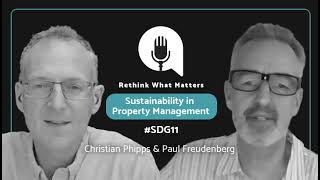
In this Rethink What Matters podcast, host Paul Freudenberg interviews Christian Phipps, Sustainability Manager at Emeria (formerly Firstport). Christian outlines his role overseeing sustainability across roughly 5,800 residential developments and 250,000 tenants in the UK and Europe. He explains that Emeria does not own the properties but manages them on behalf of free‑holders and lease‑holders, which creates a complex web of stakeholders. The conversation covers the rollout of ISO 14001, carbon reporting (Scopes 1‑2‑3), emerging biodiversity net‑gain requirements, heat‑network discount schemes, and the challenges of installing EV charge points, heat pumps, and solar on high‑rise blocks. Christian describes data‑gathering burdens for carbon accounting, supplier engagement with thousands of vendors, and the need for cultural change within the organisation to embed a sustainability mindset. He also discusses green roofs, urban beekeeping, and plans for segregated food‑waste collection. The interview ends with practical advice for other property managers: calculate carbon footprints, share best practice, and publicise successes. Christian invites listeners to connect via LinkedIn.
Chapters
That's a good question. Cultural change isn't happening fast enough. I would say that's probably the main one. I've been here 2 years now, and despite all the internal communications programs we do, despite dedicated pages and links to pages on the intranet, we have a definite hardcore of interested people who are always involved and always try and do things, but 2 years in, it's still not that big a snowball because my colleagues want to manage properties. They don't— this isn't, this isn't a priority necessarily for them. They want to manage the properties, want to keep residents happy, residents safe. Yeah.
Hello and welcome to Rethink What Matters, the podcast dedicated to aligning the economy, with the ecology and everyone for improved business performance, stronger families, and a greener, cooler planet. And today I'm joined by Christian Phipps, Sustainability Manager at Ameria, and we're going to be talking about Sustainability in property management. Can we just start off, Christian, with getting a better understanding of your role as sustainability manager there at Ameria and the scope of it?
Yeah, sure, absolutely. I was recruited 2 years ago almost exactly to what was a company called Firsport who have subsequently been purchased by Emeria in the last 12 months, so I've moved over to the above sites and the above group division into the Emeria role. Initially my role was to help with the rollout of ISO 14001 and to coordinate a lot of the carbon reporting, so that's the SECA report that the company was that was required to do for its third year due to its size and turnover. In addition to that, there was a number of opportunities to, to do biodiversity projects around some of the developments that we managed that have interesting grounds and interesting locations. So there was some, some good news as well, a lot of communications as well, and cultural changes required across most industries, most organizations at the moment. It was the same for, for Firstport, Stroke Emiria.
So what's the scope? I mean, what's the size of the, the, you know, the, the job that you've got there? How many properties and tenants?
Well, it's interesting, we— that's a, that's a movable, movable target, a movable number that's probably changed since we've started this conversation. But roughly speaking, we have over 5,800 developments we manage roughly 250,000 tenants on those developments. Um, we are the largest in the UK and across Europe as well now that, uh, Ameria have purchased Firstport and the Firstport Group. Um, so yeah, it's, um, it's, it's a considerable scope of operations.
It is, it is. And how big is your team?
You're talking to it. Great, we're all here. Brilliant.
Just so, can you give us an idea of how diverse those properties are?
Yeah, absolutely. We have various different divisions. So we have a retirement division whereby we have a large number of pretty uniform-sized buildings with 40 to 50 units in each that are dotted around, which, which cater for elder residents. They're not care homes, but, um, they do have, for the most part, live-in managers. We also have, at the other end of the spectrum, a large and complex division which, which manage top-end high-rises in, in major cities that can have things such as pools and gymnasiums in, and all sorts of interesting district heating systems, etc. And everything in between, really. We have, we have some estates, but we also have a number of developments that have been built into, into listed buildings and around listed buildings. So for example, Royal Ellswood Park in Redhill is an old mental hospital, right? We have, um, we have an old school for the, for deaf children in Scotland, right, we look after in Edinburgh. So there's some, there's some quite diverse locations, right?
Yeah, absolutely. Fantastic. So really right across the UK? Absolutely. Wow, fantastic. And do you get to travel with this job? Do you need to go and visit these places?
I, I do travel to a degree. Um, obviously the role itself doesn't encourage you to be on the road 24/7. Um, but yeah, you do need to go around and visit people. You do need to, you need to see people and to, to see the sort of size of people's issues. And, and when we roll out specific, specific problems and projects, I like to, I like to actually be there as well. So yeah, there is some travel.
Right, right. And So there's such a variety, such a variety of properties there, and you can imagine, you know, variety, a variety of challenges that face you on a, on a day-to-day basis. You know, sustainability manager for such a, such a large enterprise, um, you know, just can you give us a bit of a feel for what that role entails on a day-to-day basis?
Well, the, the underlying and fundamental, um feature of residential property management is that we don't physically own anything ourselves. So we don't own the offices that we, we use, we utilize. We don't own any of the developments. So we're very much, we're very much the middlemen. We're, we, we work for clients, we work for landowners, and we work for, for freeholders, and we're paid for by leaseholders, so by the residents. So It's a, it's a fine balance of, of sort of relationship management as well. At the same time, because they're not our properties, we, we can only have a certain level of influence as to items such as there's renewable installations and, um, EV charge points installation, etc. So we can, we can, we can assist, we can facilitate, but, um, we can't go ahead and just, and just do things because At the end of the day, it's not our money either, you know, it's the residents' money. We manage service charge accounts in a lot of locations, and there are certain checks and balances that you do— you need to go through to suspend that money.
Heat pumps, you know, they're good, aren't they, for the tenants? But do the landlords want to invest?
The nature of regulations are that residents have a lot of protections in the UK. Leaseholders have a lot of protections against potentially unscrupulous property management companies. So if you want to get anything, anything installed quickly, if you want to get any kind of improvements in inverted commas made, then you need to go down a set route of, of asking the residents formally and obtaining, obtaining numerous quotes, etc. This is a process that can take some months, so you can't get anything done very particularly quickly. Yeah. Um, then you have, as you say, the, as I said earlier, the added complication of, of the number of parties involved and the number of stakeholders involved. So it's all very well, for example, the residents deciding that they want something, but if that doesn't fit with the landlords or their particular plans, then it's very difficult to, to get things moving. And the same goes the other way as well. Um, a good example is, is EV charge point installation.
Okay.
It's a well-known, it's a well-known issue around the UK that, that publicly available charge points are not matching the amount of vehicles that are being sold, right? So there's a gap there. But, uh, you think it would be quite straightforward that you'd have residents, number of residents perhaps, perhaps in a multi-tenanted building that would want to own an electric car, would need a charging facility for it.
Yeah.
And therefore you could quite easily just install 2 or 3 charge points, but it doesn't quite work like that, sadly. There's, aside from the regulations around protection of the residents' monies that I've already mentioned, there's other issues such as the existing power supply to the building, whether or not if you install a charge point and you utilize any available space on a distribution board, for example, if anything further would be required down the line then who pays for the additional, additional energy to the site, for example?
Right, right.
Not only that, but there's also, there's also issues around do you have shared car parking spaces? If you don't have shared car parking spaces, then you're asking residents to potentially pay for long pipe runs, cable runs, for example, right? And also there's health and safety tied in with it as well. So it's, it's a tricky thing to to push through.
What would you say drives your agenda each day in the main? So I suppose there's the operational side of things. Is your role as sustainability manager, is that driven by operational problems, you know, day-to-day operational stuff, or does it tend to be much more about building a more sustainable future?
Yeah, it's not so much operationally. I do go down that particular rabbit hole from time to time, Yeah, I was going to say, for example, at the moment there's the government's energy bill discount scheme that's in the process of rolling out, whereby heat network— heat suppliers of heat networks at some of our buildings, which we do fall into that category, are required to identify and notify the government of the location of these heat networks and district heating systems so that the residents can take advantage of reduced rates.
Right.
But that's— there's quite a knowledge gap around what a heat network is, where they actually are. So on an operational level, I'm spending time talking to the teams, trying to locate all of those and trying to identify all of those. But on the other hand, I spend time doing communications and I'm also doing a lot of updates around biodiversity net gain requirements that are coming down the line in November, which are going to directly affect us as a business. It does, because, uh, yeah, well, our teams will be required to, for the most part, to manage, manage the biodiversity net gain on new locations.
It's new stuff, isn't it?
I think that it is new stuff. It is, yeah. And at the same time, I'm involved in other projects around getting better visibility around the half-hourly meter data and the electricity use that we have on our site so that we can identify anomalies and highs and lows and trying to reduce those. And as well as, as well as anything else that's coming along and hoping to view, because as I say, we've, we've been purchased by a, by a French company now, so we are subject to EU regulation as much as they are now, and we're required to report to the same levels as they do. So, so all the corporate sustainability reporting directive and its associated, associated bits of legislation coming down the line are going to directly affect us. So I need to make sure that everyone is aware of that.
And how's your French?
I can get by on holiday.
I know that, you know, when French companies buy, you know, when they buy a company, they want you to speak French, I think.
Well, they have mentioned that. I'm more than happy to spend 6 months in the south of France learning, get some training in the south of France.
I mean, I'm interested in what's driving your your task list each day? Is it projects that you've got to implement, you know, because of various environmental legislation that's coming down the line, or what is that picture for you today?
It's a combination of the both, I would say. We have ISO 14001 certification, and we also— I chair and run the internal ESG committee for the organisation. And as part of that, we have a subcommittee around the environment, which I look after as well. And just this week we had a meeting and we identified a number of gaps around how corporately we dispose of waste. It's not just our offices with bins outside, for example, and the occasional clear-out. It's all about individual locations and specific one-off events and record keeping and where, where is all of this meant to be based, who's looking after it, who's reporting, etc. So we've identified a specific project there which we will be, we'll be scoping out and, uh, and, and, and spending some time on and then communicating. Because a lot, as I said to you earlier, a lot of this is about communications and maintaining a constant stream of, of updates to, to my colleagues, predominantly to start with, right, um, around, around such things like that. I constantly am spending time gathering data for carbon accounting purposes, for example, which, which is quite onerous, if I'm honest. It's, it's difficult getting, getting such items as internal mileage usage and travel, corporate travel details, right? As well as, as well as we have a number of, a number of office locations and we, we've acquired some businesses recently whereby one of the key factors for me is identifying energy usage, identifying what the air conditioning units they have on site, whether or not there's any, any fugitive gases from them, any gas leaks. So data gathering there, their usage of pool cars, their purchasing of cleaning equipment and materials. So it's not particularly complex, but It's extremely high volume of information that takes a lot of time to gather.
Yeah, so you do look at scopes 1, 2, and 3?
Predominantly 1 and 2 at the moment, but we have been doing 3 as well because we don't actually own our own fleet of vehicles, for example, and all the staff use their own cars and claim mileage. They fall into our scope 3 as their grey fleet. So once we have that, we're also looking at— we've been collecting data for all of our cloud usage from, uh, from our cloud suppliers this year, as well as some wastewater data we've managed to locate from a couple of our locations, and other items such as our IT procurement, our furniture procurement, all our direct FM bits and bobs that we buy. Um, but yeah, we, we have also started to assess our top 20 by spend suppliers to do a loose calculation around where we think the best places to target are, to directly get engaged with them and to speak to our biggest suppliers around what their plans are, how they're controlling or plan to control their carbon.
You're doing that?
Yeah, we are. We're trying to start. So yeah, but again, that is quite a daunting task. We have thousands of suppliers.
What's the reaction of your suppliers when you say to them, you know, so what are your carbon emissions? What are your carbon reduction strategies?
Some are perplexed. Some will send me an environmental policy statement, which you could have got ChatGPT to write. They're pretty similar. They say a lot to pretend they don't necessarily mean anything. I think it's more about showing.
I think today it's just about showing intent rather than actual action, isn't it? And we're almost just happy with that, I think.
But yeah, the larger they are, the more susceptible— well, the more receptive they are, sorry, to the question, because they're being asked by other people as well.
And you've got people asking you, I guess.
Exactly, yes, we have. We've started to see requirement for, for various sustainability standards to, to some of the, some of the tenders that we apply for.
250,000 tenants, how do they fit into this picture?
That's a very good question. Um, obviously depending on who you talk to, um, the built environment accounts for between 10 and 20% of the UK's carbon emissions. And we have— I think it's been quite widely publicized recently— we have quite the spread of buildings and quite requirements for upgrades and for just basic insulation. So some of the things we are doing is trying to target where people with fuel poverty potentially, or cost of living crisis, might affect them more directly than others. So sometimes in the retirement areas, we've got buildings whereby we're having them thermally scanned to make sure that they actually have correct amounts of what and functional amounts of just basics such as insulation to start with. Again, because of the requirements that are coming in regarding rental properties and EPC standards, and the fact that the government's new Eco4 scheme is also quite heavily tied in with EPC levels, when you have a multi-tenanted building, particularly this one that's physically connected as a block of flats are, you can have, you can have a multitude of different EPC values in the same building, which doesn't seem to make much sense. But if you think about it, you've got different levels, you've got different external wall coat types, locations, you've got 2-bedroom flats, 1-bedroom flats, so they've all got different levels. So you can't, you can't take a blanket approach to one building and get everyone to enjoy the same free scheme, for example, right? So It's helping to facilitate introductions as well, because as I say, these government schemes— the last thing you want is someone turning up and saying this is a free government scheme, um, because no one believes that. It's straight, first and foremost. So you have to maintain that trust as well. So you're having to establish that some of these things are real. So yeah, helping them out is where they fit, is where we fit in with them at the moment.
So what would you say, if you're allowed to say, what was your biggest frustration or your biggest challenge, or the thing that you wish if you could wave a magic wand something would get fixed?
That's a good question. Cultural change isn't happening fast enough. I would say that's probably the main one. I've been here 2 years now, and despite all the internal communications programs we do, despite dedicated pages and links to pages on the, uh, on the intranet. Um, we, we have a definite hardcore of interested people who are always involved and always try and do things. And I guess this could be more down to the fact that, you know, maybe I'm personally a little bit too impatient to get things moving. I mean, I know a lot of, you know, giant snowballs start with as tiny, tiny snowballs, and once you get momentum going, things Things get larger very quickly. Yeah, but 2 years in, it's, it's still not the— that big a snowball. So, right, so it's a question of going back and reassessing how we communicate again, reassessing what projects we can get involved in, and just getting out there. Because, because my colleagues want to manage properties, they don't— this isn't, this isn't a priority necessarily for them. They want to manage the budget, so I want to keep residents happy, residents safe. Yeah.
Yeah, you're having to create this sustainability mindset within Ameria then, by the sounds of it.
Yeah, I mean, since we've been bought by Ameria, we've— I mean, every business has silos, but, um, the, the group companies have split off into separate entities, so it's an additional challenge trying to keep hold of, in touch with, with all the different, different developments and different buildings and different— yeah. Businesses now that, um, that we've, we've become.
Um, right.
So it's—
yeah, is, is there a lot of competition in the property management, uh, industry, you know, in terms of green credentials? Is it something which landlords are looking at?
Um, less so in my experience in direct residential property management at the moment. I do have regular calls with our business development business development team, and they, um, and they do come to me regularly to, to with specific questions that they've, they've had pop up that some they would like to require an answer to. But we're talking one or two questions in a massive tender, so it's starting, but, um, it's— there's no, there's no tsunami of them at the moment.
Um, but yeah, I think we— yeah, we do need to— I mean, I'm looking also myself to see that there's more conversation in business around sustainability and net zero, net gain as we would really like to.
Ideally.
Yeah, so that's our goal, net gain, because net zero just keeps everything the way that it is, right?
I think too many people don't want to think about how big a challenge it is.
Yeah.
How potentially wrong it's all going to go if we're not careful.
Does food come into your remit at all?
The only way it would is the forthcoming rollout of residential collections of segregated food waste that everyone's going to have to do at some stage relatively soon.
I was going to say—
How you would do that in a block of flats, for starters. It's because all of these blocks of flats have got two waste chutes, one for general waste and one for recycling. Right. You can just imagine what would happen if you start pouring pouring food down one or an equivalent one, it's going to create all kinds of issues around smell and pests. Yeah, yeah.
I think distributed heat networks, they, you know, especially if you've got a block of flats, there's more and more coming online all the time.
I know the government are keen that they become a pivot, well, a base for their net zero targets. Of 2050, and we manage somewhere in the region of 100 at the moment. And I say manage, we are the heat supplier, which means that we arrange the billing, we arrange the compliance to the heat metering and billing regulations, and we run the plant rooms. So yeah, it's our responsibility to maintain boilers and make sure that the plant's efficient so that we're not wasting any energy. There's a lot of challenges that are coming down the line. For example, decarbonizing tall buildings. I mean, we just touched on them and how they're supplied by heat networks at the moment. But how do you— these are, for the most part, these are gas boilers. So at some stage we're going to need to rethink that. So what do you do? Do you upscale massively large amounts of air source heat pumps? Is there a ground source heat pump opportunity there? There's obviously every individual location is going to have its own challenges location-wise, space-wise, etc.
You can't—
you can't— you've got, you've got a tall multi-story building, you can't put enough solar panels on the roof to, to fill, to provide enough energy because it's just the footprint in the building isn't big enough.
So, so there's legislation that's coming that's going to ban gas boilers and, uh, It's certainly going to be a challenge for the industry, yes.
But as I say, you know, it's— I think there will be developments on a legislative front before then, right? Because it's, it's going to be very difficult otherwise.
So what about green roofs and living walls and rain gardens?
The, the green roofs that we, we look after, we, that we maintain, and they do need maintenance, um, yeah, and they tend to be bequeathed to us rather than required by us, and they tend to become part of the planning process whereby they are added on as a green sort of addition to help the planning process go more smoothly. And it's not just green roofs, it's that happens with all sorts of things like sailpounds as well. But we do, yeah, we do look after a few of those, and they are very good, and they will become more and more important as the temperature starts to rise to prevent heat islands and to naturally cool some of our urban spaces. Right. As I said earlier, we do have a number of developments that are a little bit different to the norm, and they do come with large areas of open green land and water courses, etc. And I've got a number of projects going with local nature conservation bodies, volunteers, to maintain areas and to help improve areas for residents and for wildlife. And also we have one particular development near Hazelmere where we've partnered up with a local college in Guildford, and we've let them utilize the grounds to facilitate their their degree studies. And it's a lovely mix. It's not massive, but it's got woodland, grassland, it's got a pond, and there's lots of interesting things going on there, which, um, which is, which is great because they get to study it, they get to produce management plans, etc. And we, we can share that information with residents, we can share information with our, with our colleagues as well, and, right, um, and everyone benefits.
So bringing, so bringing Biodiversity, bringing, you know, the green spaces into your developments and into your properties is a part of what you'd be thinking about as well.
Absolutely, yeah, yeah. And we have, we have resources of examples of such little things, little projects happening across all our developments as well. We've got quite an influx of urban beekeeping that seems to be breaking out at the moment, which is interesting.
Is smart switching a part of what you're looking at as well? So whether that's internally within the buildings themselves, or maybe smart switching to the grid when it's a windy day and it's actually quite green to use electricity from the grid?
Yeah, I mean, we procure gas and electricity for the common areas that serve our developments, so not for obviously the residents themselves, but the areas that we look after. Not also for our offices, that all comes via the landlords that we deal with. But for the second year running now, we've procured green electricity tariffs and green gas tariffs as well. So it was important to us that we maintained that after we first achieved it last year. It was also important that when we choose suppliers, that the The supplier will plough that particular funding straight back into renewables and to provide lots of other benefits and add-ons that are above and beyond, rather than just saying, well, here you go, here's your RECO, here's your renewable certificate.
And are landlords asking you to do their footprints for them? Do landlords need to submit a footprint for their properties?
Yeah, we're starting to see that, whereas we haven't been directly asked for that yet. That is definitely an area that will be a lot more popular, I think, moving forwards.
Are there 1, 2, or 3 things that we could suggest to other property managers to be thinking about?
I would definitely suggest to property managers to look to start calculating your carbon footprints if you're not doing it already. Secondly, get in touch. It would be great to share best practice and to share knowledge with each other. And thirdly, yeah, again, share any good news stories you've got. Let's all talk about it together.
Christian, thank you very much for your time on this podcast. It's been really, really interesting to hear the challenges you've got there. I mean, such a big job.
Well, thank you very much for inviting me, Paul. It's been a real pleasure.
If somebody wants to get a hold of you, Christian, what's the best way for somebody to reach you?
I would suggest contacting me via LinkedIn.
All right, Christian, once again, thanks very much.
Thank you, Paul. Cheers.
More from Paul







ROCE: Your Business Is Growing — So Why Does It Feel Like You're Going Backwards?



