Strengthening Communities and Justice through SDG 16 - Mark Charlton of De Montfort University
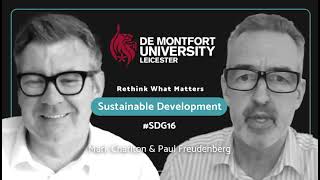
Mark Charlton of De Montfort University runs the UK's only UN Academic Impact Hub for SDG 16, which focuses on peace, justice, and strong institutions. He's working with Leicester Nirvana football club on becoming Britain's first net-zero team, but found that climate action often ignores deprived communities lacking transport, housing, and political voice. Charlton argues SDG 16 is foundational: you can't tackle climate change without strong, inclusive institutions first.
Chapters
Locally and nationally and internationally, that really we could have harnessed a few things. Like, for the, for the, the time of peak lockdown, we were able to take everyone off the streets, for example, who didn't have a home. I mean, what an amazing thing to do, and we didn't seem to move heaven and earth to maintain that situation.
Hello and welcome to Rethink What Matters, the podcast dedicated to aligning the economy with the ecology and everyone for improved business performance, stronger families, and a greener, cooler planet. And today I'm joined by Mark Charlton, Associate Director of Sustainable Development at De Montfort University in Leicester, and we're going to be discussing peace, justice, and strong institutions. That's SDG 16. I read that achieving this goal can help reduce inequalities, increase social cohesion, and ensure that no one gets left behind. So this sounds like an excellent goal to have. Perhaps if you could tell us a little bit about your role there then, please.
Yeah, sure. So I have a huge focus on SDG 16, which is, as you mentioned, peace, justice, and strong institutions within my role. De Montfort University is the United Nations Academic Impact Hub for SDG 16. We're the only university in the UK that's an SDG Impact Hub for the UN, so it's a real sort of honour in a way for us to have this, and we're the only one of just 17 in the world, which is really nice. We're really proud of that too. And my role, I run the hub for the university and I bring lots of young people into the conversation around the Sustainable Development Goals Also, I try to encourage researchers to think about their research in the context of sustainable development. So that's broadly my role for much of the week. I'm also a net-zero research theme director, so I try and stimulate new research projects that are multidisciplinary around sustainable development too. So It all keeps me busy.
And so just tell us a little bit more about the Impact Hub then, being an Impact Hub for the United Nations.
So it's an ongoing dialogue really as we try and progress globally as part of a global network of universities who are working towards the 17 Sustainable Development Goals. But we have a relationship with the United Nations in New York around and it makes us very responsive to global calls to action or getting involved with new policy and contributing to new policy ideas and demonstrating research around this work. But it also enables us to learn from other universities around the world and for us to give our models and our research frameworks for other people to copy too. So it's almost like being part of a giant global conversation, but we're right at the front of it because we've got this great relationship with the UN.
And could you tell us a little bit more about Net-Zero Research Theme Director, what that role entails?
Yeah, so I'm sure many of your listeners will be aware that we really need to curb our carbon emissions between now and 2050, ideally now. And we have to develop not only new technologies but also new ways of working and new ways of behaving that will enable us to reduce our carbon emissions. So the global scientific consensus— so 98% of scientists believe it's carbon that is causing the current changes in temperatures and extreme weather events worldwide, and the university has put this as part of a strategy to focus its research on working towards some of these global challenges. And net zero is one of 5 research themes in the university, but very much my research theme and is linked to a social justice research theme in the university, which, which both are really focused heavily on sustainable development.
Okay, and could you give us like a practical example, something that we can, you know, we can identify with perhaps in the research that you're doing and how that might actually become something tangible we could all see?
Okay, I've got a really nice one that people really seem to engage with is a piece of work that I'm doing with a football team called Leicester Nirvana, who are based in Highfields in Leicester. And they wrote to me a couple of years ago and said, we'd quite like to be Britain's first amateur net-zero football team. And I thought this was a really exciting prospect, not least because it was somebody writing to me rather than me having to go and convince someone else to do a piece of research. They were actually coming to me with the idea, so I thought that was really exciting. And then when I met the club, it was 1,000 young people living in Highfields, which is a really interesting part of Leicester. It has lots of high indices in terms of deprivation, it has a high propensity of BAME, so Black, Asian, Minority Ethnic Communities living there, which is always interesting to work with. Then also they were a football team, so I thought that was quite interesting as well. So it had lots of different ingredients that, that I wanted to get involved in. And fundamentally they wanted to talk about net zero, and not enough people are really latching on to this idea that becoming net zero and, and how we all change our lifestyles is important. So I've been developing work with them down at their clubhouse in Hamilton in Leicester around how they change their lifestyles and how they, how we apply new science and new developments to their operations to enable them to become net zero. And what I found within this, which hopefully your listeners would find quite interesting is the actual marginalization of people living in poorer communities. They don't typically have a full say on what is happening in the realm of net zero and how it would apply to their life. So currently, if I'll tell you a funny story, it's— it depends if it's funny, it might sound absolutely tragic to some people, but intriguing story nonetheless. I was working with a group of the players from Leicester Nirvana, and I said, well, one of the simple things you could do is start riding your bicycles to football matches. And they— one of the kids looked at me and said, oh, we can't do that. And I said, well, it'd be really beneficial. You could, you know, you'll be healthy, you won't be emitting any fossil fuel emissions, and it will help you prepare for the game and all of this. And then the youngster basically said, I live on floor 13 of this block of flats. The lift is inevitably out of order. My parents won't let me lock my bicycle outside, so I cannot own a bicycle. I thought, well, that's reality. Yeah, that's a fair point. And then in the same breath, my brother-in-law called me and he said, oh, I'm thinking about upgrading my Tesla. He's like, you know, doing quite well for himself.
Right. And he said, very short space of time, you had both ends of the, the spectrum there.
Yeah. And it did make me realize that actually there are two conversations going on around net zero in the United Kingdom. Well, or perhaps only one. And one is really, let's switch to UV vehicles, or let's eat vegan food 2 or 3 days a week, or go vegan full-time. But actually, if you're living in, uh, communities outside of the mainstream, or certainly outside of the middle classes, you might— your family might be using a food bank, for example. You probably don't own a car. You know, it's an ambition to own a car, let alone a, a UV vehicle. So, yeah, these, these are things that have really, uh, sort of framed my research in recent months around how are we understanding how everybody adapts rather than how people who are in the sort of national narrative on net zero and climate change. Even people who protest against climate change have the money, means, and time to protest. You know, it sort of runs all the way through the current narrative of what we know about climate change, and we're the net result of this is going to be that we'll develop solutions for climate change that are ineffective in certain communities if we don't start listening to different groups. And I know you're very keen to talk about SDG 16, but democratic decision-making is right at the heart of SDG 16. Yes, yes, a nice little net zero SDG 16 crossover there.
Yeah, you know, I think it can only really work for poorer communities when they benefit from it, even if they want to get involved. I mean, it's a great example there with the football team because they're obviously inspired, you know, on the energy side of things anyway. The, you know, the energy needs to be cheaper if it's green energy, for example. And, but anyway, that's maybe a separate conversation. Yeah, so what other challenges are you seeing in trying to, in being the Associate Director of Sustainable Development within a within an area that's challenged by lots of different social inequalities and social deprivation. And yeah, I guess lots and lots of challenges that exist there.
Yeah, so what you will see in most cities, not just in the United Kingdom, actually certainly in westernized countries, is groups of vulnerable people living in communities together. So this is a model that can be seen particularly throughout the US and, and the UK, but also in Central Europe as well. So you typically have estates where people are living on low incomes with— typically they may be of, uh, former migrant communities or have high immigration within those communities, which often means that people have moved from overseas and they were in vulnerable circumstances to start with, and then they congregate in a community which also has high levels of vulnerability. Now, this in itself creates all kinds of challenges around education attainment, and income levels and things like that. But if you put it in the climate context, these— when we start to talk about things like adaptation and how we need to prepare and make our communities more resilient, such communities are already facing significant challenges around how they how they can prosper. And if they are hit by greater climate impacts, they are going to struggle further. And that's something that's coming up in my research at the moment. I mentioned about the, the young man who lived on floor 13 of a block of flats in Leicester. Unfortunately, those flats also receive 2 or 3 degrees more in terms of temperature when it gets hotter in the summer. Ventilation is hard. Families often can't afford to put on fans for 24 hours a day when we go through hot spells. The design of these flats often make it very hard for them to cool down at the rate homes do in leafy suburbs. And again, it's another demonstration of how people living in different communities face different problems in terms of our challenges when we're heating. And this in itself is, again, it links to our challenges around climate, but it also links to challenges of democracy. Often people living in these communities don't have a say with their local councils. I mean, the councils might argue they do, but I would say that if you look at things like voting rates in those communities and political engagement in those communities are typically lower due to a variety of reasons linked to political knowledge or linked to the, the actual ability to take time off work to go and vote perhaps, or or even to register to vote, things like that. There is a huge challenge that we are facing to bring these communities through and give them appropriate support as we all seek to make adequate changes to our lives to cope with changing temperatures.
So they're more likely to get ill to be unwell.
Yeah.
Means they're more likely not to show up to work if they've got a job.
Yeah.
And they're more likely to end up, you know, seeing a doctor or in a hospital. So they contribute less to society and they increase the cost on society, if you like. I mean, this is pretty obvious stuff.
Yeah.
Does that conversation go anywhere? The conversation?
No. Well, in my opinion, it doesn't. Because we, we have yet to see adequate social reform in these communities because they— such communities are not high on the political agenda. And that might be because the, uh, those, uh, in charge feel like, well, I'm not going to lose any votes with this particular community anyway.
Very likely, yeah.
No, which is a highly likely solution. It might be that nobody wants to grasp the particular nettle which will be in the short term a potentially expensive one. It might be, but I would argue, a worthwhile investment now for a long-term prosperous solution.
And I guess it very much depends on, you know, how organized these communities can be in representing themselves and Oftentimes that's a challenge, isn't it, because they don't, they don't have these community centers, I think, or not as many of them as they used to.
The infrastructure of community space, and this is something that I learned recently, or I learned by chance, I didn't, um, working with a community group in Belgrade who they were thinking about this idea of mapping spaces in Belgrade where people got together and they started to acknowledge like the erosion over the last 30 years of community spaces. It actually started, they were saying that there were very few pubs in that area now and that how people socialized had changed like and the sort of traditions of pubs, religious venues, community centres. All of these things had been lost. It wasn't like necessarily one individual strategy to close all of these places down, but in— for a variety of reasons, the access to such places had been eroded. Even public spaces like parks, where councils have had to make difficult decisions in times of austerity around maintaining parks or just closing them off to the public to save money. That became prevalent, you know, and we need, in order to have a functioning society, when we talk about governance in the idea of strong institutions in SDG 16, we're really talking about how we govern ourselves locally as well as how we govern ourselves nationally and internationally. You know, so community organizing on the ground and keeping a sense of community is important, and ensuring that people within those communities have a say about what is happening. This is of utmost importance, but it's something that has been eroded, and it's been eroded the most in the most vulnerable communities. So kind of linking back to what I was saying before, that you kind of have these communities of vulnerability to start with, and then things become more challenging. Things have become more challenging to them in the past 2 decades around how the government decides to spend money, for one, but also there's now a greater challenge in terms of they've got to cope with less money or less welfare support going into those areas, but now we've got increased temperatures and impacts from extreme weather.
I think it's important, isn't it, that we engage people in this conversation and understand their situation as much as possible. And I know when we spoke previously, we brought up this idea of surveys and the way— and the indexes we use to measure satisfaction, and that, you know, a lot of places, a lot of countries are realizing the gross domestic product isn't probably the best measure of progress, and that there is this happiness index now. For example, New Zealand uses this happiness index to measure the happiness of its population as a measure of progress. And it's whether or not we might be able to implement something like that at a local level. And if we— if a survey came back from a local community that was very, very low, that would be a good tool to publicise, look, this is very low. If it was to be improved, you know, they could contribute more to society.
Well, I'm always open-minded to new projects personally, so I would be definitely interested in pursuing this idea. And to be honest, I don't quite— with the exception of surveys, I mean, as a research community, we do surveys a lot, so that's not any you know, it doesn't seem like a huge challenge from that perspective. I'm more thinking, well, what is the survey actually asking, and what are they asking the right questions, and that kind of thing. That's what I need to get to the bottom of in that kind of context, or whether I would be such an egotistical megalomaniac of a researcher that I'd want to quickly combine the happiness and the GDP as one thing and, and, and look at it in that framework. That's not to say somebody hasn't already done it.
So just what are— I, I don't know if we're still on justice and strong institutions, but I think it all feeds into that, doesn't it? To have justice and strong institutions, then we need to have strong communities. Yeah, because then they're needed less, and when they work, they work that much better. Um, just out of curiosity now, what is the— what is the measure used within local communities of how well those communities are functioning?
So in terms, in an SDG 16 sense, so it's really about democratic decision-making at all levels. So that if you look at one, if you look at it from one extreme angle where that would be failing, for example, in a rogue state or country, you could probably think of 2 or 3 where no matter how the public votes, 98% of them are going to vote for that particular leader, and it's essentially a dictatorship, and you can see that democracy is failing. But also you can see how things are when things are devolved. Particularly in well-developed countries who can do this stuff quite well, and the United Kingdom is actually one of them, where you can devolve decision-making to very local levels and engage more people in those forms of local governance. And I don't necessarily mean join your local council, although I, you know, I'm an advocate for democracy and councils and politics, but even at a community organizing level. I think that the value of the knowledge we have in our local communities is something that we've never really harnessed, or whether we take it for granted, I don't know. But I've, I've read studies before where, think, when social scientists have gone in to investigate a phenomenon of why some things work well, it's actually come down to somebody on the ground in that community or a network of people working at a very low level who are just making a difference for their community. And that is such an important part of governance. It's almost like a new governance that is— well, it's a new name for an old idea perhaps, that people who live in their communities know best about how their communities should be treated.
So then, if we just bring it back to De Montfort University then, how is this translating into what the students are doing there?
So all of the work that we do is really focused on educating young people. We have around 24,000 students at the university, so So we're a mid-sized university in the UK and we have put sustainability at the heart of our new university strategy. So young people who come and study with us can expect to learn about sustainability and can hopefully expect to study a module containing a focus on the SDGs. And that's something that we're working really hard at to make sure that all young people get access to learning about sustainability and the Sustainable Development Goals. That's a big piece of work. Embedding it in that way means that we can generate a lot more graduates who have a grasp of sustainable development, and so I think it's a really exciting moment for the university that we're going in that, that way. We also want to hang on to the best of those young people to develop new research and pursue PhDs in their chosen fields, which, which really focus on sustainability. So we're really pushing this agenda of empowering young people to go through the process of becoming good undergraduates, then becoming good postgraduates, and then developing PhD-level research and sticking with us. So there's a huge focus on how we teach young people, and we know that young people are going to be a big part of finding the solutions to the problems that we face.
And to what extent do you— does the university then work with local community leaders, the police, healthcare, education, to join up all the dots?
De Montfort University is what some people would describe as a modern university, so we are a former polytechnic. We became a university in 1992, but like most universities who have been born out of the polytechnic system, our work is very applied work. So we have policing degrees within our university, we have maternity and nursing. We provide, um, staff to our local health service. We provide staff to our local policing. We have a— well, I would say this, I'm biased because I teach one of the modules, but we have a very vibrant politics department which is providing the politicians of tomorrow. In fact, we had some young politicians elected recently in the most recent by-elections that we were very proud of, that we, some of my colleagues, have taught. But also because we provide this education for our local industry and our local authorities, we are in constant negotiation with them over a variety of things, not least how how the courses are delivered and how the courses are taught, but also the future direction that we will need to take those courses in. And it's a two-way conversation in that we need to be predicting to them that the direction of their services will also need to change in line with how the world is changing.
Okay. And I know you worked with the United Nations Build Back Better a better framework.
Yeah.
Does that relate to your work today as well?
It didn't— it doesn't as much as I would have liked it to, but that's, uh, um, you can't have everything your own way, as they say. I used the frame— I used the framework, uh, during lockdown, and, um, we were very pleased with the, the results of the project and we were able to influence local policy on how we did recover from the pandemic. I think my take on why I'd focus less on the Build Back Better and that it seemed to be perfect in that moment when we didn't really understand what life was going to be like after the pandemic, but once the pandemic was over things did change very quickly. And I'm sorry to say, and this is not, not a criticism of anyone locally, it just seemed to be how the world changed. The world immediately reverted back into the things it knew and loved rather than said, this is our moment to change, you know. There was probably 100 things in that Build Back Better work, not just for Leicester, but for, for locally and nationally and internationally, that really we could have harnessed a few things. Like, for the, for the, for the time of peak lockdown, we were able to take everyone off the streets, for example, who, who didn't have a home. I mean, what an amazing thing to do. And we, we didn't seem to move heaven and earth to maintain that situation, you know. It's a great example. Dissipated, you know, so it seemed like a little opportunity lost. Also, changes in how we travel and how we do business seem to revert it back into, rightly or wrongly, into the same methods. We all can't wait to get on planes and do things the way we always did, you know. Now it's become, rather than a thing that we've adapted and made changes that have benefited the environment, we more speak about it. Well, in the 2 years during lockdown, the emissions were low, like it was a good thing, and they're not anymore.
And, um, so do you think that having the SDG 16, so Justice and Strong Institutions, as a— as one of the Sustainable Development Goals, as a label if you like, is that helping to bring a focus to to what that goal is trying to achieve.
Yeah, and I would say my point to that is the peace, justice, and strong institutions is essentially, it's a call to recognize and promote human rights fundamentally and tackle some of the issues that really face society. So fundamentally, it calls for an end to war and violence. I think it'd be hard to disagree with any of that. End-to-end corruption and to stop people committing fraud and fraudulent activity and to use the instruments of strong institutions like democracy, like universities, health systems, and so on to give everyone the chance of an equal and fair life. I think these things are fundamentally important, but also they are very valuable in how we understand other things. And so, for example, given the things that I've just said, if you, if you want to tackle climate change, and like some of the points I've been making earlier in this podcast, if you want to understand and tackle climate change, you're going to have to fundamentally change the way you support people in order to deliver those changes. So you're going to have to have an element of SDG 16 being achieved in order to achieve SDG 30.
And do you have any other examples, or any— are there any other practical examples you can give us of how this is, you know, changing life in Leicester?
In terms of changing life in Leicester, I think Leicester is a very special place to me, not only because I've lived here a long time, but the first time I moved here, I was really taken aback at the high levels of people from different places around the world. And I think I haven't got the exact data in front of me, but I think we were the first city in Europe to have a minority of British white people living here. I think that's the correct statistic. And, and it was just tipped at around 51%. So half of the city has migrated to Leicester in the past 40 or 50 years or sooner. So it makes it a very special place. It's quite interesting in terms of how communities get along. It's not like all of these different communities from Eastern Europe and from Asia and— sorry, India and from China and from West Africa and so on. Everyone seems to get along and everyone seems to be behind the idea of Leicester. And I really like that. And I think so in terms of the work that I've done around SDG 16, I've sort of had a thumbs up from the people living in Leicester anyway because they present quite a good model of how to integrate. I'm not saying it's a perfect model, and like for the examples I gave before, there are like clusters of the city which are quite vulnerable, but in the main people are living and they are getting along and the city is prospering. And this might be a controversial thing to say, but Leicester looks a lot different to what it looked like when I moved here the best part of 20 years ago, right? That economically we've moved forward, visually we've moved forward, culturally we've moved forward. And these are in many ways That's a really good example of SDG 16, and I've done nothing towards that. But the things that I can do, they are often warmly welcomed in Leicester, and I'm able to sort of demonstrate good models of practice, a little bit like when I did the Build Back Better project with the city council. That was of its moment, but so many people from different communities got behind it and and we were able to enact it quite quickly.
Mark, that has been a great insight into justice and strong institutions, SDG 16, there at De Montfort University and your role there as well as the Associate Director of Sustainable Development. I really appreciate your time on this podcast.
You're welcome. Thank you very much for having me.
Thanks, Mark.
More from Paul







ROCE: Your Business Is Growing — So Why Does It Feel Like You're Going Backwards?



