Sustainable Economies: Dominic Parker of KAGE Advisory Discusses Sustainable Economies
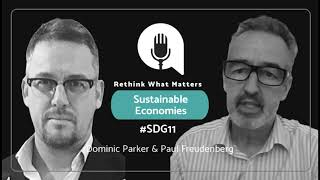
In this episode of the Rethink What Matters podcast, host Paul Freudenberg interviews Dominic Parker, Director of Carjay Advisory (formerly Kaze Advisory), about building sustainable, circular economies in Burundi and broader Africa. Parker explains how a young entrepreneur turned agricultural waste into high‑calorific charcoal briquettes and bio‑char, creating a closed‑loop business that supplies clean cooking fuel, shisha and barbecue briquettes, and biomass logs for domestic and commercial heating. The operation also captures waste heat to generate electricity for the national grid and produces bio‑char as a soil amendment, improving farmer yields. Parker discusses the massive market potential—about 30% of the global population still relies on firewood/charcoal—and the expansion into global markets for eco‑friendly briquettes. He outlines the role of government policy versus private sector action, emphasizing proof‑of‑concept projects, the need for clear green‑economy definitions, and the importance of education on carbon credits, green bonds, and blue bonds. Financing mechanisms such as micro‑finance, diaspora crowdfunding, debt‑for‑nature swaps, and leveraging the African Continental Free Trade Area are explored. Parker also highlights bottom‑up energy solutions—solar installations, mini‑hydro, and innovative piezoelectric paving—to overcome Africa’s infrastructure gaps, while acknowledging challenges in capital access and equipment logistics. The conversation concludes with advice for investors: partner with local experts, understand regional regulations, and use the circular model to drive socioeconomic development.
Chapters
We create now shisha briquettes. So these are ecologically friendly briquettes that you can put on these nargilehs, on these shishas, to— yeah, so you can, you can enjoy them. And we're seeing more and more interest in this area as well. So it's a— it goes from people's entertainment, if you find it painting, to people in the north's commercial and domestic heating, to also providing food and heating for people in about a third of the world. There is a massive market for this. It's not going away anywhere soon. We're not electrifying the world fast enough to be able to— this to go away. So we just want to make sure that people that we deal with have as clean an energy as they can have without pollution, but, and have it as cheap as they can possibly have it So what can we do to make what we do even more green, create even better products for our customers wherever they are in the world, and expand the reach from being just in this tiny little landlocked country in the middle of Africa into becoming a global player.
Welcome to Rethink What Matters, the podcast dedicated to aligning the economy and ecology with everyone for improved business performance, stronger families, and a greener, cooler planet. And today I'm joined by Dominic Parker, Director at Carjay Advisory, and we're going to be discussing sustainable economies. Welcome, Dominic.
Thank you very much, Paul. It's a real pleasure to be here. Carjay Advisory is a UK-based company, but actually it's basis comes from some work I've been doing in Burundi, which some of your audience may know, some might not know. It's a tiny little country, uh, right in the heart of Africa. Um, and I am working with a company there that produces charcoal briquettes made from agricultural waste. Um, and this business has been running for about 5 years, set up by a remarkable young man out of university, and he has been very successful in growing this business. And over the course of the last year, there have been increasing questions we have been receiving from people in government, around government, in Kwangos and the like, about how did you make this green economy business so successful? What is it that we as governments could be doing to have a successful commercial business there? I think you probably understand this, Paul, and I'm sure many of your listeners would as well, that But sadly, for many people around the world, and indeed this goes for many governments and civil servants and politicians as well, sustainability and the green economy can still be a little bit looked at like tree hugging. Now, not that there's anything wrong with tree hugging. Hug a tree if you want to. It can feel fantastic. But this is when government said, well, look, how do we move our economy, especially in an emerging market which has so many difficulties it has to face? Could we even begin to consider the green economy, the blue economy, and other such things as a viable way of helping to bring communities, our societies, and for politicians, their electorate, can we bring them into something that is commercially, socially viable, which is also good for the planet? Or are we just going to be stuck doing what, frankly, the Global North has done for years and years and just risk playing catch up?
Yes, yes.
I'm making a very short story very long here. But so Kaje Advisory was born out of that in helping governments and their associated different partners to understand how you can create policies and environments to be able to grow green economy businesses.
I think that is the challenge, isn't it, that we all would like to have a sustainable economy and live in, live in a sustainable economy. And there can, you know, the governments may have these great aspirations for delivering that. And there may be policies and rules and regulations that they put in place to try and implement that. But the reality, I think, can be very different on the ground. So what can we do to help, you know, those on the ground, small businesses, if you like, you know, create sustainable economies? What, what, what, how does Cargill Advisory get involved there and help with that endeavor?
I think that's a really interesting question, Paul. I'm going to take it a little step back, if I may, because I think there's a part of this that is a precursor to to it, which is critical. And I think a lot of this comes down to— there was a phrase a good African friend of mine has said repeatedly in different scenarios, and it applies just as well to this. It is the role of the government to plow the field and to get the field ready, but it is the role of the private sector to then plant the seed, to nurture the field, and to harvest the crop. And the problem I think we face in sustainability, and again, I'm coming to this from the basis of emerging economies, and particularly those in Africa. The key to this is just an ignorance of what can be done. That's not a willful ignorance. It's not people being deliberately difficult. But it's people going, I just, I maybe come from a background in economics, if I'm lucky, or in sociology or some such thing. And I understand a bit about the game of politics. But this whole green economy, blue economy thing, you're just saying words to me now. And I don't know what we do or how we do it. Where do you even start with this? We have issues talking to people about things like, which I'm sure many of your listeners would agree, carbon credits, which is a fairly basic thing that people talk about now. We have politicians and civil servants who have no idea what a carbon credit is. And so there's a part of a basic introduction to things like that.
Okay. Are you in particular referring to Africa? Because I think that's where you work mainly. Is that— would that be fair?
That's— this is— I'm talking particularly about my experiences in Africa. I've worked there on and off for the last 25 years. So, okay. Yes, this is particularly there. I'm not suggesting that all governments are the same, but those in emerging economies, those that have so many stumbling blocks to deal with, this just seems like another one to put in the way. And it's trying to help them to understand how we can go about making a simple transition to a cleaner, greener, friendlier environment that's better for people today and people in the future. You asked a very good question about how do we get people to buy into this and how do we get communities and people involved? And I think for this, like so many other businesses as well, The key to this is there has to be proof of concept. You have to be able to show people how things can work and how things can be better.
Yes. Yes.
And that's particularly where we combine Cargill Advisory with the other Cargill businesses that there are.
Right.
We bring those together to show how this can work.
Okay. So what are those other Cargill businesses?
So the first Kaze business, the principal one this all sprang from, is a company called Kaze Green Economy. Kaze is the founder's surname in Burundi, Delphine Kaze. Kaze actually means welcome in Kirundi, the local language. He, in 2018, with about $30 in his pocket and coming out of university where he had been looking at environmentalism, had seen that there were a lot, there was a lot of deforestation in Burundi. Burundi's got about 12 million people or so living there. It's a very, very concentrated population in a small country. And it is, there's very, very little electrification in the country. And most people actually like about, about a third of the world in gross terms, but about nearly all the people in Burundi cook using wood or wood charcoal. Right now, the downside of this is that for the population to be able to do this, they were getting through between about 3,500 and 4,500 hectares of forest every year, deforesting that amount of hectares every year just to be able to cook and eat. Now, when it comes to things like hectares, that doesn't mean very much to me. So I always have to go and try to convert that into things that I know. So that would be the equivalent of around about 5,000 to 6,500 World Cup football pitches, right? Every year. Or there's another equivalent you can do here. If you have any listeners in America, New York, it's about about 10 to 15 Central Parks every year. Okay.
No small thing.
That is an enormous amount. And this has been the case so much so that Burundi only has about 5% forest cover left. Wow. Which has a major impact not only on the biosphere and all the ecology within that, but also on carbon sequestration and all the other things that your listeners will know about. Okay.
Okay.
So his view was, well, how can we deal with this? There are other things that deal with that. They are things like agricultural waste. 80% of the population of Burundi is involved in agriculture. So how do we bring this into it? Because there's a lot of food produced, there's a lot of waste from that food, which is then burnt, which also contributes to global warming.
And so, right.
So we take the waste from that agriculture, we pay the farmers for it. Yeah, we convert that into charcoal briquettes. Right. Which are a clean energy. So they have a higher calorific value than wood and wood charcoal. So they burn better, they burn for longer. They don't give out anywhere near the toxic emissions that wood and wood charcoal do.
Right.
And also beneficially for people in a very poor country, it's cheaper than wood charcoal. So it benefits the community enormously. In the process of this, we also produce something called biochar. Biochar is basically crushed charcoal that gets made into— it's kind of glued together using natural resins into these charcoal briquettes, but it can also be used as a natural fertilizer.
Okay.
It's referred to by many people as black gold these days, actually, as it's so good. And we then sell that back to the farmers. which means that they can take their denuded soil and they can make it a lot healthier, which means they can grow more, which means they can sell more, which is good, which means they produce more waste, which means we can take more waste and pay them for it. And we can make that into briquettes that we can sell.
Anyway, that's called being out of gold. That's amazing.
I mean, the whole thing is brilliant. We also are now in the process of taking the extraordinary heat that is produced in our factory in Bujumbura in Burundi. Yeah. And we're using heat capture technologies to convert the heat that's produced in making all of this into electricity, which we can then put back into the national grid. So this is a proper circular business. And this is, this is how we start this at the basis, Paul. This is what we say to governments. Look, we have created something here that is circular. It benefits the farmers. It benefits the retail customers, better quality charcoal for cooking with.
Yes.
Benefits us because we're a business and you need to show that businesses can operate in your economy. Mm-hmm. Charcoal, which benefits the farmers even more by creating better soil for them. We put energy back into the grid.
Yep.
Green economies can work.
I think that's such a brilliant idea with the briquettes. So what, what, what is the market for these briquettes?
There is an enormous market for this. Most people don't realize that about 30% of the world still cooks using firewood or wood charcoal. And then when you've got a population of what, we're near 8 billion now, I think, or something, that's, that's a pretty sizable part of the world population. So at the moment we have a lot of our local communities buying this and other communities around Burundi who are buying this. But we've also found other benefits for it as well because it's not just wood charcoal we produce. We also produce biomass logs, which is not charcoal, but highly, highly pressured agricultural waste that's put together, something like rice husks or coffee pods and things like that that's pushed together at very high pressure and high temperatures, which can burn as well. We can make pellets out of that which are perfectly good for using in Europe, North America, anywhere across the global north for both commercial and domestic heating, particularly at the moment when we are seeing more and more pressure in Europe and North America and elsewhere. For making sure we have clean energies to be able to do this with. And we don't have smoking wood logs and so forth. So that is a market we're expanding into. On the charcoal briquette side, there is another interesting market here, which we're just starting to get into. And I love this, particularly with the imminent presence of COP28 in Dubai. Yeah, I don't know how aware you are of shisha, sometimes called hubbub, sometimes called narghile. We create now shisha briquettes. So these are ecologically friendly briquettes that you can put on these nargilehs, on these shishas too.
Yeah.
So you can, you can enjoy them. And we're seeing more and more interest in this area as well. So it's a, it goes from people's entertainment, if you find it entertaining, to people in the north's commercial and domestic heating, to also providing food and heating for people in about a third of the world. There is a massive market for this. It's not going away anywhere soon. We're not electrifying the world fast enough to be able to— this to go away. So we just want to make sure that people that we deal with have as clean an energy as they can have without pollution, but and have it as cheap as they can possibly have it. Right. So what can we do to make what we do even more green, create even better products for our customers wherever they are in the world? And expand the reach from being just in this tiny little landlocked country in, in the middle of Africa into becoming a global player. And this, I think, is the key part to this for me. And one of the reasons I got involved is that for countries in Africa and businesses in Africa, they need to be able to see that being commercial is not a bad thing. Just because you're working in the green economy, you don't have to be a social enterprise. If you are one, I don't have a problem with that at all. But if you are working as a commercial business, and you're making it a success, and you're making the world a better place, and you're employing people, and those people are then feeding their families and so on and supporting other people, and then maybe get ideas to go and do their own businesses off the back of it, and you're creating an economic environment, which grows and prospers, that is a good thing. And so when I came to this, what I wanted to bring to it, and I'm hoping I'm doing with this, is bringing up— because I've got quite a few grey hairs now— is bringing a bit more of an international perspective to it of what could be done. And it seems to be where we're going, and the business is growing, and we're expanding into different things. And well, the future is golden.
Yeah. So yeah, if you could tell us a little bit more about the customers then for these briquettes and what they might be doing at the moment, where perhaps this is a better alternative.
So the customers for our briquettes in their basic form are really families that have no other form of access to energy in any consistent way, and they need that for cooking. And there is a huge market for that in and around Burundi and across Africa and across, as I said, about a third of the world. But more interesting, this are organizations in the North, global North. And there are two ways I'm going to spit this out. The first one is businesses that are looking for energy sources, which may have looked traditionally to wood pellets, wood biomass, and use that for powering industrial heaters or domestic heating. It's all very well and we support people creating or using wood biomass. It's great. It's a very sustainable way of doing things inasmuch as you can replant forests and trees and we're all in favor of that. There was a piece of research that was done that was published last year, which unfortunately says that in certainly in the more areas closer to the equator, only about 50% of replanted, reforested areas actually take, because saplings take a lot of management and maintenance. So we are very pleased to see companies that are reforesting and so forth. Yeah, but more needs to be done to check how successful that reforestation is. Only 50% of it is taking more in that area. When we're using agricultural waste to create biomass logs and charcoal briquettes. We are taking waste that would otherwise be burned and pollute the atmosphere or left to rot and pollute the atmosphere, creating into that something that can be burnt, that was going to be wasted anyway. We're creating something that is a clean energy source. So we are very interested in speaking with organizations anywhere around the world that are looking for biomass logs, biomass pellets, charcoal briquettes as a commercial or domestic heating source, clean energy, domestic or commercial heating source. On the other side of it, which is more interesting for some people, is actually in the retail world, right? Because what we are also creating is environmentally friendly, eco-friendly barbecue briquettes or shisha briquettes, right? So if people want to use this, we have briquettes that burn at a higher calorific value for longer. Emitting far fewer toxins in their smoke and generally can be cheaper as well than wood charcoal. So yeah, so we're also really interested in people and maybe weirdly in the area of retail because what we are creating can be used as both barbecue briquettes and shisha briquettes. So if you want to have a barbecue, our briquettes can be used. Obviously they are a cleaner form of energy. They have a higher calorific burn value. They're good for the environment because we're using waste that would otherwise pollute the atmosphere from either rotting or from being burnt by farmers. So you're doing good while enjoying a barbecue or while enjoying a shisha. And we're always interested in talking to any restaurants or distributors or anybody like that who wants to get involved with us and doing good for the world while enjoying yourselves.
You know, if we are to raise Africa up, I think, you know, it is all about energy, isn't it? And there are various sources of energy. Biochar is one source of energy, but there's also solar, there's hydro, there's lots of different forms of energy, but nothing happens without an energy source. So what's, what's your view on that across Africa?
One of the biggest issues of Africa, and this is in everything that it does, is a lack of infrastructure. But in the world of energy, this is a marvelous benefit for Africa. Because it is not relying on legacy infrastructures that require a huge amount of maintenance and a lot of upkeep. Now, there are amazing things being done by governments all over Africa and actually, indeed, all around the world to put in place major modern clean energy infrastructure from wind turbines to dams and hydroelectric to solar farms and electric grids, batteries for storage, all of these great things. Yep, loads of them going on. And I'm so happy that that is happening. But this, this top-down approach— I shouldn't say but, I'm going to say and— this top-down approach has a problem in that it takes a long time. And it's hugely cost intensive. It's actually hugely labor intensive as well. And you have to have the capacity building within countries to ability sees. I am not in any way saying stop doing this. It's critical, it's vital, and it's great what the government is doing here. But it takes time. Yeah. So our view is, again, in Africa, and this can be done across all emerging markets, to be honest, Paul, is to say you need to have two approaches. You need to have a top-down approach, which the government is doing and takes time, but it's taking dramatic steps in doing that. Simultaneously, though, you can have a bottom-up approach. And what we're seeing, and indeed we're involved in, but what we're seeing principally is how can you take things like, let's start with solar, how can you take solar and make that available?
Right.
In Burundi, it's again a small country. It's pretty sunny, stays about 25 degrees most of the year. It's pretty much on the equator. We are working with communities and we're working with businesses to put in place solar into their— onto their buildings, onto the land near them, which they can use to power a local grid.
Right.
Or which we can then feed back into the national grid, the building of the national grid as it's going on. We are also doing the same with hydro and we're actually just starting this now. There's huge hydro projects going on. You see particularly this in East Africa, following down the Nile and around the Great Lakes region. But there's also very, very hilly places in the Great Lakes part of, of the world.
Yeah.
And so it's quite simple to be able to say, why don't we create mini hydroelectric power stations on the hills? So you have a river or a rivulet that runs down for about, let's say, 100 meters, 150 meters. Yeah. That is then channeled to power a small hydroelectric turbine, and that can power a local community.
Dominic, let me ask you this. This is all— this sounds great.
Yes.
You know, Africa, fantastic country, lots of natural resources, lots of sun, at least in my imagination. But I believe there's lots of sun. And, you know, and the technology is there. You know, there's no new technology going on here. So what's the challenge here?
The challenge comes down to being able to get the equipment necessary into various parts of Africa. If you look at the large economies, the likes of the Nigerias, South Africas, Egypts, Kenyans, it's fairly easy to do that. They have strong economies, we can get things in pretty quickly. If you look at smaller countries and economies, poorer countries, certainly, the question for them is, how do we find the capital to do this? And indeed, in the particularly small ones, which may often have reserved currencies. How do we convert that capital into dollars or other hard currencies so we're able to acquire this? That's the main thing. The big issue is finding the capital to do it.
Finding the capital, but is the desire there in these countries to do this, or are they distracted by wars and cultural infighting?
You could look at Britain and say the same thing. No, I think there were always people who were going to be distracted by power in itself. The politicians that I've ever met, the civil servants that I've ever met, have genuinely had the interest of the people at heart for the overwhelming majority of them. And this is something they want to do. And this is part of what Khaje Advisory does, is to show people, actually, look, you don't have to have this multibillion-dollar project at the outset. Start small, right? That's all proof of concept. If we can, if we can get you to learn how to do it in a small town area, yeah, there's no reason why you can't build the capacity to expand that out to other areas.
I'd imagine you'd need some kind, you know, you need a certain amount of commercialization within the country to make this happen because you need some, you need some trade going on. You need a market for the energy. That you're producing, you know, so people have got to have a reason not just to buy it to switch the lights on, but in order to make stuff and sell it, you know. So how does that fit in?
Yeah, everybody wants to make a living. Everybody wants to do better for themselves and for their families and for their children and future generations.
Okay.
Burundi in itself is, if you accept GDP as being an accurate and a fair measure of wealth, Burundi is the poorest country in the world. Now, I don't actually accept that as being a fair measure of wealth, but a lot of people do. I spent a lot of time in Burundi. Everybody works. There are great businesses there. There are people bringing in businesses all the time. There are people who want more and are working to do more. And for them— and again, I'm using Burundi as an example because I know it so well. For them, the core to this, as it is for every country in the world, is I can't make things unless I have power.
Yeah.
So my pressure is on the government and on other local businesses who can be independent power providers, right, to structure this and set this in place. Because if I've got power to be able to make things that, that I know people need, because I also have the problems of facing these issues of needing things, if I can make the things that people need, I know people will buy them. It's into this. I'm going to be brief about this as well, is there's something that you may be aware of and your listeners may be aware of called the African Continental Free Trade Area, which was established a small number of years ago. I believe 53 of the 54 countries of Africa are now signatories to this, which is the largest free trade area in the world. It's double the size of the EU.
Yeah.
Free movement of goods, peoples, and services. For the overwhelming majority of stuff, there's a tiny amount that there are some taxes on, but free movement of goods, services, and people. So if we can make things in Burundi that we can sell to people in surrounding countries like Rwanda and Tanzania and Democratic Republic of Congo and Zambia and so on, yeah, we'll buy it. And then market economics kicks in because, you know, if you can make it cheaper and sell it for more, you make it cheaper in Burundi and sell it for more in Zambia, hell do it.
Yeah. Yeah. So, so I do remember actually reading a little while back that there is a very tight correlation between the supply of electricity. So how intermittent the supply of electricity and GDP. This is, there's a very strong correlation there. So that in itself seems to be a very good business case for saying, look, you know, if we can sort out the power supply, your GDP is going to go up.
Yep.
And at least at the beginning, probably health does improve the GDP. It maybe deteriorates later on. But that's another subject. But at least in the beginning, everybody gets to feed themselves, gets a roof over their head, they get an education, there's some healthcare. And so what's the problem with that business case then? Why is this not a breeze for you? What's the, you know, why don't they look at that and go, yeah, sure, let's go and let's roll this out?
They are. This is the thing. I think this is every government I've ever worked with in Africa, and there were a few. Is doing what it can to put power and electricity in place.
Right.
All of them.
Yeah.
And I guess I was saying earlier on, this is one of the strengths is a lack of legacy infrastructure.
Right.
So there are new things coming up all the time that can be put in place. One of the things that we've spoken about, Paul, offline is something called piezo electricity.
Oh, yes, that's right.
Exactly. Which is we are working on at the moment. And it's a really clever bit of technology. So if you go back to remembering your school day physics, I don't have a tough time remembering things like that. But if you do, there's a thing called kinetic energy. So what we do with this is we say, let's build a paving stone, a flagstone that can move ever so minutely when you tread on it. Piezoelectricity takes that kinetic energy of you treading on a paving stone and it moving slightly and it converts that into electricity. So to put it simply, you could walk or drive down a pavement or down a road. And as your wheels or your feet pass over these pavements, you are creating electricity. Now, there's a very good case study of this being done in Brazil with a company that had gone into one of the favelas in Rio de Janeiro, and they had covered the surface of a football pitch. When I say football pitch, it was a bit of land that was used as a football pitch. And then having made this into a piezo-electric football pitch, let people play soccer on it. And I think we're all aware that the Brazilians are rather fond of football. So the pitch was pretty much used all the time. Yeah. The power from this being used, I wouldn't say 24 hours a day, but a large chunk of the day in the evening ended up being able to, to power a large proportion of that favela for flights.
Mm-hmm.
So the nice thing about what we're talking about with Africa is there is the space to be able to bring this into play.
Right. So it's a lot of it is about funding, then it is about raising the capital and the investment.
Yes.
And does microfinance play a role here for you?
Oh, I love microfinance. It's a really interesting question again. I think there's another way of looking at it. Microfinance, yes. And there are plenty of great organizations that can do this. There's another thing that's quite interesting, which we're starting to see in different places. And that actually, which I think is more important, is crowdfunding from the diaspora. Right.
Okay.
Now, the African Union splits Africa into North Africa, Central Africa, Southern Africa, East Africa, West Africa, and diaspora. Because the diaspora is a huge— has a huge membership, shall we say. And a lot of the people in the diaspora want to be able to not just send funds back home to help their families, but also to help develop countries and environments. So we are seeing more and more cases of organizations setting up crowdfunding sites targeted specifically at diaspora to help fund local projects. So it's a form of taking microfinance in a slightly different direction.
Can you just give us a little bit more detail? Can we get into the weeds of what exactly you're doing there and how you're helping to help Africa become a more sustainable economy, maybe with some case studies or some stories? What specifically are your skill sets there that are helping companies to find their feet in Africa?
Sure. The key to this, Paul, has always been how do we help governments bring about the policies to enable the bottom-up development of, of the green economy in countries. So how do we help them to help businesses and people benefit from the green economy?
Yeah.
So for example, let's take Lake Tanganyika, second deepest lake in the world. Burundi sits right on the edge of that. Nothing happens on it. There's a couple of ships that go on it.
Right.
Pretty much it. Okay. So how can we, how can we do something with this that is to the benefit of the government or any government with any country that borders Lake Tanganyika or indeed Lake Victoria or any other of the Great Lakes in the Great Lakes region? Right. Part of this is luckily they have not been overly polluted in the ways that you might see up in the Global North and other areas as well. And there is pollution, but not dramatic amounts. Actually, the worst pollution actually is water hyacinth, but there's nothing else much there. So what can we do to take, for example, the blue economy into consideration here? So this is talking with the government and say, what can we do with local communities to maintain the biosphere of, in this case, Lake Tanganyika?
Right.
What can we do to work with funders, development finance institutions, banks around the world to say, government, you have a national debt. What if we refinance this national debt in such a way that we will create blue bonds? So if you, the government, preserve a third of the water space that you have on Lake Tanganyika.
Yep.
You encourage the ecological development of it. So it becomes a natural— it retains its position as a natural environment. We will swap out— we will put available a fund to swap out your national debt for that. So the more that you do this, the more funds we will give you in lieu of your national debt.
Right.
Which means you have more capital available then to invest in the socioeconomic improvement of your country. Okay. So that is one example of how we do this. You can do that with green bonds and the like in wooded areas and forests and the like. So that's just one part of it. One of the critical ones for us has been How do— and I think as we said this at the, maybe at the outset of the podcast, one of the critical things is how do you get people to understand what the green economy actually is? A lot of it is education, Paul. A lot of it is what do we mean when we say carbon credits, green bonds, green finance? What do we mean when we say sustainability, circular economy? And then once you've explained what these things are and how they fit together, What policies can we put in place that will enable investors in these areas, these sectors, people who have an interest, an interest in the environment, and there are increasing number of investors and funds out there who are finding it difficult to find anything to invest in the moment and love this area. How do we create an environment for them with the appropriate policies, with the appropriate structures in place where we say, look, we have an energy project, look, we have a blue finance project on Lake Tanganyika that you might want to get involved in. The one thing I would say to any organization who sees the opportunity in Africa, and the opportunities are legion, is make sure you work with somebody on the ground who understands local regulations, local laws, local business cultures, local cultures, local languages, and so on. Because without boots on the ground, yes, it's a real struggle.
It's very much about having the right contacts, isn't it? And they can get those contacts through yourself, right?
Yeah, through us. They're very welcome to do that. This is very important to us, and we have contacts across the continent. I wouldn't necessarily say in every single country, but we have direct contacts in a lot of the countries, and we can get to them. We've been around a long time. So, um, yes, we're very happy to help people who want to do that.
Okay, so thanks very much, Dominic, for your time on this podcast in helping us to understand, you know, what a sustainable economy is. And yeah, it's really great. It's been great to find out a lot more about what you're doing there with the charcoal briquettes as well. So yeah, once again, thanks very much, Dominic, for your time.
Thank you very much, Paul. It's been a real pleasure speaking with you.
More from Paul







ROCE: Your Business Is Growing — So Why Does It Feel Like You're Going Backwards?



