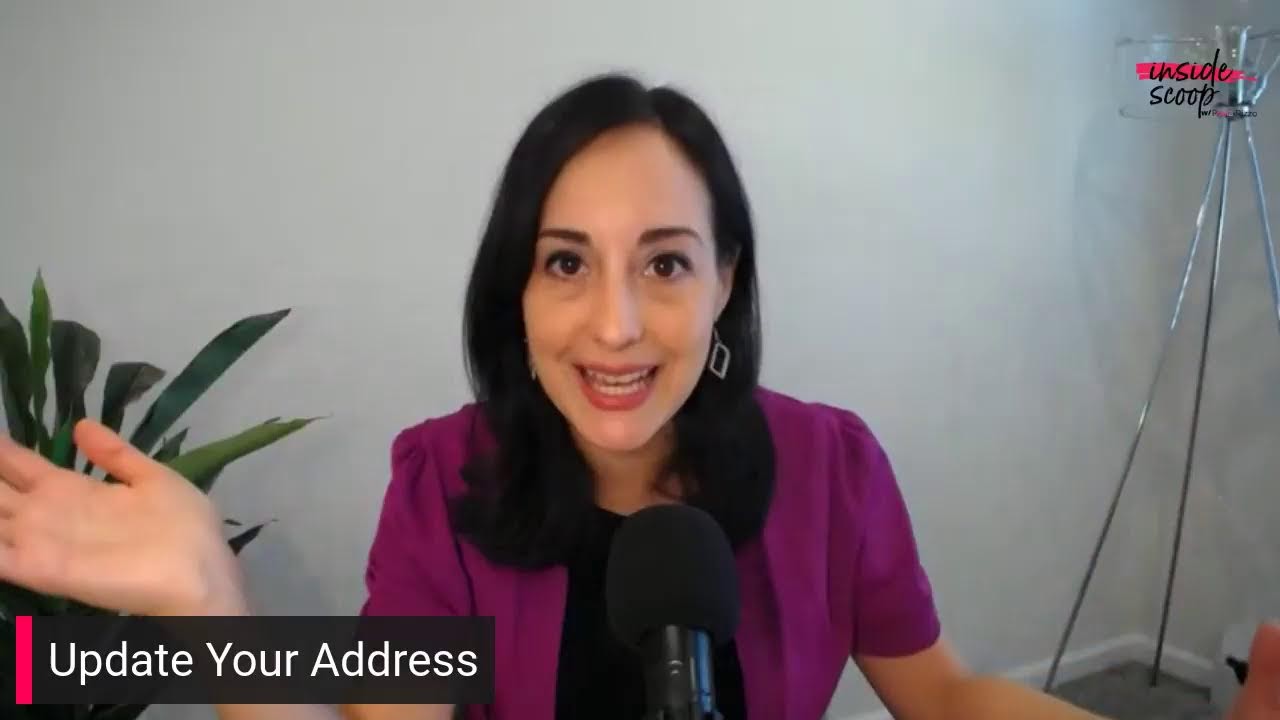
Paula Rizzo talks with photographer and executive coach Lisa Andrews about looking better on camera at any age. They cover lighting, angles, posture, and how to handle "Zoom dysmorphia." Andrews shares practical tips for professionals who use video in their work.
Chapters
Hey there, I'm Paula Rizzo. Welcome to Inside Scoop. Today we're talking about a topic that is going to be around for a long time because video calls, video chat, what we're doing right now, live streaming video, it's not going anywhere. And you need to be able to embrace the way you look, the way this— that you sound, all of it, uh, at any age, at any part of your life, any part of your career. And actually, this is really having an effect on people because People magazine just came out with an article about people getting Zoom dysmorphia, it's called, uh, where they don't like the way that they look on camera and they're actually going to the plastic surgeon and getting surgery so that they look better on camera. You don't need to do that. We're gonna talk to an expert today who's gonna teach us all sorts of ways to feel and look better on camera. Her name is Lisa Andrews, and she'll be here in just a moment. She's a photographer and she's an executive coach. And I'm thrilled to have her here because this is something that has always sort of plagued people, not just from Zoom, but, you know, as a TV producer for years, I've interviewed people and women especially have said, oh my gosh, could you touch up that video in editing? Could you do something different? To it to get rid of the wrinkles. This is something that is, it's, it's really, really vexing people and it has for quite a long time. So I want to dig in on that. And I also want to invite you to check out one of my resources. It is a checklist all about how to become a go-to media expert. And one of the things is feeling better about the way that you look on camera. And I share all sorts of things about How to do that if you go to paularizzo.com/checklist. I'm also a LinkedIn Learning instructor and I do have a whole bunch of courses all about how to be more productive, how to make sure that you're actually getting things done. If you go to paularizzo.com/linkedin, you can check those out. And I have one, it's called The Power of Lists to Get Stuff Done, which also was just featured on Delta In-Flight Entertainment, if I can toot my own horn for just a second. Which is super, super exciting. I saw it myself when I was just on a flight. I love that. Like, how cool is that? So if you're in the air or on the ground, you can check out those courses. PaulaRizzo.com/LinkedIn. And, you know, for sure, definitely let me know if you have any questions throughout the, the course of our time together. Leave them in the chat box below. We're going to be able to take some questions. There. And without further ado, I would love to bring on my guest, Ms. Lisa Andrews. Thank you so much for being here.
Oh, thank you so much for having me, Paula. I love your show.
Thank you. Thank you. Well, let's talk a little bit about this People magazine article. It's all about how people are, you know, it's a play on body dysmorphia, and they're calling it Zoom dysmorphia, where people are getting surgery. Now, you have been working in this field for a very, very long time. What is happening? What's going on here with people?
Paula, I love this. You picked a topic I'm very passionate about, and people really go through hell with this. Zoom dysmorphia is how mental health professionals— specialists, actually— they are calling this type of bodymorphia, where people start seeing flaws in their appearance that either don't exist, they are distortions caused by lights or cameras, or flaws that they have never noticed. Because they are not very often on video camera. And after quarantine, this changed completely. They have been spending too many hours staring at their faces.
Yeah.
So I work— yeah, I work with Transformational Photography, whose core is exactly put clients in front of cameras to promote this self-knowledge. And what I strongly believe about the Zoom, this more is that we are not often on camera. Mental image that we have of ourselves is normally outdated. So I've seen it with clients for over 20 years, meaning we see ourselves every day in the mirror. We see photos, take photos that we edit with filters, and we delete our bad photos. Yes. So somehow—
So used to being able to edit.
I'm so guilty of that. Yeah. So we somehow lack a tool true knowledge of our current self-image. And our minds still hold on to those versions of ourselves where we were younger, slimmer, somehow better. That's what causes these issues with Zoom now. Zoom forced us to confront a raw image of our faces that few of us had been exposed to. So lots of people literally got disappointed as if they hadn't seen themselves in years.
Wow, that is amazing. That's actually, you know, think about it too. People keep and hold on to those headshots of themselves that they really love, and they're super old headshots, and then you meet them in real life and you're like, wow, you actually don't look anything like that anymore.
Exactly.
Interesting point. But there's more to it though. It's not only just not liking the way that you look. I mean, this has other implications as well.
Yes.
Tell me about that.
Well, yeah, the main problems that happen there is like it generates poor self-esteem and anxiety. And the stress level can be so high that another recent study showed that 1 in 7 women felt exhausted after Zoom calls. How many of us relate to this one, right?
Yeah, for sure.
Yeah. Some reasons of that exhaustion are related to the hyperfocus and the overexposure, meaning the flaws they are seeing in themselves, they not evident to other people or even real, but they cause a lot of pressure when you are on camera. So also when we talk about career, I also have a degree in business and I worked in corporate most of my life. So I'll bring a little bit of that experience to illustrate here. I worked with headhunting and training, and when it comes to professional performance without the benefit of the team energy, and the shared passion in that room with a group, the individual feels more exposed and anxious. It's the spotlight effect. So if they're already experiencing any type of lack of confidence in their looks, the result could be a missed opportunity. They will participate much less in those Zoom calls. They will sit in the back hoping that it ends as fast as possible. So it's really essential that people try to overcome that difficulty.
Yeah, that's a good point. It's like, don't look at me. Let's get this call over with. I want to be done with this. You know, don't, don't, uh, don't call any attention to yourself. I get that. Um, so let's talk a little bit about the good part here is that what you see on camera and what you see in the mirror are actually not the same. So what you're seeing, when you are on these Zoom calls, when you're on these video calls, it's a little different than what reality actually is. So tell me about that, because this is actually a little silver lining that I want people to know all about.
Oh, that's, that's a great point. And absolutely none of this is all real. This, I want you guys to think that web and photo cameras, they were created for the experience of having a face-to-face interaction, not exactly to have the highest image quality. So the same is true for photos. For example, if a selfie taken from 12 inches can increase your nose size up to 30% compared to the same photo taken at 5 feet. So based on that kind of premise, just back to Zoom, think that webcams can produce more rounded faces, wider set eyes, and the same broad nose issue that we discussed before. So you should never take into consideration— the same way that the mirror has a variation to cameras, the camera in the computer and in the phone, they are compact. Therefore, before getting depressed or looking for cosmetic procedures, it's vital to recognize the type of limitations that this kind of technology has and understand that they provide a flawed representation of your true appearance.
Ah, see, I feel a whole bunch of people saying, "Goodbye!" I feel freed, right, by that, knowing that. Yes, exactly. That's amazing, amazing news for all of us. It's really, I mean, it really is. Look, I've spent my career in the TV industry and it's always been said that the camera adds 10 pounds or it's not exactly, you know, right? So we know this. And so of course there are things that we do as people who have worked in this type of media for years to make yourself look a little bit better, to be able to, you know, sit a certain way or use my good side or whatever it is. Brianna is saying, "This makes me feel so much better. Thanks for this. Love this insight." Yeah, totally. I get it. I get it. But let's talk about some of the things that people can do to kind of trick the system a little bit to feel and look better when they are on camera, because I know you have lots of good solutions.
Absolutely. Wonderful. So I'll go through some quick technical tips first and then some specific for aging on camera. Okay, so lights are awesome. Lights can cause distortions and this kind of aged look. So mind your lights. Keep one good source of light in front of you. Use a window whenever possible, or one good artificial light always in front of you, never behind, or you're gonna look dark. And never above, because when they come from above, they form all sorts of shadows. And please run from fluorescent lights, really do, because they will emphasize every possible flaw on your skin, and you're gonna really feel terrible about yourself. So in terms of distance and angles, I recommend that you sit about 2 feet from the camera in your computer, and the same with your phone. So to make your life easier, also put your computer on a stand and your phone in a tripod when you're doing video conference, because this way the cameras will be at your eye level. Most people can't keep their computers on the desk, and that creates all sorts of horrible angles coming from here.
And yes, we don't want horrible angles. It's true. Move that camera back. It doesn't need to be so close to you.
Exactly. Yeah, yeah, yeah. And since we're talking other things, sometimes people ask me about apps and other stories. I mean, what can do it? Some people know that Zoom has apps, and the Zoom app has like the possibility of retouch your image. But others, I really tried several and I don't think they were better than Zoom, but What I try to do during quarantine when my clients ask this kind of questions, what, what can we do like in real life and lights production, etc., that we can do this. So other than what I explained, there are some little details. Makeup, for instance, it should be done in front of the lights you're using, not necessarily the makeup you use normally. So I would suggest you start in the bathroom but finalize your makeup colors in front of your screen. So the way you can do that is you start a fake Zoom call or use any kind of camera apps in your computer, put your lights on like you're getting started, and finalize the makeup here. You're going to be surprised. You're going to see how much lighter or stronger than usual your makeup will be. I recommend sometimes like, yeah, terracotta palettes. They tend to work for most skins. At the same time, Dark lipsticks and eyeshadows, they tend to emphasize dark circles and make people look older. So depends, some skin tones can go with that, some others can't. And finally, a detail that people always ask me, hands and neck, they tend to look old on camera.
Yeah.
So I recommend you guys use a strong moisturizer several hours earlier if you have a chance, and a little bit before going on video, literally spray or wet those parts with water at that point because it makes it gain a lot more elasticity, and that's going to be captured by the camera. So, and finally, ladies, if you used to do your nails, I hear people say, oh, my hands look enormous on video, or they look so aged. There is a little detail, and I even did a little illustration here to show. I just did one hand other than the other because my hands are a little bigger.
Ah, let's see, let's see.
Yeah, so if you wear translucent white nail polish, polisher, even a big hand like mine looks a little bit more delicate. On the other hand, if you don't, your eyes go straight to the knuckles and you see all the defects. So if you see, even though they're the same size, you show me that again.
Move your hands up a little so, so we could see them a little higher up. Yeah, yeah, okay. Yeah, yes.
So I'm saying when you see the one that is done, the nails are done and with a light color, it's a little bit more finished up while the other one, your eyes tend to go here. Here I go to the nail polisher.
Yes.
Gets a little bit less attention to the hand. So little details that when we cannot touch up everything with the computer, you can do some little things that sometimes, or even if you don't, at least you're not going to be so neurotic about it. Like, oh my gosh, I look awful. You know why the camera is capturing that detail. Ah, very helpful. Yeah. That is a good point. I love that.
That is, you know, I've been doing my nails just because it kind of looks It's like an accessory that you have on camera because, you know, now—
You look great.
Yeah, what, I mean, but what background do, you know, depending on what your background is, like the newest accessory is your hands and your nails at least. But it's nice to know that it's actually doing, doing some, you know, anti-aging things for me as well. It's funny that you mentioned the moisturizer because, you know, coming from the TV world, I always remember the makeup artists, to your point, they would always finish the look if they could in the studio with the anchors and, and the people that we had, uh, you know, our, our experts and stuff. They would come in, take one last look under the lights, and then stay off to the side. But the same thing, they would put moisturizer on the arms of the guests in the chair when they were getting their hair and makeup done, and I never knew why. I always thought it was like a nice, like spa detail, you know, like, oh, how nice you feel. It makes you feel nice, you know. I didn't realize that it was actually because it makes your skin look better on camera. Wow, look at that. I love it. That's amazing. Um, now one other thing that people often ask about is, um, you know, like wrinkles, right? Like specific wrinkles on your face after, after the fact, there's not much you can really do with that. I mean, Photoshop and things for still photography, you know, they can do great things. For video, you can't retouch video, you know, very much. So is there anything we can talk about specifically that, you know, when it comes to angles or whatever for wrinkles?
Well, what my clients normally ask me is how much I should sacrifice of my smile not to wrinkle much.
I see.
Because during movement, I don't see much you can do. What I tell my clients is, if you have a flattering light in front of you, you're going to have less wrinkles, quote unquote. If your face is well illuminated, you're not gonna have extra wrinkles from shadows. So this is one thing that I insist, great light. If you can do the triangle, you know, one in front of you and two on your side. But that's going to minimize the problem. But for what is, let's say, inevitable, I would highly recommend that for videos, since you have to move, and especially for professional videos when you have to talk to clients, be charismatic. Never sacrifice charisma, not your wrinkle. Let's say you notice that when you do something, you— that wrinkle showed up more. We're going to talk a little bit more about that before, about how you can body map yourself. But you can literally look ahead, smile, see how it wrinkles, then to the left and to the right. And yes, you can discover what's your best side if you can do that. But when you're talking to people, sometimes anything that's like, like frontal, you cannot avoid. So what I would recommend is try to do everything you can makeup-wise Also about moisturizing, that works for the face too. If you can do it several hours earlier, what happens is the makeup has pigments. If your skin is dehydrated, it's going to just suck in and the pigments will be on top and the wrinkles will be more visible. So that's the best one I can give you that's a practical one. And just complimenting, I would say never not laugh or never enjoy that moment that you're doing because, oh, I'm gonna wrinkle. Because you, you feel it's a beauty, even it's a mix of charm, energy, and the real features. So smile. And if you, if you know that laughing all the way up, it's going to be too much wrinkle, okay, don't do this all the time. Make, make sure that when you laugh, you don't do this, because when you go backwards, your neck looks bad. These details. But the rest wrinkling a little bit for a good smile, I'm all for it.
Oh, I love it. That's such a good message. You know, it's so nice. It's like, don't, don't sacrifice yourself and who you are and your passion, your excitement for a wrinkle. Are you listening out there? You know, I want to talk about body mapping. Now, this is something that you created that you use with your clients. Tell me what it is. And then we're going to go to some of the audience questions because there's a bunch of questions that are coming in. So if you're watching live or on the replay, leave us some questions and we'll get to them, you know, either during the live broadcast or you'll be able to see our answers, you know, below in all of the social media platforms. So body mapping, what is it and how can we use it?
Well, body map, in short, it's a technique where I film and photograph my clients in different angles, colors, wearing different colors and outfits. And later we analyze what we can do to make the best out of their image and body language. For business and personal life. So from there, after we have all that data that we get from the coaching sessions, or sometimes I teach them how to do it at home, what I like to emphasize, because people say, oh, I'm not in the mood to do this, a lot of people go through this. So what I like to emphasize is that this isn't a superficial process that focuses only on good looks. Actually, it has nothing to do with that. I created the body mapping technique over 10 years ago as part of transformational photography, not things that you're gonna share. And it was during a time of illness. I was sick and I looked awful. I lost hair on top of my head, my entire head here. I got aging spots on my face and I lost tons of weight. So it was hard to look at myself and I had no interest in being on camera. Sometimes people say, oh, you do it for a living. No. So I like to talk about this so people feel inspired that you can do that too. So I didn't like to be in front of the camera then until I realized the magic that self-knowledge could do for me. So my corporate job then required that I looked good all the time. And my boss started literally hiding me in the back because I looked too frail and that was not good for their brand.
The image, right?
Yeah. Wow. Yes. So that type of bias taught me a lot about the discrepancies between who we are inside and this vessel that we inhabit. And that's what I said earlier. This, um, this image that we have in our heads of ourselves, they not always match what the outside is looking. And even if it's for something as simple as being sick for a while. So the depression, dysmorphia, dysphoria. All this comes from this discrepancy. So that's important to keep in mind, that vanity aside, self-image does have to do with self-esteem. So if you guys tell me, I hate staring at my face, I hate taking pictures or videos of myself, I get it. But trust me that it works. So when I talk about this technique, photograph yourself, video— if you make videos of yourself, The core of body mapping will be self-knowledge. And that's what's going to help avoid problems like the Zoom dysmorphia. So it's hard at first. And what I'd like to share here is the key to get rid of the discomfort is the discomfort is not going to leave you because you're doing a lot of Zoom calls. Exactly. Doing a lot of Zoom calls is what caused the problem, right, Paula? So what body mapping has that's different from just staring at your face is that you know that the purpose of creating all that material, videos or photos, it's going to be analyzing to improve. And that gives you hope. It changes a little bit. You know, it's like a lot of people here, executives and all, read The Art of War, the book. And the principle is that if you know yourself, you know the enemy. And our enemy here, we're talking aging, disease, whatever it is, you can win the battle. And that's what we need in that case. If you cannot confront your demons with all this stuff, then it's better. So yes, I love it.
And you do have a free assessment that people can, can take, which will help with this. So if you go to picturecure.com/self-image-assessment, and I have this linked in there, you can go ahead and Liza has an assessment that you can take. To be able to help you figure this out for yourself and really be able to, you know, knowledge is power. And I want to go to some of the questions that we have here. Someone asks from LinkedIn, what colors are best for Zoom? What do you think?
Well, there are professionals that do your own self-analysis of colors. So normally, if you have access to this, this would be awesome. What I recommend in body mapping, if you don't want to go to another professional, is there is not one color for Zoom. It's going to depend on your background, and you can initially find the best colors for yourself by getting, like, even you don't even have to wear all your outfits, but just putting them in front of you with the— always test everything with the lights. Put your lights on, decide on your backdrop if you're going to have a green screen with something neutral or whatever, and then you start putting some pieces of cloth or clothes in front of you, and then you see, oh, this one, well, and then you make this decision. Today, for instance, I had a busy background behind me, kind of, so I had to wear black. In a more neutral one, I could wear another brighter color that goes for me.
Yeah, exactly. That's a good point. The only color to avoid is green if you're using a green screen, because you will disappear, and we don't want that to happen to you. We have a question from LinkedIn. Jihan is asking, what tips do you have for jewelry? Well, one thing that I would say, and I'd love to have your input as well, Lisa, but nothing that's too clunky, nothing that's gonna distract from people, and also nothing that's gonna make too much noise. You don't want things that are like messing up if you have a microphone on, is gonna hit your microphone. And do you have any additional details on that?
No, I'm all with you for that. Only addition would be if it's professional, keep it even to a minimum if you're gonna— do something more social, then you can go with the necklace. What Paula said, careful with anything that's gonna affect your microphones.
Yeah, good point. It should match, you know, what you're doing, where you are, you know, the purpose of that. Charles is watching on YouTube and he says, Lisa, your tips are great. That's great. Uh, what type of camera do you recommend? That's what Diana is asking. And the lights, should they be cold white, warm, or another color? What do you think?
Well, for light, well, let's start with the lights. Um, I normally use a cool light in front of me, and then I play with the other two. I use three lights. So what I do is that in front of me, for my skin tone— again, it's all about your skin tone— what I recommend, if you don't want to go crazy with a lot of expensive things, is try that with your reading lamps, even one in front of you, one on each side, and then get like normal bulbs in cool and warm colors and play with them. One cool in front, one cool here, one warm here. How do I look? And then yes, because those are cheaper for you to have an idea. After you know that well, then you can invest in always LED lights, by the way. And you get LED lights that can— yeah, LED lights that you can switch. Some of them you have the option to do in the same equipment to have cool or warm, or mix the two of them. So if you can look for one of those, I think Paula has an amazing list of equipment. There is one in my website as well. If you want any more details, feel free to email.
Yeah, yeah, no, good point. I, if you go to paularizzo.com/checklist, I have all sorts of things that you can, you know, find out of how to look better on camera and all of that. So thank you for that plug, Lisa. Very nice. Okay, we have a couple more questions too that I want to be able to make sure that we get to. We talked about jewelry. What about hair? There's a question. Gian has a— what do you recommend and how should you wear your hair? What do you think?
Again, a lot of this personal things. I would recommend that you take photos or film yourself. You're going to be the best judge of this. Obviously, you don't want hair on your face. You don't want things that you're going to be falling. It's the same as when you're giving a speech on stage. You don't want things that move too much. That's 101. In terms of what to do with your hair for specific thing again, do the lights, do your hair straight or in a certain way, try every possibility that you can. But what's going to give you the answer is filming or photographing what you're doing. And then you're going to see mistakes that you're not seeing in the mirror. What I like to emphasize is this: the mirror doesn't show you much. That even my upcoming book is called You Beyond the Mirror, exactly because I talk about these details. You look at yourself in the mirror every day, like when I was sick. And I didn't see everything. The day that I start taking photos of myself and looking at them with a more scientific look, I found the mistakes, I found what I could improve. So sure, I highly recommend that you, you do this. My call to action for everybody would be exactly take more photos of yourself and analyze them, and you're gonna— all this details much more easily.
Yeah, see yourself, understand what you look like. There's a couple questions here about, um, positioning. This is interesting because, you know, you did talk about having the camera be eye level, which is what I always tell my clients too. You want to, you know, raise up that camera on books or a tripod or whatever it is to make sure that you're looking directly at the camera so it's not, you know, looking up, up your nose. But is there something you can do? Brianna is asking from LinkedIn, is there something you can do with your body? Like, should you position yourself in a certain way? What— how should we do that?
Well, I, I think for what I tell clients that tell me I'm losing business because I don't feel I have the same chemistry on camera. What I would say is technically, yes, put a stand so your eyes are here, but it doesn't help much if you're staring here to see everybody. So eventually I look here to see your faces, but talk to the camera. Look for where your camera is. Sorry, before somebody asked me about the camera I use. Sometimes, depending— today I deliberately wanted to use what you guys are using, so I'm using the camera in my computer. The definition is not the best. When I do something more high-end, what I do is I will do like something's going to be eternal and it's not for teaching purposes. So I use like EOS 6D from Canon, is the one that I normally use as an external camera, and then it's higher than here. So you have to know that you're going to have to look at that camera that's a little higher and not to here. So in terms of position, what makes you lose contact with your audience sometimes is that you're looking at the other people. So I highly recommend if you have to talk to clients or in a meeting, have your points in your mind, look at people generally, but always come back here and talk to them like you're in person. Show your personality, talk to them like you are face to face.
Yeah, for sure. Make eye contact with the camera. It's one of the things when I'm working with media training clients, it's always the hardest piece because You know, you need to talk to that camera like it's a person, even though I'm not looking at you. But I know that it's gonna be a better connection if I'm looking directly at you like this versus looking down, you know, which when you're doing multiple things or you're in a meeting, you know, you are multitasking. So people, it's understandable. But when you're presenting, when you're the one on camera, you should absolutely be looking directly in that camera. There's a question from LinkedIn about teeth, about especially for video. Should we be investing in teeth whitening, dentists? This is another sort of like, come as you are. If you have a gap in your teeth, like who is it? Who is the— oh, Jewel. Remember Jewel, the singer? For years she had a gap in her teeth and then she got it fixed and everybody lost their mind over it. They were so mad that she did it. But I don't know. What do you think?
Again, personality is what counts a lot for me. I love when people embrace what they are. What I like— everybody is familiar with the Dove campaign that they say embrace your scars, this and that. The only thing that I have to add there is I work with cancer survivors, transgender people, a lot of people that initially don't want to be in front of a camera. So what we talk about is let's body map first and see everything that can be improved and then what can't be improved. Like aging or whatever problem you had because of an accident or something, then you embrace it. So in terms of philosophy, that's what I believe. And specifically about teeth, et cetera, one thing that I tell people is if even, uh, in another conference I did the other day, they said, oh, I have crooked teeth. And, uh, what should I do if I can't really go to the dentist and spend thousands of dollars with that? Lighten your teeth. And even if you don't have to go to a dentist for that, crest stripes or stuff like this.
Sure.
They do a great job. And the lighter they are, the flatter they seem to the lens. So it's a way to trick.
Ah, it's another trick. Another trick. So the lighter that the color of your teeth, the lighter they are. Ah, I love that. That's such a good tip. Well, I mean, this has been so much great stuff. I know, you know, we've had a lot of people asking questions. Continue to ask questions in the chat boxes below. We'll come back to this if you're watching the replay. Ask your questions because we will absolutely come back and answer them. If you go to picturecure.com/self-image-assessment, you can get Liza's self-image assessment to be able to, you know, start with this body mapping stuff that she's talking about. But it really, it makes a big difference if your knowledge is knowing how you're coming across, so then you can make some of these changes to feel better and be more confident because video is, you know, Video is where it's at. We're going to be embracing video for a very, very long time. So I'm thrilled that you're here. Thank you, Lisa, for all of your goodness and wonderful stuff. I appreciate you being here so much.
Thank you so much, Paula. I appreciate that. Thank you guys.
Of course. Of course. And thanks for being here. Again, if you go to paularizzo.com/checklist, you can check out my checklist to become a go-to media expert. And media these days is not just traditional media anymore. More. Now we're talking about Zoom calls and presentations and all of that kind of stuff. And I'm thrilled that you joined us today. So thanks again, and I'll see you soon. Bye.