Catharsis Episode 1: Pedro Franceschi

In this candid monologue, Pedro Franceschi, co‑founder and co‑CEO of Brex, shares his personal journey from his first scrappy startup in Brazil to building a $12.3 billion fintech company. He explains how founder burnout and mental‑health crises—panic attacks, chronic anxiety, and the pressure of strategic pivots—are often hidden behind the celebrated milestones of fundraising, product launches, and growth. Franceschi describes two major mental‑health breakdowns: one after the launch of BrexCash in 2019 and another during a painful strategic shift in 2021 when Brex refocused on serving fast‑growing startups. He details the support systems that helped him recover, including therapy, psychiatry, daily meditation, sleep tracking, vacations, and a strong community. He argues that mental health should be normalized for founders, likening it to routine personal‑care habits, and stresses that without such support, immense value is destroyed when founders quit. The talk also touches on early lessons about product‑market fit, the importance of focusing strategy, and the need for founders to recognize their burnout limits and proactively take breaks.
Chapters
My name is Pedro Franceschi. I'm the co-founder and co-CEO at Brex. And at Brex, we build corporate cards, bank accounts, and spend management software for fast-growing companies. Your last valuation was at $12.3 billion. And, you know, just excited to be a founder. Why startup founders quit. It's not, you know, fights with a co-founder. It's not them being kicked out of the business by an investor. It's them literally being so burned out, so stressed that they quit. And that's really sad because it's just outrageous the amount of value being destructed by this problem and just how little people talk about it. And I shared my journey in a blog post that I wrote maybe a year ago. And just the number of founders that came to me saying, "Hey, thank you so much for sharing. Thank you for telling me your story. I feel so much more comfortable in trying to deal with this in my own ways," was so massive that to me it was clear that something was wrong and we had to do something to change it. And I remember founders telling me things like, hey, I can't tell, sometimes I miss my appointments because I'm afraid of telling my EA that I have a therapist, right? Or even saying, I'm afraid of telling my board that I do therapy because they are going to think I'm incapable of running the company, right? And I think my my journey, I think a lot of people talk about the bright moments of building a company, the moments that you raise a round, the moments where you're talking to a customer and the product is working and you're delivering the vision, but there are really dark moments too. And I think that's something that every single successful founder I know has been through and people just don't talk about it enough, which is why we got so excited about doing this and telling more stories like mine to other founders that haven't necessarily seen that, that dark side as much. And one thing about mental health is we talk so much about physical health, right? We talk so much about exercising and not smoking and not drinking, right? And, you know, being— living, you know, a healthy life, right? Sleeping well. But we live in our minds the whole time, and we don't spend any of our time thinking about it. And I think My hope is that mental health can become as a normal part of our life, just like brushing your teeth in the morning, right? You don't talk about it because it's boring. It's a non-event. And for some reason today, it's still this sort of interesting topic of any sort where people don't talk about it because there's a taboo around it here in the US, which is just incredibly sad. I think when my dad passed away, that was the time that that I think I got really into computers. And I think kids have different ways of dealing with trauma. And I think mine was that, you know, just like deeply finding interest in something. And I would probably say that that also played a role in like my history of mental health, because that was in some ways like the first relief I had, even though I didn't understand what was happening. And it took me many years to unpack my dad's passing and grieving and all that. But it was, Computers were certainly a part of it. So my first journey as a founder when I started our first company in Brazil was really fascinating, I would say, for a few reasons. One, because you just don't know anything about what you're doing. So in many ways, the degree to which you have to hustle your way out of things is higher. And in Silicon Valley today, a lot of people, you raise millions of dollars to start a company. And then you build a company with very different assumptions than when you're way scrappier. In our first company, we raised $300,000. That was all the money we could raise because we were 16. No one would give us money. And really, I think what we learned is how to be so scrappy because we just had to make enough money to pay for payroll at the end of the month. So every product we build, we just build this really good intuition for is it going to sell? Is it going to work? Is it going to have product-market fit? And it was also really challenging because many times we almost went bankrupt, maybe 4 or 5 times throughout the journey of the company, especially the first 2 or 3 years, which was very stressful. But in some ways it was because we were so young, I think we weren't even aware of the size of the amount of responsibility we were taking. So we had a few other instances of almost going bankrupt. I would probably say the The most common one was, are we going to make payroll or not? Because there's little people with families and they depend on the company to making that work and they decide to leave a comfortable job in Brazil to join a startup in 2013 when startups are not a thing anywhere, not even in Brazil. Probably the only place in the world is Silicon Valley. And I think The thing is we just had to build a product that we could capture money in the same month to pay for it. So we basically went to customers and said, hey, what is the number one thing you care about? Is it building a better, increasing your conversion rates in your checkout or is it a lower price so we can convert that into building a more sustainable business? And we literally just did exactly that. So it was this customer-focused by sheer will and by necessity because we just had to capture that value to make payroll. And it was really stressful because a lot of the times we had to come up with a creative idea out of thin air because look, we have 3 weeks of runway and how do we make up payroll? And that was just the way the company was ran. And then after a while we hit this breakout where we served larger customers and it stopped mattering as much because we were able to be profitable and make more cash. But for probably a year and a half or almost 2 years, it was really, really tough. And I think startups have 2 journeys. One is how hard can you work until you find a product-market fit? And in the case of Wrex, there was probably a year to a year and a half. And the second phase of building a company is Whenever you find product-market fit, how long then can you do it for? Right after, okay, how long can you build this business for? I remembered a conversation I had with Paul Graham a few years before, and I asked him what was the job of a founder as a company scales? And he told me that the job of a founder is to figure out how to be happy. And I didn't understand that back then. And then at that moment it clicked. Because companies are a long game and Facebook has been there for almost 2 decades, Google over 2 decades, Microsoft for 4 decades and it takes time to build something meaningful and enduring. And the moment that I was back then is not a happy one and that's the moment that people quit. And I think if I had quit back then and I didn't have the support to build, understand my mental health and deal with it, I think a lot of value would've been destroyed. So the job of a founder is just to figure out how for how long can you do it for. And the job is really stressful. So the conclusion is that you need all this support around you. And at that moment, I was able to have therapy and to have a psychiatrist with me and have all these different support systems to understand what I was going through and figuring out how to do it for a very long period of time, which is ultimately what matters and how value gets compounded. And to me personally, I think there were two sort of big crises that I had around mental health on Brex. And the first one was in 2019 around the time that we launched BrexCash. And I remember that we were working on this, this was our second product after the card and we were working on it for a couple of months and working really, really hard towards the end to launch it. Weekends, nights, just doing whatever it took to launch it. And I remember that the day of the launch was, I think it was on a Thursday and we were working on the weekend before, the nights before, and Thursday arrived and everything was ready. And then Enrique went on stage on TechCrunch's disrupt to announce it. And the whole company was gathered together in our SF office to watch the announcement. And I just remember it was one of these, one of the most, probably one of the most incredible and memorable moments in the company's history. And people who were in that room still remember the energy and the excitement. And I just remember looking around and seeing how everyone was happy, but I wasn't happy, right? I just wanted to feel something and I didn't feel it. I was just not happy with what happened, right? I was just stressed about it. And I thought, you know what, I'm probably just tired, right? So I went home, got some sleep, woke up the next morning feeling so anxious, right? Because I was like, well, we launched Cash, but there's no users. Now we need to grow. Let's go and go. And I didn't take any moment to celebrate the accomplishment we had. And I was just sort of in this hamster wheel of like, oh, what's next? What's next? What's next? And not only ignoring what we accomplished, but not giving myself any time to rest and just And then not understanding what was happening, I decided to sort of power through it, right? And I kind of ignored it, kept working, and didn't really unplug on the weekends. And then a month later, I remember I was in this Halloween party in New York with a lot of my friends and people that I really liked, but just feeling really down and anxious and then burned out without really understanding what was going on with me. And I remember just going to this party and feeling really down and not being happy at all. And I went to the hotel. So I woke up in the morning and I had a panic attack. And I'm not sure if you ever had a panic attack, but it's like very, very, very scary. And I remember waking up and just like sweating and my heart rate was up and my breathing was shallow. And I was just walking around the room and I didn't know what to do, right? Because I thought I was having a heart attack. I thought I was dying. Like you don't have You don't have any idea what's happening. And it's not like anything happened, like someone said something to you, just your mind is so tired and so burned out that your body literally sort of enters into this panic mode. And it's one of the most desperate things that I think I ever felt in my life. And then I called my mom and she was like, "Look, this is probably a panic attack. You should see a mental health professional." And my friends were around me and helped me in that moment, which was pretty painful. And then I talked to my doctor and my doctor was like, yeah, you should look for mental health professional. And he introduced me to my therapist who I still see every week since then for now almost over 3 years. And it changed my life in many ways. I have a therapist, I meditate every day. I use this ring to track my sleep and measure how well I'm sleeping. I have a psychiatrist, I go on vacations and I try to literally unplug from work every night. I try to read and all these things are just rituals that allow you to be performing at your top performance and be happier about it. The same way Olympic athlete has their diet and they have to sleep that many hours and they have to train and they have to do this in this routine over a period of time and that compounds into really high performance. The same is true for a founder. You have to eat healthy, exercise, of course, work really hard, but also have ways of coping with stress, anxiety, have your emotional support needs met, your support network around you, and all these things matter. And for a lot of founders, they're an afterthought. And I think that's why so many of them burn out and get to a point where quitting is the only option, which is incredibly sad. And I think that one of the big mistakes we made at Brax is thinking that we could serve everyone and every customer really well. And one of the big things in our strategy is at some point we said we want to have a million customers at Brex. We want to serve a million businesses. And of course a lot of these businesses are small businesses, right? And we thought, well, it is not like we said we want to serve only small businesses. We said we want to serve small businesses and large companies and startups and everyone. And we thought we could do it for a while. And then I think in last year in 2021, we realized that we actually couldn't and that we were not able to serve anyone really, really well. And we went through this really challenging time of saying, we need to focus. And focus is really painful, but it's the only thing that gives meaning to your choices in the end because When you say, hey, I want to serve small businesses, but you're still serving enterprise customers and mid-market customers and startups, you haven't really said anything. The only thing that gives meaning to the choices is when you say, this is the things that I am not willing to do to do this one thing really well. And a lot of our strategy as a company was like, let's serve small businesses, do that really well and get a million of them on the platform and of course grow across the board. But that was our primary focus. And when we realized that that was wrong and after investing almost a year in that strategy was really painful because I had to get first in front of the leadership team and say, "Hey, we made a mistake in our strategy. We actually don't know what we were doing. We're gonna change strategy and do this different thing now." And which thankfully now worked, but back then it wasn't obvious at all. And at the same time, getting in front of the whole company and just saying that, like, hey, like, you know, we're pivoting, we're shifting and narrowing our focus to serve just like startups and fast-growing companies really well. And we're going to forget small businesses for now and just focus on our core. And that was like really, really, really painful because in these moments where you are, you're pivoting like and shifting your strategy. And we had almost 1,000 people. It just takes such a massive toll on you personally. And I think it was by far the most stressful moment of my life and the most anxious I think I've ever been. I was one day in my house and I literally couldn't work. I got on the computer and I was so anxious and so nervous that I was like, it felt like the world was imploding because everything was on me. I had to do this, talk to a customer and talk to someone on the team and someone was quitting. And it was everything piling up. And I literally closed the computer because I couldn't work. And I sat on the chair and I was like, I'm 25 years old. I'm perfectly healthy. I have a great life, great friends. I literally cannot work because of stress. My mind was literally melted. And that was the moment it was like, this is not cool. This is not cool. Burnout is We talk about it, of course, no one wants it, but that was the moment it was not fun to build a company. Of course, there's going to be hard times, but that was like, I actually don't know if I want this. And as you start going through therapy and you have some support systems like medication for a while and trying that out and losing my own prejudice against it, and having my therapy and, you know, changing my routine. So I spent a lot of time in Brazil where I had a more sense of belonging with my friends and my family because we were remote. So taking advantage of that as well. And then over time you start seeing, you know, like, this is all manageable, this will all go away. And then slowly I got off, you know, anxiety meds. So I got back to therapy regularly. And, you know, we got through it and Brex is now fine. And, you know, working in this new strategy and a lot of our team is still there, really happy and excited about what we're building, but it was really dark and people don't know about it because they just see the news and Rex worked and the things that are working, the products we launched, but it takes a massive amount of energy from you as a founder to make these movements. And unless you have all these support systems around you, you will fail because that's Startups are not a magic trick. It's just so much energy and work concentrated in one short period of time. And so you need all this support around you and I had it. And I think looking back, the biggest thing now is I actually didn't know what was my limit on burnout. And I think now I know exactly what it is. So when I start approaching the line, and I start feeling anxious, I know how to recognize the feeling already. And I know I need to take a break. I need to stop for a little bit. I need to take this weekend and literally do nothing, turn off my phone and be bored, because bored is the opposite of burnout. It's just so easy for you to lose hope and be like, things like, you don't feel any desire to do anything. You just feel so tired and so anxious and so burned out that you literally wanna say, "I wanna quit my company. I wanna go live on the beach, completely away from all the stress." And I think everyone goes through some of this. And I think the most important moment in these moments of despair is one, just having help. So having a mental health professional that understands what's going on and can help you. 2 is having a community around you that can support you. And 3 is the reason we're doing this is to just know that it's normal and every person that goes through building something great, you know, goes through these moments. Like, it's absolutely normal.
More from Pedro

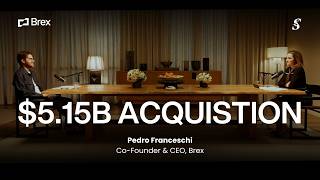

Fundador da Brex fala ao CNN Money sobre venda de R$ 5,15 bi à Capital One | FECHAMENTO DE MERCADO



The Agentic Commerce Revolution is here - but it's not what you think! (Brex CEO Pedro Franceschi)

Brex founder Pedro Franceschi on the one question CEOs should constantly ask themselves



We developed 'best in class' enterprise travel expense solution, says Brex CEO on Navan partnership