Balancing Creativity and Honesty in Business Storytelling and Storytelling Pitfalls to Avoid
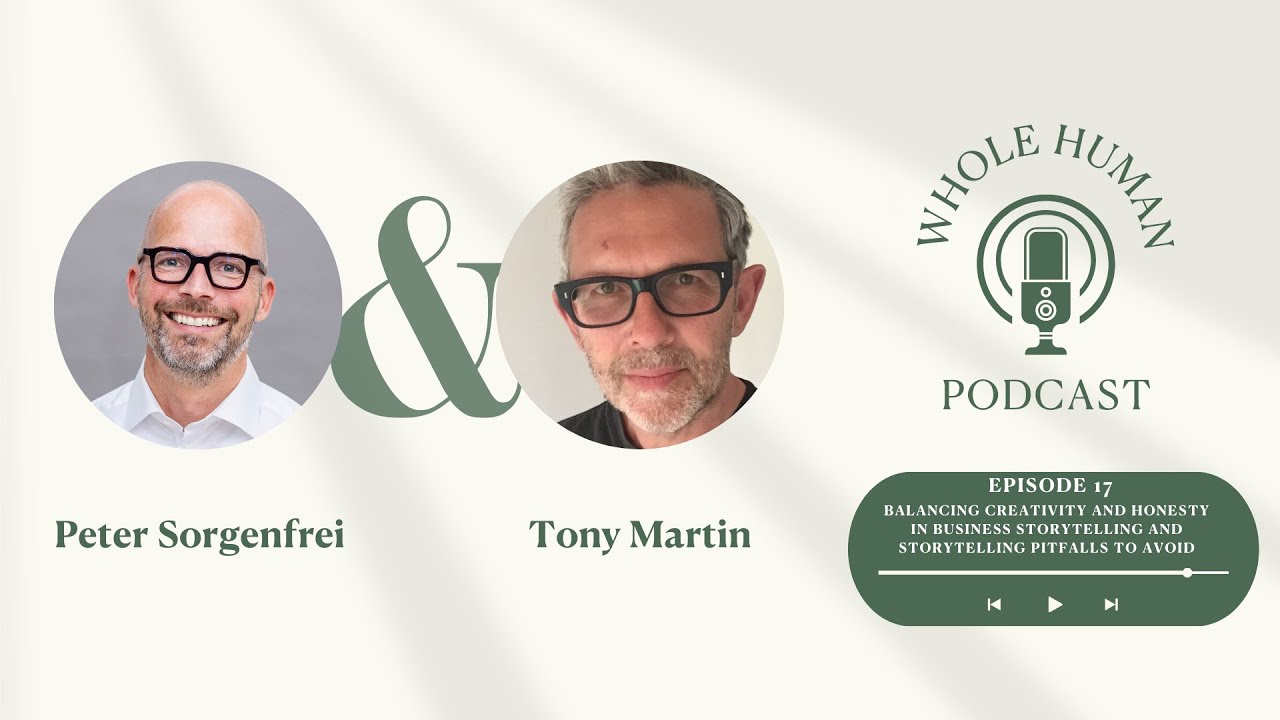
Tony Martin, former CEO of drone-entertainment company Celestial, discusses how founders can balance creative storytelling with honesty. He warns against over-hyping: a camper-van startup's inflated pitch attracted wrong investors and strained operations. Martin argues that knowing when to hire a dedicated storyteller matters as much as the story itself.
Chapters
Welcome to another episode of the Whole Human Podcast. Today I have Tony Martin with me. Tony, welcome on the show.
Very nice to be here in podcast land. Thank you.
The thing, right? Podcast land, it's its own thing. Everybody has one, but this one is going to be different because we try to have honest conversations about topics and themes that are important to founders and CEOs with all without all the just so crush it Gary Vaynerchuk, Alex Hormozi style. Love those guys. They're really good at something that you're also good at, which we're going to talk about today, which is stories, storytelling, communicating your vision. But before we get into that, for the people who may not know who you are, Tony, would you mind introducing yourself?
Yeah, I'm Tony Martin. I'm the ex-CEO and co-founder of a company called Celestial. And Celestial is a drone event, a drone entertainment business. But my roots in the entertainment business go well back beyond the start of Celestial. So everything from being a lighting director to a musician through to a a record company executive, and then I ran a few technology companies as well. And yeah, all of that led to my co-founding of Synthesia.
So you are, in the true sense of the word, a creative person, right? Whether it was working on script or setting lighting or eventually guiding these projects through fruition and the record business, you've been in and around this longer than most people. What is, what are some of the most important things that you've learned along the way in the creative industries? What matters to be successful?
Right off the bat, I'm gonna, I'm gonna go into the storytelling piece because I think telling the story, whatever that story might be, is really important. But I'm gonna, if you don't mind, rewind a few decades because I reflected quite recently on the fact that I've been doing that for a really long time and If we go back to when I first started out as a lighting director, I was 19 when I was pretending initially to be a lighting director. And then I got taken on tour around the world by lots of different bands into my early 20s and beyond. And even back then, I had to tell the story effectively as to why, as a debutant lighting director, I wanted to do it this way. Not that way, not the way you always do it. I want to do it this way. And this is why. It's going to look weird. It's going to look strange. It's going to be bizarre for you guys who have been doing this for decades longer than I have. It's going to be very strange for you to take this on, but I need to do it a different way. And so those roots of good storytelling and looking at things from a slightly oblique angle, like different way. Those are the 2 things that have sustained me throughout my career. And you mentioned that my roots are in creativity. That's absolutely true. But actually, there are 2 golden threads that run throughout my career. One of them is creativity. And the other is technology. And I've always been absolutely passionate about technology and the possibilities it offers, and the misuse of technology, right, the alternative use of technology, that tangential Look at what technology could create, what it says in the manual it'll create, but what you can make it create if you tweak that knob a little bit too far or you turn those settings off. Those are the things that fascinate me.
So if you had in the old days, for the kids listening, not knowing anything but a digital camera, but if you had a regular camera, you would actually— oh, hold on, let me rephrase that. Everybody takes a picture with their phone, but back in the day we had some old cameras. We would essentially play with aperture and all these settings to the extreme, you're saying, to create this art. There's another thing that you mentioned that I didn't ask you about last time we spoke. 19 years old. Where did that confidence come from? Where did that belief come from that you should say to these guys, I know you've been doing this for a long time, my way is better?
I was very lucky that at 19 years old, I moved to a big city in the UK called Manchester. At that very moment, Manchester and Factory Records, which is the record label based there, they were opening a brand new nightclub called the Hacienda. And it was a beautiful nightclub in an industrial setting. And it looked different from any other club in the world, maybe apart from a couple of kind of warehouse-type propositions in New York. Anyway, I, it was newly open. There was a jaded guy who was probably younger than I am now. He's probably in his mid-forties, maybe early fifties, who was doing the lighting. And he didn't like it. And so I kept plugging in and saying, can I have a go? Can I have a go? Eventually, this is what happened. This is the turning point. I got called down into the office and the boss of the record label said to me, hey, look, we're getting complaints. About the lighting. And I was like, oh, nerd. And he was like, yeah, the lighting that you are doing is looking way better than the lighting that the other guys did. So we fired him and now you're the lighting director here. And that was at the time when we had bands, Madonna was coming through, U2 were going through, like all of these bands. The place was open 7 days a week. And long story short, that's what gave me the confidence because I just made it happen. I had an instinct for the technology. And someone demonstrated faith in what I had delivered. And then lots of other people did as well because those bands started to basically inviting me on tour and I would pay me money and couldn't believe my luck.
It's, I didn't tell you this when we spoke in the past, but our stories is very similar in that as I was an 18-year-old stock boy at a warehouse for Sony Music in Paris, putting CDs in boxes and taking X number of this, Y number of that to send it to stores.
Yeah.
And I was like, I speak German, I speak English, I speak French. I must be doing something wrong if I'm working in this warehouse. So I went to the head of HR and I said, listen, I speak a bunch of languages you guys don't, better than you do. There must be something I can do for you. And I'm interested in marketing. What do you say I have a go in the marketing department instead of being in the warehouse? And she was like, okay. And so I ended up becoming the bag holder for Lenny Kravitz, Sade, New Kids on the Block, Chris Cross.
Lenny and Sade were both on Sony. And I was later on in my career, I was a senior executive at Sony Music as well.
So I mean, with all of those things, I was just the bag holding guy. But the point is, I had the confidence to go to somebody and saying, I think I can do better.
Exactly. And you said, what was I doing wrong? I was in this warehouse, but actually, you know what? You chose that warehouse. And if you hadn't chosen the warehouse, you wouldn't have had that conversation.
And I chose the warehouse because I wanted to move to France and speak French. And as an 18-year-old at the time, there was not really a lot of Starbucks down there. So that's how you did it.
Yeah, exactly.
The other thing I think that led us both to, to that place and confidence was you. Right? We didn't know any better. I think what happens as we grow up, we start second-guessing or we start saying, no, I can't reach for that thing because what will other people think? Like infants, right? There's, they just do stuff. The older you get, the more concerned you are with others' perception of what you do. And so you're holding yourself back.
Yeah, I think that's true to an extent, but I think there is a massive exclusion clause that we can apply for that. And that is entrepreneurism. Right. The entrepreneurs maintain that eternal optimism and that ability to say, why not? Of course you can. And have you thought of this? And why don't we do that? So that there is that kind of almost childish naivety that comes along in the, it's in the package of entrepreneurship, doing something that no one else has done before and just shrugging your shoulders and saying, why not?
And I completely agree with, and that kind of brings us to the next idea that we wanted to explore around. Storytelling, right? Because you can have the most brilliant, most sort of progressive or innovative person do something.
Yeah.
But if they can't share that within the world that captures other people's imagination, then it's null and void. So tell me a little bit about— so you came to realize the power of storytelling early on when you're doing the lighting design at the nightclub, but when you launched Celestial, for example, How did you use it there? How did you convince people that this was a way to do entertainment?
We were lucky inasmuch as there had been a couple of landmark events around the world, one of which was the Winter Olympics where Intel put a, I think it was 150 drones or something, put 150 drones up in the air. And then they had an image of a snowboarder kind of going down a mountain, right? The landmark thing. Everyone was like, oh my goodness, how did they do that? So a few of those little seeds had been planted around the world. And also my co-founder was a filmmaker. So here's the thing, right? We didn't have any drones. We didn't have a business. We didn't have whatever, but we did have creativity on our side. My ability to tell stories, his ability to make film. So what we did was we made a promo and we made a promo that demonstrated a whole bunch of drones in the air. In the air. With a couple of actors and so on and so forth, except we didn't have any drones. We did it all in post-production. So we told the story, we told the story visually, and I told the story verbally. And it was a very handy cocktail. All made up. Yeah, I wouldn't say fake. I would say it was concept, right? It was a concept. It was a concept outline. It was a visual advertisement. It was a short film that demonstrated the power of what this stuff is going to look like. And then we could go to a real case study like the Winter Olympics and say, and look, these guys have done it already. Now, those guys were Intel, right? With limitless funding. And I think at one point they had 150 engineers just working on developing that drone system. We were not Intel, but we did, with just the two of us, have the ability to tell that story very effectively, both visually and verbally.
And so how does somebody learn how to do that? You learned early on. I'm a 35-year-old engineer. I've figured out some new gizmo. How do I learn to tell the story?
Yeah, it, I think there is a little bit of a question mark about whether that is endemic, whether that is in the DNA or whether it's a learned skill. What I think is a— yeah, yeah, yeah. Well, what I think isn't—
You're already through.
What I think is way easier to learn is an honest recognition of whether you are the storyteller or not. Right. And so you can, you can be the best engineer in the world. You can have the most wonderful solution to the most egregious problems. However, Are you the storyteller? Now, the product, but are you gonna go down a bunch of rabbit holes and blind alleys trying to either demonstrate that product or explain that product to someone that actually just wants to be excited and wants to give you some money? So what you can learn is that honesty, right? And okay, I'm the engineer, I'm not the storyteller. I'm gonna go and find a storyteller who could be my co-founder or a chief marketing officer or whoever they are. I'm gonna bring them into my confidence. I'm going to explain to them in technical terms what it is we can do and why that is going to change the world. They are going to tell the story on our behalf. They're going to be like the Babel engine, the translation device between me, the technical innovator, and the market and the investors. So being honest, you can definitely learn that skill. Being a storyteller, not always, because people have different strengths, right? And Right. You just have to recognize that. Indeed.
I was about to say the reason that CTOs have CEOs is because they need somebody to tell the story.
That's exactly it. That's exactly it.
And so finding a co-founder, but the other thing that you touch upon, I think is tremendously important in order to be a good storyteller, which is the honesty, right? Everybody's chasing or talking about authenticity in their communication. And I get I, when I hear that, because you don't have to talk about getting authenticity in your communications if you are authentic to begin with. And so what I've seen experienced with my companies as I pitched them, I literally did not know how to tell a story. I just told them how it was. And because I did that, I gained their confidence and they understood that I understood that what I had wasn't necessarily perfect for what they needed, but we would try and get it there. whichever way we could because we were honest, standup people trying to build a business. So that worked really well. The thing that, let me change gears a little bit. This is a little bit of a curveball. You've watched the Apple keynotes recently, I'm assuming. What is your impression of how they present product today? What is your impression of those shows that they put on in terms of telling a story?
Steve Jobs was a massive hero, right? And his authenticity was born out of excitement and a kind of an understanding level within his DNA without necessarily being as technical as the people building products around him. So that authenticity was right there. However, what I feel about Apple right now is that they They've almost become a caricature of their own stylization, their own presentation. I was at, I was, we did a show for the launch of a Samsung product recently for the new S24 AI embedded phone that we put on a big drone show. And what I didn't so much about it was the fact that they were, it felt like they were trying to be cool in their presentation style. And so this presentation style. Has become a little bit cookie cutter now. And I would say without any disrespect to Apple, because obviously it's one of the most valuable companies in the world, it does a lot of things right. I've been an Apple devotee since they, since forever. However, they now in my mind lack authenticity because they're just using the template. They're always so excited to announce and you won't believe it and so on. And I'm really pumped and the audience, et cetera. So I think that some of that authenticity that was in Jobs' DNA, and he was authentic because he was super excited. And let me tell you how you can become super excited. You can, you're either technically literate, in which case you can see an alternative application for the technology and you can mentally build a product around that. And because you can mentally build a product around that, you want to evangelize it, you want to tell everyone about, right? So that's one way of doing it. Or you go to your CTO, as we were saying a moment ago, you ask him to explain the product to you. And then you say, yeah, that's amazing. But have you thought about this? And then you jointly come up with a product, and then you can evangelize with authenticity and enthusiasm and take that product to market.
Because I don't know if the right expression is jumping the shark. I don't think it is, but I just like that expression. But the way that they do it, it's amazing. It's incredible. It's the best ever. It is a caricature at this point. If Mr. Cook was listening, I'd say to him, buddy, just be yourself.
Yeah.
Just talk about this stuff the way you would talk about it if you were with me and Tony and having a pint.
It's got to go back to a fireside. Yeah. A fireside chat. Lose all those superlatives. Right. Yeah. Let's have a chat about, you know what, I've, I've got that problem we always have. I've got a way to fix the problem. Why don't we talk? Let's talk about how we can fix that problem. What do you think about how I'm fixing the problem? That's it.
The way to go. Saying that it's the best ever, saying that it's amazing, it's incredible. It's like crying wolf.
I'm like, exactly.
I don't, I'm starting not to believe you now, buddy. Yeah.
And yet, which is the understatement, right?
Call me and Tony and we'll come fix it for you.
Yeah, exactly that.
Uh, so we're talking a little bit about story. Another thing that I know is on the minds of the people who will be listening and watching this is some of the downsides of storytelling, right? Some certainly technical founders that I know, they're like, oh, it's all smoke and mirrors. And why do we have to tell these stories and stuff? You had, you have a camper van.
I knew you were going to ask me that. I did.
I do believe there might have been some downside in your great ability to tell stories as it relates to the campervan business.
Would you mind sharing a little bit about that? Thank you for bringing it up. Okay, so listen, as we know, creativity and technology, yes, big tick in those boxes. 50-year-old classic campervans from VW's Surfwagens from the '60s, not So rad. I'm not that mechanically minded, but I do like them from an aesthetic perspective. Anyway, I, my wife and I, we moved to the south of France. We were gonna, we are gonna have a few of these camper vans just as a side hustle and yeah, rent them out and see what happens. We got some coverage in a national newspaper in the UK called The Guardian, and we were inundated with inquiries. We had 3 or 4 at the time. I went ahead and I took bookings for 25. And so it's just like, okay, it's an opportunity. Let's do this. And off the back of that, I went and raised some money. I was not careful enough about the type of money I raised, right?
Hmm.
So to your point, I told a good story. I managed to get a million through the door from some enthusiastic investors, but the strings attached to those, to that finance were the wrong string. They were asset purchase funding opportunities, but it didn't allow me to refurbish those assets and it didn't allow me to hire people, right? So the wrong kind of money, I attracted the money like a magnet. That wasn't the problem. I attracted the wrong kind of money. And the downstream effect of that was that my poor wife, poor me, ended up doing way too much of the practical day-to-day operational stuff. As well as the strategic growth and the kind of moving it. We moved it into 3 territories. We ended up with 40 of those vehicles. And so that's a really great example of the perfect story yielding the less than perfect result because I was thinking about my enthusiasm and my belief in the project without thinking about the detail of the type of money I was raising. So, That was a really big fail. And, you know, we got out of it without it costing us too much money, but it cost us 5 beautiful South of France summers of our lives. And the reason we were in the South of France is because we wanted to enjoy that time.
Part of the point here is convincing people. It takes storytelling, part of it, to convince people to participate as investors or to join you as colleagues or employees or whatever. But you also have to make sure that you include important details about how you want to set this up and how you want to do it. So it's about not just selling the vision necessarily, but also selling the actual business.
Yeah. Yeah. And I created my own pressure point, right? The good thing was taking bookings for 25 vehicles because that was obviously a business straight away, right? It was obviously a business, but the bad thing about doing that was the fact that I had taken bookings for 25 vehicles. And now I had to go and get some money and go and get those vehicles and then refurb those vehicles and then get them registered in a foreign country and so on and so forth. I created my own pressure point. And what I did by doing that was I lost the detail, I lost the scrutiny of the money that we were bringing in. That was wholly my fault. And I could— it was stupid. But it was lesson learned. We always talk about the lessons learned. Yeah.
Indeed. It sounds like fun though, until you realize you have to go get all the vehicles you ordered.
Listen, Peter, I'm just going to— this is— I'm going to put a line under this story with this very brief comment. It sometimes was fun until 4 o'clock in the morning one morning. I was driving from the west of the south of France to the east of the south of France in my own recovery vehicle with orange lights flashing on the roof. Delivering a replacement vehicle to a client who was stuck on the other side of the country, 4 o'clock in the morning. I said out loud, what the hell am I doing? And at that point I was like, okay, this is not the business for me. I'm going to close this down.
We're going to do something else. We've all, we all had those crazy save a customer story. Let's say we're driving, driving across with a new van. Yeah.
Whether you're pulling an all-nighter and you're doing some coding or you're delivering a camper van across France, it's the same deal, right?
My favorite story is that somebody organized the delivery of somebody's favorite steak at an airport they were landing at because they wanted to apologize for a mistake they'd made while they were in the air.
That's it.
So there's a couple of, there's a couple of those around.
Enough of that.
Tony, I want to, we're going to round off shortly, but I wanted to ask you, given your vast experience with this, If I'm a founder today sitting around saying, how do I get better at storytelling? And what is it? Where should they go? Where should they look? What should they do? What are some tips? Is there a book? Is there a website? Is there anything you can recommend somebody pick up?
I've always been a bit of a self-starter and I've always tried to plumb my own methodologies without going without any kind of go-to products. But I think we've touched on it a little bit already, and that is Be honest with yourself about the viability of the product. Be honest with yourself about whether or not you feel you can tell the story about this product to those either customers or investors. And be honest about going and getting the help you need, the puzzle pieces you need to make the picture, right? Maybe it isn't just you. If it is just you, great. You are one of those folks like you and I am. You've managed to maintain that childish kind of naivety and the why not mentality. But if you're not that person, you just need to be honest about that because you've still got a great product there. It's just that you may need some help getting the story about that product out to others.
And with those words, thank you, Tony, for joining us.
Pleasure.
To everybody listening, this was another episode of the Whole Human Podcast. We will link to Tony's LinkedIn or website. We'll figure that out so you can go find him if you're interested in speaking with him or presenting him with some future opportunity in some way. And if you have any other topics or ideas that we should cover on the podcast, you can always let me know. I'm easy to find. Thank you so much for listening and have a wonderful rest of your day.










