Balancing Parenthood and Entrepreneurship w/Zohare Haider
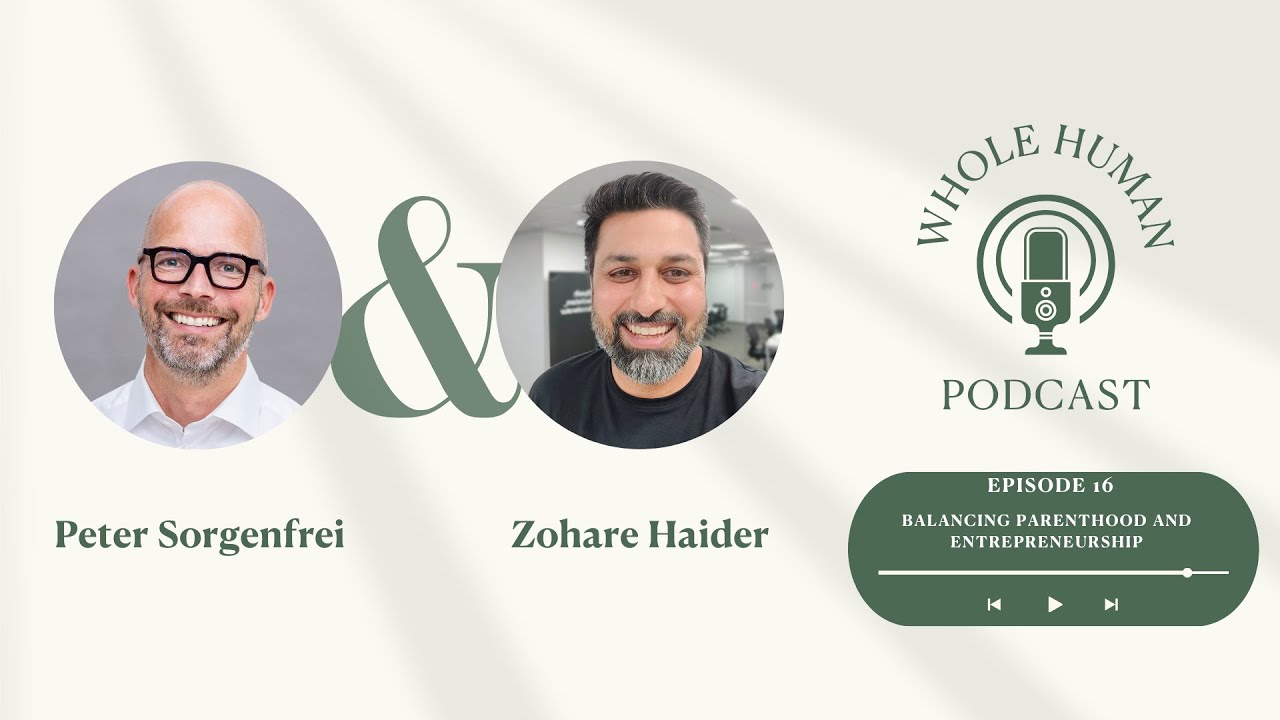
In this Whole Human Podcast episode, host Peter Sorgenfrei interviews Zohare (Zohir) Haider, co‑founder and CEO of Jalebi, a Dubai‑based B2B SaaS platform that gives restaurants, cloud kitchens and catering firms visibility into their supply‑chain and food‑costs. Haider walks through his personal background, the non‑linear genesis of Jalebi, a disciplined customer‑discovery process that led to a clear problem‑solution framework (industry = F&B, customer = B2B purveyor, delivery = SaaS, pain = cost/revenue leakage). He discusses early product pivots, the importance of early pricing, and milestones such as Techstars 2021 investment, UAE Ministry of Economy Future 100 recognition, and recent high‑value customer wins. A large portion of the conversation shifts to founder‑level topics: building a resilient team (96‑98% retention) through radical transparency, flat culture, and humane policies; the interplay of fatherhood and entrepreneurship, legacy thinking, and teaching his young son about value, work ethic and money. Haider shares advice for founders about deep problem validation, aligning product to revenue or cost impact, and the role of maturity and personal values in sustaining a startup journey.
Chapters
Welcome to another episode of the Whole Human Podcast. I'm your host, Peter Sorgenfrei, and today I have Soher Haider with me, who is the co-founder and CEO of Jalebi. Soher is based in Dubai today. How are you, my friend?
I'm very well. Thank you, Peter. It's great to have speak with you.
So there might be a few of our listeners or the people who, who see this that don't know who you are. So could you introduce yourself and tell us what you're up to?
I would, I would expect most won't know. I'm not that famous, but I'd be happy to introduce myself. My name is Zohir. I am a 44-year-old tech entrepreneur. I'm based in Dubai. I've been here for about 13 years. I've been in the Middle East for about 14 years. I started in Qatar, originally from Pakistan. I was born there. I was pretty much raised there, educated in the United States and, you know, been a worker and a money earner for maybe 20 plus years now. And I think the gray hair maybe substantiates that. I'm building a company, which we'll probably talk a little bit more about a little later, but it's basically a SaaS company working in the F&B industry. Trying to help F&B businesses like restaurants and cloud kitchens and catering companies to improve their supply chain and their food costs by understanding their raw material and inventory consumption across the whole operation. I built a couple of other companies before this, and I've had an exciting career.
And you've been, you're also an investor, right? You're an angel investor in a couple of companies.
I am. Yes. I've invested in a few companies, some tech companies, some traditional companies as well, like to kind of you know, I mean, it's like, let's not make a thing out of it. They're small checks. But I think, you know, really the idea of diversifying your own money, but also putting conviction where you're looking for it yourself. I think it's kind of one of those things where I believe that if you do something in the universe, it'll find a way to give it back to you as well.
That's, that's actually an interesting framing that I haven't thought of that when, so I've built 6 companies, right? Like over the last, you 20 years or so. And of course, I was looking for money a lot. And so having that empathy for somebody else now building a company— and so my impression is some of, of our colleagues that are co-founders and founders of companies, they don't really consider themselves traditional angel investors, but they look at themselves as people trying to support others who are pursuing a dream, just like they sought out the support of somebody before them, right? So, so maybe that's a way to think about it. So what caused you, what, what, what, what caused you to start Jalebi? Where did the idea come from?
Oh, um, I guess it's never really a straightforward journey, extremely nonlinear. So the genesis was basically a small workshop between myself and my co-founder and a few other people. It was June or maybe May 28th, 2020. My co-founder and I had met under the pretext of my first company, which I'd started 15 years prior to that moment. And I was trying to reinvent it, bring it to the Middle East somehow. And I wanted a co-founder. So I met with him. COVID basically, the time that my co-founder and I had spent working together and kind of building a relationship, it had only been a few months that we'd met, maybe 9 months. And COVID just kind of threw it out the window. It's like, you're not, you're not going to build anything together. Not this company at least. And I needed to go to bed. My wife is very happy that it died, by the way, by the way, just don't tell her that. So we kind of, we'd resolved that the two of us wanted to continue working together and we wanted to stay in the F&B space. That's a space that we're both very passionate about. We have experience working there in some way, shape, or form. And we wanted to take our learnings from the past experiences, but try and avoid the big pitfalls. Like for example, we did not want to do a B2C play. We want to do a B2B. And it had to be a SaaS play. And it had to be something that was solving a large and unique enough problem that nobody cared about, as in from a technology competitor point of view, but was a very deep and searing pain that the customer or the end, you know, beneficiary. So we, we didn't really arrive at a kind of, this is what we're going to build. We just came up with a framework. We said SaaS, B2B, and product, not service. Hmm. And we went on a journey of about 18 months to kind of, let's say, learn about the value chain of F&B, really try and dissect it by process of elimination, start where most of the usual suspects do, which is very far out on the demand side and try and see, okay, how do we help the business generate more revenue? Right. That's what we were thinking about because that's what most people do is like, that's what businesses will adopt. And we had a few business models. We tried one, we failed it. We tried another, we failed it. We went from You know, organizing the aggregators, the delivery aggregators to building a QR pay-at-table solution, which became very popular about a couple of years ago. And these are very early on, right? When we arrived at what Jalebi is today, that was about 18 months into this process. And this was great because we had spoken to maybe 500, 600 customers and many, many people had kind of validated or invalidated our thought process. So I really like to believe that The customer discovery process led us to where we are today. And it's not like we're a roaring success, but we've got our accolades and successes that we're happy about. But what really kind of led us to start this company was a pure and I guess earnest desire to solve a very, very deep and let's say largely ignored problem in F&B.
I'm going to allow myself to summarize what you just said because It is— you did it brilliantly.
Oh, thank you.
It is something that a lot of certainly first-time founders or people coming into companies don't do, and therefore they end up struggling, right? They jump straight into the pool instead of kind of thinking about, should I be in this pool? And so my, my simple summary of what you said was we knew what industry we would be in, F&B, We knew which customer in that industry we would target, the B2B player, so the purveyor of the F&B. We knew it was going to be a SaaS company. We knew we're not going to be suppliers of coconuts, right? Yeah. We knew we were going to do a technology company that was a software as a service business. And then, and here's the kicker, then we spent 18 months studying deeply the value chain to kind of figure out where was there a problem that was big enough, a pain that was big enough for the customer that nobody else cared about.
And can I take you to my investors right now?
Well, I mean, I just, you know, you sent it. We're going to send this episode to your investors because, yeah, because that's it, right? You really try to understand where's the biggest pain, and then you started setting out saying, okay, can we solve this with a, with a SaaS? And convince the B2B guys to buy it. Yeah, we think we can. And then you started building stuff. Then you started talking about it. Then you started figuring it out, right? So, so I think the lesson here that lesson number one of this podcast, and we're in, you know, we're seven minutes deep. So this is really nice stuff. Is spend more time understanding if the problem that you think you're going to solve. Is it big enough and valuable enough for your customer? And that doesn't mean asking a couple of friends and asking a VC or asking your mom. It means going into the market, really understanding the dynamics, really understanding also the competitive landscape. I mean, I'm not saying you shouldn't do something if there's competitors because that just means that what you're doing could be validated already.
Yeah.
But please do that work. And, and so here just gave us the framework. What industry, what type of customer industry, what kind of delivery mechanism, SaaS, what kind, how do we find the problem and the pain? Those are the 4 things that we need to do first, and then we get started.
And if I can just kind of, you know, sweeten that a little bit, there's this urgency to sort of establish a, a commercial proposition and a price point very early so that you can prove revenue and, and traction. And I think there's this, I guess, confusion about what's more important. Do I set a price point that people will pay, or do I validate that there is a price that makes sense for what people believe is a valuable enough problem that they're willing to put money towards? Because if, you know, you're, you're in this cat and mouse game of, is the problem big enough that they can put a value on it? And then we could take a share of that value and make that our revenue. Or do we go and say, hey, listen, this is the product. These are the 10 features and this is the price we're going to charge. Take it or leave it. And that's a problem. That becomes a challenge. We actually started off like just throwing it away for free. We're like, just get people to use it. Just punch buttons. It doesn't matter. And today, in fact, we signed our— sorry, today I was just going to say today is actually significant because we literally just signed our highest value customers to date.
Congratulations. If there was a button in this recording app where I could do like fireworks, I would, but I don't think there is. And balloons. But there was another thing you said, Sohail. Yeah, exactly. Let's try and see if Apple picks it up, right? You said something else which I think is quite significant. Again, we all know this, but not a lot of people do it. There it was. There comes the thumbs up.
Actually, this is the one. Yeah, there you go.
Oh, there it is.
Balloons.
Fantastic. Anyway, which is you set out to find something that could either— no, well, actually, you said set out to find something that could generate more revenue for our customers.
Yes.
And that's the other kind of equation that's missing. How does what we do either help our customers save money or make more money? There's no, there's no in-between. I mean, if you can do both, brilliant, but you have to do one of the two.
Yeah.
And I think, you know, many of the founders that I come across, certainly the ones that are on their first business or even their second business, are too enamored with the technology right now, it's AI, right? Everybody says, oh, or well, is it actually solving a problem that a customer has that's big enough that they want to pay you money to do it? And have you proven that it's going to save them money or make them money? If you don't have clear answers to those, no wonder you're going to be rejected by investors and potential customers, right? So remembering to, to identify the ways you're either going to reduce cost or increase revenues for your customers is paramount.
100%.
So, you know, you said we're not there yet. And obviously, by no means, we're not perfect. You've been going for 3 years and some months at this recording, like 3 years and 8 months or so. What were, what were some of the key successes along the way? You know, what were some of the points where you're like, yeah, we got it, we figured, we figured something out that's important?
I think the first You know, and it's not like when it happens, you realize it, but I'd say the first one was the right co-founder. I think that's a very critical part because it's like a marriage. Many people talk about it, but don't really appreciate how similar they are. Getting into a relationship with someone on a shareholder and a cap table is not different from a marriage certificate. But then you also have the validation along the way. You'll have tremendous amounts of rejection. I think another success for us is the scars that we've acquired over the years without steering off and, you know, losing conviction. It's not measured in the same way, but I think a way of culminating that would be the time that somebody said yes to us the first time. The first one would be maybe there was this startup platform in UAE from Sharjah, which is a city. But I think the big one was Techstars. When Techstars originally invested in us back in 2021. And at that time, we hadn't actually arrived at the final conclusion of what our product is going to be. At that point, it was just, okay, great founding team, doggedness, you know, really focused on a problem. And it seems like they're going after an old problem, not like creating a new one. You know, it's not like AI this and ML that, but this is like, let's go back 30 years. Another 3 really important, I think, milestones would be we were recognized at the end of last year by the Ministry of Economy of the UAE as one of the Future 100 companies. In fact, the award is sitting right behind me. That was really important because that's the federal government of the United Arab Emirates basically telling us you are one of the 100 companies that actually align with the economic agenda of our country as a startup or an SME. And that kind of, you know, being on that kind of a podium where you're going and shaking hands with ministers of state and being recognized for whatever you've achieved, whatever you've done, you've basically, you know, gotten to a point. And I think the last one would be really sort of kind Kind of being able to go back home and still feeling as excited about what you're doing after all this time, it's very easy to like kind of get bored or lose interest. Every day I come back with more vigor and I think that really kind of comes from 2 things. One is that every day you're unearthing a little bit more that continues to demonstrate to you how much more you still have to learn about the problem because it's just so damn big. And then the other part is like your home life, right? Like I think for me, my wife and I, you know, we've been together now 17 years next month, actually 19 years engaged for 2 years. And, you know, we were co-founders together. We have recently had a kid 5 years ago. And so we've been through a journey together and our relationship has become much stronger, much better in this period. And I think these are really foundational elements that Helped me be a better founder. So I think these, I mean, they might not be conventional, like, oh, we won 10 awards. I mean, we did win a bunch of awards, but the one I mentioned is important because of what it represents for us, right? It's more of a morale booster than anything else. There's no reward with it. We won startup pitches and everything, but so these are the, I think these are the markers for me. And I really kind of look back and say, okay, where was I 6 months ago or a year ago or 3 years ago? And have I improved?
So, so I think it's no secret that you and I both have a little bit of gray hair. Mine is just only in the beard. Do you, you know, putting one of your success markers as I'm still excited to work on this problem every single day, and the fact that you and your wife could be co-founders and still, and you said become tighter, is that because of your maturity? I mean, do you think that would have been the same if you were 25 years old doing this? I think it's a combination of that.
That's a great question. And just to clarify, she's not the co-founder in this business. She was a co-founder in the last business. Yeah. But yeah, actually probably part of that, part of the safety, the comfort of us came that we co-founded, ran and operated a company and then we knew when to get out. You know, that's a big important part, but I think it is a very, I think we've made great choices in our life and I have no regrets about how they've turned out. I definitely think that maturity is, is, is not something inherent in a factor of just completing the time markers, but I think it's the doing of things that you can look back on and say, okay, I've done this before. It's familiar and I can do it better the next time, whatever it is. You know, having a kid late is very atypical in our culture. Typically people are, you know, out of the wedding door and boom, they've got a kid, right? Like 2 years in, they're already maybe 2 kids. We waited like 13 years before having a child and Being a father and a founder of a company around the same time, I feel like the maturity as a person that I've acquired has really allowed me to be much more level-headed and more focused. Resilience has not changed, but I think those 2 characteristics in the beginning, they're really important because I agree that the maturity is definitely an index that it cannot be underscored at all.
And now you mentioned that you're a father and a founder, right? That leads me to, I wrote I've written a fair amount about this topic because I have a 12-year-old son.
Yeah.
And so, you know, one of the things I experienced was having a child made me a much better founder because it caused me to be more focused. It caused me to be more conscious of my time and what problems I was working on. Obviously, as you know, and anybody who listens who's a parent knows that it's the most wonderful thing in the world, but it can also be trying at times, right? That your patience and the way you communicate and Getting them to put their socks on in the morning and trying to do a Zoom call without interruption. There you go. And it's funny how when the phone rings, they always need something from you, right? They come over and then it's like, it's kind of like magnet actually. But, but, but, but so, you know, you, you had your child at 38, 39?
39. Yeah. Yeah.
So, so very similar to me. Is, is your child old enough to understand what it is that you do? At this point, or is it just too early?
You know, he knows the name of the company. He knows the logo. He knows the, he knows how to pronounce it. He knows what work looks like. He thinks that work for me is like being on a call with a bunch of people all the time, which, you know, for the most part, it can't be. He knows that I work in the food industry. He doesn't necessarily understand what an industry is, but he knows that I deal with something to do with restaurants and food. And he knows that every time we go out to eat, which is much to the dismay of my wife, I will always without fail ask them what system they're using there as an opportunity to business.
Leave a business card.
My wife hates it every time, but my son is always very intrigued. He's going to turn five in October, but he's very perceptive.
I'm gonna I'm gonna not be very popular with your wife now because I'm gonna give the business card to your kid and have him walk up to the restaurant owner or the whomever is seating you and saying. I like this. Please help my daddy's business succeed.
I love this. That's, you know, from a father and an entrepreneur to another, I will accept that. I will take the consequences that come with it. Who says no to a kid?
You'll have to call and let me know when you close the first deal and your son is actually done. But I'm asking about this because one thing that I thought about after I became a father was The legacy. Yeah, I was. I was. So at the time, my the businesses that I had when I had him were helping companies sell more stuff, right? So I had Coca-Cola and American Express and United Airlines and all sorts of companies like that as clients. And honestly, I was like, do I want to be? Do I want my son to look at my his dad and say, my dad helped? Coca-Cola sell more soda.
Yeah.
And so I had a little bit of a come-to-Jesus moment. I'm not religious. And if you are, anybody—
I've had one too, by the way, a few. I'm not even Christian, but it's a good—
I mean, it's like, do I really want to do that? So I started thinking about, you know, what is it that I'm doing? Because we have a choice. People like you and me have a lot of choices in the sense that we We're not really good at being employees anymore, right? So we have to start something ourselves. So I thought about what is— what am I going to do that, well, my son can point to in the future and saying, you know what, Daddy was part of getting people to eat healthier, or mental health, which is what I mostly work with, right?
Being—
have you had those thoughts yet or not?
Or? You know, so I'm a bit of a romantic, I'm a bit nostalgic, I think a lot about my childhood and kind of really reflect on how that's turning out for me as a father and for my son as well. And not in a way to kind of, let's plan, you know, what the outcome needs to be. It's really just trying to be a good dad, right? And being a dad that's responsible, that's there when I need to be. And also, you know, routine oriented, right? So my kid knows when to expect me, when not to expect me, because these are also important. And these are, by the way, characteristics my wife has infused in me. I was very disorganized before that. Suffice to say, I'm a diamond in the rough. If it's okay to say that.
Please.
But I think, you know, really kind of thinking about how to kind of transcend what I'm doing and how to be able to sort of, so if the question is about creating legacy, that's something my son can carry on down the road. You know, I wondered, my dad and I were about the same age apart. He was about 47 when he had me and, you know, he's 92 now and, you know, still living strong, but he had a business for a while and I was 12 when he shut the business down. I knew what he did. I used to go to his office every day and, you know, play video games on the computer at the time. It was the '80s and '90s, but, you know, and he was very advanced for what he was doing at the time, a fighter pilot before that. So very analog, you know, career to a very like, you know, anyway, but I wasn't the gap between when the company shut down to when I started working was just too wide for me to really kind of inherit anything. With my son, I think I'll probably, if I don't exit from this company at some point in a good way or otherwise, I'll probably have built another few companies in the meantime, right? But what I want to do, I think instead is really kind of inculcate this culture and ideology in my son, kind of like I think what you're sort of really alluding to is the idea of thinking really freely and thinking really enterprising about enterprising opportunities in ways that are non-conventional, right? So for example, in In North America, it's very common for kids to learn how to sell lemonade with the lemonade stand outside on the side, right? Sure, it happens everywhere, but it's very popularized because of Hollywood. And just the idea of learning how to be able to give something in exchange for something, that idea of currency is something we started to introduce to help them understand money and relationship with money and the expense of things. Can't just point at something and expect it's just going to appear. Santa's not going to come.
Yeah.
But I think just trying to figure out how to be able to sort of help him understand the importance of why we work and what we're trying to do, whether it's for our company, whether it's for ourselves, and just being able to understand that the importance of all of this is not because we make money so that we can do the things we want to, but we do the things we want to and we'll make money on the process, but we'll also add value and help other people in that process. I think it's really just about good values, right? And passing those on. And I probably butchered your question completely, but—
No, you didn't. And a good answer is incumbent upon the questioner, right? So I should have been clearer. But you mentioned some things that got me thinking because we're going to talk a little bit more about our kids. And it just happens with this podcast that we end up in random places. But teaching our children The value of money, right? In a world where increasingly now you live in Dubai. I don't know which part of Dubai you live in, but when you live up where I live in Copenhagen, you think of Dubai as excessive wealth and everybody drives a Lamborghini, right?
That's pretty much what where I live. It's exactly like that. The Palm Jumeirah. I'm doing something wrong then.
But but but but my son sees this, right? He sees that on different social media, and so. What I tried to talk to him about when it comes to understanding the value of money is to say, like you did, there is an exchange of some sort. You have to create something that somebody finds valuable. But what that is has changed, right? It used to be that you would farm the land, pull up the potatoes if you're in my regions, and sell those potatoes, and somebody would find that valuable. But today you can make money, literally, on sharing information that you have in your head. And somebody might find that valuable, right? So, I was trying to say, you know, value can come from many things. But the thing that matters, and this is my punchline, is that you, my dear son, enjoy doing what you're doing.
Yeah.
Because you can make money as a carpenter, or as a banker, or as a TikTok influencer or whatever. There's going to be— when he grows, you know, in 6 years, When he turns 18 and sort of needs to really start making his own money, who knows what he'll be able to make money on. So, my conversation with him was around saying, as long as you like Sohail, wake up, enjoy going to work, are energized about what you do, then you're doing the right thing.
Yeah.
Second subsection, and please don't hurt anybody else in the process. Right?
Yes, absolutely.
So, you know, if he grows up to be an arms dealer, I, I'm not sure I would be proud, but beyond that, you know, he can pretty much do whatever he wants.
Yeah, no, I hear you. It's, you know, it's, it's hard, right? I think we make it harder for ourselves. We're already under a lot of pressure from a lot of people, a lot of expectations, but kids, you know, just something that you We might try too hard and sometimes things are just going to turn out. You just have to really kind of focus on the good value system, which you just said. And I think really it's just an enabling environment. Hopefully there won't be alarms.
We've, we've spent a fair amount of time talking about our kids and I appreciate that, but we are getting to the point where we have to wrap up and I might ask you back for another episode because we're not really getting into All the exciting things that we had in our pre-chat. I want to close off by talking a little bit about one of the things that you've done, as I understand it, very successfully. You've essentially retained 98% of your team throughout this journey.
Yeah.
And I say that's remarkable because of the, you know, you're in a SaaS, B2B SaaS business. You're in a market where talent is not plentiful. So people are probably going to be, you know, asked to come join your competitors or join other companies. How have you done that? How have you retained such a high number of your team?
And, you know, just to kind of give you back a kicker, the numbers maybe changed a bit, maybe more 96% now. But it's very marginal. Yeah, it's absolutely catastrophic. I'm sorry. I also want to add the fact that as a tech company trying to build at an early stage and reliant still very heavily on, you know, external capital when revenue is not possible, raising money in 2023 was like, you know, trying to drive, you know, a snowmobile in a sandstorm with no goggles on. And we, I think, you know, we're, that's why I started by saying we haven't really kind of conquered much, right? I think when you think of the, hey, we're incrementally moving, but I think the real trick has been when we saw the adversity of what building a company and operating at a time when you have very scarce resources financially and otherwise, we had 2 choices. We could either be the kind of people that just go in hoping for the best and just keep people informed with what is absolutely essential and nothing more. Or open up completely, become transparent, engage everybody at every level of the organization with as much relevant information as possible without creating any panic or fear, but letting them know that, look, things are going to be tough. They've been tough as a startup, but they're going to get really tough because you might have days when we might not be able to pay you a salary, where you might have a landlord coming, banging down your door and threatening to kick you out. Your family member might be sick and you have a deliverable that just cannot be excused. Like, There are going to be some complexities that we're not going to be able to necessarily have a playbook to navigate around. So I want you to know that, you know, we're going to go through this together and we're going to deal with it together and whatever we need to do, we'll figure a way out together. And ultimately, I think that was probably the single biggest sort of factor in keeping the people. Our team has grown with us. Yesterday we announced 3 of our first employee, earliest employees who've You know, been with us for 2 and a half years in the company. And because, you know, the beginning of the company was just me and my co-partner and a couple of ragtag people, right? But, you know, we're now like over 30 people. So team surged over the last year and a half. And mostly the retention I'm talking about is like people who've been with us for at least more than a year, right? And that in a short lifespan of 3 plus years is pretty good. And the biggest reason was because we just kind of opened up and said, look, We're not going to hide anything from you. We're going to tell you how things are going. You know, if we're running out of money, we'll give you enough time that if you need to jump ship and go and do something else, we'll give you the respect and do that so that we don't just show up one day. Because I've had bosses do that to me in the past and be like, we ran out of money a week ago. Sorry, we're not going to make salary this month. Right? It's like, what? Like, I have a rent check coming up. You know, I've got like school kids that I need to, fees that I need to pay. Right? So while those things can't be moved, but at least you're prepared. And then if there's things that we need to do around that, and I think that's what it is. So. Yeah. We've been through the worst of it together, and I think that we'll really, really relish the best of it together. And I think if you don't build good team culture, and culture is not nice laptops and team lunches and BS like that, honestly, I think that's really kind of fairy dust and sprinkles. But the real stuff that matters is getting down at a human level and basically telling people, look, when we say we're a flat organization, it definitely means there's no sir, ma'am or anything like that. But more importantly, it means that if I've done something wrong, you can call me out on it. And it also means that when we're winning, we're winning together, but if we're losing, we're also losing together. We're not going to do things in isolation. And I think if there's one thing that I found even today, a lot of founders who ask me the same question, like, how have you held onto your team even with like, you know, bare bones or fumes in your bank account? It's because of this. It's because I've actually encouraged people to leave the company with 3 months notice and we'll pay them for that time. And they've refused to do that. They've dug their heels in deeper. And it's a very bizarre kind of almost like reverse psychology that you don't intend to work, but it does because there's just so much conviction. And that's something you can never pay for with anything except for really just truly connecting with people at a human level, which I think really ties into the theme of your podcast.
I think on that note, we'll have to end it here. It was, it was wonderful to speak with you again, Sohail. Thanks for joining me on the show.
It was my pleasure. Thanks, Peter, for having me and talk to you soon.
And for everybody listening or watching this, this was another episode of the Whole Human Podcast. I'm your host, Peter Sorgenfrei. If you have any founder CEOs that I should talk to or any topics that you want me to cover, please let me know in the notes where you're listening or watching this or find me online. That should be pretty easy. And I'd be happy to record an episode just about the topics that you care the most about. Thank you so much.










