Bridging the Gap Between Tech and Service for Small Business Success w/Christine Telyan
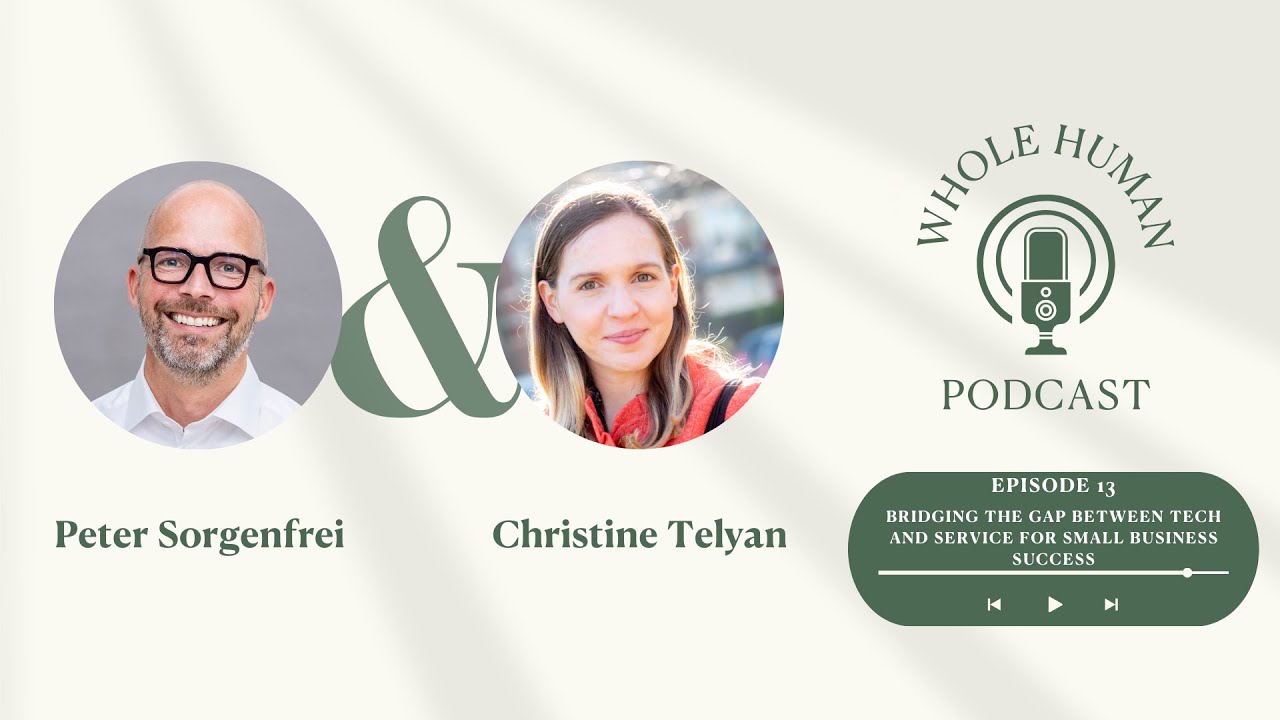
Christine Telyan co-founded You and I to build websites for micro-businesses in seven days for under $200. Two-thirds of the 33 million U.S. small businesses lack a satisfactory website, and DIY builders and agencies don't serve them well. UNI switched from freemium to paid, which improved customer quality, and now operates a 140-person remote team with a 30-day refund guarantee.
Chapters
Welcome to another episode of the Whole Human Podcast. I am your host, Peter Sorgenfrei. With me today, I have Christine Tallian. Christine, welcome on the show.
Yeah, great to be here.
Good. Christine, For the people who may not know who you are, could you please tell us a little bit about what it is that you do and your background?
Yeah, I'm the co-founder of You and I. We help any small business get online. So we'll build you a fully functional website in 7 days under $200 and help you with your maintenance and digital marketing.
That sounds amazing. A fully functional website in under 7 days for $200. Typically, my podcast is not a pitch thing, but that's just too incredible to sort of let go. How do you do that?
Well, it's taken 10 years and it's been kind of a long journey, but what we really kind of latched onto right at the beginning was that for this demographic that we're trying to serve, which is really only the small business owner, the very small business. So, A sole proprietor, you know, some group of few people, right? For them, they need more than technology. They need also to marry that with service. They need to kind of be shepherded through the process. And so what we've really kind of been researching and invested in all these years, how do we optimize this process of building a platform that is integrated with the human side of it to be able to deliver A solution like this, low cost and really still at a high quality.
When I first met you and we spoke about this, I immediately started thinking about what kind of business could I come up with to test this service.
Did you do it?
And I have a few ideas just because I was curious to see, you know, if I— so I've been doing this for 15 years. I've started 6 companies, you know, But if I was— I was gonna say a hairdresser, but that's kind of funny because I'm bald, right? But if I was doing something else, what you do sounds tremendous. I mean, how do you keep up with demand? There must be so many people who want this.
It's, you know, it's funny. It's, it's a huge market. And although, you know, you think about websites, this is something that— isn't this a problem that's already been solved? There are a lot of players out there. But it is a very underserved market. So take the US itself, about 33 million small businesses, right? The fact is staggering. 2 out of 3 of them either don't have a website or aren't happy with the one they do have. And that's even though there are all of these players out there. And you know, what do you have? You have the do-it-yourself website builders on the one hand, so the Wix and Squarespace, GoDaddy, and you know, they're amazing products. Platforms, but they're amazing in the hands of people that know how to use them. And there are millions of freelancers and web devs out there that do use those platforms, but in the hands of the small business owner that we work with, it's a struggle. And you see, I mean, a lot of these companies are public companies, so the data is out there. You know, only 1 to 2% of the people that start on the, let's say, a freemium product with them ultimately convert to a paying subscriber. That means 98% are not completing the journey because you need to be on a subscription to have basic things like a domain and sell products and bookings and so on. So if 98% are failing, I mean, that tells me a big part of the story. And that's even with the millions of freelancers that are using these platforms to serve the other end, which is, you know, if you go to an agency or a web dev, they'll do it for you. But there, you know, go on any of the platforms, Upwork, Freelancer.com, They will show you, you know, the minimum ticket is maybe $1,500 for something decent. And then, and then what? Let's say you launch your site. Who's going to maintain it? Are you going to learn the CMS as a small business owner? And so this is kind of the, you know, long ago, this was kind of the space in which we kind of identified that we needed to play. I think part of it is that neither my co-founder or I are software engineers. And I think because of that, we had a little bit more empathy with the small business owner about the now, like tech will solve everything in the long run. But all that, you know, how long is it going to take for websites and media to trickle down to these business owners? And certainly not all of them will, will benefit. So we saw that for this demographic in particular, and we only focus on these kinds of businesses. They did need more and we did need to bridge this whole gap of tech and service, which is something that big technology companies don't want to do. They just don't want to touch service.
Right. And you mentioned your co-founder and the situation there is also not as common as everybody else because your co-founder is also your husband.
Yeah. And, you know, I think the conventional wisdom is don't do it. Like, just stay away. And I think not just with spouse, like with a friend or family. You know, but I'd take the other side of that argument based on 10 years of doing it. You know, there, there, when we were starting, there was an interview I saw with another entrepreneur, successful entrepreneur who started a, uh, business with his wife. And the interviewer said, I could never start a business with my wife. And, and the entrepreneur said back, I could never start a business with your wife either. It, it, it's really about the individual. And I think in our case, there are a few things line up and I, I think it's a little bit of, I don't know, sage wisdom for anyone out there thinking about doing it with somebody close to them. You have to have a common vision for the business, like the big picture. Are you aligned? And we've been 150% aligned on what we want to do since the beginning. And that's really stood the test of time. Do you have complementary skills? Otherwise you're going to be stepping on each other's toes. And especially when you get started, you have to be stuck in and do a lot of things. So you have to fill the spaces differently. Do you have a common lifestyle, I think, a common approach to living. I mean, if one is a workaholic and the other one kind of has a more traditional work, you know, view of work, that's also not necessarily compatible. And I think that, you know, in our case, we kind of joke with friends that it's like our first child, you know, like the older responsible one, because we have 2 smaller ones. And it is a little bit that, you know, we care about it. So yeah, we'll talk shop in the evening. And it's not, it, you know, it's organic. It's, it's because we care about it. We have ideas and it, it works. It works in our life. So you have to kind of know that rhythm. And, and then I think from a practical point of view, you also need to figure out, um, those milestones. So there is some security in kind of financial planning. You're going to be without income for some time.
Right.
You know, you have to make an agreement. This is what we're going to do. And, you know, because you can't do this if you're worried about the basics. So you have to have some guardrails there.
And you can't do this if you're worried about the basics, even if you're not doing it with your spouse, right?
Well, indeed, that's very true. Yeah, yeah. You just are double levered in this case. Yeah.
Indeed, right? You're basically both jumping into the boat and not having somebody standing on shore with a safety net of some sort, i.e., a corporate job. And then we can discuss whether that's a safety net. But I wanted to highlight the 3 things that you pointed out, and you might have to help me here. So, because this goes for working with any co-founder, right? Are we fully and completely aligned to the vision of this business? Do we want it to be the same thing?
Yeah.
Was the first thing you said. The second thing you said was, do we have complementary skill sets? And that one, I want to touch a couple of comments on because oftentimes I see people founding businesses together and they say, well, you're the tech guy and you're the sales guy, broadly speaking, right? And the reality is that they both have strong opinions about the other area, even though they're not necessarily qualified.
Yeah, yeah, yeah. And no, it's a good point. And I think it is a little postscript to that point. Which is you have to have a process for decision-making. So, yes, in the areas in which, you know, I run or Ein runs, like we trust each other 100% that the buck stops with whoever's in charge. Hmm. We do have discussions about like important things. You know, I run marketing. Okay. So I, I may brainstorm. I say like, I'm thinking about this. What do you think? And in terms of having a spar— sparrings partner. who has total aligned interests, like that's wonderful to have that discussion. But there are times and there have been like significant moments where we had a difference of opinion, but that the owner has to step up, take a decision and own it. And there have been times where we've disagreed and we've each had to kind of live with that and for the better. Totally. So you have to be comfortable with that. If you're going to have your nose in the other person's business. It's also not good for the team because they lose clarity on, well, who's deciding here, you know?
And again, that also goes for non-married co-founders.
Oh, absolutely. Anybody. I mean, yeah.
Yeah. So, so decision rules is another important aspect of this. And I think maybe I'll do an episode on decision rules altogether because that's something that a lot of founding teams struggle with. And then the third thing you mentioned was around I think you said, you called it lifestyle or sort of approach to working or not working. And I think that's a key one to elaborate a little bit on too, because people typically get into business together and saying, yeah, now we're gonna give it our all. And they say that they have a safety net or they've made savings and stuff.
Yeah.
But the tolerance that I have for financial pain versus my co-founder is definitely going to be different.
Yeah.
Because we are 2 different humans, right? So, so figuring out with whomever you're starting a business, when it starts to become painful in terms of when you can't make your income or when you, when you're working too many hours and can't kind of defend it with the people around you or whatever it is, I think is a really important conversation to have.
It is. And it's also, I think, really tied to, you know, not being in love with what, you know, your ideas or what what you want to achieve, but rather, you know, okay, what's the reality on the ground? Like, is this successful? Are we going down the right path or not? And it is important to set like calendar timelines. I mean, this is one of my learnings, big learnings, you know, 10 years doing this. You know, one of the big kind of lessons learned, regrets, whatever it is, is, you know, I wish we got to where we are today a little bit faster. I mean, some of the pivots along the way, everybody will have them, right? I, I have yet to meet like a Okay, there's like Mailchimp, but like, you know, they're few and far between those, like those companies that aren't going to take some decisions, but, you know, doing them faster. And sometimes, you know, you just have to be a little bit more brutal about, about it.
What, what, what do you think prevented you from making those decisions? Why do you think you were wavering at those points? Are there any decisions where you can be like, that one I actually could have taken faster, but I didn't because ABC?
You know, sometimes things are kind of working. So, like, you know, we, we were doing a freemium model for a while.
Mm-hmm.
And we had some cohorts that were, you know, converting to our SaaS at 10, 12%. Like, that's really good. The, the, the payback on the, uh, acquisition costs wasn't that long. Like, it was, there were a lot of things, but the path to scale was too slow. And not only that, much more importantly, the customer that we were bringing in on freemium just wasn't as committed. And, and that impacted like their engagement with the product, how long they stayed with us, all this. Whereas moving to a, you have to make a small commitment because affordability is a, is a through line in our, in our business, a small commitment, but you make that commitment upfront of dollars, just really cultivated, you know, it attracted a much more serious, more committed customer who really want, you know, this was the right moment for them to do this. And it's the counterfactual, right? You don't know when you're running and you think it's working, like, let's optimize, let's tinker. When you work with small businesses, you have to tinker, tinker, tinker. You know, is it a tinker or is it a hard pivot? Right? And, Right. you know, we, we decided like just the pace was not there and, and I think it was really quality of customer that forced our hand.
And I think you mentioned getting a commitment causes people to be more, well, committed, right?
Yes.
I think a lot of businesses are realizing that they have a free version and then you can kind of upgrade to something more and more premium kind of experience. The one that comes to mind for me was Basecamp or 37signals, which does like a CRM, right? At some point, They're like, oh, we have too many variations of this. Now it's just going to be $99 for everybody from the bat. You know, when you start using us, it's $99 a month. I think it is, right? Which for what they're providing is a lot of money with all the alternatives. There's plenty of alternatives if that's $5, $6, $15 a month or whatever. But they were like, well, that's fine. You can go there. But if you want to be with us, we want you to commit to our platform and use it. And one of the things that they saw was, yes, they lost a significant amount of customers in the short term.
Right.
But a lot of people came back because they'd gotten used to the product and actually realized the product was worth the $99. And the other thing that happened was churn went down. So, the amount of people that left them dissipated. Have you seen the same things in yours? Totally.
Totally. I mean, I think There are so many things I think of about there. Like, first on the simplification, like reduce the menu. This is just such a truism, like in, in all businesses. You, you Starbucks now, which is an amazing brand, right? But they're running through this moment, kind of a tough moment, and the CEO of Chipotle's coming in and all this stuff.
Mm-hmm.
What is he gonna do? He's probably gonna just reduce the menu because they've had all this operational friction around the quadrillion choices of drink that you can order. Right? So there is so much virtue, and that's actually a lesson that I think we've done really well from the beginning, which is in our product, infinite choice for our customer is not, is not a priority. It's not, you know, you, you need to focus on what's important. So I think in that, them kind of rationalizing and, and doing that, we've benefited from that a lot, and it allowed us to put, to achieve operational excellence a lot more, more effectively, I'd say, and easier. And allow us to direct resources to the, the things that matter more. And so this is getting to a retention point. You know, we incorporate service and we have to do this at the low prices we charge. You know, that only works if you cultivate a customer base that is really loyal and is going to stay with you a long time. And it's because we've made these choices to focus on what's important. So on the sites, for example, like you need to be able to present the brand Authentically and professionally, you need to capture leads and be able to contact the business easily. You need to sell sell stuff, sell products, and accept bookings. All other stuff—information architecture, SEO design, whatever—we that's our problem as the web web design, and that's stuff we can standardize in a way that enables us to move efficiently from the perspective of the business. What They don't need to worry about that. And because we don't put that in front of them so much, it really helps kind of move things forward. And then we have resources to say, okay, let's focus on what is your USP? Let's make sure that comes out. The brand, which is not just font and logo, like the whole thing, right? Where is your experience? Let's make that sing and then have our team be available like as a constant, like You know, so many of our customers are, just get the peace of mind of being able to reach out to somebody from our, our team because the journey of getting online and being online and growing online is like, it's a mountain. I mean, you're scaling a mountain as a small business, right? And you kind of need a Sherpa, right? So for us, this starting with the customer selection around the commitment is like the And then simplifying the choices gives us kind of the resources and the bandwidth to provide the support that this demographic needs to be happy and to stay with us. And that bears out in long-term retention.
And it's— you mentioned SEO and information architecture and stuff like that. I mean, if, again, if I'm assuming I'm a carpenter or a hairdresser or something, I don't even need to know that those things exist.
Well, that's it.
As long as I'm getting a flow to my website and people are booking my services, right?
That's it.
It's kind of like the— and I don't want to be rude, but it's kind of like ignorance is bliss, right? In some ways, there are certain things that we don't need to know as small business owners as long as it's working. And then over time, as we get more comfortable with it, then we can dive into. So for example, I've been online for a lot of years. I didn't start thinking about SEO and know what it was until 5 years ago.
Yeah.
And so I think some of these people are on a similar journey. I wanted to, I wanted to touch a little bit more about your, on your team. So, so how many people are you today? How have you built the company? Who's, who's involved?
Yeah, we're 140 people actually. We are a global company. We are fully remote. We do have offices, but we got into a remote culture even, even before the pandemic, partly because, you know, we did have, you know, a big presence in the UK. With Brexit, there were a lot of people moving back to, you know, where, where they were coming from. It was hard to recruit talent. We just said, we're, we're, we're doing this fully remote thing, built a culture around that. And a lot of our operations is in the Americas because the US is our biggest market. So. The client service, the website design and build, and the success team is located there.
That's a lot of people to manage.
Well, I'm certainly not managing 140 people, but, you know, there is a, there, you know, we, we have, I think, not many layers of bureaucracy. That's for sure that I have, you know, 5, 6 reports and There is a very open door policy, so there is no real distance or daylight between you know I'm on G Chat and talking to people who are interfacing directly with customers if I need to. So we I think that the structure is really kind of as it's grown over time, but I think you know it's because it's grounded in the processes that we've developed, and so yeah we're able to. leverage management, I think, as a result of that. So it is, it is a lot of people, but I think it's a testament to the fact that we've kind of developed a pretty well-oiled machine around a lot of the services we deliver.
And, and I'm assuming with, with such a disparate— I mean, do you guys get together? Do you do what other remote companies do, like you're bringing everybody for, for a few days in the same spot and that kind of thing? How do you, how do you maintain that culture outside of Of chat tools and video calls?
So people who are located, you know, proximal will certainly get together. And I think, you know, as we are distributed, we try to have these kind of hubs and gatherings in the hubs. We try to do more of that. We have yet to do a global onsite, which is, I'm hoping for next year, but we do this more in a regional way. And yeah, once, twice a year.
That's a— it's an amazing story. And you started just 10 years ago.
Well, it feels like a really long time, but it is amazing. We are celebrating our 10 years and trying to make hay with that.
So, what's next for you and I?
Well, getting the word out, more partnerships, helping more businesses. I think that's the big thing. We have some really cool partnerships forthcoming, hopefully in the rest of this year. I will be excited. when, when we can announce them. Um, but the idea is really to work with partners, um, to either fold in UNI services into some of their subscription or member offerings, um, and widgetizing our offer, uh, so they can put it within their product and make it available to their customers. You know, AI is a real tailwind for us in the hands of experts. You can do a lot. We can build new tools. We are doing that. So that's great. And one other thing is in the idea of kind of reaching more small businesses, building some headless tools that allows us to transfer our, our processes to other platforms. So all our sites—
That you might have to unpack, because I'm not sure everybody will understand what building headless tools means.
Well, basically, so not tied to, let's say, a specific CMS, all the sites at UNI right now are built on UNI's platform and our technology. And, but there are other website building platforms. And so The ability to do what we do, but, you know, on other platforms is something that we're working on really just to, to be able to serve more small business owners. But, you know, for us, it's always been about that affordable, affordable, easy, quick solution. And no matter what we do, that's really going to remain.
So, and this is going to be a purely selfish question, right? So I'm a coach to founder CEOs, clients all over the world. Starting businesses is kind of my badminton, right? I mean, that's kind of what I do for fun.
Yeah.
So somebody like me who doesn't know how to cut hair or tend to a garden or, you know, fix the electrical wiring in a house, how could I use you and I? I have a website, I, you know, all this other stuff. How would somebody like me who's in a services business Go about testing your service and using it?
As a coach, we, we serve a lot of coaches actually. It's one of our biggest segments. It's, it's really very easy. I mean, the, the process is straightforward. So literally you sign up, you're presented with a questionnaire that we've kind of iterated over the years. If you have an existing site or some social media or things you've done, I'm sure you've a ton of content, Peter, like you present it to us, and we ask you questions, all in a digital format. And you book your call to meet with one of our onboarding guys. And we'll present you the site that we've built for you about a week later. At that point, if you want to make changes, we'll do everything for you, any edits. And, you know, very importantly for the small business owner, this is a risk-free experience because there's a 30-day, you know, no-questions-asked refund, which a very small percentage avail of, but It's there because we stand behind our product and we don't want anyone to be unhappy. If you want to really make the most of it, the, the, the thing to do is really join our growth program. So that's fast becoming our most popular one where you'd be paired with a growth marketing advisor and they meet with you monthly. They've created a personalized program for you. And the idea is they'll write SEO content for you monthly and meet with you to kind of deliver on your goals. So Maybe you have a lot of leads and you want to beef up your email marketing or explore new channels. They'll work with you on that. And the thing is, it's not like paying an agency to run ads. They're working with you understanding that, you know, we want to do the max ROI stuff first. And then, you know, reluctantly, maybe we get into paid ads and things like that. So that's, that's what I, you know, it's already here for you.
So basically what you're saying is, So if I had an idea, so I'm, you know, I'm working with founder CEOs, I love it. But let's say I wanted to do maybe a niche offer for first-time founders, or if I wanted to do something else, you know, my hobby is apples, right? So I wanted to do my apple cider business.
Okay.
I could get online and start getting an audience and start getting customers within roughly a week's time.
Yeah, I mean, you'll know, right? You know, it's not we build it and they will come. You got to work at it, right? Our most successful customers, you know, it is this mountain and Sherpa thing. Like our most successful customers know that they need help. And so they entrust people who know what they're doing and have done it for many, many people for many years, but also that they get involved in saying like, these are the services or these are the products I want to promote. This is what goes on in my kind of business. These are the seasonal things. I'm seeing others doing this and kind of working together on that. But you have a side business, you have main business, we see it all. So yeah, easy enough to try and fast. That's, that's exactly right.
This was tremendous. We'll have to round off now because I have to start writing on what it is I'm going to do with you guys. Sounds good. It was a true pleasure to have you. Thank you so much.
Thanks for having me, Peter. It's great.
And to the people listening, this was another episode of the Whole Human Podcast. I really appreciate your comments and questions. If there's anybody else you think I should have on, just let me know in the comments where you're watching or listening to this, or send me a note. I'm easy to find. Thank you so much and have a good day.










