Building an intentional culture for high performance w/Mark Zawacki
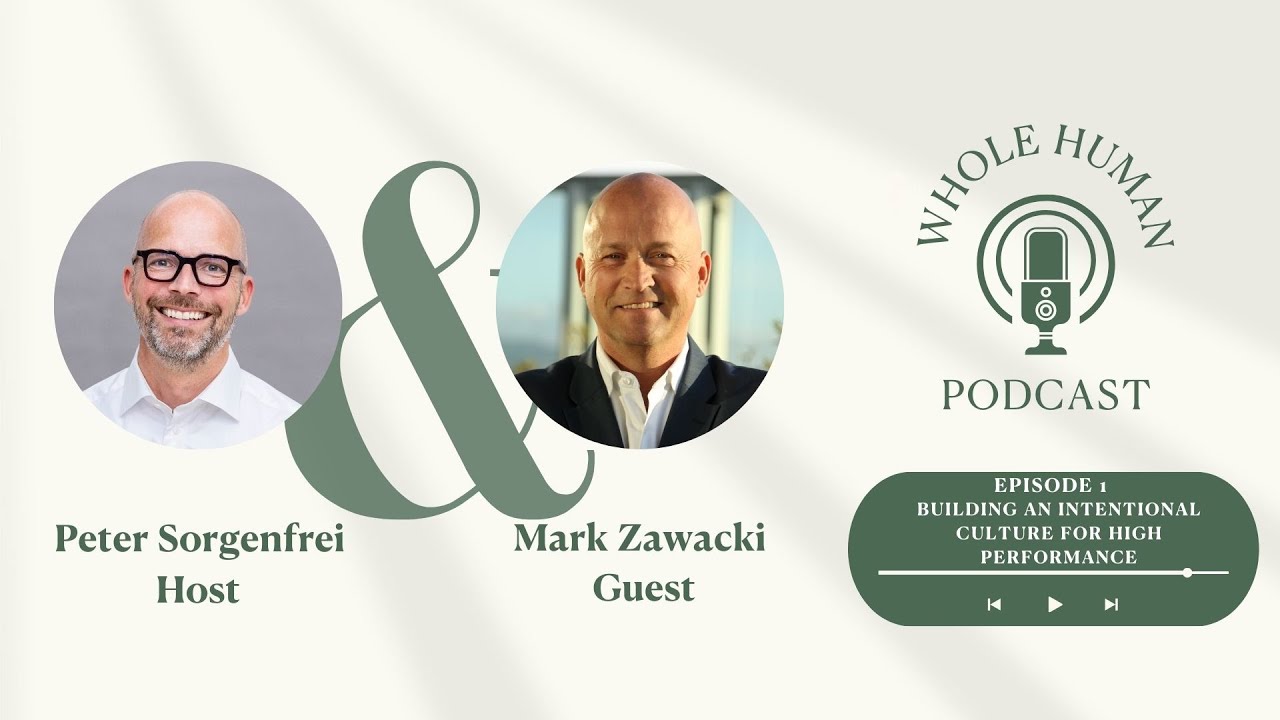
Mark Zawacki, a venture investor, explains how founders build high-performance cultures by starting with personal values and translating them into organizational ones. He advocates hiring for cultural fit over skills, using case simulations and off-script interviews to assess it, and structuring jobs around task identity, significance, and autonomy to keep people motivated.
Chapters
Welcome to another episode of the Whole Human Podcast. Today I have Mark Sawacki with me. Mark, welcome on the show.
Thanks for having me today.
So Mark and I had started chatting a few weeks ago, and one of the things that was Particularly interesting from his past experience was his focus on culture. So that's going to be the theme of our conversation today. But before we get into it, I'd like you, Mark, to introduce yourself to the people who may not know you, a little bit about your background and what you're currently spending your time on.
Thanks. So Mark Zawacki, a lot of people call me Maz. Funny story behind that. Those are my initials, but it became my nickname. I always have my whole career, I've had one foot in Silicon Valley and one foot in Europe. Where I've lived on and off for, for quite some time. Started out in tech, joined Symantec when it was a startup. They were launching into Europe. So I raised my hand and I said, sure, I'll go. 1 year became 7, stayed a long time. But after Symantec, I stayed in Europe and I went into management consulting and I worked for a boutique firm called Index where we were doing re-engineering all across Europe. That's probably first where I really had a lot of cross-cultural experience. Came back to the US, helped set up a venture fund. A lot of those venture investments were then getting into Europe. So I was back in Europe a lot more. I was an independent strategy consultant for quite some time at that time, working with very large multinationals, primarily in Europe across different sectors. And now I'm back in venture again. We have a fund focused on hospitality and everything related to that.
Very, very cool and very illustrious career going on.
So see, 5 jobs in my whole career.
Yeah, but still a fair amount of back and forth and also between being on one side of the table and the other side kind of thing. And it's interesting now that you're focusing on the hospitality industry and that's where you guys do your investment. How does that tie together with your focus on culture? The first thing you spoke about when we spoke was Culture. Is that connected to that somehow?
Or it is, it is in a very significant way. I've had the pleasure of working in about 80 countries and visited over 100. And that was, that's also a pretty deep experience in cultures. But as an investor, I, when I net it all out, teams matter and team culture matters. And I'd rather have a I'm paraphrasing John Doerr, who was an early investor at Symantec, later invested in Amazon and Google, did pretty well as a VC. But John said, I'd rather have a great team with an average idea than a great idea with an average team. Teams win. And under teams is culture. And so I got very early in my career fascinated with how these great teams, and underneath that, the great cultures truly succeed. I think culture is, at the end of the day, all we have as a differentiating factor.
And so when, how do you start off? Right? So I'm a founder listening to this, or we're a co-founding team listening to this. And we know that culture is important.
Sure.
How do we become intentional about it? How do we actually do this in a day to make sure that we create that high-performing team?
Intentional is the perfect word. And I was going to say intentional before you beat me to the punch. But it's this notion of what are 3 or 4 values? What are, what are 3 or 4 really important values that you personally believe in as a leader? And then how do you transpose that onto the organization to have those shared values and you reward those values and they're visible manifestations that everyone in the company can get behind? Um, to me, that's where it's got to start. It's got to start with the leader. with a vision of the kind of company culture that they want to have with the kind of organizational culture or team culture or work culture, however you want to define it, whatever box you want to put around it, but it's going to be a manifestation of that leadership team's personal values. And then how do you pass that on? And it ultimately comes a way of saying, this is the way we do things around here.
Is your impression that many of the founders that you meet actually know their values, that they've, it's quite apparent to them what their values are?
No, that therein lies the problem. They're busy building product. They're building, they're busy trying to find product market fit. They're certainly out busy raising money. They're out busy hiring. They've got 18 hours a day stuffed with tactical, I call it tactical, but stuff to do. And they lose sight of that longer-term vision of, hey, are we building a sustainable culture here that ultimately we're going to bond and connect around? I'm sitting here, it's quite early in the U.S. and I'm sitting here in Cupertino, California, across the street from Apple's headquarters. And they had a culture. They had a culture when they first started out and it was emblazoned on t-shirts and it said working 80 hours a week and loving it. Now you could argue that might've been an unhealthy culture, but it was a workaholic culture that just said, we're going to pour everything into this business and we're going to pour all of our— it's very intentional. And when you look at, I've got a lot of roots here in Silicon Valley where I am this morning. You look at the manifestations of the laundry on service and the free food and the beanbag chairs, but You look at all that's that, those are very intentional cultures that are actually supporting a workaholic. Maybe that's a bad word, but it's promoting a very strong work ethic. I'm trying to keep you in the office working as hard as possible on what we think is a big mission. So you don't go home too early. And all of those accoutrements are designed that way, good or bad, and we can debate it.
But, and I, and I think actually recently, and I do want to debate it, not because I disagree with you, but I think We talk a lot about culture. And so I just finished reading Walter Isaacson's Elon Musk biography, right? And Elon is also one that's very keen on working people a lot of hours and setting extreme demands. And so historically we went from, you didn't ask any questions. You basically went to work, did your work, and you went home. Yeah. Then we moved into workaholic people killing themselves, literally. Japanese sort of hardcore work culture. Then we came to in the last 20 years, I'd say we've started having more of a balanced approach. I call it work-life integration. A lot of people talk about work-life balance where colleagues and employees started asking questions and wanting to work from different places, that kind of thing. And now literally today I was meeting with a very successful fintech and the guy there is, I don't care about people wanting to work everywhere if they want to work here. They work in the office with me because that's what I know is required for us to succeed. So back to intentional. I think if you say, this is how we do it here, if you wanna be part of that, fantastic, but these are the terms, then whether or not you have laundry service to keep them there or dinner or whatever, people just need to know what they sign up for. Yeah.
Sure. And I, and I think that is happening. I think there's an intentionality. In this post-COVID world, there seems to be both in, let's say, in the technology sector as well as the financial services sector, hey, we probably need to get people back to work a bit more. And this whole idea of hybrid, well, first it was remote and then it was remote hybrid and now it's hybrid onsite. And it does appear to be a pullback to the office in the US and Europe, and maybe it becomes a perhaps a 4-day workweek. But the conversations I've been having with executives, both in Europe and North America, and I haven't had many conversations on this topic in Asia, a few, but not as many, is, and it goes back to culture, is those serendipitous moments, those connections, the way that we operate as an organization has manifested itself In our interactions and people like to work at home and we don't have the commute hours and we don't have the laundry bill of getting ready for work, et cetera, et cetera. But it seems to be that executives are saying, what, for the most part, we need to be in the office a bit more. And they're saying just what you said, these are the rules. And if you don't like it, go find another place to work. But more and more we're seeing companies, and I'd say these are 2 kinds of bellwether industries, but it looks like the technology sector. And financial services globally are starting to pull in those reins. I didn't think we're going to major in this topic on the conversation this morning, but that does seem to be a trend that's picked up in the last 6 to 9 months.
And I think the good news is that if you do not want that environment, if you do not want to commute an hour to go to the office, we live in a world where a lot of people can do other things and there's a lot more remote opportunities. And so we see talent having Options that they didn't necessarily have historically.
Correct. There'll be other companies that disagree with that, Peter, that there'll be plenty of opportunities where I'll say enlightened, but other executives will say, hey, you can work remote, stay where you are and we'll figure it out. But I did hear somebody say something interesting, probably about 18 months ago. I forget who said it. It was pretty powerful, but they made this point that If all we did was exist on Zoom calls, you take remote to its extreme, but all we did was Zoom calls. What company culture would you really have? Would you have any differentiating culture if life was 100% remote Zoom calls?
Yeah, you probably wouldn't. Right. And so I've always argued in the 6 companies that I've done over the years, I basically told people, you can work from wherever you want. I've always done that. But the thing that we did was we ended up having a culture so people actually wanted to come to the office, right? Because they, they enjoyed being around the people. They enjoyed the environment we created. And so we never had that issue of people not showing up. And then of course, on occasions, we would ask them to come because we would have all hands or we would have something, right? But I don't remember having a deserted office ever. There was always somebody around because people felt like they wanted to come in.
Sure.
But actually, I know you didn't expect to have this conversation today, but this is underlying the intentional, right? So it starts with, do we want people to come through the door and come be in our office or not? And that's why we went that way. What are some other things? Sorry.
Yeah, I'd add another layer. I'd add another layer to that. So we talked about work and we got into this conversation about hybrid work or remote work. But as I said, having been blessed with being in lots and lots of different cultures around the world, there's the national culture layer on it. Norwegians are very different than the Danes, and the Danes are very different than the Dutch, and the Dutch are very different than the Belgians, and the Belgians are very different than the French, and they're very different than the Germans, and, and they're all very different than the Americans. And that national culture and how people think about who they are and about how people think about work and how they're being. is very different. And we work in global organizations and we're not that well versed. We bring in a lot of bias and baggage from our own experiences into that environment. So you can try to figure out a work-life balance. You can try to figure out kind of a company culture. And I watch these big tech companies primarily out of Silicon Valley, but when they go international, when a Salesforce expands or a ServiceNow expands or VMware or even a Microsoft, take your pick, and they're trying to export that culture into a regional office. The people hear the slogans and they hear the, they hear the verbiage, but it means something very different to them.
Yeah. And it, and it, it's very difficult to make it stick. And that's also another thing that happens today, right? So you mentioned Norway. I, I've had a client in Norway for quite some time and they're looking for tech talent, which is not in Norway. They may not even be in Europe. So you're forced also to have these environments where it's not because you want to go international, but it's because the talent you need actually isn't in the region you're in. And so, so you create these companies where you do have remote while at the same time trying to do culture, which is incredibly difficult. I want to switch gears a little bit because one of the things that you mentioned when we spoke last that I thought was incredibly interesting is you essentially have 20 things and we can't show your slide today, but you have 20 things that are like key in creating a first-rate company culture. Can you just mention a couple of those that you think are most important when people are considering how they can build their culture?
Yeah, we certainly talked about intentionality and we talked about getting that leadership team to define a few and move forward with it. One important one, and it's turned into a bit of a slogan, those aren't all mine. What that is, is a compendium or greatest hits of things I've pulled from a lot of different sources and put it into A single page, as it were, is hire for fit, train for skills. And I think too often we flip that around and we still try to hire for skills, but we really don't understand the fit. And so hire for fit, really make sure that person aligns with you. There's so much. First of all, the skills are changing all the time. And second of all, we can, through online platforms, through podcasts, there's lots of ways of acquiring new skills.
Yeah.
But fit is more important than skills. And so really turn up the volume on, can you, even in technical jobs, they're changing very fast. And so can we hire for fit and then train for skills, not write a traditional job spec that deepen skills and then misfit?
And yeah, I want to dive into that one a little bit because I do think it's a theme that's been going on for a while.
Yeah.
Still a lot of founders and CEOs, they actually struggle with this, even, even trained HR professionals. How do you assess in your mind, how do you go about assessing fit in the interview process? What's required very specifically? What is your experience there?
So one of the problems we have in, we have a lot of biases in hiring. The research for 40 years has said. We make up our mind in the first 5 minutes of an interview, whether we like somebody or not. And that likability has a lot to do with whether we progress them in the interview process. The overall term here is the predictive validity of interviewing is very poor. We make up our mind in the first few minutes, and then secondarily, we don't have a chance to really see many people in action. We make a decision in a, in an artificial environment. And then we hope it works out once we hire them. And so I'm a big fan of assessment, 360-degree assessments, and putting somebody into a simulated work environment in the interview process. Case-based studies is usually the way to do it. But importantly is you create an environment where they, more than one interviewer is observing at the same time. Because if I interview somebody alone and we debrief, I'll say, I like A, B, and C, but I don't like D, E, and F about them. And then you come in and you say, well, I like G, H, and I didn't see A, B, and C, but I'm really concerned about X, Y, and Z. We have this disconnect trying to match up what I saw and what you saw. And so can we create interviews and can we look for fit collectively? And long, long time ago in the '90s, early in my career when I was living in Amsterdam, but our main office was in London. And we were hiring new MBAs out of INSEAD and IIM, LBS, and other European business schools. And I created an interview methodology that said, we're going to give somebody a case, classic case to work on. But when they come back after an hour, I think we gave them 45 minutes to present to us. One of the interviewers is going to be the pretend CEO. One's going to be the pretend head of finance, and one's going to be the pretend head of strategy. And so we're all at the same time observing this consultant candidate take us through the case. And then you could collectively align much faster around, so we're seeing somebody pretend to be a consultant before we hire them. And then secondarily, we're all observing together, is that person a good fit? Are they framing the problem and delivering a pseudo solution, a hypothesized solution? Um, in front of a group and do they have gravitas and do they have the kind of energy and experience and measured dialogue with us that we're looking for? So, so we got to see them perform and we got to see that collectively.
And that was a lot of on-job performance stuff. People used to say, oh, you have to consider whether you want to drink a beer with this person, right? So, and I'm not sure I agree with that kind of sentiment, but what we've done over the years. Hiring 200+ people is spending time with them in different environments. So rather than them coming to a conference room and sitting down and interviewing with us, multiple people, we would also do cases. I would call them at like odd times, maybe like a quarter after 6 on an evening. I would bring them up and say, hey, it's Peter. I was just checking in. I wanted to ask you about this, that, and the other to see how they responded when I caught them in a non-interview situation. Or when they're in the middle of making dinner, were they calm enough, for example, to say, you know what, Peter, right now it's really a terrible time. Can I call you back after the kids go down? Or whatever it was, right? To see how they responded. And when we hired people, one of the things they said was, it seemed like you really cared about getting to know us because different people spent different times with us. And so for me, cultural fit was an ability to handle large amounts of disparate information, if you will, and your ability to essentially remain calm and collected when we caught you off guard. So we weren't trying to trick people, but we're trying to get them out of the interview room, so to speak.
Yeah, I think that's fair. I'm not big on the beard test. I think people have used that and it works, but I think there's, I think there's other ways around that. But when you want to touch on some of these other company culture aspects, um, I would look for aligning the mission of the company with the people. And the best way to do that is equity. And the best, the best equity is the hardest to get. But when I look at the tech sector, one of the ways it aligns culture is we have equity and now we're aligned and more and more companies, particularly startups and scaleups in Europe are doing that. Well, It's obviously a lot harder if you're a, if you're a FTSE 500, if you're a CAC listed company or DAX or pick your flavor in Europe. But if you're a large multinational in Europe and you've been around for 120 years, your culture is very sticky and it's very hard to align people to purpose if you don't have those kinds of incentives or rewards to get them alongside.
And I think that's really, I'm not sure how many people at Lufthansa is going to listen to this podcast as an example, right? But if you take sort of a traditional or a German carmaker, BMW, let's say, you, I think the thing for fit there is actually making sure the candidate understands what does it mean to work here? Not just the brilliant stuff of you're going to work on a big brand and you're going to make a difference in the world, but actually what's the day to day like? Being an engineer at BMW or working in finance at Lufthansa, right? Whereas for the people that might listen to this in the worlds that you and I work in, we have a much greater chance of changing the culture or affecting the culture because they're typically smaller companies. They're typically younger companies. And they know that one of the things they have to get right is culture because people don't come for the brand, certainly not in the beginning, right? When Jack Dorsey was hiring the first employees at Twitter, they came because they believed in his vision, not because it would look good on their resume.
Sure. I, when I look at all those aspects of culture, and as I said, it's this collection of this compendium of different things that have been espoused. I pulled it into a one-page presentation and I, I talked to it. I firmly believe that the job of leaders is to create more leaders. And Jack Dorsey is a good example of that. But your job isn't to manage. Your job isn't tell people what to do. Your job is to create more leaders. And if you can figure out how to create more leaders and get good at that, you're going to, you're going to grow significantly so, and you're going to be able to, um, have that lasting unique company culture. But that really, I challenge anyone listening today. Think very deeply about how to create more leaders. And it's related to another point. And that is understand motivation theory. What is your model of motivation? What are you doing to, to get people to think about motivating employees? And the best kind of motivation is self-motivation. How do you, how do you fire up people inside so they show up in very powerful ways? And when you look at the, when you look at the research on this topic, We know the 5 variables and they have these, they have technical terms around them, but task identity, task significance, skill variety, autonomy, and feedback. Those are the 5 things that we need to bake into jobs. And if we bake those 5 variables into jobs, and they're pretty self-explanatory, task significance means I need to work on something that's important to the organization. I don't want to work on doing something that's irrelevant and doesn't tie to A major objective of the organization. Skill variety, pretty important, uh, and pretty self-explanatory. Don't let, don't hire somebody just to put on the front left tire in an assembly line. Let them put on all 4 tires. Let them put on all 4 tires and the doors. The more variety we build in those jobs, the more satisfying it is. Uh, feedback should come from a manager or a leader, but they're not really that good at it. There's a lot of bias in how we give feedback to people. The more important feedback is the success of the product or service itself. Autonomy. Don't micromanage people. Tell them, give them leeway. This is what needs to be done, but don't tell them the 7 steps they got to do to go do it. Give them some autonomy and freedom to go discover how to deliver it. Be there to coach them and advise them, but don't micromanage people. So those 5 variables explain motivation theory. And I think we have let that go. We've forgotten about it, but there's a ton of research on the topic. Core Job Theory, it's called. And it explains, it's timeless, but it really explains what excites people about their work. And then I see these big, I, I, I don't like the word digital transformation. I think there's a lot of hype in there, but I see these big digital transformation initiatives or these big, just call them transformation initiatives. And they go in and they gut jobs and they don't, okay, you're going to do this now and it's going to be enabled by technology. And isn't that great? Well, no, you just tore the very guts out of a job and now people identified with their work. You took away all their skill variety, for instance, you took away their task significance, or you took away their autonomy. And the reason you built that productive work culture is in a very large way, the identity people have with their jobs. And if you strip that out because you just nonchalantly Digital, digitally transformed.
Made it more effective, made it more efficient. And you actually are losing the essence of why they're there, what they want to do.
Correct. So, and that happens more often than not. And when I share that motivation theory and those 5 variables I just gave you, people are like, what are you talking about? We thought we did a good job. You didn't. You threw the baby out with the bathwater.
But I think it's, and then spilling how you put it and the 5 levers or the 5 variables feels like there's levers on them, right? Because some people would argue, well, if you give people too much autonomy, They don't know what to do and they're lost and they, nothing gets done. And then on the other side, you're basically telling them how to tie the bolt on the wheel that they're putting on the car to your personality.
Sure.
So, so figuring out where on the spectrum you need to be, where on the scale you need to be, which each employee is another difficult task for leaders and managers, right? Because you might have 2 people in the same department. One needs a 7 on one and the other one needs a 3 on that one to Sure. But having the framework, I think, is a very important point. And I think that's something that people listening to this should try and look up because it will help you understand how you can better manage, lead, and motivate your employees.
Yeah. And it is a framework. I do want that Lufthansa aviation apprentice to be pretty specific how he puts that bolt onto the, to the engine. And I don't want that apprentice nuclear engineer at a power plant in Germany to have too much leeway on how things are going to work today at the nuclear plant. So there, but it's a framework to think about motivation because motivation theory is deeply embedded in the kind of culture you want to build.
Yeah. I, and back to, and unfortunately we are about to run out of time, but part of the examples in the Elon Musk book that I referenced earlier is He, as he's taking over Twitter, that's a whole nother topic of how that went down, but he actually starts meeting with some of the junior engineers and the ones that tell him good ideas or ideas he actually picks up on, he gives them authority and then they go do, and then they get caught up into it. They work with him for a couple of years and then at some point he turns on them because now he can't use them anymore. He's pretty ruthless like that, it seems. But the point is part of the autonomy, part of giving people that leads to better solutions as long as you're within regulations, like in the Lufthansa example or in the nuclear power plant example. Right. So, yeah.
Let me, I know we're running out of time. I want to leave you with one more.
Yeah.
I'm not sure it's on my list of 20. It might be, but it may not be. I was always interested in what's called achieved versus ascribed status. Achieved status is we crawl up the corporate ladder and we're one of the top 100 managers. And by def— we're a VP or an assistant VP or whatever title you want to give them. But the achieved status is we're a boss, we're a leader, we're on top and we've earned it. But what's more interesting to me is ascribed status and how you develop leaders informally in the organization. And maybe they're up and coming. And this manifested itself a long time ago. Steve Jobs used to grab 100 leaders at Apple when he was still running it. And they weren't the achieved status leaders. They weren't the people that had the top titles, but they were emergent leaders that he really ascribed leaders, as we'd call them, where that was really the meeting you wanted to go to. And it was an offsite over in Santa Cruz, a place called Chaminade. And every year It was a surprise who he had picked. And there was some jealousy around that. And there was probably some negative attributes. This was the meeting you wanted to go to every year. This was the one of the up-and-coming leaders. So ascribed versus achieved status is really important as you develop a culture and think about your emergent leaders that may not be in positions of authority today, but they're— look for patterns of influence. Look for patterns of followership, not leadership, but followership. Who's listening to those people? They've got some, they've got some momentum behind them. And there's signals in the organization you need to develop them for the benefit of your culture.
I think that in itself, how do you find your scribe leaders? That could be an episode in itself. Unfortunately, we have to end for today. I will now refer to you as Maz and not Marc. It was a pleasure having you.
Peter, thanks for having me. And I'd love to talk about this stuff, so I really appreciate it. Appreciate carving out the time.
Maybe we'll do an episode, uh, a second episode at some point. To the people, uh, listening to this or watching it, thanks for joining us on the Whole Human Podcast. I am Peter Sorgenfrei. If you wanna know more about Mark and what he's up to, we will link to all the places you can find him. And as usual, if there's a topic or if there's a guest that you think we should, uh, cover or talk to, let us know and we'll make sure to make that happen. Thanks so much.
Thanks, Peter.










