How to carefully choosing your investors and staying true to your goals w/Dominik Zaussinger
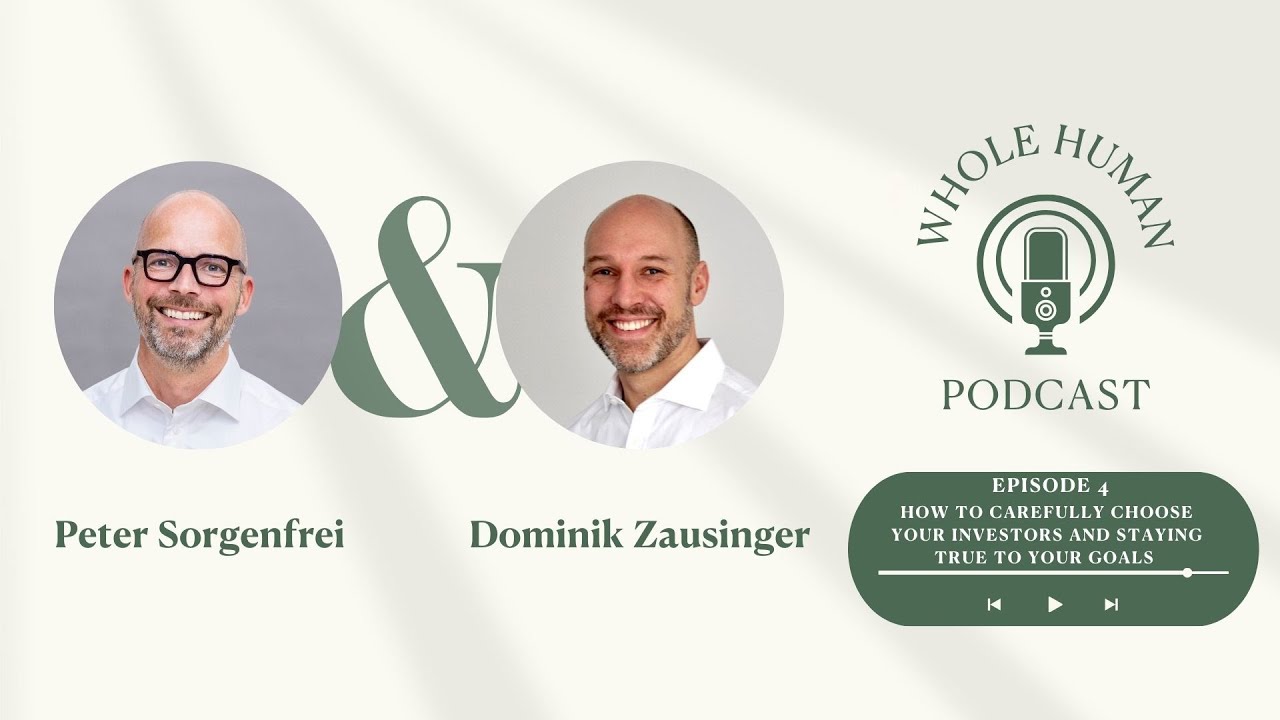
In this Whole Human Podcast episode, host Peter Sorgenfrei interviews Dominik Zaussinger, a former architect turned tech entrepreneur from Frankfurt. Dominik recounts his career path, starting with an architecture background, moving into programming for spatial design, and founding an engineering services firm that grew to 25 employees. Recognizing client demand, the team pivoted to productizing their in‑house tools, which required external capital. They accepted an investment from a family‑friend of co‑founder Martin, who also brought in a private financial advisor. The advisor’s unrealistic expectations and push for a unicorn‑style growth plan clashed with Dominik’s niche product vision, leading to over‑dilution of shares, blocked decision‑making, and the inability to attract further investors. The founders eventually negotiated a shutdown of the original company, retained the intellectual property, and are now planning a restart while navigating legal closure. Throughout, Dominik shares hard‑earned lessons: rigorously vetting angel investors, ensuring investors understand the market, using proper shareholder agreements, staying true to the company’s strategic goals, and maintaining strong co‑founder communication. He also reflects on transitioning from a small startup to roles within mid‑size and large corporations, and his future aspirations to co‑found and lead a new venture.
Chapters
Welcome to another episode of the Whole Human Podcast. Today I have Dominik Zausinger with me from Frankfurt, Germany. Dominik, welcome on the show.
Yeah, welcome, Peter. Thanks for the invitation.
So Dominik, for the people who may not know who you are, would you mind sharing a little bit about what you've done in the last couple of years, maybe the last 10 years, because you've done a lot, and then what you're up to today?
Yeah, actually, I will start actually a little bit before 10 years because that's a crucial part why I'm today where I am. So actually I was trained as an architect and then traveled around the world and worked as an architect. I was in Luxembourg and in Amsterdam. I traveled to Japan and Tokyo. I've lived for quite a while. And then actually I went to Vienna and worked there as an architect. And that was actually a crucial point because back then I really saw like how painful architects work still today when working with CAD. Everything is done manual still nowadays. And that triggered me a lot. I was looking for ways on how could we change that. And then I found out, wow, there's actually universities that teach you how to program for architects or in the spatial design or whatever. Really triggered by that because the results that they showed were really amazing. And it made me think about this really might help us to get better designs for everybody. So I went to ETH in Zurich, did a post-degree there about programming for architecture, and this was like an eye-opener. What is possible with information technology? It was all about dealing with everything, spatial programming, controlling machines or microcontrollers or whatsoever. And then afterwards I started my own business with that. And actually it was about, yeah, dealing with really complex geometry in the building industry.
So when, so you started your first business in 2013 or was it earlier?
Something about that. Yeah.
All right. So you've been an entrepreneur for the last 10+ years.
Yes, indeed.
Sorry?
Quite a long history in that. Yeah.
Yeah. And, but it's a classic case of you seeing a problem. Seeing a challenge in an industry and deciding to do something about it. So when you started your first company, did you do that alone or did you do that with somebody else, a friend or somebody?
Actually, first I started alone and then worked for 1 or 2 years alone, and then I crossed paths with Martin. He was actually doing more or less the same thing in the same town, and we joined forces because actually there was nobody else doing that as well.
So that's random that you were in this, which, where were you living at the time?
In Frankfurt.
Okay. So that's not a town, that's like a giant city. For, for those not familiar, because otherwise having 2 people working on the same issue in a town, yeah, it would be quite fortuitous.
Um, it was indeed still a very coincidence because in the whole of Europe there were maybe 3, 4 people doing that and then 2 people in the same city.
Yep. And in the beginning, you guys funded this out of your savings and then you got revenue and stuff. Did, at what point did you think about taking external investment? Did you do that with the first company or no?
No, not at all. The first company actually was quite different to what I think is like the startup thing. It was an engineering office. So we offered services, we had projects running on for smaller projects, and then we just grew. So everything was self-funded by ourselves.
That's in hindsight, that's always a nice business, right? When you're independent of the interest of the, the grosskapital, the The big capitalists. All right, so you guys are ferrying along, you're doing this engineering services company, things are going well, I'm assuming. Then tell us about what happened.
We grew the company, everything was really running well, and we had more and more larger clients, and the company grew to 25 people, engineers and developers. And then it was, I think in 2019, 2020, something around, our clients always kept on asking more, hey, this 3D software you're using, can we buy that? It was obviously, it was a lot of own development that was purpose was for in-house usage. So it was not a tool that you could sell right away, but we had then the idea, yeah, that makes sense. We put so much effort into developing new cool tools, so let's make it a product then. And that's where the second business then started.
So again, we're going from, you discover a problem, you being in the manual world. You digitize it, you start delivering it as a service, and now you're moving toward selling it as a product.
Exactly. That hits it.
And, and so how did that go when you built the product and started selling that? What happened?
The thing is, it was very clear to us that we couldn't fund that with our own means anymore. So we needed external funding. We knew how much effort you need to put into development because we did that for a long time, but we were totally new in delivering a product. That is something we haven't done before yet. We know only the technical development would need a lot of money, and that's where we looked for external investors.
Mm-hmm. And who did you go to for investment at that point?
There was a, a guy who was in the family and friends of Martin. It was someone who was really long befriended with Martin's dad, and he was just a multimillionaire, so he had a lot of money. And we asked him, would you like to, to join us? Because we knew that he invested in a couple of things. And so we asked him if he would join ours, our company, and he said yes.
And so he was a family friend. It was somebody that you knew. He invests. And, and at this point, things are still rosy, right? Because I have a suspicion that something didn't go so well with this investment. So exactly. Can you tell us how that evolved?
So in the beginning, everything was super fine. The, so he invested, he got, so he was a shareholder back then. And then it was always the deal that, okay, we develop the product and he will take care of getting additional financing because the finance that he put into the company was obviously not enough. Everybody knew that. And he took care because he has a large network of rich people and companies that he takes care of the next step to finance it, to grow it.
And did he?
No, that is clearly simple said no. The tricky part, what really goes— went wrong was like after 3, 4 months or something, he introduced to us his private financial advisor. What you need to know, this family and friends guy, he was like almost 75 years old and he's not really that kind of a business angel that we would imagine. It was more or less a private guy who has a lot of money but has no clue about how business angel is working. So he's not really a professional investor. And then when this private financial advisor joined into the team, that's where the trouble started.
Okay. Because the, the private financial advisor had different expectations about return profiles and capital allocation, those kind of things, or?
In the end, it was like the crucial point was that he didn't understand the market nor the product. And We never had the idea of making our product like a unicorn thing. We knew we had a cool product that was for a niche market, really worthwhile, but it was not like this Uber thing or whatever.
Right.
This guy suddenly saw, okay, this will revolutionize everything in the CAD world. And we told him, no, you have no clue about the CAD world. Doesn't work. Please calm down. Yeah. And then he always told us like, You're thinking too small. You should large, you only should think in large dimensions. And that's where the story went on to get really difficult.
So it's always easy to be smart looking in the rearview mirror of, right, in hindsight. But what would you advise other founders to do as they're thinking about angel investment?
Is there like a couple of tips that we can give people so that First of all, I think it's really to think about who you get involved in. When, I mean, startups, when you're looking for investment, you get tested a lot. The other way around is important as much, that you test who you're gonna involve with as well, because not just take any money that is offered to you. I know there's difficult times where it's really hard to get money, but it's way better to not take money in that case if somebody doesn't know what they're doing. Doesn't really prove you're right as well, that he's the perfect investor for you.
So, so a simple way of saying that is whomever gives you money, make sure that it's actually them who are part of managing and running and not a financial advisor or not an associate of theirs, right? To make sure that they fully understand what it means to be an angel, right? Because oftentimes we see people who have made some money and They want to be angel investors, but what made them successful business people doesn't necessarily make them good investors. And then I think the third thing that I also talk to people about when they're looking for investment is, to your point, when you need money, you want to take any money you can get. And it's just really important to also be true to yourself and saying, if something feels off with an investor. Even though they're the only ones who will give you money, it's probably better for you to say no thank you and find a way to find somebody else, right?
Yeah, indeed. Yeah, that's definitely the case.
How did this thing then evolve? What happened after the financial advisor got involved? Did it go really bad? Was there anything around control of the company or contracts or anything like that? Or did it just not become as successful as you had hoped?
In the first place, it was not as successful as we hoped because he just created a business plan that was way too exaggerated. I have to say that was the unicorn thing style. And he talked, he approached VCs that were more like the Wall Street kind of VCs that invest like starting from $20 million or something. And obviously they were not interested in our product because they saw it's a niche product. And which he didn't believe into. And this went on for a couple of months, and at some point the money was over the first initial investment, and that's where it got really complicated afterward.
So tell us what happened.
He already had a couple of shares of our company, and so when the money was end, it was then the tricky question, shall we stop that venture? Or he's willing to invest some more but wants to have more shares. And that's what happened then. He, he invested some more money, he got more shares, and then he got already, but that actually caused the next problem, which I was not aware of before.
Uh, and, and the next problem being that he now had control of the business or?
Not yet. So he did not control yet the business totally. He had, because of the contract already, yeah, before a lot of control, so he could block some decisions. But what happened now is that we recognized finally that his business plan is not worth it and his strategy of approaching the really huge investors doesn't work out. We started searching our own investors, which worked actually pretty well. So we had within a couple of months, 2, 3, 4 investors who were willing to invest, but then they clearly told us there's a red flag. This guy has too many shares now, and this is an absolutely red flag for any investor.
Mm-hmm. So essentially the situation you had gotten yourself into blocked you from getting additional investment.
Exactly. That was the case. So on the one hand, this guy, it would've been necessary that the first angel investment would have needed to reduce his shares, which we were willing to, and to pay him well as well. But he didn't want to anymore because he said, if there is an external VC who wants to spend money, this must be really worthy. So I don't want to get rid of my shares anymore.
So maybe that's the 4th lesson, right? That whomever invests in your company at the early stages are also going to affect who might invest later.
Yes.
The type of investor and their ownership stake slash their ability to control outcomes. So it's a really tricky thing to navigate when you're raising money, especially in the early days, your first company, you're not used to it. Some rich uncle comes along. You don't necessarily understand the contracts super, but you're really running fast trying to build your business and you do need the money. And so you're like, ah, it's going to be fine. And you sign something and you get into bed with somebody. So I think again, we should underline the need for people to really do this diligently and carefully. You don't need to hire super expensive lawyers and do really complicated agreements, Because there are plenty of resources out there with templates, whether it be Y Combinator in California or other sort of accelerator programs that have templates for different kinds of shareholder agreements, different kinds of equity agreements that will let people at least take inspiration and start there and make something manageable. But you, when you started, didn't have access to that. I think you may not even have known that it existed.
Exactly. On the first hand, that, and actually it was never our plan, right? If your clear goal is to have this kind of Silicon Valley startup and you want to become a unicorn or whatever, yeah, obviously, probably you're in that business and you think about how will I get there? But this was never our initial plan. We had a cool product or we had a cool technology that we wanted to make a niche product, which I still think is, would be very successful, but we were overrun. Yeah. By this guy who probably suddenly saw our unicorn thing in our technology. So this is as well something like, really, this is not a pivot or something. That was totally a totally different direction that he took. And this is something you should never do, I think. Just stay true with yourself, what you, what your goals are. But that is something as well, make clear for yourself, what is your goal and your target? Is it the unicorn or is it a niche product or what is the, The type of company you're trying to be in 10 years or 5 years.
Super important point. Have an idea of what you want to build and then find the investor profiles that fit that rather than find an investor profile and then end up building. This is, this happens, I want to say 80% of the time. Startup gets investment. The strategic direction changes because of the investor interest. It doesn't go well because the founders are not completely Invested intellectually, mentally into it. Their vision is different. Things start to go bad. Investors exert more control. Company doesn't succeed. But you ended up succeeding. You ended up managing out of this somehow, didn't you?
Yeah, we managed actually. So in the end, it was for us very clear during the last period that there was no back and forth. The angel investor didn't want to sell his shares anymore. And all other VCs told us, as long as this guy has that many shares, we won't invest. And we had a clear, pretty clear defined runway, right? So the thing was like, we, in the last 1, 2, 3 months before really the runway was over, we tried to find an agreement with the business angel. And we told him as well, if we don't fire all the people now, we would go bankrupt in 2 months and whatever. And he told us like, no, you're not allowed to fire people. Because that was something he had in the contract as well for this major decisions. He's allowed to block them. And then we told him the only solution is then because of the law in Germany, you have this quitting time rules. Yeah, we will go bankrupt. And he said, yep, that's it then. And then we knew, of course, obviously that we would go bankrupt. And there's a special rule in Germany now how a bankruptcy runs.
Mm-hmm.
And that's the interesting point where we could save our stuff.
So you, as I understand it from our previous conversations, you essentially regained and or retained control and all the IP, right?
Yes, indeed.
And then you guys went on to scale the company effortlessly, or did you run into other challenges along the way?
At the moment, the company is still not running again. It's not up and running. So we gained all the technology and the IP back again.
Mm-hmm.
And currently at the moment, there's still the, the legal process of shutting down the old company. And as long as that is not yet done, we cannot start with a new company. And currently we started both in, in, in third-party companies working again as well, and now are making the plans to restart the company. Probably it might be the case as well together with the new companies we are involved in at the moment.
Nice. How is your relationship with your co-founder throughout all this?
Perfect. Yeah.
How did you guys manage? How did that not create tension or division?
There's always tension and division, but in the end it's, I think, which kind of guy you are. It's like the same with when you're married, right? You will always have tensions, but as long as you find ways how to deal with it, and we had fights and everything, but still we always fight together. Hmm. But it's a good question. That's how, what the trick is.
Yeah, no, but again, you didn't know Martin until you met and started building this, the engineering services company, right? So when, again, when I speak to a lot of founders and co-founding teams, it's random, the people who end up starting companies sometimes together. And so dating and getting married, right? It's random sometimes unless you're on one of the apps and You'd like, but so being successful at that does take some work. You and, and Martin must have found a way to deal with those conflicts. Do you, do you have a structured process or is it just because of your personalities that it's a lucky match in heaven? Or how do you guys deal with it?
I would say it's a lucky match.
I'm holding.
It's really just a lucky match. We, we didn't have any strategic approach to that or strategy, not at all. It was just like we always found a way to talk about things. Uh-huh. That's it. I sometimes, of course, the stuff he does, I hate it. Other way around as well. But we always find ways on how to talk with it and we know what's the strengths and the weaknesses of the others. And as long as you accept it, it's quite easy to deal with it actually.
And, and so today, how big is the business that you're in?
The company I'm currently involved in is like a medium-sized business. It has 200 employees around the world, like in Germany, India, and Dubai. The one Martin is involved in is rather, I would say, a larger company with 6,000 people, mainly in Germany, but, or in Europe. Yeah. And that's totally new for us as well because always having been in this super tiny business. Yeah. And that's a new world to us.
So how is that? How is it navigating being part of, uh, corporate? And of course this is going to be public, so I don't wanna be, put you on a spot here, but how have you made that transition?
I'd say it's tricky because it's a totally different world from being, running your own business. And then for 12 years, a small business where every decision is more or less made by yourself. And now being like within a company where not every decision is up on your table anymore. It, on the one hand, it frees my mind. For the really crucial parts, but on the other hand, of course, it's somewhat tricky that there are certain important things which I cannot decide anymore.
So when you look out into the future, do you think your future is in a mid-sized company, or do you think your future potentially at some point reverting back to being the the founder and and CEO or Geschäftsführer?
I think it's in the middle. It's yeah because we're in between. Yeah. So we're really at the moment talking about. Making something together where I'm gonna be co-founder as well, and then yeah, being probably Geschäftsführer again. And I think that's it where it will end up to being part of maybe a larger family, but being not just like the standard employee anymore.
Yeah, Dominic, this was a super insightful conversation. I think you shared a bunch of really important. Things to think about when you're looking at taking on an angel investor, the kinds of agreements that you do, how you manage through it, how you manage out of it. You've shared with us that together, even with a stranger, you can actually build a company successfully without having massive conflict or issues along the way, or at least you can work through them. And I think that's, that's heartwarming, right? It's not a story that we hear so often that people actually manage through these things and survive. Or thrive. So thank you for that. Thanks for coming on the show.
Yeah, thank you for the invitation. It was really nice talking to you. And that's, I think, the main message, always stay positive.
And to everyone watching and listening to this episode of the Whole Human Podcast, I really appreciate that you tuned in. As always, if you have topics that you would like us to cover or guests that you think I should talk to, Please send them our way. And thank you again for following and listening along. Have a good day.
Thank you.










