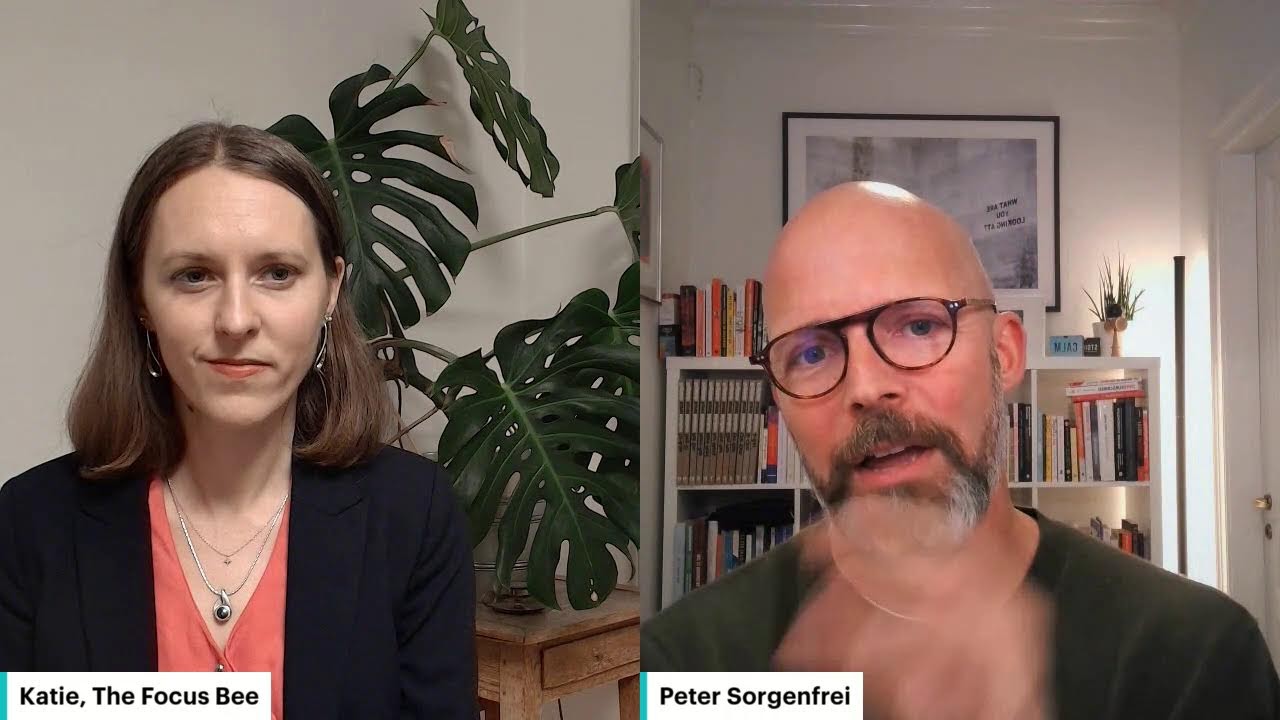
Katie and Peter Sorgenfrei, an executive coach, break down overwhelm as context-dependent and offer concrete tools: brain dumps and the 3-priority rule, time-blocking with Pomodoro sessions, cold plunges or shaking to reset your body, and removing apps from your phone. They stress early detection and choosing done over perfect.
Chapters
The year, many of us can feel overwhelmed with so many different projects, mostly in our business and work, but also maybe in our personal life. This is why I'm very excited to be here with my friend Peter, and Peter and I will dive a bit more into how we can reduce overwhelm with some practical tips and techniques. And this is an interactive session, so any questions at all, whether you're following us on LinkedIn or Facebook or YouTube, them in the chat and we will answer them as we go along. First, a brief intro, who we are, what we do. Peter, a few words on your work and who you are.
So glad to be back and doing this with you, Katie. So I'm Peter Sorgenfrei. I founded 6 companies on 3 continents over the last 15 years, and now I spend my time coaching founders and CEOs on the challenges that happen when you build these businesses. So it's a lot about our personal habits and tendencies, and also about how to run these companies most effectively. So that's how I spend my time. And Katie, for the folks who do not know who you are, what is your game today?
So I'm Katie. I am an engineer by past trade turned entrepreneur. I used to work as a map— doing maps of the sea floor as a hydrographer. And then I shifted my whole career to create my own business, The Focus Bee, 7 years ago. I'm the host of the Top 5% Podcast, the Focus Bee Show, and also the author of The Magic of Focus. And I work primarily with business owners, founders, and CEOs to help them to have more support in terms of gaining focus and clarity so that they don't feel overwhelmed and so that they can thrive in their business and in their life. So let's dive in. Overwhelm. Peter, what were the first things that came to your mind when we put together this talk?
Well, I started thinking about what is it actually to be overwhelmed, right? Because it's kind of a fluid size. For, you know, some of us, overwhelmed might be that there are 6 different cereals in the cereal aisle and we're like, ah, which one should I choose? But for an air traffic controller, overwhelm is when they have to land more than 2 planes every 2 minutes, perhaps. Then they start thinking about overwhelm. So I think it's a contextual thing and it's a very fluid size, which means we should be careful, or I should be careful at least when I meet people that say they're overwhelmed, not to immediately think, well, really? But actually understand why they have this feeling and what it means to them.
Interesting. Yes, I feel that it is highly contextual because for some people, very minor circumstances can suddenly feel overwhelming. And like you said, the air traffic controller dealing with a lot of pressure and a lot of things simultaneously will feel calm. I feel it's a lot around our perception. And I know that in my case, it's when I see that certain thoughts aren't finished. So we have the beginning of a thought pattern or project or an idea, and then another one on top, another one, and then they sort of all pile up and it's like nothing is quite finished in my own mind.
And that's very much the world that we're living in, right? Because with the The plethora of things that we need to relate to or to do in our personal lives and our professional lives, the sources of which we do it. I'm looking here at my— I have stuff on my iPad. I might have stuff on a notepad. So there's a lot of unfinished information around us and unfinished thoughts, to your point. And so how do we avoid becoming overwhelmed by this? Like, we will talk about some specific techniques today. But what is sort of the simplest piece of advice that we can give people if they're feeling overwhelmed at the moment? What is the first thing that they could start thinking about doing?
I mean, the first thing that always comes to my mind is breaks. And I know that when we are in a phase of overwhelm, we sort of get almost addicted to it. It's like to escape the overwhelm, we seek more external distractions and stimulation, which just creates more overwhelm. And as we feel more overwhelmed, we want to numb that pain. So let's listen to another podcast and then let's watch this video. And then if we just stop and stop and cutting out the noise and having a real break also means stepping away from technology and from consuming information. Because I think sometimes we feel we're having a break by just doing something else. But if it's also more important, more information, it's not really restful for the brain. So the very first thing that I do anyway, when I start to notice I'm Totally overwhelmed. Break, walk, and then brain dump everything on my mind, either reMarkable or computer or notebook or paper. That's the very first thing I do anyway when I start to notice that things are piling up in my head.
I do a very similar thing. I literally change the environment. So I walk away from the office that I'm sitting in now. I don't take any of my digital tools with me. And then I sit down, like similar to you it sounds like, with a piece of paper. And then I write down, why do I feel overwhelmed? There's a lot of things to do, right? Okay, fine. Which things are there to do? And then I start writing those down. And typically that list is much shorter than the list I can find in my Google Keep or in my Notion or in all the other places that I have different lists, right? And so that tells me that the things that I remember as I'm sitting there Those are probably the most important ones. And if I just start working on those and forget all the other stuff, then I can manage the overwhelm. But you mentioned something which I really, really resonate with as well, which is the break, right? So essentially it's a pattern interrupt. You're stopping what's happening and you're going outside of where you are. And because you're stopping that pattern, you're slowing down the brain a little bit because you're giving it a different input and giving it a different impulse. Somebody said to me, actually, literally earlier today, we were talking about all this advice that we seek out. And you mentioned that too. And he said something along the lines of, I'd rather take one piece of advice and implement it than seeking out 10 new pieces of advice.
Right.
But we have a tendency to seek out more information when we feel overwhelmed because we're looking for that magic bullet or that thing that's going to solve it for us, yet it doesn't exist. And the only thing that happens is we become more overwhelmed. Excuse me.
I feel that's the case with all the problems. I mean, not just overwhelm. I feel when we are stuck in our business or life or wellbeing or relationship, we seek out a ton of advice and it just gives us the illusion that we've solved the problem. Now that I've consumed 10 pieces of advice on this problem, I know what to do, but then we don't actually do anything about it.
So I think having just that one Do you ever do like a thing with your husband where you're like, okay, honey, we're now going to empty the fridge for what we have. We're not going to go buy groceries today. We're going to empty out the fridge. We're going to empty out the freezer. We're going to kind of have a clean out. Do you guys do that?
Yes, especially before going traveling.
Certainly before going traveling. But the reason I bring it up is it's this idea that if we work within with the materials that we have, with the food that we have in the pantry. I have plenty of food in my pantry. I don't need to go to the grocery store for the next 6 days, right? I can probably manage the sustenance that I need to manage with whatever is in the house at present. Yet a lot of us, we go to the grocery store every single or every other, every third day because that's kind of something that we do. And I feel like as knowledge workers that many of the people who will be watching this are, We have a tendency to go acquire more information and acquire more tools or frameworks or techniques when all we actually need to solve the problem in front of us, whether it's making a meal or solving a business problem, exists within our current information pantry, like our bookshelves or our computers, right? So another way of solving overwhelm or thinking about overwhelm is working within the restrictions of what we have. So not allowing ourselves to take on additional information to solve the problem before us because we actually have the information that we need.
That's why I'm a big fan of coaching compared to mentoring. I think mentoring and teaching definitely has its place when we have specific issues we're working on with someone that has more experience. But a lot of the time, like you said, Many people know that they need to exercise more, or that getting up early would allow them more time, or it's better to finish evening reading than watching TV, whatever it is, or different habits they could put in place in their business, but they struggle to implement them. So then it's— I feel it's more interesting to look at what would be some core habits that we could put in place. So if we're talking now around overwhelm, for instance, scheduling some breaks during the day, Mm-hmm. Limiting time for our decisions and all the different habits, single-tasking, things that we all know are very useful to reduce overwhelm and be more focused. And where are we getting stuck? Why are we struggling to single-task? Okay, because we're hooked on the dopamine of multitasking. Can we challenge ourselves to a Pomodoro, 25 minutes only doing one activity, and then train our focus that way so we don't feel so overwhelmed by so much stimuli? And it's like you said, we generally know the things that would help us to reduce overwhelm, for instance. But it's at the implementation that we get stuck. So I feel it's more interesting to look at why we're getting stuck. What are some habits and patterns that we have ingrained that means that we work nonstop, but we don't take breaks and we multitask the whole time. And when we're on a live call, we do something else at the same time. And this is what creates that overwhelm. So if we know that, what's the opposite? What could we do instead?
Yeah, maybe we have overwhelm from the tools that will help us with the overwhelm in this present moment, right? Um, so, so the way I think about it is I ask people, I ask clients just to do one thing, right? So, so I don't ask them to do time blocking and use the Pomodoro and take mental breaks and do the other things. I said, there's one thing I want you to do every single day until we speak again. help you with overwhelm. And then we talk about which one of the many techniques that it is, but rather than giving them, giving them many, many things to think about. Um, and, and one that I've liked— I've sort of reflected on this conversation— one that I've, that I've found has been super helpful, and they're all very good, but one that in particular works for people is the idea that every single night or every single end of workday you write down the 3 things that you need to be doing tomorrow, and that's all that you look at. So when you come back into the office, or if you're working from home or whatever, you look at that list, and those 3 things, those are the 3 things that you do. And the mere exercise of that is the to-do list might be 80, you know, items long, and there might be urgent emails coming in and all sorts of other things, but just by having that mental shift and saying There are 3 things I need to do tomorrow. When you sit down, there are 3 things that— these 3 things are the ones that I'm going to do today before I look at my email or before I think about my super task system or whatever I have. For many people, that actually slows them down enough to help them combat overwhelm quite quickly.
This is something I've been implementing for a long time, to be more outcome-driven and not to-do list. And I do it either first thing in the morning or the day before is better because we're sort of more clear from all the things we've worked on.
Mm-hmm.
And I even go 1 to 3 things for the next day because sometimes if you've got a day that's filled with meetings and calls and workshops, you might just have blocked that 1 hour, 1 hour and a half in the morning. So what's the one thing, that one proposal, that one blog article, that one workshop? So 1 to 3 main outcomes. And I think The joy of that is that it's so easy to get caught up in all the urgent things. And when we do that deep work, it gives us a greater feeling of satisfaction. We actually feel that we're progressing on something.
Right. So rather than clearing out our inbox and feeling like we accomplished something, we actually work on an outcome that matters in our business, right? Same kind of feeling, but completely different impact on our business. Inbox zero is nice. It doesn't necessarily make our better businesses or more money or whatever it is that we're trying to accomplish. But doing this focused exercise will. Another thing when we're talking about overwhelm is sort of the physicality of it, right? How does feeling overwhelmed manifest with you or with your clients sort of on a physical level? How do you feel it?
This is interesting. I think obviously it depends on the person. Sometimes it can manifest as that sort of freezing, almost analysis paralysis, just so much things to do that we can't think clearly and we can't do anything at all, or into this very nervous agitation. So going very quickly from one thing to the next and jumping. And I was also reflecting on this before our talk and thinking that we often think of overwhelm as a mental thing, but if we start to think of it on a body perspective, what helps us to feel calm physically?
Mm-hmm.
The classics, right? Walking, breathwork, exercise, all these things. I feel that when we practice these regularly, it doesn't mean we'll never get overwhelmed, but I feel it happens less and we get on track a lot more easily because our body has oxygen and can breathe and is feeling good. It's a lot easier to feel overwhelmed if you sit all day, for instance, and your cortisol level rises because you haven't moved. My watch measures my stress levels, and when I'm sitting all day, for instance, traveling on the plane, it goes through the roof. I mean, such high levels of stress. And I'm like, I was just sitting. And this is something we don't think about, that sitting for long periods of time— and by long, I mean, yeah, over an hour and a half or 2 hours— this really generates a lot of stress and cortisol. And then of course, that adds to the overwhelm that's already present for some.
Exactly. And I think Looking at it, if there's like, there's 3 sort of body-based techniques or 3 things around the body that I like to work on. One of them, and the people who know me are going to be tired of hearing this, but jumping in the cold ocean as I do every day, doing the cold plunge, right? That actually helps because, I mean, you can also just splash cold water on your face, but kind of giving your body that cold exposure. starts— and I don't know the biology of this, I'm not the scientist— but I can tell from my own experience and from those of the people that I've worked with on this that it actually calms you down even though it's a shock to the system. And I'm sure that somebody's going to listen to this and be like, well, that's because then you're starting to fire off something else in the body. I'm like, that might be, but at least it, it covers, uh, or it calms down the overwhelm. But there's another one that I've started to do recently, and actually it was inspired by my girlfriend who literally is a scientist. And it's this shaking thing, it's this bouncing thing that's kind of become popular, and I'm sure it's going to be the next cold dip, right? And I didn't really think I would do it, but animals, when they sort of get high tense and stressed, Once they need to get rid of that, they shake because it literally comes out of the body. They shake it out of the body, and only animals and humans can do that. So if I feel overwhelmed, I've started to now like standing and bouncing and moving my body, and it honestly feels good. It honestly feels like something is leaving my body and I'm calmer because of it. So if you don't feel too silly and if you're listening or watching this and you feel overwhelmed, try to stand up and bouncing a little bit. That might actually help you.
That's why also dancing is so good, because dancing is a form of shaking. You're literally shaking it off the body. And I haven't done that shaking thing very often, but I did do it once or twice, mostly if I found something quite intense energetically. So if I've had a very heavy conversation with someone around a very heavy topic, and then I would literally go and shake my body out of it because I didn't want to take that energy with me. That worked. That worked. It's not something I often think to do, but it does work. You said there were 3. So cold plunges, also love it. Do cold showers every day. Shaking. And the third one?
And the last one is sort of a variation of grounding, right? So it's literally standing Either with your bare feet on some grass if you have it near where you are, where you live. But a variation of that actually, which I've done ever since I was a little kid, and I only realized this as an adult, which is lie down flat on my back on a hard floor. So again, I want people to try this if they have a hard floor in their apartment or if they could do it in the office building without it looking too conspicuous. But if you lie down and you kind of feel the surface underneath your heels and under your legs and on your buttocks and back and head, that is very grounding and that calms you down in a remarkable way. Obviously, if you lie there too long, you might fall asleep, but just a few minutes, for many people, that calms the system down because it kind of feels safe. The body doesn't have to worry about standing upright. You don't have to worry about how you look and feel. You just give up to the floor. It's kind of like a yoga exercise. And that can help folks if they feel physically overwhelmed to calm the system down.
I never heard that before. I like it, lying down on a hard floor.
I did it as a kid, honestly. And my mom told me this. I'm 50 years old, but But we can still learn from our parents. And my mom said, well, when I was a small child, if I couldn't sleep, if I had a hard time sleeping on a regular mattress, on a regular bed, I would crawl out of bed and lie down on the floor and I would fall asleep. Because I told her about me that I started doing this, you know, she's always like, oh, you're jumping in the ocean, you're doing all this weird stuff. And then she said, well, you did that as a kid too. And apparently that was what calmed me down. I would fall asleep on the floor and she would come in and put me back into bed.
Fascinating. But I also love the grounding and that's a really good point. And I know Gary Brecker talked about it on Diary of a CEO recently. And it is something if I've been very technology. So what I mean is if I've worked all day and then been on calls in the evening, I sort of feel my whole body is buzzing. It's hard to explain. And then it's true that if I put my feet on the ground outside, outside for 5 minutes, that feeling goes away, that sort of overcharged electric feeling. And that definitely is linked with overwhelm because I noticed in those moments, on top of a lot of technology, I've generally had a lot of information and a lot of stimulation. And the grounding and the calmness and being outside in nature also really helps. And one thing that I've— yes, go on.
No, I was just going to say somebody remarked here in our chat that the lakes in Scotland are really good for cold plunges. But the North Sea is not very clean, unfortunately. And so I think it's an appropriate time to put in a caveat, like, don't jump in the ocean if it's not safe because of waves or because of pollution. But as an alternative, do not do the cold shower thing because that's just a terrible experience. The water moves across your body, which means you don't get that small film that normally will happen when you sit in the ocean. So it'll actually feel terribly cold to do the cold shower. The alternative, my friends, are if you have a hot tub or a tub at home, fill that up with cold water and sit still in that. Or if you don't, take a big bowl like a salad bowl, put water in it, ice cubes, and then just put the front of your face into it for as long as you can hold your breath. Don't get yourself into a dangerous situation. Um, that will also give you the same experience as a cold plunge.
I still love my cold showers though, but it is a very different experience. It's the cold plunges when you're in nature. It's a lot more, I don't know, spiritual in some way, and you feel this connection and it's nice. But cold showers are very convenient and they do wake you up. It is a shock to the system.
I love the ocean. I absolutely hate the cold shower. I never do it. So, but to each her own, right?
For each their own. I know loads of people who hate cold showers. One thing that I would think about when I would think about overwhelm, and I know the one recipe for disaster is this context switching. So going from thinking about something in business to thinking about a totally different project, to thinking about our personal lives. And I know with a lot of people working from home, there's a lot of context switching. So I know that I try and block, you know, half a day for a certain project, I know that I think it was also Paul Graham that came up with the maker schedule and the manager schedule. So the maker would be you do the creative work. So typically when I do podcasts and YouTube, I block a whole half a day or a whole day even just to do that. And then the manager is more back-to-back meetings and emails. But I'm curious, Peter, how about you? How do you manage this sort of context switching? Because I know that this is probably what makes me the most overwhelmed the most often. is when I haven't blocked my calendar in a way to really separate things and I end up switching between lots of different projects.
I'm terrible at it.
You do a lot of context switching?
All the time. And I'm really good at telling people and helping them not do it, but doing it for myself, I'm like the cobbler with the hole in the shoe, right? And so the only way I've found to not do that is again to remove myself from the physical environment. So actually, I'm sitting in my home office today, which is more or less the worst place for me to be to do work because it is so easy to go over to the bookshelf, to go to the kitchen, to get some almonds, to do something else than the thing that I'm supposed to do. So if I need to not context switch, I literally will take a laptop and go to a place where there's no Wi-Fi and then sit and work there. And that's how I do it. And I think people are like, oh, but you should be able to, you're teaching people all this other stuff. I'm like, yes, but I'm also human. So we need to know and recognize our own— I don't want to say failures, but our own habits. And so creating, for me, the trick is to create a context where I'm forced to do the thing that I need to do. I'm super effective on planes and on trains and in hotels and stuff. Again, last week I was in Oman for a couple of weeks here for vacation, and I spoke to somebody about the thinking that I do when I'm somewhere where I'm not connected is infinitely better than when I'm connected. And so I literally will go on trips just to think and write, which means I will go take the train for a couple of hours somewhere in Denmark Just to do that work there versus trying to do it here at home.
Interesting. But I think this is a great part of that self-awareness and knowing what our struggles are and tweaking the environment. So if you know, for instance, anyone listening to this knows that they have a massive sweet tooth and they crave sugar a lot, then not having it at home means you don't have to chronically use discipline not to eat it, which is extremely draining. So it's really useful to know what are some things that we really struggle with and then to hack the environment, change things, change— take the train to be disconnected and just do that so that we can do our best work and overcome it. Because sometimes we can use discipline and willpower to overcome some of these patterns. But also, like you said, we're human and sometimes we crack. So then having a system in place or a strategy to bypass it can be really helpful.
And I think the overwhelm, we mentioned a little bit, the phone, right? The fact that we have access to all this information or access to all this distraction. So many of my clients I help with essentially a phone addiction. And they're all like, well, I put a restriction on how much I can be on Instagram, let's say, right? But the problem with all those tools is it allows you to override it because I'm like, ah, just 5 minutes more, or reduce the limit or ignore the limit for the rest of the day. Also, for those of us who have children, we also try to limit screen time for certain things for our kids, right? I have yet to see that work. The only tool I've known to work is to tell my clients, take Instagram off your phone. That's the only way you're going to be able to manage that. It is simply too addictive and too nice. But use it on your laptop or use it on your desktop, because then you deliberately are going in to make a choice to say, I'm going to sit down now in my office and look at Instagram for the next however many minutes you're going to do that. But when it's on your phone, you end up doing it almost regardless of how disciplined you are. However, I know you and I know that you're able to manage it. So what's the secret?
To manage the phone addiction or to manage—
The phone addiction. I know that you're very good at that. And I'm curious if there's something you can share with us that will help others be better at it than they are today?
I think the one thing that helped me most is probably that I really, really dislike the identity of someone that's always on their phone. And so I think during the years when people— it happened over the last 5 to 10 years, people started being more and more on their phone. And when I would see myself from above, being on the phone and stuff. I just disliked it so much. I found it repulsive. And I equally, at the same time, really like the identity of someone who's present, someone who's a good listener, someone who shows compassion. So the idea of if I'm having a conversation with a friend, whipping out my phone and writing goes totally against, you know, being a coach and supporting people and listening fully and attentively. So I think that was actually a huge part, just seeing myself from above spending a long time on the phone felt wrong. And then the other thing is I don't have much on there of much interest. So I really just have my WhatsApp, my messages. I don't have Instagram. I don't, you know, use Twitter either, or YouTube. YouTube I have on the tablet for my morning videos for yoga and Pilates. Same with my Insight Timer is also on my tablet. And only recently I started using Strava, so I track my fitness with my Garmin. That's fun. So that was more screen time, just putting some photos of my runs and my hikes, but I really enjoyed that. So essentially just WhatsApp, my Strava and Garmin app, Google Maps if I'm lost, and podcasts if I'm on the go. Sometimes I listen to podcasts on Spotify, but that's about it. And so there isn't really— so even if I'm in that moment of I feel really bored and I don't know what to do, there's nothing on there that's of great interest for me on the moment. So then I'll just wander around the flat and I'll randomly pick up a book, or I'll do something in the kitchen, or I'll tidy something, or— and it's just, I think it's A lot easier not to do it when you haven't developed the habit of doing it. I think once you're really addicted to the phone, and it's something that people don't talk about enough, I think it's one of the hardest addictions to break because everything's on there. After I said I don't use it much, I still have, you know, sometimes train tickets on there and bus and, you know, so we need it sort of during the day as a tool.
I, I'm, but I'm kind of disappointed Katie, because I had hoped you'd said, I have TikTok, I have Snap, I have LinkedIn, I have all this stuff, but here's why I only use it, you know, 6 minutes a day on each. But you're actually doing what I advocated, which is don't have the candies in the house, you won't eat them. Don't have the apps on the phone.
A lot easier.
And I agree with you, when other people are present, I also don't want to be that person, right? My phone is not on the table when I meet with somebody. My phone is always on silent, by the way, um, which is kind of an annoyance to people who want to reach me on the phone, but that's just how it is. Um, so, so, so removing that distraction is definitely possible. Katie, I, I wanted to, to talk about something else because we're now— we've talked a lot about techniques and stuff, but you, you started broaching this a little bit, the mindset, like the You said, I'm not the person who does this on my phone. If we take that to overwhelm, how should we see ourselves in the context of the overwhelmed person? Because maybe there's a mindset shift here we can work on in order to change that.
I definitely think there's a mindset shift for everything. I mean, the way we have a perception and the thoughts we have dictate our behavior. So they're fundamental with everything. And I think with overwhelm, it's shifting it to focus. So typically, As overwhelm is linked to some form of multitasking or multi-thinking, if we're thinking about loads of things in parallel. So in contrast, being very big on focus, and maybe the reason I got so interested into focus and created the Focus Bee, etc., is because I struggled with multiple projects, multiple ideas, multiple thoughts all the same time, all the time. And that helped me to think, well, wait a minute, is there another way? Can I just have these interests Park them and then just choose one, work on it, finish it, finish it. Completing things, I think, is really useful to not leave that window still open. So even if it's completing one clear section and you have the second section to do, so compartmentalizing. And sometimes I'm a bit, well, almost too strict or severe with my boundaries, as in I will not check my emails for 4 days. I think when we were in touch for a project—
I know, and that's kind of annoying.
I will not be reachable from this time to this time. I try to now be a bit more flexible, but the reason I was so strict on my boundaries is because I get overwhelmed if I switch contexts. So if I am off, I can get overwhelmed by just one or two projects or emails. So then I tend to not check anything. So it's quite radical.
I think some people might find a better balance, but for me, it's easier that way than And I think now that people who will be watching this might criticize us for like, yeah, but that's easy because you guys are your own bosses. You know, what if I work in a department and I have a boss who expects to reach me and I can't just tell him or her, say, hey, I'm not going to be online for the next 4 days? So, so if you're in the context of sort of more of a traditional work environment with a boss, colleagues and bosses and that kind of thing. How can you manage that overwhelm? How can you— you said saying no, you said setting boundaries. How do we start that conversation if we're in a corporate context? How do we sit our colleagues down and say, in order to manage my overwhelm, I'm not going to be available outside the hours of 9 to 5? How do we do that?
It's tricky. And I think it's a case-by-case situation because depending on the relationship you have with the boss, depending on the work you do, depending on So many different factors, but it's a matter of also showing how much more productive we are when we're not constantly checking our emails every 5 seconds. So I have a lot of clients who say that it's hard for them to block an hour or an hour and a half first thing in the morning because they need to be available on email. I always say, okay, but has this been even a conversation? Has this been discussed as a possibility? Have you said, is it possible for me to have 9 till 10 just as deep work and only check my emails afterwards? At least open the conversation. And then if they say no, okay, can I have a 30-minute deep work before. When is the latest I can respond emails? Can I check once every 2 hours? And actually having a discussion around how frequently do emails actually need to be checked? Because I think it's very easy for us to turn this into a habit and check them all the time, when in fact, maybe every 2 hours is sufficient. And then also discussing what does urgency mean? Does an email need to be answered within 24 hours or 48 hours? So all those conversations need to be had. And I think a lot of the time, there's just so many assumptions. The assumption is if someone emails me, I need to answer within half an hour or I'm not seen as productive and people think I'm not working. Well, if that's the assumption, how do you ever get any deep work done without chronically feeling overwhelmed because you're dealing with too many sources of information at the same time?
We might be getting to a rounding-off point, but there's one idea that I wanted to bring back that you mentioned initially, which is this of focusing on one thing and actually getting it done. Another restriction or another trick here, if one is feeling overwhelmed, is to say, by the time I put down the pen tonight or turn off the laptop tonight, I'm gonna have finished 5 things or 3 things or 6 things or 8 things on my long list. Now we're talking a scenario where you haven't done your 3 priorities for the day, but you literally look at whatever is on your to-do and you say to yourself, by the end of today, 5 or 8 or 10 of these are going to be closed no matter what, right? And you find that you relatively quickly can make decisions about things and actually realize that done is better than perfect. And so you can reduce your overwhelm by forcing yourself to close off whatever it is, ship it, and be done. Um, have you tried that? Have you been in that situation where you forced yourself to finish things?
Every single day. Every single day I time block and I leave myself an hour and a half to do whatever the proposal, a blog or newsletter. And if I'm not done and I'm approaching the last 15 minutes, 20 minutes, I wrap it up. And the Parkinson's Law, the fitting things in that time, of course there are some exceptions, right? Sometimes I will suddenly go on a different direction and realize I need another hour or 2. But I'd say 90% of the time it works. Done better than perfect. You block that half an hour, that hour, that 2 hours, and you learn through time and patterns how long you need for most tasks. And then I just use it all the time. Right? Yeah. How about you?
The same. I've gotten really good at just doing it and then be fine with whatever comes out. So one example is my content on LinkedIn. Right? So I, I write a ton and share a ton of stuff there and on newsletters and, and many other places, and people agonize over their posts and all sorts of other stuff. I have help now. I have Christina who helps me with the graphics, and, and that's wonderful. But, um, most of the time I have an idea, I, I get some AI help, I modify it in some way, and that's it. I don't spend you know, as much time as I probably should on the hooks and, and all this other stuff. But I do that because I know that even a 60% perfect post or newsletter is going to help people. And so I'd rather that it comes out and helps people than it not coming out. Um, and so I try to produce new content every single day. Um, I also have started using Instagram and produce a short video there. Not these days because I was on vacation, but coming up I will produce a video every single day on there, which is not produced at all. It's just me talking to the camera. But I think that's more important because it'll help somebody than the lighting being right or the graphics being right or the hook being right or the title being right, because I'm not in it to sort of grow a media brand like others. I'm in it to try and affect and help people.
Yeah. Progress over perfection, right? And I think it's important discussing this topic of overwhelm to have compassion for ourselves also along the way. And when we're struggling or feeling overwhelmed or stressed, that is something that we all deal with. And as long as we have some routines and habits that we can go back to, taking those breaks, avoiding a bit the Context switching, single tasking, and different body tips that you also gave with the grounding on the floor and the cold plunges and all these different techniques can really help us to manage that overwhelm. I think it also comes down to catching the bird early, noticing when we're feeling overwhelmed and catching it early and doing something about it. And then compassion, recentering ourselves, and then life continues, right?
Indeed, indeed. Katie, should we round it off and say thank you for those who watched and listened? This, we will— it'll be on our profiles, obviously. Mine is on YouTube. I think you will share it there as well. If the folks who have watched this have any other ideas for topics that we should talk about? We will do one of these every month, we've committed to. So in a month's time, we'll do another one and be happy to take people's suggestions. Yeah.
Sounds good. Thanks a lot, Peter, and thanks guys for, for watching and commenting, and talk soon.










