Navigating the Startup Roller Coaster w/Alexander Sterk
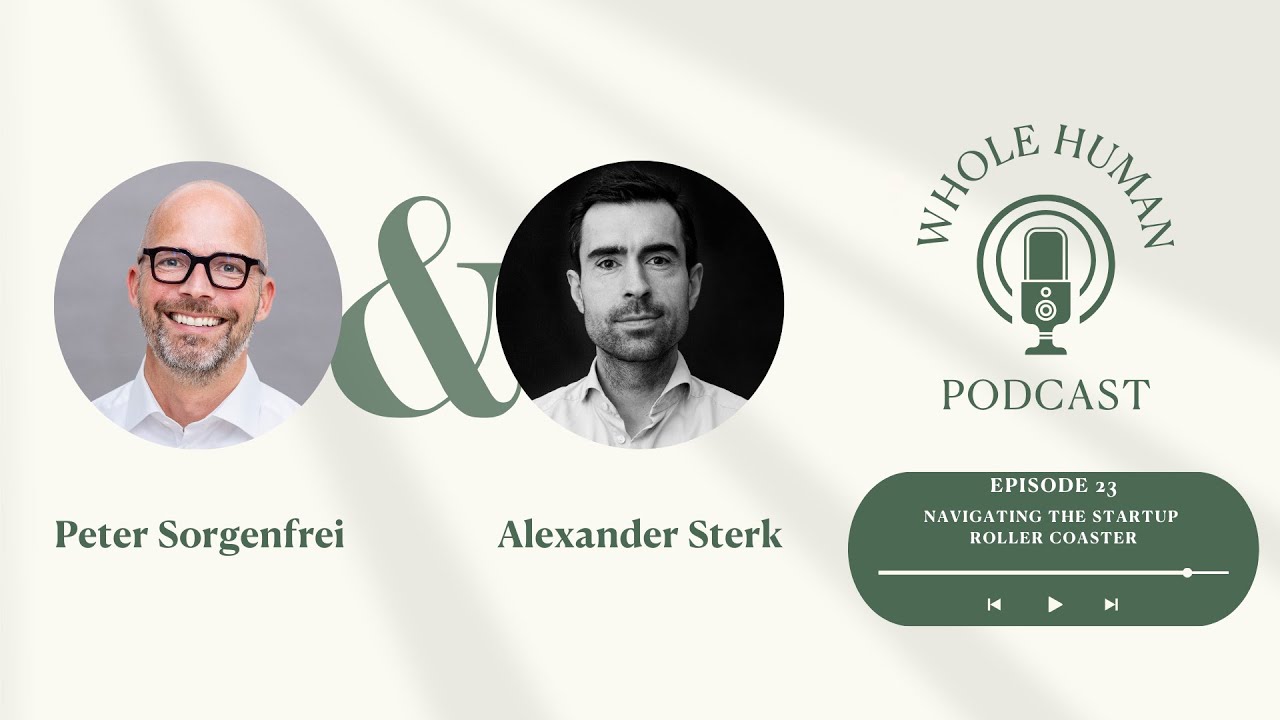
In this Whole Human Podcast episode, host Peter Sorgenfrei interviews Alexander Stäck, the founder of Vesper, a commodity intelligence platform that provides subscription‑based data on food commodities such as sugar, cocoa, dairy, oils and fats, and recently launched a dairy‑commodity marketplace. Alexander recounts his transition from a 7‑8‑year career as a dairy trader to building a tech‑enabled business despite having no coding background. He describes the early product development process using freelancers, the intensive search for a CTO, and the rapid scaling to about 85 employees within five years. The conversation covers Vesper’s early profitability, the decision to raise venture capital, the subsequent shift back toward profitability, and the strategic vision of becoming a global commodity information and trading hub. Alexander shares personal challenges, including balancing family life, the support (and skepticism) of his wife and entrepreneurial family, and the emotional roller coaster of startup life. He emphasizes core lessons for founders: relentless focus on the few things that move the needle, prioritising product and customer work over outward‑facing activities, executing quickly by “just asking” for resources, and maintaining a mindset of having nothing to lose. The episode concludes with advice to aspiring entrepreneurs to simply start, act fast, and continuously evaluate whether the CEO role remains the right fit as the company grows.
Chapters
Hello and welcome to another episode of the Whole Human Podcast. I'm your host, Peter Sorgenfrei, and with me today I have Alexander Stäck. Alexander, welcome on the show.
Thank you very much, Peter. Nice to be here.
Alexander is the founder of Vesper, and I wouldn't do it justice by explaining what it is. I would say it's a commodity platform, but what does that mean? So Alexander, for the people who may not know you or Vesper, could you please introduce yourself and what it is that you're up to?
Yeah. So the thing is that at Vesper, we're up to basically a commodity intelligence platform. So we Sell in a subscription-based model, intelligence about sugar, cocoa, dairy, oils and fats, all basically a lot of food commodities that, yeah, companies use to make chocolates or bakery products, et cetera. We supply them with the intelligence and that's what we do. And on the other end, we, uh, just launched, actually was super excited, a marketplace where for dairy, where people can buy and sell dairy commodities. So that's the latest product that we launched. That's what we do. I was a trader for roughly 7, 8 years, mainly dairy. And then I found out the information flow was quite old-fashioned. And I thought, if I create a platform where you basically have all that information, it makes it so much easier to have negotiations, to have discussions. And so that's what I was doing. And it was in Amsterdam. And I thought it was a good idea. I had no experience with tech products. I could open a laptop, but I never did some coding. I never did anything basically to To justify that. So that was, of course, that's one of my weak links is that I had, I couldn't code, I couldn't do anything, but I knew what the product should be.
Um, so you were experiencing, you basically had this need as you're sitting as a trader, you, you, you knew that the industry needed something. Yeah. That something didn't exist. And then you figured out, well, I'm gonna, I'm gonna build this thing. Is that how you started?
That's exactly what it is. Yeah, that's exactly what it is.
And so you must have then had to go out and convince somebody else to join you in this because you're not doing it by yourself. So, so how did you go about finding the people that you started building the company with? Who are those people?
Yeah, so in, in the first person, of course, what I needed was a tech person. But one of my friends, he was working with some freelancers. So he said, you can really start freelancers. So I had 2 software developers that were freelancers with 1 designer. So they created the MVP, but then I knew during that MVP period that they wouldn't stay. So I had to find basically our tech guy. So after, I don't know, more than 40, 50 interviews, I found the CTO of the company. He started actually on the day we went live with MVP. We, he pushed the button and he was there. So the That I was really lucky, and I had some other guys that came in. One of the first guys was Seb. He's still there with us, and he was just like me. We did all kind of things. We went to exhibitions together with the iPads that we rented to showcase the product, and it just starts from scratch. And the few the first few people are so key there, and then via you got other people in. But we were in a market that was super hot. It was. VCs were hot, but also therefore getting, finding good people, it was super hard in Amsterdam.
And how many people are in the business today?
It's around 85.
That's a big company and you've done that in just 5 years. You said yourself that you didn't have any experience with tech and maybe even building a company before. How has the last 5 years been growing a business to 85 people? I'm sure there's a lot to unpack there, but just in a few words, how has that been? A roller coaster.
I think that's the right thing. The, I love it. I love what I do. I love building the company, the products, uh, working with the people, uh, and the customer. I love it. The thing is that you get to know yourself very well. Uh, you learn that you're very bad in a lot of things, at least I am, and, uh, good in just a few. Uh, but in the beginning you can't, you have to do everything because you don't have money, you don't have a lot of people doing it for you. So you're doing a lot of things that you're not good at or you don't want to do. And, uh, I just, I just love, but it was a roller coaster because you keep doing things very, you know, not right the first time. How the product looked like 5 years ago versus now, completely different world.
Did you along the way have to raise financing or have you financed this Just surely through your own savings and operational returns.
In the beginning, my own money and some— I had a 3F, so friends, fools, and family. So that helped. These were the— in the beginning, and my own money. But the thing is that I think quite quickly we realized that we had something on our hands. We had— so we said, okay, we had something, we have something. Is it smart to raise money? But we were profitable the first 2 years. So we said, okay, let's raise money. And that's what we started doing. So we start raising from the VCs, but then actually when we raised, et cetera, and then we saw that the market was changing again. And actually I thought, if I look at companies in the past, they were always growing based on the investments that they've got from their own turnover they make and profit that they make. And now it was their VC time where you basically had 1 year of turnover, you could get 5 million investment. But then you have to make that oak stick. You have to grow it in. And I think that was maybe a bit of an unhealthy situation. So what we do now, we're back to the road of profitability. So we, yeah, we'll see. And then from that moment, we will see if we will do extra investments or not.
Okay. What's the plan with the business, Alexander? You started it because there was a need in the market and now you've been going for a while. What do you think this thing is going to turn into?
Yeah. So, well, I think globally I want to build Vesper into a commodity place where you can actually have the information and where you can do, for some of the commodities at least, actual trades as well. So not all commodities are meant to also be traded on the marketplace, but I think some of them are. But for the intelligence, we can do all. So that's where we want to be. We want to serve clients, the F&CG, the retailers. I think that's what we can do globally. With a few officers around the world, deck in-house, and I think that's what we should do.
And as a Vesper, you mentioned that it's been a roller coaster. Has there been times where you felt like giving up and just been like, you know what, this is too hard, I'm gonna go back to being a commodity trader or doing something else?
Never one moment that I Thought of giving up, and that has also to do because I personally believe in what we're doing. We had the people internally that were believe what they were doing. We had other people believing this external people investors, Cheryl. But we also have the clients. We had top clients that believed in what we're doing, and it was so much space to grow, to improve. And even though that sometimes it was hard, and it will always be right, it's a road. It has ups and downs. Then somebody leaves that you're like, oh, why? But then actually somebody else, you think it's, oh, we can't replace this person. Then somebody else comes in that surprises you and you go like, wow, actually that's amazing, that person. So you see that even though you think it's a setback, actually it becomes an opportunity again.
Hmm.
And yeah, therefore I think giving up, no, never crossed my mind, but it is that you sometimes have very bad days. And that's for sure is what happens. And then, yeah, I think I'm quite a positive person in the sense that I look at the positive things in life and I always see positivity in certain moments and I just keep on going. And I think that helped me along the way, but it also helped me that the people around me that believed in me, in the team, the customers, the family at home, that helps me. So I think that, yeah. Yeah, these, all these things together make sure you don't give up.
And you also had a situation where you relatively quickly reached profitability, right? And you managed to have a buffer going in with some of your savings so that you could make the initial investment. So you also didn't have that external pressure to create a return as fast as, as others might. You mentioned briefly your family, you had the support of them. How has this road been For the change that went from, you were a commodity trader, which is also a fairly high intense environment I can imagine, to being a startup founder. Can you share a little bit about the dynamics at home? What have been some of the positive side effects perhaps? And what have been some of the challenges you've had?
Well, I think what is a big difference is, especially in the beginning when I told my wife that I wanted to start this business and I have this idea. Is that she wasn't that happy because she said, I would love to have kids, raise kids, and we didn't have kids when I started, and I want to marry, and all the money went was gone into a company. And she said, yeah, is and you will not earn money in the beginning. How how are you going to do it? But luckily, her father was an entrepreneur himself. He set up one of the biggest dentist chains, and he said, so she knew a bit about yeah how. Living in an environment where somebody takes risk is setting up an own business is helping. So I thought in the beginning with quite some tough discussions, but then actually she starts supporting the idea. Of course, when I had a lot of flexibility because we didn't have kids, and then the kids came in and it became a different story, right? Because you want to be there, but also you want to be at company. And balancing that was is still one of the hardest things I found at the moment. Still spending time in the morning, helping in the morning, or being. Early away and coming back late. And that balancing is— I didn't find the key yet to unlock it. Basically, it's not in balance always. And yeah, that's just— we try to manage it at home also with some extra help, but it's not an easy one, I found. And the company, just, there's always something to do. There's always work. And this probably has everybody that Started their own business. And what I do is I have a strict planning. I start now focusing more and more on things that I'm good at. So I do a lot of work that I like more and more. And that's because the company's growing, but still, yeah, there's always something to do. And it's always also in my mind, even though maybe I am relaxed, it's always in my mind. And that also plays a game, but because I really like it, it's not a problem.
Yeah.
Right.
It doesn't stress you out in a way. It just, it feels like it's energizing, but there's always something going on.
Yeah, but it's exactly, and that's the energizing part, right? So I think that's because I really love what I'm doing and I can do more and more of what I like. So I also got people in that are very good at managing the internal teams or doing more things with finance and stuff that I feel less—
Inspired by?
Yeah, exactly. So I think that is for me very helpful. And yeah, that makes sure that I also try to be at home too. But also I travel a lot. I go a lot to exhibitions, fairs. We have clients all over the world. So there we go. It's Malaysia, then it's Singapore, then it's the US, then it's somewhere in Europe again. And so I'm also out, but that was also, my wife was used to it because when I was a trader, I also traveled quite a lot. Quite a bit. So you also that was part of our lifestyle a bit. So that helped me a bit that we grew into it together. But it's yeah, it's a choice that you make. But also on the other hand, you also don't know. And that's also what people say is like yeah, but you make the decision. Yeah, but when you start a business, you just have an idea. You want to disrupt something, but you have actually no clue. What if it starts working? What it will do to your life, what it will do to your time schedule, what it will do. Yeah. So with your mind, so you have no clue on that when you start. So it's also, you just have to experience it and deal with it.
So, so it sounds like you have a really good setup. You've been able to attract talent that can help you manage the things that you're not so inspired by and run the business. You've been able to grow from nothing essentially to a fairly sizable global business with a spouse and a partner with whom was with you for that journey and supported you in those ways. Not everybody is that fortunate, right? Not everybody has that kind of support or managed to do those things. What do you think has set you apart? Obviously you've found that you've married well because you're now— You weren't married at the time, I think, right? But you found that life partner. So congratulations on that one. But what else do you think you've done or what sets you apart that somebody can be inspired by and saying, if I'm struggling managing all this stuff and I'm listening to Alexander, what would you tell them? What kind of advice could you give them?
I think it's a few things, but it's one is focus, right? So focus on really the things that are, that matter to you. You can't do everything, right? So what I see is that people want to do everything and want to be part everything, try and make choices. I can't, it's not always best. Yeah, it's not always most strong, but that's what I do. So when the weekends, I also want to spend a lot of time at home and I'm already gone a lot. So that's what helps me, that time and space with family. But also I think what is the most difficult part in the beginning, what I think is the most difficult part, at least from my side, is making decision from a night job. where you have a lot of— what I enjoyed as well, as a quality trader, what was a good setup in life, um, making a decision to do something where you get all the insecurities of life. And because you can feel, and people will laugh at you, who will like, ah, it was not a good idea, et cetera. But when you making that decision from a nice warm bath, At a company, making decisions to do so. I think that's one of the hardest things. The only thing what helped me in that with that mindset is I got nothing. I I got nothing to lose, and I don't care if I lose. Right? So what I mean with that is I've got a salary to lose. Yeah, I got a job to lose. But if the worst case scenario for me was if I fail, I will just become a quality trader again. Because I know that I can do that. I'm good in that job. It's fine. I will find one. I maybe lose one year, two years, but yeah, nowadays how often people are going surfing in Bali for a year, whenever they go out, I think it will not really change my complete roadmap of my work life. So I thought I can just try it out, do it. And if I will learn something, I maybe I fail, worst case scenario. So I burned a lot of money and then I failed. Otherwise, if it works, hey, cool. I've got something new I can learn, I can develop myself and challenge myself. So with that mindset, and then when you, but when you do it, when you have the idea, then I think you really need focus. You really need to know, okay, if I'm going to do this, this is something new, set up from scratch. You really need to dive into it. You need to spend time on it, a lot of time, because at the end, people can say, yeah, but I need a good life-work-life balance. It's crap. I understand that. And I, I would love to give it to everybody, but when you start a business, Yeah, it's not for a lot of people given that they have a great work-life balance and start a company. You know, maybe some companies can do it, but I think majority can't do it. So it is making hours. It is grinding. It is a lot of hard work, but I think if you really want it, if you really want it, then you can get it. And that's what I wanted. I wanted this to work and I saw the positivity and then I Just do it. And a bit of luck, right? Everybody needs a bit of luck as well.
Absolutely. But I think the thing that you started with by answering focus, I think that's actually key. And what happens to a lot of founders is there's all these things that they have to do. And so they run around doing all these things instead of focusing on what is the one thing, the 3 things I need to do today to move the needle. What I see, and one of my pet peeves, is a lot of founders in the early days spend a lot of time on activity that is outward-facing. Marketing, participating in conferences, doing all this other stuff instead of focusing on things that are inward, which is let's make sure the tech works. Let's make sure our customer service process works. Let's make sure our team is happy. Let's make all the stuff you do inside. is what's gonna make you a great company over time. But it seems to be the reverse. It's, it's like, I'm starting a company, you're announcing it to the world, and then you go talk about it outside instead of actually doing what you need to do in the business.
Yeah.
You don't seem to have made that mistake. You seem to have been very focused on, with your freelancers in the beginning, building a working product service. And then later on in the last couple of years, you started becoming more public about what you were doing. Is that fair? Is that reasonable? Did you manage to do it that way?
Yeah. And I will add on that. I think you say a very, I come to agree. The thing, and what I add on that is that there in Amsterdam, there were so many events also globally about these SaaS companies, SaaS events. You can talk to VCs the whole day. You can talk to, how do you say that, other entrepreneurs that start something, et cetera. I almost did none of that. None of that. I was just focused. I was like, why should I talk? It's good to learn. I had a few advisors around me because I know that I need to learn. The game is already played of companies. So I did, of course, find some people around me that I can help advise, learn. But going to all these events, I didn't do it. When I could choose an event in the evening or I talk to a customer, For a whole evening, I choose a customer, talk to them for a dinner and learn a bit about how to improve the platform. What should I do better, et cetera? And I do that. And that's the thing, the choices that I made, all especially in the beginning, but I still make them. If you see how many VCs there are out there, growth companies, you can be talking to VCs the whole week and investors. And they just want to get to know and learn you. Focus on the product, focus on your customers, what to improve, what to build. And I think that's important, Jeff.
Yeah. Did you mention your father-in-law was an entrepreneur, but is there in your family history of entrepreneurship?
Yeah, I got aunts, uncles from, actually my father was the only one that wasn't, but the rest was all entrepreneurs, Jeff. So they did that. One had a gate dream. One did have, had his own house, did gardens, landscaping business. Exactly. Thank you. And one other was doing, sending out people, detachment, what is, how do you call that? Like this agency of people placing, replacing people at companies. Okay. So everybody had their own thing. So they did quite some things. So I, yeah, they, they did.
But all of those businesses that you mentioned, they're fairly traditional businesses. It's some people, a van, some hands, make some food, maybe dispatch some, some staff. So you're the first one who's built a global tech company. What's the, what's the conversation like at the family Christmas table? Do people understand what you do? Do they appreciate it?
Yeah, they think it's, it's, they, they are very happy for me and they, they love it, but they also say like, how the hell does that work? So you have a company, you do this turnover and the valuation is this. How does that? They're like, huh? Why? And tell me. But, and then you were making loss at that stage. And then the company is valued at this. They didn't understand at all. It was like, would you make profit and then you invest that in the company again? Or you, you buy new machines of it or you hire new people. So, but what they do really understand is a catering business is evenings. It's grinding. It's locations. It's super late, super. Early mornings, it's super hard work. They understand that. They see the sacrifice that you sometimes have to make, that you can't go to parties where you're the, when everybody goes on holidays, you have to stay here. So these sacrifices, the choices, focus, et cetera, I think they know. Grinding, working hard, they know. Only the SaaS business, how this works with VC, I'm saying that game is just like, I think they still don't understand why people do this.
And what I also ask people like you who survived, because that's what you've done, right? Being in business in 5 years after starting your first startup is actually quite remarkable. Um, and so you must have managed your cash well. You must have been good with customers and all these other things. But I always ask somebody like you, outside of focus, Which we've covered a little bit. What is one piece of advice you would give somebody who's thinking about starting a company, who's sitting in that hot tub, in the warm bath, as you, and contemplating, maybe I should do what Alexander has done in my industry. What piece of advice would you give them?
Do it. It's the most beautiful thing ever, and you have nothing to lose. Just do it. I think People, when I speak to some of the guys that have an idea, et cetera, and they say like, okay, how did you start on it? Or what would you say? It's like, they talk about it so much. They, they go for coffees, they speak, they think about it. They think, uh, and it just, I would just do it. And, but then the, I think the execution part, what I see is with a lot of people, they are super smart and they have a good idea, but then the execution part is difficult part. And I think that's where you. Need to be a bit, uh, how do you say that?
A bit, yeah, informal.
A bit, yeah. Yeah, you need to be focused, but also a bit informal. You have to just pick up the phone, call people, be a bit naughty in the sense of, yeah, you just have to, you, people don't make time for you. You have to ask them for time. You have to take it a bit, right? And I think that's what I mean with execution is like, you can think about it and the idea you can do it, but if you think it's a good idea, okay, then just execute on it. Go for it and grab it, take it, right? Because nobody's going to give it to you. So just grab it, call the people that you need, ask for it, find out, go for it. If you need software developers, or do you need the computer, ask for it, be a bit, yeah, a bit proactive from that as well. And I think that's what I see that people find difficult. They all look at, yeah, but what if this and what if that? And maybe I don't have that. All true, but there's so many what-ifs in life. Just do it and you will see what happens and all the what-ifs for the company you don't know yet. I mean, when you started, you had no idea what you end up with.
Right.
Yeah.
I think that's, so I ask this question of all my guests and every single one is like, just do it, just start it. Right. And I don't know if it's because we're talking our book because we're doing it and we're enjoying it. Or if it's because we realize that nothing ventured, nothing gained, right? When, if we fail, I failed with a couple of companies. I just pick up and in my case, I start another one because that's the only, I don't know how to be an employee. I just know how to start companies. So, so that's, I think that's an important one. But the other one is on the execution part where you mentioned something which many founders struggle with. And that's the ask. That's actually going out to people.
Yeah.
Hey, I'm doing this thing. I'd like to share with you. I'd like to ask feedback, or can I borrow some resources? Or can— people are so afraid of getting rejected. I was on a phone call with a person who's worked in sales for many years, and he's essentially trying to teach me to be better. So I have a coach, right? I'm a coach and I have a coach. And he's teaching me even at 50 to get better to ask for stuff. He says, Peter, I have called so many people in my career. They've called me so many names. I don't remember a single one of them. True. And they don't remember me. So if somebody says no to you, you just move on or you're persistent if you really want to do a deal or whatever it is. But at the end of the day, there's 8 billion people in the world. There's millions of customers for whatever somebody who's listening to this is selling. If somebody's saying no, just move on to the next one.
Right.
And it's the same thing with getting help.
It's that ask. I think it's, I think that's, you know, where in the combination with, you don't, you just don't care, or you just ask. So when I needed something in the beginning stage, I just called somebody immediately. I thought about it, call immediately, or try to get the number, try to get that person. I want to speak to you within 5 minutes. Whereas I see a lot of people go like, yeah, let's set up a call. I sent them an email, very long email, try to explain everything and then set up an email. And then in 2 weeks, maybe 3 weeks, you have a meeting planned somewhere, et cetera. Whereas I was execution now. I want to know now, get speed in, get, I want to have the answer. I want to know if it's a good idea or not, or worse. And I think asking it, people are maybe rejecting, I think one form, but also they're used to. Be that polite, right? I think you need to be not that polite in the beginning.
And you're adding the urgency, which I love. Instead of trying to set a meeting saying, hey, do you mind if I call you this afternoon? Because if they say no to that, you can say, well, what about tomorrow morning, right? Instead of waiting for somebody's calendar to, to free up for 30 minutes in, in the future. Alexander, we have to start rounding off. What is something I haven't asked you today that I should have asked you so that you could share your knowledge with Cool. The culture can be about the business. It could be about the role of a founder entrepreneur. It could be about the relationship at home.
Yeah, no, what I think about, what I would say then is about yourself. So one of the things is, you know, what I just said, I think that's one of the things that I like to give advice on is the beginning part is just doing and asking and just don't care. Don't be too polite, but that's what we just covered. The other thing is what I think is a difficult journey that you go through as a, as you start to go a bit further is about yourself. Because what's the position you're in yourself now? I'm the CEO. I'm the founder of Vesper. Is CEO the right role for me? I don't know. Is it still now in the beginning? Yes. Founding? Yes. Is it with 400 people? I don't know if I'm the right person. And you, you're constantly developing yourself and the company is growing fast and faster maybe than you actually grow. And, and when, at what stage is it still for you interested to be in that role or not? And when do you need somebody to come in to help you certain roles? I think that's a part that is, it's not a black and white answer. You need somebody else to, you need people like what you say as well, coach. You need somebody that helps you to discuss that topic.
Yeah.
Because that's not one that you're gonna find out yourself always that easy. And I think when somebody else asks you the open questions and challenge you a bit, I think that helps you massively to find out what is your role within the company? How do you develop yourself over time? Um, because I think that's key.
That's great advice. Alexander, I wanna thank you for your time today.
Thank you very much, Peter, for having me.
You can still hear me. Oh, there you were. We just froze for a second. I'll say it again. Alexander, thank you so much for joining me today.
Thank you very much for having me, Peter. I really enjoyed it.
Very good. And for everybody listening, this was another episode of the Whole Human Podcast. I'm your host, Peter Sorgenfrei. I do this with amazing people like Alexander. If there is somebody else that you think we should have on, Please let me know in the comments and we'd be happy to have them as a guest in the future. Thank you so much and have a good day.










