Preserving Human Creativity in the Age of AI w/ Ekow Duker
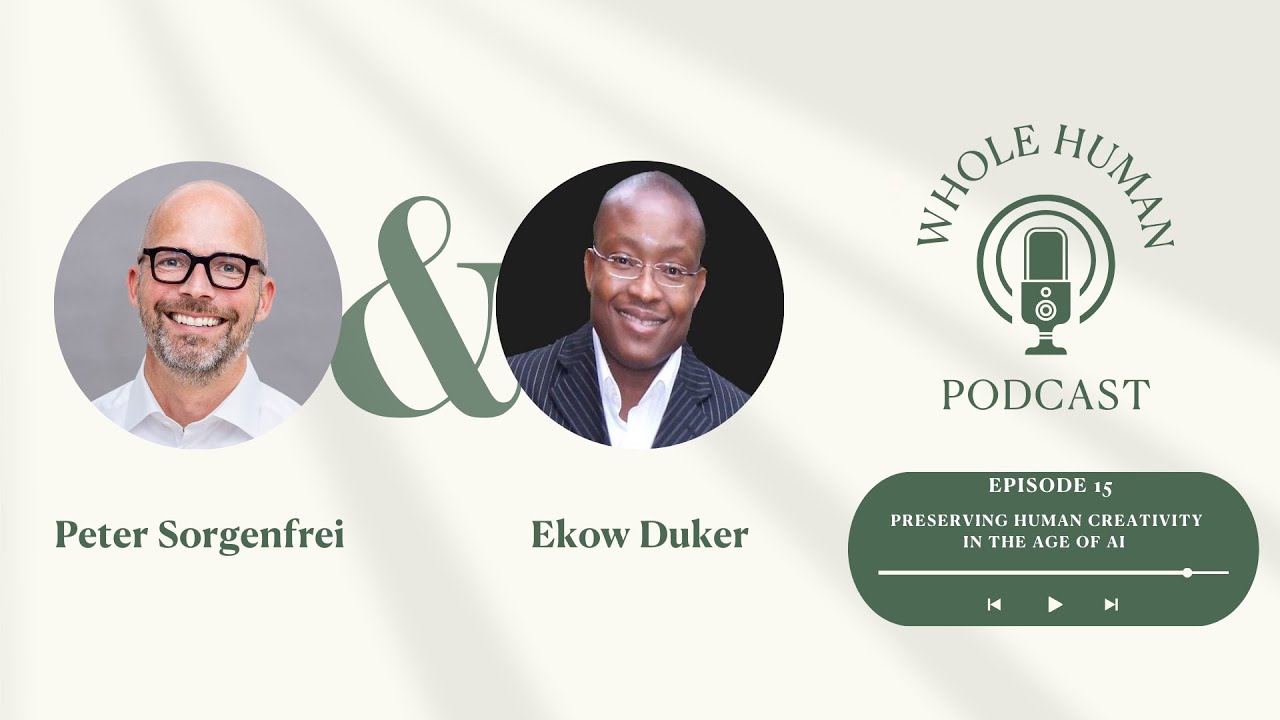
Ekow Duker, a former oil-field engineer and novelist, co-founded the AI Shop to help businesses use language models for real problems. He draws parallels between writing novels and building startups, both requiring resilience and empathy. He worries about preserving human creativity as AI advances rapidly.
Chapters
Welcome to another episode of the Whole Human Podcast. I'm your host, Peter Sorgenfrei, and today I have Ekow Duker with me. Ekow, welcome on the show.
Thank you very much, Peter.
Where are you in the world today?
I'm actually in Johannesburg in the, well, it's sort of getting to the end of winter. But I guess in South Africa, we are always surprised by how cold it gets. So it's a little bit cold too.
And how cold is that? When, for people not knowing, South Africa right now, we're recording this on August 1st. How cold is it down there?
Well, I'm actually from Ghana, which is in West Africa, which is very hot. So it feels like 3 or 5 degrees Celsius, but it's probably closer to 15 or 16.
All right. All right. So 15 degrees Celsius. I, I can't do the conversion to Fahrenheit, but for, for, for most people that would feel a little bit chilly if you're used to twice that. When, when we got to know each other, one of the things that I was really fascinated by was the transition you've done from sort of your early career to how you spend most of your time today. So for the people who do not know you, could you give us a little bit of an introduction to who you are, where you came from, and what you're doing today, please?
Sure, happy to do that. So my name is Ekow Dukah. I'm from Ghana in West Africa, but I live in Johannesburg, South Africa now. I've had a few different careers. I've worked as an oil field engineer. I've worked as a corporate strategist. Now I run a tech startup and I'm also a novelist. So I do a few things and I found that there are certain aspects of each that have helped me in the other things that I've tried my hand at.
And, and how did you— if we go back to the beginning, so you started your career as an oil field engineer, and then I can imagine how the transition must have gone into, to strategy. But, but what was that? Why did that happen? Was it a life choice because you wanted to get away from the oil fields, or, or how did that happen for you?
Yeah, it's kind of funny. So, so the oil field was a hard job. Sometimes it could be a lonely job, but I find that I miss it sometimes. The transition to the oil field to a corporate role was pretty traditional because many of the engineers, and I, and I was by no means the first, would have to stint in the oil field, go back to school to do an MBA usually, and then transition to the corporate world. So that's what I did. So after the oil field, I went to do an MBA and then moved to South Africa and started working for a consulting firm.
Okay. And then at some point you were done doing corporate strategy and you thought, now I'm gonna do a startup.
Yeah, I think I didn't know any better, but yes. Yes. So I think this was back in 2016. And I had the opportunity to join a small startup, which was a data science consultancy. So, so myself and, and the founder Megan, we worked together for a while, you know, to grow the business. And it was a big change from working, working in the corporate to working, to working for yourself. Yeah. And I think there's a lot to be said, a lot to be said for working for yourself.
So, so how did you manage that transition? So working in sort of the, a bigger corporate setting to working for yourself, what were some of the things that you had to learn how to do?
So I remember, so I remember sending an agreement to a client and they came back with some changes and they said to me, have your legal person look at it. So I was thinking, well, we don't have a legal person. I'm the legal person. You know, so you suddenly have to wear lots and lots of hats from legal to HR and, and so on. And, and, and try to look as though you have a legal person.
Right.
You know, there's lots of, of new roles to learn because in a startup you simply don't have, you simply don't have the full, the full range of resources that a large, that, that a large corporate would have. But then having said that, the disciplines you learned in the corporate were also helpful, such as planning and work plans and doing stuff and being able to get stuff done to actual deadlines. I also found that those skills or learnings were very useful.
And do you think that, so I'm assuming there's a fair amount of independence in being an oil field engineer, right? I imagine that you will have to figure out a lot of things yourself and have to go out and look at the fields and look at the installations and stuff. Was there anything in that experience that you'd kind of bring into all of a sudden having to wear all these hats in the startup?
Yes, I think so. If I cast my mind back to the oil field, there was always a very strong sense, I would say more than independence, it was more a sense of of being able to do anything. So there was really no, or at least you were trained to think that there's nothing you cannot do so long as you do it safely. So you had a bit of a swagger, and I think that helps in my current role that my default position is that we can do it. And I think that goes back to the oil field.
Right. And I think that's a very common thing among the founders and startup people that I meet is this sense of we'll figure it out, right?
We'll figure it out.
Yeah, we do this, whether it's putting somebody on Mars as Elon is doing, or whether it's figuring something out with this, with AI and how to manage that in a way that's beneficial to all of us. Most founders, CEOs that I meet have that attitude, right? We'll manage, we'll work it out. So, but you're not only doing a startup, you're also a novelist, you said. So tell me about that. How, when did that start and how did that come about?
Yeah. Yeah. So I always say that goes back to my mother. So my mother was a teacher. She taught 6 and 7-year-olds for much of her life. And she always encouraged us, her children, to read a lot. And I guess from reading a lot, it's not a big step from wanting to write your own one day. But then I never thought to write until my first job as an oil field engineer, which took me to Libya. So I was suddenly in the desert. And as you can imagine, in the desert, there's not a lot of stuff to do.
Mm-hmm.
So when you're not working, you have a lot of time. And so that's when I started to write and I started writing for the company magazine. And I guess many of the engineers didn't write. Mm-hmm. So writing for the comp— so writing for the company magazine was actually the first time that I got an inkling that people might like what I wrote and how I wrote it.
Right.
So that was where it started.
It's funny cuz I'm, I'm thinking about my favorite author, Murakami. I know that's not super original. I know he's, he's a favorite among many, but I think he started— his first writing was also for like a company magazine or a travel magazine or something like that. And then that turned into, then that turned into obviously a very prolific writing career. So I think many, many great writers have started like you. What kind of, what kind of stories is it? What kind of novels is it that you're writing these days?
So there's been a change. So when I started, I would always write about relationships in some form, usually relationship setting that goes wrong. So my first novel, Dying in New York, was about a traumatized young South African girl who had an obsession to make her way to New York.
Mm-hmm.
So the story is really set up as a series of conversations between The girl and her counselor in New York. So there's a lot of flashbacks where she's recounting her story. So I guess I'm always drawn to the underdog or drawn to the little guys, people who don't have a fair crack of the whip. I've always been drawn to them and seek to give them a voice. Recently, and I guess with the tech, I sort of veered into probably science fiction. So, so, so I have been writing along those lines, but I'm finding that my pre— I'm finding that my publishers who liked the previous stuff don't like the science fiction.
And, and, and that's another challenge, right? You're, you're writing for an audience in some way, but you're also writing for a middleman, right? Your publisher needs to—
Exactly.
Yeah. Your publisher needs to, to approve it. And as you're, you know, where do you find inspiration for these stories?
So as you may have guessed, I'm a bit of an introvert. So as an introvert, I live a lot in my head. So that's where a lot of the inspiration comes from. So when you're writing or, you know, when I'm writing, you actually start to form quite close relationships with the characters.
Right.
And when the writing is really going well, it actually feels like you're taking dictation to the point where you might write something and then hear a voice in your head saying, no, it didn't happen like that, change it. So it, it's, it's the characters that give me the inspiration. And it's more than inspiration, it's actually a sense of adventure. 'Cause when you sit down to write, And I don't necessarily plan out the novel. It's as much a discovery for me as I think it is for the characters.
Right. So, so, so what you're saying is when you start on some idea of some story, you're not planning for it to be a novel necessarily. You're just exploring what the story that you have in your head, what that might become.
Yeah, pretty much. Yeah, pretty much. So, so I, so I let myself be guided by the characters. And of course there's a, there's a structure to writing and a way to do it and a formula. So I, so I don't discard that, but, but I try to be true and, and write in the character's true voice cuz I'm taking dictation after all.
Yep. Now we are gonna try and make A parallel or sort of a transition to how that is to your current startup, the AI shop. Oh, no.
You know, yeah.
What, what, how do you— I don't know how to ask this question, but I'm thinking about, you know, the stories that are going on in your mind, the way that you can imagine the future, the kind of narrative that you're creating, and then now building what is essentially A venture or like, well, you can describe it better, but basically you're trying to create a bunch of tools using AI for different job types in different industries, right? So you kind of have to imagine what those jobs are like. I'm listening to myself, I'm butchering this question. I'll just leave it to you. How do you take your, you being a novelist and apply that to what you're building with the AI shop?
Okay. So, and I think it's a great question. So being a novelist, one of the things about writing, which is very similar to being an entrepreneur, is that no one asks you to do it, right? You know, so no one will ever come to me and say, why aren't you writing? Or why aren't you starting a company? It's actually an odd thing to do.
Mm-hmm.
And also when you're doing it, no one cheers you on. So you have to have that inner sense of resilience, find that, find that engine deep inside you to keep going.
Yeah.
When no one asks you to do what it is that you're doing. And to many people it seems odd or silly or crazy. So, so I think the experience of being a writer translates very nicely to being an entrepreneur because it allows you to keep going. Now, specifically to the AI shop, I guess that goes back to being a writer as well, because when ChatGPT came out sort of November 2022, I was super fascinated by this thing called a language model. And I guess because my interest in writing and language drew me to want to explore what a language model was. So what is this magic or what is this thing doing? So that led me to learn as much as I could. And the idea kind of crept up on me that why don't you start a company that actually tries to bring the benefits of language models to a much wider audience. And I think it's much like writing because we all have this urge and we all have this urge to be heard. So I guess starting the AI shop is, I think it's really an extension of that.
So is it a way for more people to get the benefit of these tools? And, and do you believe that your background in, in sharing and telling stories Will, will help you communicate that and for them to then understand the power of the tools?
I think so. And I'd like to think so because what we tell my— it's what we tell ourselves. So myself and, and Simon, my co-founder, is that the business problems that we try to solve were there long before GenAI. So when we talk to clients, We talk about the problem. We like to talk in a very empathetic way. We hardly ever talk about, we hardly ever talk about the technology.
Right.
So we just try to put ourselves in their shoes and the technology is always secondary.
Yep.
So as much as we enjoy it and we enjoy the tech, we don't lead with the tech. So I think that comes to storytelling. And being able to tell a story that the audience will understand and empathize with.
I love the fact that you're writing and that you're a novelist and a startup guy. There are so many of the founders that I work with. I write too, right? And I'm not sure if we discussed this, but I wrote a novel, didn't finish it yet. Maybe we can have another conversation about how do you actually finish your work. But, but there's a lot of founders who are storytellers, right? And to your earlier comments about the parallels, they, they, they share kind of their vision or their story about what the future might look like, and therefore why their solution, their approach needs to be, right? Whether it's an AI business or whether it's a bakery, it doesn't really matter, but they're storytellers.
Mm-hmm.
And so one of the things that I've advocated for years is to get people to write more, you know, write down their ideas, write down their arguments for something, write down their processes. So there's a Danish word, skriftlighed. I don't know what that is in English, but essentially it says that we communicate more in writing. And I'm going to tie this to the language models because I think increasingly as we write, the language models will also start understanding us better because they will be able to interpret more easily what it is that we're trying to do. The flip side of that, of course, is are we educating technology to replace us? And that's my question.
Right.
Are you concerned with the advent of AI? Making the stories in your head less relevant?
This one has to be, so this morning I went to my son's school for like, you know, the year-end sit down with the teacher. My son is only 3 years old. And the teacher was telling us his progress in counting. So she said he gets to 99. Mm-hmm. Then she asked him what comes after 99 and he says 40. And I was thinking, that's just like a language model, isn't it?
Mm-hmm.
So in the short time that I've been doing this, there's been such a tremendous advancement in the capability of language models. And I think that every prediction or every doubts we've had about language models where we said, you know, they can't show empathy or humor. They've proven us wrong. So I'm very loath to say language models will never do something, but at the same time, I would like to think also, maybe I'm trying to have my cake and eat it, that language models will always be, for the large part, really good assistants who will get better and better, but I think there'll always be a certain humanness that if we trade that away to the language model, we as humanity, I think, will be a lot poorer.
Is it like when we had Big Blue, the IBM chess computer, for years competing against Kasparov, right? The reigning world champion at the time. In chess. And people are saying the computer can't beat him, the computer can't beat him. And he kept beating the computer until at one point the computer did something which was irrational.
Yeah.
In chess.
Yeah.
And then ended up beating Kasparov. Right. So the computer actually starting not doing the math, but did the math and said, I'm not going to listen to the math. I'm going to do— I'm going to make another move. And that's when Kasparov lost.
Yeah. And I think that's where we are. I think that's where we are with the language models and GenAI in general becoming more and more capable, more and more cost-effective. I think much of the value and much of the innovation, as much as there's a lot of hype, I think there's a lot more ahead of us than there is behind us. So I'm excited to see what's coming and how we manage it.
And I think that is a wonderful note to end on because there is much more ahead. Ikov, I wanted to thank you for your time today.
Thank you, Peter. It was great chatting with you.
And for the people listening, this has been another episode of the Whole Human Podcast. As you heard today, sometimes it doesn't go super smooth when I ask questions. But I hope you got value out of it. If there's anybody else you want me to talk to or any other topic you want us to cover, please let us know. If you want to know more about Ika Vdukar and the AI Shop and the other wonderful work he's done, we will link to him in the show notes where you're watching this or where you're listening to the podcast. Thank you so much and have a great day.
Thank you, Peter. Thanks, everybody.










