The Blueprint for Impactful Entrepreneurship: Lessons on Growth, Innovation, and Giving Back
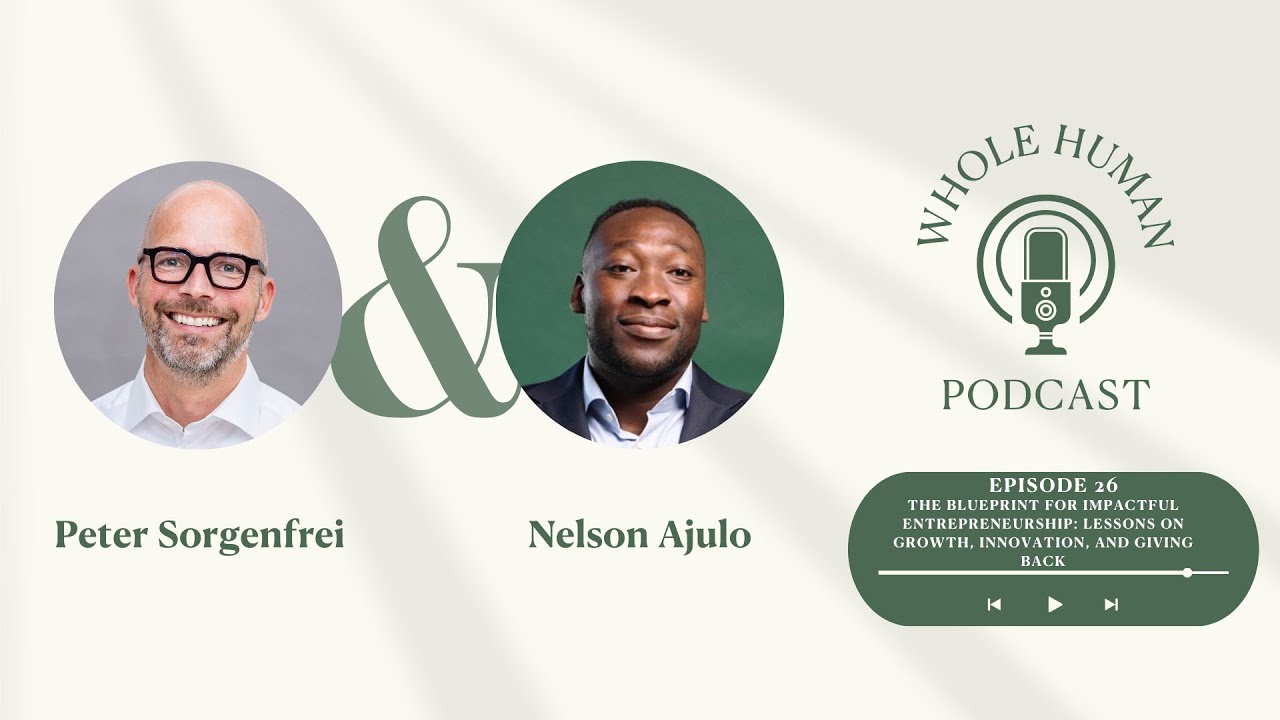
In this Whole Human Podcast episode, host Peter Sorgenfrei interviews Nigerian entrepreneur and venture partner Nelson Ajulu. Nelson shares his journey from starting a business at 18 with the dream of early retirement to becoming a multi‑founder, researcher, and investor. He explains his PhD focus on human‑capital efficiency and how insights from comparing Nigerian and Dutch economies inform his ventures. The conversation explores Nigeria’s startup ecosystem: a youthful, hustling population hampered by limited knowledge, capital, and internet freedom. Nelson highlights the gap in entrepreneurship education and the need for strategic scaling, market positioning, and partnerships. He then details his flagship platform JobID (a LinkedIn‑for‑Africa) which currently has 75,000 users and aims for 2 million in six months. JobID redistributes 50 % of revenue to users via blockchain, creating a community of stakeholder‑owners. Growth has been entirely organic, and a forthcoming Series A will fund infrastructure for rapid expansion. Nelson also discusses his role at 15Wins, a venture fund targeting a $50 billion pool to back Nigerian companies, emphasizing mentorship, go‑to‑market support, and foreign direct investment. The interview shifts to his investment philosophy, focusing on social impact, founder quality, and risk diversification. Finally, Nelson outlines an ambitious AI roadmap: six generative‑AI agents (Brittany, Diego, Sophia, etc.) designed to automate personal assistance, project management, and meeting efficiency, with plans to integrate them into JobID/Jobble and eventually offer whole‑organization AGI services. The episode concludes with a look ahead to scaling these technologies across Africa.
Chapters
Welcome to another episode of the Whole Human Podcast. My name is Peter Sorgenfrei. Today I have with me Nelson Ajulu. Nelson, welcome on the show.
Thank you, Peter, for having me. I'm looking forward to see how the conversation would go. I'm also happy to share my experience as well.
Great, Nelson. So for the few people listening to this who do not know who you are, maybe we can do a brief introduction. You've, you've done a number of businesses. You're a venture capitalist, you're a multi-founder. So the brief highlights, what should people know about Nelson Ajulo?
I started my entrepreneurial journey actually at a very young age. I was 18. I had this dream that I would only have to work for 2 years or so. I would just scale the business and after that I can go on the beach and relax and have other people running my company. Um, but that was, I'm like, uh, 16 years down the line now. I'm still, I'm still here. And then the bigger it gets, the more involved you actually will get. So that was just, that was an illusion and not actual reality. I enjoy sports as a person. I think I'm big on creating opportunities and really connecting developing parts of the world with work opportunities and vice versa, because I see that we can have a win-win scenario both sides. So I think maybe in a nutshell, this is who I am.
And so starting your first business, you touched on it a little bit. You wanted to work for 2 years and then basically not work. Was that your motivation to start the business or was it because you saw there was a need in the market and you thought, I can fill that need?
Yeah, I think the main motivation was mostly around, I think maybe to go back a little bit. I am African, I'm from Nigeria, and I grew up between understanding the potentials and the problems in Africa. And then I also, I was also raised as well in the West as well, seeing opportunities and possibility as well in the West. And as a child, I always remember asking myself the question as to why is it that here there's a lot, you put in the work and then you see the result. And here you put in the other side in Africa, you put in the work, but it's not as much opportunities that comes out of it. It always baffles me because I see that there's some people that think the same as me, are super smart and the like. So as an adult, I constantly look for that solution that could actually, like, what could be wrong and how could we fix it so that we can actually eradicate things like poverty and the likes. So also when I got the chance to do my PhD, I also specialized my PhD on, on efficiency of human capital, which is actually one of the main ingredients that affect, let's say, the national economy as a whole. And also comparing, let's say, Nigerian economy together to, in relation to the Dutch economy and also seeing how you can learn from both approaches. And it's quite fascinating what we realized. And that's also some of the things that, that now we are building into companies and that we're building into different notions to actually create that sustainable solution. And through the iterations, we also see that these are things that could be instrumental for other developing economies and not only Africa, but actually even within developed economies, you also have different sides, people who are also less privileged and people who are also very privileged. And these are also models that can be applied to also create that level of equality overall.
So, so when you're talking about efficiency of human capital, I think I'm gonna turn our direction a little bit to the African continent because I have an expert with me today, and it's just not often that I get to, to speak to somebody like that. So tell me a little bit about the startup environment in Nigeria, both then and, and now. Is there a culture of people wanting to take fate in their own hand and, and start their own business? Or what's that place like? What's Nigeria like in that sense?
I mean, I always say every Nigerian is an entrepreneur.
Interesting.
Oh, really? Every African? Well, before we narrow it down to Nigeria, every Nigerian is an entrepreneur. You should just go up the streets of Lagos. Everyone is hustling and trying to— everyone, like, if you need to fix a shoe, if you need to build a ship, if you need to build an aircraft, everyone can do it. As long as you give them money and the possibility, they will find a way to make it happen. It's just a mindset of possibilities and the mindset of can do. It's just insane how, but then of course you have that mindset, but then you also have lack of resources and lack of opportunities and the ingredients to actually make those value or mindsets a reality. So you've got this bunch of dreams just walking around the streets untapped. And it's actually, that's one of my biggest pain. Like whenever I touch ground in Nigeria, it's one of my biggest pain, like how so much That's how much talent can just be wasted without actually having the right ingredients to make them flourish. And this is a population of almost about 220 million people with a youthful population. I think about 65% of the population or 60% of the population is above 25, is around 25 years old, sorry. That's just to tell you how youthful the population is.
So you have a very youthful population. population who thinks that they can build an aircraft or a boat or do whatever it takes. So, so what is it specifically? You said lack of resources. I can imagine most entrepreneurs lack capital, right? But what other resources do they lack that, that the work that you're doing through your investments and in other ways are helping them get? What are those things that they need?
I think one of the biggest resources is also knowledge, right? Knowledge in the sense of, okay, this is how it should be done. This is the best practices or a small exposure in itself. But then you also have that lack of capital as well. Also maybe lack of access. I think when it also comes to even internet has been such a huge blessing, and I think that will be a very big catalyst also for Africa in the future. But it might not be if some of the censorship that, let's say for example, the EU is trying, that they're trying to pass now really comes into force, mate. It might also hinder that growth and possibility. But if, let's say, if we keep on the same track as this narrow and we have this freedom of internet and let's say the sovereignty of internet and we keep progressing in this track, I wouldn't be surprised if actually if Nigeria or Africa also, and the same with India as well, also lead actually the race of AI or artificial intelligence or some of the race of this new upcoming technologies and future innovation because there's talent there. The productivity factor of that talent is there, but what will be missing now is the know-how and the exposure to what's possible and the exposure that this is even possible. And then the capital also in terms of resources to meet that production or productivity. If all of those things align, this can be a very huge opportunity that will even But then of course, if Africa comes up or if Nigeria comes up, it is not diminishing to the whole world because that could also maybe create a new form of competition globally, which only leads the whole world to further innovation in itself. Because then we have these different strengths from different parts to amplify and build more.
So you were one of those young men, you're still a young man, but you were one of the ones that took initiative and started your business. I think you said at age 18. And since then you've been part of, I lost count, to be honest, but you've been a founder or co-founder of a bunch of different companies. Some of them, I suspect, didn't succeed and some of them are still going and have succeeded probably beyond your dreams. What is one thing you've learned from starting all these businesses? What is something that you think back of and saying, if I can teach an entrepreneur in Nigeria this thing, Then I think they'll have a better chance of success having that knowledge. What would you teach them?
I think how to scale a business or how to start a business in the right way. I'd say one thing that, uh, I say, for example, Nigeria is full of— Nigeria is a country full of entrepreneurs. Every 220 million people could be an entrepreneur. Well, entrepreneurship is different. It differs. What I've learned in my recent years or from experience, even within the Middle East, I say, or even within the West, I think it's also, it comes with experience, right? If you're starting, if you are starting your entrepreneurship journey at the beginning, you probably have the wrong priorities or the wrong kind of focus, or you probably think about the wrong kind of formula. But then over time you learn what scalability means, you learn what the market or market positioning and the likes. And some of it comes with experiences. But furthermore, I feel like in Africa there's a huge gap in actually understanding those science, the science behind entrepreneurship. What people know is trading, is negotiation, whereas entrepreneurship goes beyond that because you also need Coordination, strategic positioning, strategic partnership, fundraising. Some of these nitty-gritty that, that is maybe it's actually unknown to them because it's not even a reality. It's not even something— there's almost no venture capital landscape in Nigeria or in some of the African countries are not even active. In some places it's almost dormant. So because of the state of heart in this kind of places also means that they don't even have exposure to it. And then when those instruments are missing, the scalability ratio is also lower. Of course, there are some few people that maybe, for example, they've lived in different countries and they have different kind of exposure to different kind of Western organizations or countries that maybe know this, but this is not a widely known knowledge or that is widely available out there for them to be able to tap into or understand. So these are the things that I wish, personally, if I also, if I knew some of the things I know now, obviously I think I would've scaled a lot faster because I would My learning curve would've been shorter, would've been smaller, and I would've built a lot more scalable businesses right from the onset.
I think it's one of those things that's actually universally true. The scaling of a company is where a lot of founder CEOs that I meet either in my practice or in general are struggling because it's very different from being a couple of people having a good idea, trading, as you're saying, selling your services, selling your products. To then building the structure of the organization that can roll that out across regions or across countries or across the world, right?
Yeah.
Even with digital businesses. So, so which of your, our companies are like our children? I, I forgot to ask. I don't, I'm not sure. Do you have children? Like real children?
Well, I would refer to Corridor now.
So, but, but let me say, I have a son, right? I have a child who I of course love more than anything on, on the face of the planet, but I've also built 6 companies and all of those companies I see as my children in some way. Well, we all have our favorites. So success or failure, if you look back at, at all the different companies you've been involved with, which company is the one that is closest to your heart?
Oh, that's gonna be very hard to choose.
What we can say to the listeners of the podcast who are in your current business, of course it's the current business. We all have long-lost loves. So one of your previous companies, which one was, which was a favorite of yours?
Ooh, that's gonna be, that's gonna be really hard to choose. Maybe for the, I think currently now, I think my most favorite, which I think the reason why I really like this project is because I could create a lot of immense impact. I did have 3 dreams when I was growing up. And one of the dreams was to positively affect 1 million people's lives. It sounds really impossible too. And actually for a while I didn't know how I'm gonna make that happen. So I've been wondering, how can I make it? 1 million is a huge number. But now I think I found it and it wasn't intentional. It's just, it just happened. And then I realized, holy shit, I can actually affect millions of people's lives with this technology, with this solution. And that is called JobID. So literally what we do with Zartech now, we are now scaling it into a web application and a mobile application. So in essence, it's more like LinkedIn for Africa. At the moment now, we've got about 75,000 people on this platform, but within the next 6 months, we want to scale it to 2 million people in Africa. And this number is not significant because Nigeria alone is 222 million. So it's not. So this is not a lot of numbers. Actually, in the future, we'll be scaling it beyond that. In the next 6 months, we target 2 million users and they can socialize with each other. They can connect with each other. They can have their professional profiles on this platform. And now we can, when we have this consolidation of skills, we can now post them to the Western view that evolved to interact with African profiles. You can go here and connect with them. When you post a job, within a few minutes, they get connected. to someone. But the most interesting part is that 50% of the revenue that we generate, either from companies that are paying, paying to post a job or that are doing survey, because I think Africa is very under-researched. So now with this bunch of people there, you can now post a survey to do any kind of report or any kind of research that you want to do with millions of real people's data. Or let's say you want to sponsor an advertisement, any amount of money that we generate, 50%, we are redistributing it back to your community. On our platform in the form of using our blockchain technology so that we also can create passive income now. Because what makes what makes any platform that generating bunch of billions? What they have? They tell the user and then they don't participate in this benefit in this game. So we actually want to start with this in Africa to say okay, 50% of all revenue we generate we distribute it back again to society. And you know, let's maybe it becomes everybody every user becoming a cons. consortium of owners on this platform. So for me, I really see this as the most significant way I can create a lot of impact because for me, this project is not about making the profit, but actually to actually create impact. So I'm really excited for the job I do.
So if we zoom in on that business then a little bit, how do, how are you getting those users? Is it just word of mouth? Are you spending a lot on customer acquisition through advertising? You know, Because it has this social aspect to it, the social good that you're creating, I can imagine that there might be NGOs and others who would want to support the distribution of this. How are you going about it?
Currently now, it's all through word of mouth. We haven't started a single campaign. We haven't started blasting anything. We haven't started— we don't have promo anywhere. We don't have viewbot anywhere. Currently now, it's just all organic. Because of the messages spreading organically. And this is actually why we think when we create a promo and we blast it out there, that the acceleration of the platform will be huge, that we will not even be able to keep up with the volume of interactions on there. And that's why also at Moonright now, we are about to narrow— we are about to start raising a Series A to make sure that the infrastructure is ready for that huge expansion. And also that we can also keep up with the momentum because The proposition is just brilliant, which is that we want to redistribute back the profit back to everyone. So bring all your data, bring all your knowledge, bring all your know-how to NARO, come to this community, invite people that you know, and based on people that they know, they also benefit from any kind of financial interaction that they do on the platform, right? So you come to the platform, you become a stakeholder in the platform, whatever you do in terms of your professional profile, you do it on there, you also earn money back from it. And also you can also get a job and it's just, and this is what they already do for free on different platforms. And now they can do it on our platform, even in a much more secure way, because also when they're sharing their professional profile, they can put it behind a QR code so that it's also not reshared over and over again. There's a lot of interesting ways that we also serve the community back by also giving them free tools for storing their contracts or for signing their contracts. This is just, is an amazing opportunity that they can get to do this for free. They don't have to pay. All the users come to our platform for free. They don't need to pay to use this, utilize this solution. They can also chat with each other on the platform. They can make video calls, they can make audio calls without paying a dime. And also at the same time, if they invite people to our platform and if they also interact, if people that they invite to the platform also interact with any kind of paid content, either they apply for a job. They like any sponsored post, they like or they attend to any sponsored survey, then they earn money continuously for life through those trees.
Amazing. You mentioned that you're raising a Series A, but you yourself are also an investor through 15Wins, right? The VC fund that you're a venture partner and founder at.
Yeah.
Um, let's talk about this side of the table, right? So not only are you a founder CEO seeking investment, but you're also somebody who provides investment. How has that journey been for you to go from being the founder to being the investor? What were some of the things you needed to learn making that transition?
I think I realized the hard way that I need partnership. I need people. I need people that knows better than I do. I need people because just one person is not enough. We all have our core competence. I can tell you about my core competencies if you ask, but also it's also different kind of investors or different kind of partners that also come with their own core competencies. And then when you combine these, then you have an explosive. possibilities. The same way I seek for those assistance to achieve the dreams and the possibilities I want to achieve, the same way I also see also future of coming entrepreneurs as well. They're also seeking for my kind of expertise or for our kind of know-how that we take for granted or the network that we take for granted that we can actually give back also in a similar way. It's also, it's more of a form of giving back. And that's why we've set up this, um, $50 billion, uh, fund in Nigeria to actually be able to give back to upcoming Nigerian companies or entrepreneurs that also want to, that have a global ambition, that want to take their businesses from, let's say, from 10 to 100, that we can also assist them with their whole global journey and global scalability. We can also offer them insight into some of the experiences that we've learned there. Also, it's not only we support with fund, but also we support with mentorship, go-to-market, international partnership, and acceleration, which we actually hope would also in turn help to create more job opportunities in Nigeria. Also bringing a lot more FDI into the country, and we hope that we can also scale this into different markets in Africa.
That's amazing. Well then, how do you— I spoke Danish there for a second, which I guess you don't understand just yet, so I'll keep it in English. What is the hardest part about being an investor outside, of course, picking the right companies? What do you find the most challenging as you're sitting there making investment decisions?
I think there's a way to have some tolerance. Maybe as an angel investor, I'm more about social impact. So for me, it's very clear. If the project does address social problems, then for me it makes sense. And of course, if the project is able to pay its own bills and the continuity of the project and also the founder, who the founder is, and also if, or the founding team, and if they have the right kind of mindset. I think that's a lot much more easier. I think what is not as much easy is more, I think it's more when it comes to the venture funding. I think it's more like a canvas sometimes because especially when the organization is quite young or quite, no matter how good the idea is, there's always this question mark, right? So it's not about good ideas. And also sometimes even amazing teams that they do, let's say they do have issues sometimes and then they break up. And the projects still end up in the ditch as well. So I think there's always those question marks and eventually it all boils down to maybe just spreading the risk and diversifying the portfolio. And yeah, and maybe also staying close to the organizations for a while, for the companies and seeing their track record and seeing how, seeing if they fulfill or if they say what they promised that they would do, maybe over a period of 3 months or 6 months, but you can also see Yeah, that's, I think that's the, that's maybe one of the easiest way to, but you can never really tell fully.
All right. I wanna talk to you a little bit about what's next for you, right? So obviously Jobly, you're gonna push that platform. You're gonna continue to work with Sartech and building that company. What's on the horizon for you over the next couple of years? What would you love to work more on in addition to those?
Yeah, I'd say over the next 2 years now, we will be scaling and be growing mostly JobID and Jobble. Both of them are actually very similar projects. So JobID is a professional profile, I think I've spoken about that, also the social benefit and the likes. But Jobble on the other side is more of an advanced, it's more, I think it's more of work as a service. Currently now, TrueSight, we connect developers, right? Mostly from Africa with global work opportunities. So we've also seen that there are some jobs that can be done by AI, which is by an AGI. So we've built currently now 6 AGI models. One of them is Brittany. Brittany is a personal assistant, so it can schedule meetings, it can collaborate with different— you can just CC it in an email and take over the conversation to schedule the meeting, to plan to do, to create alerts. And also we are working even to enhance it that you can order for different things, you can call people and the like. So we We, that's part of the roadmap that we have now, but currently now you can do all your administrations like coordinating meetings, coordinating to-do, prioritizing, and shifting your calendar as to when it should be. We also have another agent, which is Diego. Diego is a project manager, so does the risk analysis, assign projects, break down projects, can also come up with priorities, user stories, and assign it to different developers based on, or different team members. It's not only a development PM, but it can also be For normal projects as well, assign it to, because we know that we have a skill, because from Joby, we have a skill database, right? Of everyone based on skill database. Also Joby utilize that to also leverage how to assign the project to who on the team and the likes. So we also have Sarah. Sarah, actually we have a patent pending on Sarah because Sarah can do, sorry, Sophia, not Sarah. Sophia does the coordination of meetings, generate agenda. Plan the meeting, but Sophia also ensures that meetings are much more efficient, which also means meetings are much more inclusive. So for the first time now, we've been able to hack meetings efficiency, which have never been done before. And we have millions of meetings on a daily basis, and this is the missing list of decisions that affect people's lives, but there has never been transparency as to the efficiency of meetings. So Sophia now will generate agenda, sits on the meeting, generates a meeting report at the end of it. And then send it to everyone, but also feedback to make your meeting a lot much more efficient, what you've done wrong and how you can make it better. So, and also we have—
you have a bunch of new services rolling out. My head's spinning that you guys are managing to do that, but it sounds like you're headed in the direction of making organizations and work more effective leveraging generative AI. Is that a fair headline for what's next for you for the next couple of years?
Yeah, because definitely I think also for organizational scalability, of course there's one part which is that, which is where let's say we're less reducible to opportunities to where it was not before as well. That's that part that will always be there. There's also the other part that, okay, organizations also want to scale for that, that we can also, with our knowledge of making teams and placing teams and arranging teams for different organizations, now we're also making AGI, a set of people to also for those organizations to also leverage as well. And then we're also selling the AGI as a person and increasing the efficiency or the possibility or the scope of work of this AGI. So we are starting with 6 AGIs at the moment. The organization can rent or can, yeah, can rent. And in the future, we're also planning to actually have those 6 AGIs be able to talk to each other and also be able to coordinate that in the future we can actually give a whole organization AGI to business with. So that's— Oh, we're working towards now, Jobu, we're planning to launch the MVP in January 2025, alongside with the MVP of JobID, because we need JobID also to— we need the SQL database to run a lot of what we're doing also in Jobu as well.
Wow. Nelson, we ran out of time. We said, before we started recording, we said, Peter, we could talk for an hour. And you're right. Well, we try and keep these episodes short. So Nelson, I want to thank you for joining me today.
Yeah.
Thanks. And to everybody listening, thank you for listening into another episode of the Whole Human Podcast. I'm your host, Peter Sorgenfrei. If there was anything in this episode that you want to learn more about, let me know. If there's any other topic or any other founder CEO you want me to take, bring on the show, I'd also love to hear from you. Thank you so much for listening and goodbye.
Thanks, Peter. Bye-bye.










