The Challenges of Hiring and Delegating w/Pierre Pignault
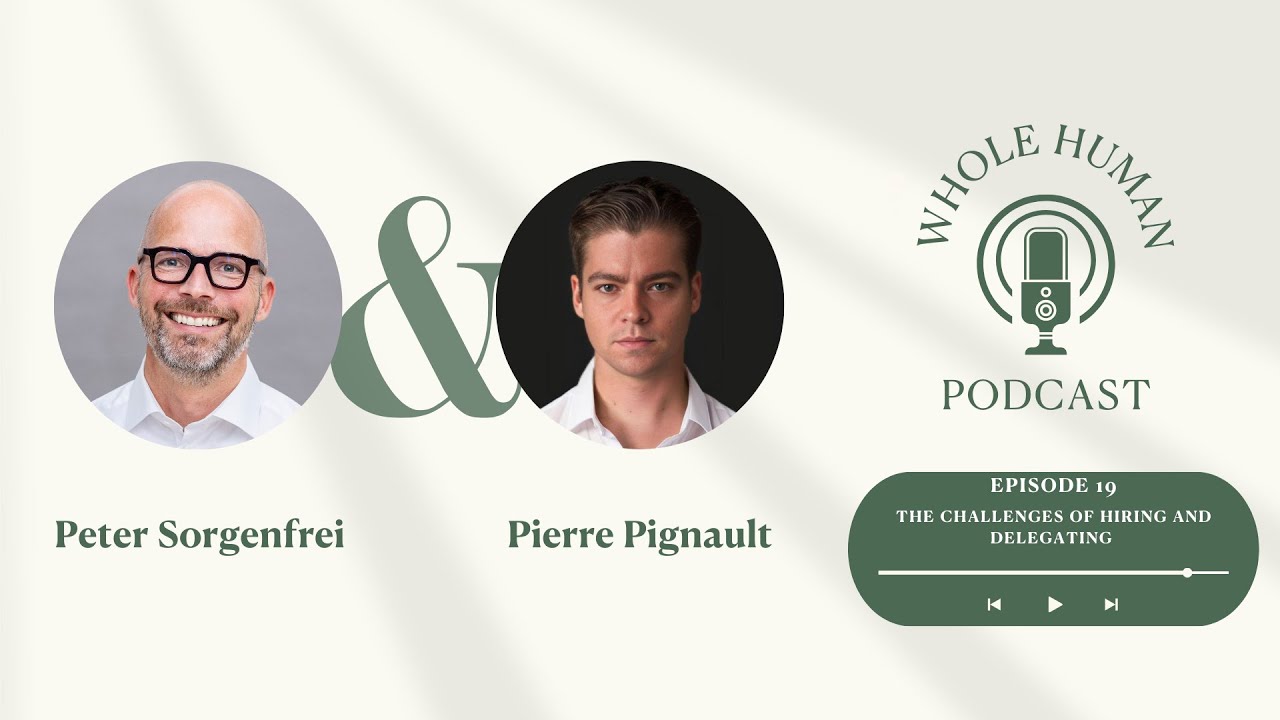
In this Whole Human Podcast episode, host Peter Sorgenfrei interviews Pierre Pignault, founder and CEO of Mailsaur, a consulting firm that specializes exclusively in email deliverability and security. Pierre explains how his experience as an intern managing email deliverability for a SaaS company in the US sparked the idea for Mailsaur, and how the COVID‑19 surge in email traffic accelerated its formation. He discusses the realities of being a first‑time founder: the roller‑coaster of highs and lows, the importance of stamina over speed, and the difficulty of building a sustainable business without external investment. The conversation delves into the lack of early processes and KPIs, the challenges of hiring and onboarding, and the reliance on personal networks and a recruiting agency to grow a 15‑20‑person team. Pierre highlights the need for clear sales processes, delegating non‑closing tasks, and building a resilient organizational structure that can operate without his constant presence. He concludes with practical advice for new founders: start the company, stay open‑minded to where value can be delivered, and focus on adjusting the sails rather than trying to control the wind.
Chapters
Welcome to another episode of the Whole Human Podcast. I am your host, Peter Sorgenfrei, and with me today I have Pierre Pignon, who is the founder and CEO of Malesoar. Pierre, welcome on the show.
Peter, thank you so much for having me. It's a pleasure.
So, for the people who don't know you, Pierre, and there might be a couple of the people watching this or listening to this who have not come across you on social media, who are you? What are you doing? What's Mailsaur all about?
So, Mailsaur is a consulting company. We help email senders all over the world try to achieve the best possible results possible deliverability and security for their email communication. So it really translates into auditing and implementing sets of best practices, whether it's technical or kind of like human behavior management, which I believe is a really big part of it as well. The goal is to get their emails to land in main inbox and to also reduce as much as possible the risk of some type of frauds happening through emails, right? So this is our sole activity. This is the only type of consulting we provide. We don't do marketing, campaign management, and all of that. We just care about—
So you're solely focused on deliverability and the avoidance of fraud in the email chain system?
Exactly. Deliverability and security for email communications.
Very well put. Now, I'm not an expert in this field, but it seems like there's a ton of companies doing email deliverability consulting or services of that kind. So what prompted you to get started with this? Why did you start the company?
So I think first of all, I would like to address the fact that you're saying there's a lot of companies that are doing it. Obviously a lot is quite, you know, depending on what you consider a lot, right? But I don't think actually there's a lot of it. It's kind of a new thing. We do have obviously competitors and people, but you're talking about a handful of companies in the world that are actually specialized in this and that are not tied to a specific sending platform, right? So you go on any kind of platform, you may be able to get some support with your deliverability, but it's gonna be really tied to the platform and it's also going to be software support type, like tickets, right? You just ask your questions and you get the answer. We work with all platforms and we really kind of like have a handholding posture, which is different than what you would get from typical support, right? And this is why we're able to differentiate ourselves from that kind of help.
So I'm maybe making the common mistake of putting you in the same bucket as some people like ConvertKit or Mailchimp or some of these other services, which basically just allows me to send email, but they don't necessarily help me make sure that that email ends up in the inbox it's intended for.
Yes, we do not deliver any emails. We're not a software provider. We don't have a tool for you to deliver email. We come in when you already have a tool or when you want to set up a tool and you wanna make sure you have the best possible return on investments on your efforts with this tool.
Got it. And so why did you start the company?
A few reasons. I worked in the US after my master's was done in France, and I was an intern. And as you may be familiar, you usually give the interns some little tasks that he cannot mess up too much, right? And one of the tasks I had was making sure that The company were delivering the emails that they had to do. It was a SaaS company located in San Diego. Now it's called Cloudpets. They really went to do an amazing journey. I was in charge of making sure that anybody sending emails from support to sales team to product marketing was essentially delivering them to the right person and was delivering them properly. And this was kind of like back in. I would say 2014 to 2017. And the landscape, the technical landscape of email was getting a little bit more complicated to the point where I realized that essentially what I was doing was kind of like unique, at least within the realm of the company.
Mm-hmm.
And I, US visas are difficult to extend and maintain. If you're not a citizen, it's difficult to stay over there for a long time. So I had to come back to France and I wanted to continue doing what I was doing, right? So I continued working for this company and I realized, well, I can actually probably propose these services to other typical companies in their field or SaaS companies, because if it helps this one, maybe it helps another one, right? And this is really how this started. This was the desire of me to be having work at home. I didn't feel like I wanted to be in an office. I didn't very much feel like I I wanted to have like the whole kind of typical, you know, teammates and all that structure. I wanted to just, I was really into investigations, data. I've been playing a fair amount of poker in my life. And this is also something that poker is a lot of analytical skills and statistics and deliverability. The way you audit clients is also really based on number. So I was actually having a very decent time doing email deliverability for my clients. And I started doing it more and more. COVID hits. And as you may know, COVID led to a steep increase in emails, good and bad emails, right? And filtering become more difficult. So COVID was actually for us a positive event where a lot of people came to us and say, hey, you know, we We were not delivering a lot of email prior from COVID Now the only way for us to reach our customer is emails. So we have the DLT issue, we need to fix it. And this started really the company as a legal entity. I was a freelancer before that.
And so as a first-time founder, how has that been, right? This is your first company, if I remember correctly?
Yes. Yeah.
So, so how has, how has that been? Did, did, has it lived up to your expectations of the life that you wanted?
I'm not sure I had very much the right expectation about, I think, I guess I was very idealistic and thought, you know, you start a company in 2, 3 years, you make a lot of money and then you travel the world and blah, blah, blah. I think what I would say is this has been kind of a roller coaster ride. I think there's very high highs and very low lows in the life of a founder. And you need to really be able to handle these moments where you're like, you know, we're not going to make it. It's like we don't have the sales or whatever. And then 3 weeks after, you're like, damn, this is amazing. I need to recruit 3 more people because there's so much sales and so much stuff going on. So it has lived up to the good expectation. I'm very happy to be where I am right now. And I don't think I would trade it for any other job. But it's probably not as glamorous as some people want to picture it on, for example, social media, where it's a very, very long marathon. And it's not really about how fast you can run. It's more about how long you can run properly. Without falling.
I think that's a great quote. It's not about how fast, it's about how long. Because that's, I mean, that's typically what happens with startups, right? They essentially run out of steam because they've been running too fast for too long. So in many cases, it makes sense to slow down and be more deliberate with your choices and live for another day.
Yes.
Actually, that's something we should probably, that's something I should write about, this idea that It's really about stamina more than anything else.
Yes, because I have personally came to respect a lot longevity. In the past, you see stars, like you see this huge startup that raised like $300 million and they hired a bunch of things and you're like, wow, this is amazing. Like these guys must be super rich, drive a Lamborghini or whatever. And then when you actually look at it, no, most of these companies will raise a lot of money, will unfortunately fail, and it will lead to obviously a lot of people being laid off. I mean, I can't imagine the life of a founder when you have such money pressure and you cannot meet whatever expectation was there. So our goal is we're not a big company in any way, right? We got 15, 20 teammates and we want to keep on growing organically. We don't have investments. I'm the sole owner of this company. And we just want to keep on providing a good place, both for our clients and for our employees. We have people that have been there since day one. They still are really happy to work with us. And so, yeah, I think, you know, sometimes what you see and you see social medias have been playing a lot of part in amplifying this kind of thing. But like, I really, really came to respect people that have been in business for 15, 20, 25 years because I know what it takes to be there for so long, the weight that you have to carry, and it's very impressive.
When we spoke before this episode, we chatted a little bit and you said something along the lines of you didn't feel like you built a strong foundation from the start. Do you remember that part of our conversation?
Yes.
And what did you mean by that? What was it that you did not do when you were starting that you wish you had done?
I think that in the first year of my company, every single month, I was surprised and amazed to still be in business. Every single month, I was like, look, you know, this is just a trend. Like, I'm just being very lucky. I have all these clients, but then I don't know, COVID's gonna end or they're gonna find someone else and then I'm not gonna be there. So— I did not necessarily believe that you could actually build something valuable around the concept of helping people deliver their email in main inbox, right? And when you talk about that to other people, they're like, well, you know, that's a niche thing. Like, are you really making money off of this? Is it really a need or is it just like a technical thing and something? So the problem when you don't believe necessarily, it's not really don't believe, I don't think it's the right word, but like when you, you don't believe that you'll be there in like 3 to 5 to 8 years, you don't structure processes around a 3 to 5 to 8 year company, right? And so we had a lot of things that were done without procedures. We had very little tracking of some of the KPI that a business must track. So we were lucky enough that the growth we had was enough to kind of power through.
So you succeeded despite yourselves in a way.
Exactly. Well, I still succeed decently despite myself, by the way. Like, I still make an amazing amount of mistakes. Like, if you— I probably make every single mistake that one person can do when running a company.
I spoke to an entrepreneur from Iceland yesterday. Siggi has a company called Overtune. They make electronic music bits for all the hit songs that you hear on Spotify where you listen to music. And he said he was really good at not dying. That's how his company essentially had stayed in business for 5 or 6 years at this point in an industry which is notoriously fickle, right?
So yes, I agree. It's all about the resilience that you have and it's also Yeah, it's not dying, but I think you need to be a good salesperson. When you have a small company, before actually becoming a company, you have a funnel. And I heard a person, I think a few years ago, say about that, like, do you have a company or do you have a funnel actually? And that really struck my mind because like a company is a place where essentially if I was to leave for like 6 months, the company will still be there in 6 months and run and operate properly, right?
Yes.
You have your sales, you have your partners, your CSM, whatever. We did not have that. And arguably we don't still have that, right? We were just a place where people come with an issue, get into a tunnel, we fix the issue, and then they come out without an issue right now.
Yeah.
So it's, you know, there's always a difference. Like you may have a legal company, but if you don't have the capability to essentially leave the company for a while and say, okay, you run it, I don't think it's an actual full company, right?
That's a really interesting observation. There are 2 things that you just said that I want to keep talking about. One of them is the sales part, because I think that's something that founders vastly underestimate because in the beginning they get business, if you will, from their network or people that they know, and it's based on their personality or their person, but they don't build the systems to have a business development engine that allows them to essentially get known to more people every single day and handle inbound leads and, you know, do cold calling and emailing and all the other stuff, right? So, yes, that's one part of it. But the other thing that you're saying is another big problem in startup land, which is if the core founder or founders for some reason stop doing what they're doing, would there still be a company? And in many cases, I think the answer is no, there would not be a company. So what are you guys doing now? You know this, you're aware of this. What are you doing now to make sure that if for some reason Pierre is not involved in the business for a couple of months, that the train keeps on running?
So first of all, I don't think we're there yet. I think if I was to leave for 6 months, then there will be some troubles. We are building company with silo. We have now a deliverability team with a manager of the deliverability team. We have a customer success manager in charge of the satisfaction. We have marketing, we have billing, we have, you know, we're trying to slowly build this out. And we want to get to the place where, again, if I leave, again, 6 months is maybe a little bit too much on top of that. Like, even pretty big companies, if CEO leaves for 6 months, there's gonna be some trouble. But at this stage, like a month or a month and a half would already be a good start, right? So we're slowly getting there. We have limited resources. It's all about resources. I'd love to hire tons of talented people to take over and replace me, but it costs money. It costs time to train them. And the last thing that I wanna do is I think, and it's not in any way a way to like praise myself or anything, but I think I'm the very best salesperson right now for for my company. Like I think I haven't produced enough documents. I haven't got enough knowledge and things to just hand it over to someone and be like, hey, this is the playbook of how you sell Mailsauce services, right? It's still vastly knowledge that I have myself and things that I'm basically used to by hanging out on projects. So it's, the sales is probably one of the last piece of the edifice. Like you want to keep sales or at least the big sales for yourself as much as you can. Because you're the best closer for your company.
So, maybe it's about actually building process and structure that allows you, Pierre, to just do that thing that you're best at, right, in the sales process. So, I'm advising a founder here in Copenhagen who's building his sales organism. And I'm telling him he and his co-founder are the best people in front of the client. That's who people are still buying. But everything that happens up until that point, somebody else can be doing.
Yes.
The tracking of leads, the initial communication with leads, the setting it up and stuff. And it shouldn't necessarily be somebody outside the company. It can be, you know, there's a bunch of like appointment setters and stuff, but those guys should never actually talk to the customer.
Yes, I agree.
Because they don't know, to your point, all the stuff you know. So I do believe that the founder is often the best person to be the salesperson, but It doesn't get done because of course they have other things to do and there's not that push so that you basically wake up every morning and you say, okay, today, this afternoon, I'm speaking to these 3 prospects about these things in this way because somebody else has done all the legwork to get us there, right?
Yeah, we are, I think, at the stage where everything else beside the closing is quite handled by other people and also the onboarding and everything. But we get a really large amount of meetings. Like I'm talking anywhere from 70 to 120, 130 meetings per month. And this really, I mean, every meeting is a 30-minute meeting, right?
Yeah.
So you can quickly make the math. Some of them will not show up, some of them will be shorter, some of them don't need our help really. But at the end of the day, most of my time is spent talking to people and You know, really trying to— I'm not even saying closing anything because I don't believe like you need to get in this sales call with the thoughts of closing anything. You don't really know. You just want to get there with the thoughts of, can I actually be helpful? And can I be so helpful for free that they're actually going to consider paying me for services?
And I think that's a wise strategy too. The whole fear that I'm giving away the shop and then they won't buy from me is actually False. The more you give away, the more likely people are being like, okay, this I trust this person. I'll do business with them. They can they can build my they can they can help me with my deliverability. So I was thinking about you know you said you're fifteen twenty team members. How did you how did you go about finding those people? So the whole hiring process as you're growing, you've only been around for. 4 years or so, right? So yes, that's, that's a fair amount of people to find, hire, onboard. How— what's your process for that? How do you do that?
Just a first disclaimer, I'm extremely bad at hiring. I've had many, many unfortunate HR situations due to my lack of capability in hiring the proper person. I've been also extremely lucky Despite my lack of ability, I've met amazing people that are on the team. So I'm super happy with the team, right? But—
So you're saying it's dumb luck. You're basically saying you got lucky.
I got lucky. And not only in HR, it's also, I mean, you know, you create your luck or a little bit, right? But like, I've been fortunate enough to meet very good people that despite the lack of proper hiring process, despite the lack of proper onboarding, have been able to get on top of what they needed to do and be extremely good thing in the company. So we find people, I would say mostly in 2 ways. The first one is we have a network of people that we know are doing email deliverability, whether it's another company or freelancer, and we can give them some part-time work. And if they do really well, then we hire them full-time.
Mm-hmm.
This is, I guess, one of our preferred way of doing that because it allows a lot of flexibility You start, we give you a couple of clients. If you're doing well, you stay. If you're not doing well, we'll just end the collaboration and we'll just redirect the clients to someone else, right? So obviously what this requires is to have a large pool of people because not everyone will be available. Not everyone will be within the budget that you have and not everyone will do well at the job. So you need to hire, you know, almost 3 times the amount of people that you want to finish with like a— a stable team that actually does its work properly.
Mm-hmm.
The second means for us of hiring is we simply have a partner in France, you know, HR company, a recruiting company that they know our requirements. They're kind of like on the market. And whenever they see a resume or someone that could be interesting for us, they just send us over, hey, what do you think about this person? If it's the right time, if it's the right person, we set up an interview. And this is how we got most of the people that we have on. In France, we have something called CDI, which is kind of like the long-term legal employment in France. We also have teammates outside of France that are in freelance, right? So most of the French people have came through agencies and recruiting companies which have given this profile.
The acknowledgement that you're not good at hiring is also an interesting one. A lot of founders feel that way. And I think it's because they hire with the heart in some way. Right. So they see something and they kind of fall in love with the person, not romantically, of course, but with the idea of the person. And they're like, and I need some hands and let's just go. And then they kind of throw away sort of logic and reason and testing. So that's another very common theme.
Yeah, I agree. And I think you also have the time pressure. You're usually Not like, I guess, bigger companies which have very defined cycle. They're like, okay, you know, 2, 3 years, we're gonna need X amount of people. So we start the round, we try them out. And so you're usually kind of hiring in a rush. Like, dude, I got like 20 clients who just showed up. I need someone. I have 2 weeks to find him. And so you get to someone and you're like, well, he actually looks like he could do the job, even though you didn't evaluate that properly. Get him in the boat. You're like, yeah, get him in the boat. Yes, it's definitely a lot of non-tangible factors that come into that decision. But I also think that you're dealing with humans and this is the beauty and the difficulty of humans. Like you may actually fill up everything, even from a tangible standpoint, you may be perfect for the job, but in 3, 4 weeks, something happened. It doesn't even have to be with us. You know, your girlfriend is dumping you and you're just so sad that you just want to throw everything so you don't show up for 3 weeks. you find a new job that you really liked and you didn't know it was there. So it's human management, right? So—
Yeah, it's a tricky one. So I have hired more than 300 people in my career. I'm good at it. I'm really good at hiring. But I also spend, when I was the CEO of my last company, I had 70 people in 5 countries. And I reckon I spent at least 60 to 70% of my time Wow. Right? And that's— I could do that because I very quickly got other people to do a lot of other stuff. So, the folks that I hired, my first layer I hired, the first 3 people I hired were folks that essentially took care of running the business so I could focus on finding more people, right? But there are different ways of doing it. I think The most important piece of advice that I give people that are feeling that they're bad at hiring is, yes, use experts externally. But probably most likely, it's because you're not spending enough time on hiring.
Oh, yeah.
And if that's the case, figure out what else needs not to be done, right? It's about delegation and sorting out through all the things you need to do so that you can spend as much time as you need on the hiring bit. Pierre, we're coming up to the end here. If somebody is listening to this or watching this, because it's also going to be on YouTube, what piece of advice would you give somebody thinking about starting their first company, thinking about becoming a first-time founder? What would you tell them?
Do it.
Yeah.
But don't try to achieve whatever necessarily dream or idea you have, really go with an open mind of saying, look, I need to provide value. I see a lot of folks that start their company saying like, hey, I'm going to do this and this is what's going to happen and this is the product and this is— and the problem is they encountered real life and the people are not interested. They're not interested in it the same way as they thought. So you really need to be able to be open-minded and feel like, okay, you know, I had this idea of a company at the beginning, but it seems like I can actually provide value in this sense rather than in this sense, right? And so not necessarily being too hung up on like a specific idealistic vision that you may have at the beginning may actually allow you to have a viable company. I've seen a lot of people push and push relentlessly for what they have in mind, how they had it in mind. And it might not be a big adjustment, right? Maybe they're pretty right. Maybe they just need to deliver it another way. But because they got too hung up on that, they just spent the money and there was no runway anymore.
So just do it and be ready to sort of maneuver through finding what your company is supposed to do, not what you think it's supposed to do.
Yes, yes. I think that's probably one of the— there will be tons of advice, right? It's difficult to just select one, but this and then I think the only thing that I want to say before, I guess, stopping to talk, but one thing that I've heard is you cannot control the wind, but you can adjust the sail. And you got to figure this one out because look, there will be time where it's bad and it's bad and it's not your fault and you got to sleep at night and you just got to make the decisions that got to be made. And sometimes the wind is amazing so you can actually grow and get some speed. You know, you're running a ship and you just— the only thing you can control is the ship, not the external conditions.
And with that, Pierre, I want to thank you for coming on the podcast.
Thank you, Peter. It was a pleasure.
For everyone listening or watching this on YouTube, this was another episode of the Whole Human Podcast. I'm your host, Peter Sorgenfrei. We do episodes like this with founders and CEOs from around the world. If you have somebody in mind that you think I should talk to, I'd be happy to hear it either in the comments here or you can send me a message. I'm easy to find. And if there's a topic that you'd like to hear more about, for example, hiring or working with investors or how to scale your company without investors, you can let us know that too. Thank you so much for listening and see you next time.










