Turning Inspiration into Impact: The Art of Entrepreneurship w/Pol Rosset
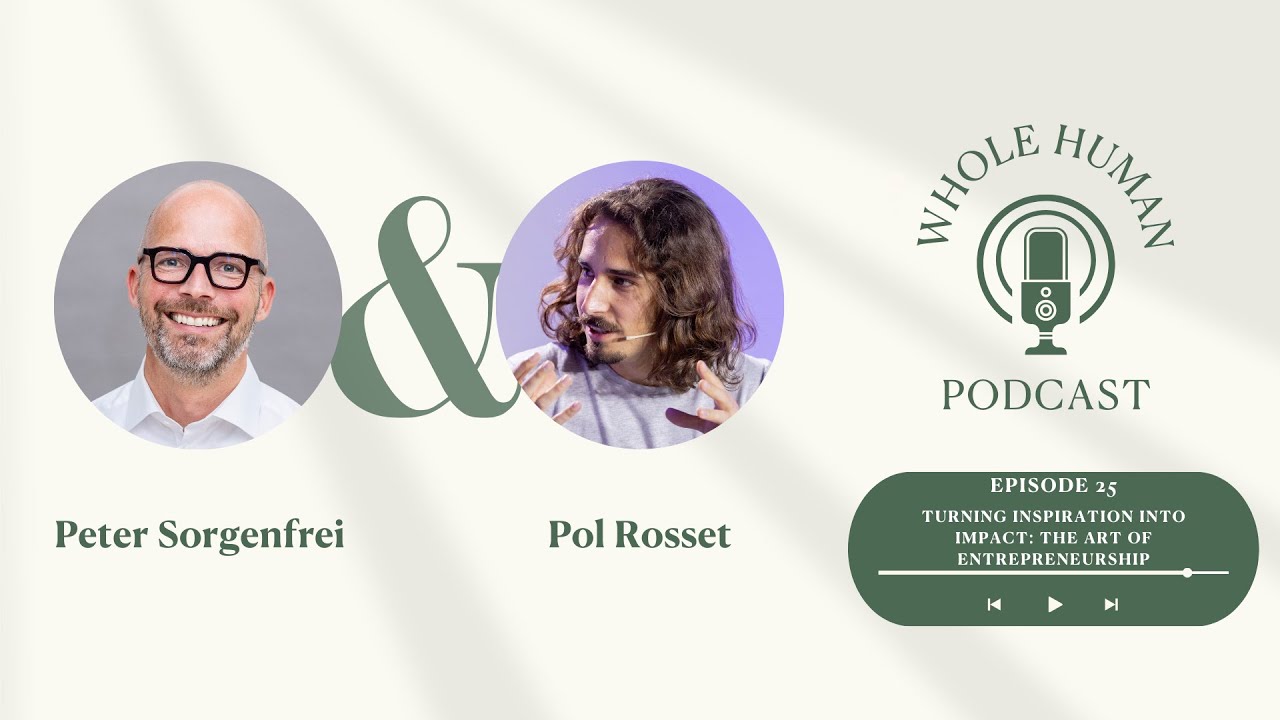
Pol Rosset built Windowsight to turn TVs into art galleries, splitting 50% of subscription revenue with artists. He started by cold-emailing 5,000 artists and now reaches 30 million TVs through a Samsung partnership, solving the problem of how creators actually get paid on digital platforms.
Chapters
Welcome to another episode of the Whole Human Podcast. I'm your host, Peter Sorgenfrei, and today I have Paul Russett with me. Paul is the co-founder and CEO of Windowsight. Paul, welcome on the show.
Thank you very much, Peter.
So today we're gonna talk a little bit about how you, more than 7 years ago now, started a company, and it's unique in the sense that you're doing it with a family member of yours. For the few people who may not know you on this podcast, could you introduce yourself, what you're up to, and, and where you are in the world?
Thanks, Peter, for allowing me to be on the show. I'm Paul Roset. I'm from Barcelona, and I started this company 7 years ago with my father and my brother. And a little bit what we did is, well, we didn't know anything about startups, anything about entrepreneurship. Yes, because my father and my grandfather, they were business owners. So since I was a kid, I always had this in my blood. I, I knew what was building a company and managing a team, but at that time was not really a startup. It was traditional companies. So it was more a startup. So we gotta start this project and this, um, journey without even noticing that we were starting it. It was an idea that we had around 15 or 20 years ago of transforming a TV into a window to the world. And it was a frustration that I had when I was a kid, when I was going to exhibitions and galleries of our family, friends, painters, photographers. When I arrived at home, I realized that I would never see that exhibition again. And that was something that in music, in movies, you could have all those at home. And it was not something that it was exclusive to the person who was buying the CD. If you bought an album, you bought an album, but I could also listen and anyone could listen it. But with painting, with illustration, with photography was not that. And at that time we didn't even have Spotify or Netflix. And now we have access to all the music and all the movies and even all the sports in the world. So 7 years ago, I was finishing my degree in mechanical engineering, which has almost nothing to do with what I'm doing. But we were on a trip, a family trip, and we said, okay, we need to start doing this. That's not possible. We need to build this platform for all these artists in the world and also to share it with the masses, with the people who don't have access. to these kinds of art, which is photography, painting, illustration, anything that it can be on a screen at the end of the day. For those who don't know, what basically we are doing is we are transforming TVs, your TV that you have at home or in an office or even in hospitals. We are transforming them into a place of inspiration, into a place where we bring the photography, the paintings, the illustrations super well digitized and that you can transform your spaces. Depending on your mood, what you like, your taste, and you get to learn all these artists. You enrich your space, but also you bring all the stories behind that artwork. Like photographers for National Geographic, they want to use their photography to teach something, to help us understand what's happening in the other side of the wall or in our neighborhood. So basically that's what we are creating and that's how I got started on this.
So it's an amazing idea. Essentially, you're democratizing access to paintings, right? So I went to Amsterdam a couple of years ago. I saw a Banksy exhibit. I took pictures, right? And so I can have those pictures now in as my screensaver on my computer, let's say.
Mm-hmm.
But what you're doing is essentially giving me a high-quality experience on typically a bigger screen, namely my TV. Of either artists that I love or themes that I'm into. You mentioned National Geographic and photography of nature. Um, that's a really simple idea in many ways, right? It's, it doesn't sound too complicated, but how has it been to, to build that business? Is it easy to get access to this content and display it in millions of homes? How does that actually work?
Well, it's not easy and it's not complicated because it seems obvious when you speak to someone and say like, how nobody did it before. And it's not true. Bill Gates, 35 years ago, tried that with Corvus, but at that time the technology was not ready. I don't know if you remember TV 30 years ago. It was, it didn't look like an artwork. Now it's completely different. So Definitely. It's something that it's not, it hasn't been easy at all, but it's good. It's not difficult also on the sense that we are doing something that we love and we are building something that we really believe it's something for the future and it has a sense. And the community we are building it with, it's very It's very happy that we are doing this. So we always have good connections with all the artists that we are meeting, all these painters, photographers. And it's huge to be in contact with these amazing people that you thought that you would never meet. And they love what we are building because we are building something that has, that it's meaningful for them. They don't do stories to be on someone people's home, like a rich guy that can afford a $1 million print or artwork and no one else is gonna see it. Maybe 1% of the artists are like that, but not all of them. So it's—
So for an artist who, so how do you, let's say you look at your platform and you're thinking, we need more content, like this. It would be great if we had more architecture, for example. But walk us through what actually happens. How do you get those images?
Well, at first we started gathering the artists that we liked and that we thought that they were a reference on their spectrum or their area. And we started creating a list, a Google Excel. And we still have that. We have around 5,000 artists' names and their profiles and their websites and their phones if we find them in their emails. So basically it was cold calling, cold emailing. And then when we started having new artists that were hyped about what we were doing, we started having referrals or people calling each other. These guys called me. Do you know them? Because they said your name. So for instance, an example, when we had the first National Geographic photographer sign up, then we had 20 others very quite easily because they're a strong community. So it's always this kind of pursuing the new artists. However, as one thing that I learned is that supply is always easier than the demand. So in that case, We started with the supply. It makes no sense to launch a platform or a library with no books. So you need, uh, the books. And now we are focused on the demand, on how we, the channels to get the distributions.
But anybody can sign up, right? I can sign up today here living in Denmark with my smartphone. I somehow connect my account to my TV and then I can start streaming. Yeah. If my TV's connected to the internet, which it is, I start streaming your content, right?
Yeah, it's super easy. You download the app on your phone, iOS or Android. You need the TV that supports our app. We work on Samsung and LG on Android TV, and we're doing new deals, Apple TV as well. And then you start streaming. At the end of the day, now there's a freemium model of free and a premium.
Mm-hmm.
Thing is, we are giving a lot for free, but then the good thing is that the premium gives 50% of what you pay of your subscription directly to the artists you watch. You don't need to pay in advance or say, I'm gonna buy this artwork. You have access to all the artworks like with Netflix or with Spotify. But what we do, which is different what they do, because that was something, I have a lot of friends that they are musicians and they're struggling with getting paid on Spotify. That's very, it's a huge problem. There's a lot of strikes. So what we do is we split your money directly with only the artists you watch. If you only watch— I don't know, Tim Lehmann Photography, and you're paying $10, €10, €5 that goes to Tim Lehmann because we are splitting only the— so it's super easy.
That's another issue with creative content, right? That there's, as we're democratizing access, the original creator is essentially not getting paid for their work, but it's nice to hear that you guys have solved that. If we can jump back to a little bit to the beginning. So you started this business with family cuz you had this idea. How has it been to have a business that involves your dad and, and, and, and your brother?
Well, it's very emerging because it, it pops up in every conversation. So you, even on holidays, even on You go on a walk or you, I go, I don't know, biking with my father and we speak about it. And it's when we are having dinner, when we are having lunch, it's everywhere because, and I think it's a good thing because we believe in what we are doing. We are passionate about it. And that's one of the things that kept me pushing and being consistent for these 7 years, me and them. Which is having each other. I don't know, solo entrepreneur, how it is, but for me, having someone who believes in you and has the same vision, that was something very important.
And I think many people who are doing business with their partner or parents or children experience that, right? That it fills, it takes up a lot of space also in your personal time, so to speak, because it is a thing that unites you, but it could also divide you.
So yeah, you need—
I, or could do that.
Yeah, I think you have to have a strong relationship and, and that's something that we had and it's, that's something that I grew up with because my father grew, worked with his father and with his brother. He's still working with them, with his brother. Um, and, and I got to learn that you need to separate some things, at least in your head, because not everyone is Everyone is different, so you are different than them. You need to understand that you love them because they're your family. In business, they may have some things that are, that maybe you don't agree exactly, or, and then when you need to be happy when you are with them as a family, and then try to be the best when you are doing business, but not try to mix the feelings.
Mm-hmm. At least the feelings are the things that you And that's a hard one for most of us, whether it's family or whether it's not family, right? Being in business together, building startups, the emotions oftentimes creep in and affect. I want to chat a little bit about 7 years is in startup land a long time. Has it been smooth sailing along the way or has there been times where you were like, that's it? Yeah, I mean, We're giving up, we're going home. Yes.
And, and we still consider ourselves seed or an early startup because we haven't— we, you see this in things in movies or stories like this startup in 1 year or 6 months, it's a billion-dollar company or whatever. And we are still here for 7 years. Spoiler alert, we were too early. It was Bill Gates was even earlier, 35 years ago.
Right.
So, and we are still here and that gives us a competitive advantage, but it has not been, uh, smooth. Consistency is very, and persistence is, is very important. And it's not easy because you want to, it's not that you want to give up, but you think about it when friends tells you about it. Have you think about it or what are you gonna do if it doesn't work? You have all these kind of negative inputs of people that are not entrepreneurs, that they just want their 9-to-5 job or whatever. And it's also good to be in touch with other entrepreneurs, to have a coach, to have someone you can speak with, to guide you with someone who has already been there and have built other startups. So that was very helpful for me as well.
It's an interesting thing, right? That all the people around us who have opinions about what we're doing. But they have no idea the fire inside or why we're doing it necessarily. They just look at it and they're like, that's different from the traditional path of a regular job. And it seems very insecure. And it is. There are occasions where, so I know, for example, at some point you had to fire half the team, right? That must have been dreadful.
Yeah, that was. It has been probably the most difficult decision. It was around 3 months ago, so it was not that far away because 7 years are a lot of, is a lot of time. Business and revenue was, we have, it's not still coming. So you have some expectations, you want to grow, and sometimes you have good news, like we have this deal or we have this. But sometimes you need to take hard decisions in order to keep pursuing the vision. If you really believe the vision, it's worth pursuing and you have to take things, do things that you are not comfortable with. And firing half of the team, it's not definitely comfortable sitting with all of them in a round table and explaining them the situation that You want to keep trying, you want to keep moving forward. You don't want to close the company because we are on the best moment or whatever. And that's what you have in your head, but you cannot keep paying the salaries of, you know, 10 people if you're not getting the revenues that you expected. So that was probably the most, and that, at that time I thought, okay, either we fire half of them, do we quit? Do we? And we had this, as you mentioned, you have these friends and people saying, well, what are you gonna do? Have you thought about what you do afterwards? And my, always I would say no, I, until I, I stop doing this, I'm just focusing on this. You're not gonna, because otherwise it's like regrets. And no, you as an entrepreneur, you need to go all in and focus is important. And, and being, you don't, you are not, you're never sure that it's gonna work. In fact, 95% fail. So you are always about to fail at the end of the day.
So. I remember when we spoke to prepare to record this episode, we talked about that perseverance that you have that I, I will allow myself to call it stubbornness.
That's okay.
One thing that struck me when we talked about this is you refuse to give up. You refuse to stop doing this. And I, I love your idea. I, I love the, the product, the service, the concept, everything about it. But in many ways, what you're doing is not societal critical, right? So it's, if you allow me for a second to sit, to compare it to—
Yes.
If you were working on a cure for Alzheimer's or working on something that had massive mental health, it's mental world mental health day today, by the way, mental health or physical health. I can really understand. But the fact that you are so passionate about bringing art illustration to more people is really commendable. So, so this is probably a hard question to answer, but, but what is it inside of you that refuses to give up and go work on something else which might be easier than this?
Yes, it's a good question. And sometimes what it's easy, it's not what it's more meaningful. And it may not be the cure of cancer or something like this, but how I believe and how I believed it from the beginning is that it's something fundamental. It has a strong vision and a strong value to society, and we are filling a gap and we are filling something that it's It doesn't make sense that it's not happening. So we are not following a trend, and that's something that I had a lot of investors 3, 5 years ago. Are you not on the metaverse? And then one year afterwards, are you not on, on NFTs? Are you not on— you went— so all the— there are all these ups and downs and new technology, new trends. And I'm not pursuing a trend that it's just gonna blow up and down and just chasing the money. or chasing the quick win. Um, we are chasing a fundamental, which is it makes no sense to have this black TV in front of you when you are teleworking, when you're having dinner with friends. It makes no sense to waste this useful device that millions of people, billions of people already have at home and that we can transform. And you mentioned wellbeing. It, we are not curing the cancer or whatever, but having art in our daily lives proves every day the importance of art in, in wellbeing. And, and this book, it's amazing. I'm, I'm finishing Your Brain on Art and it's every time there's more studies on how brain affects our mental health, how we can even increase our life for 10 years if we consume art at least 40 minutes a day. And how we've already proven that in, in some hospitals we are working, when we reduce the stress, the perceived waiting time on waiting areas, we are enriching lives. So it, it's very meaningful and it makes no— so I know it's not gonna be easy, but someone has to do it and it happens to be me. I hope it's gonna, it's gonna happen to be me.
I, it was a little bit of a trick question, right? Because I take clients to art museums. And so as I'm a one-on-one coach to founder CEOs, and I work with them on, on a bunch of personal and professional issues. And what I like to do is I take them to art museums just to walk and talk inside there rather than doing it outside, which we also do. And the reason that art museums are brilliant is because you see something that draws you in and you start paying attention to— To the details. Details in paintings or in sculpture, and you start thinking about the person who made it, and you start thinking about the time that they made it in, and you start thinking about what is it that captivates me about this thing. On Saturday, I'm going to the World Photography Exhibit here in Copenhagen. Same thing. So the fact that you have created a vehicle to bring that museum experience essentially into people's homes and to your point, to these big black surfaces that are hanging in our home anyway, I love it. And I don't understand why it should be so difficult, for example, investors to understand that this is something that the world needs and this is something that can be a viable business model over time. So I'm cheering for you. I think, and that's also why you're here, right? I want to propagate your man, your message.
Yeah.
What's next for you guys? So you recently had to fire half the team. It doesn't sound like the money is rolling in. How do you see the next period for you and the company?
Well, you mentioned a couple of interesting things, going to the museum and why investors don't see it straight away. Let me comment one thing about the museum. You owe to museum, but how many Friends of yours, or how many people go to museums?
Fewer and fewer. That's the YouTube, right?
Yeah.
People don't go to museums anymore because they sit in front of Netflix.
Exactly. Uh, in front of the TV.
Mm-hmm.
So, and that's the problem when at the moment I mention about art in a VC, they disconnect. They're like, oh, we are not interested. That's 1% of the population that goes to museums or whatever. How I see it is that people don't go to museum because they don't have the experience first. So you wouldn't go to see a concert and spend, I don't know, $100 or euros or $200 in going to see a musician, a group, if you didn't have the experience first listening at home with your friends when you are in the car. We expect people to go to a museum before they haven't got the experience when it's easy. We don't have, we don't have it easy. Same with, I'm in Barcelona, I don't love football, but people fly all over the world to come to Barcelona to see the match when they can see it at home, sitting in a sofa, much better, much more comfortable. Why they do that? It's not why they do that. It's they do that because they had the experience first. So that's the gap we are trying to bridge. And our audience, it's the world, it's everyone. It's not who currently goes to museums, it's everyone who doesn't go to museums. And that's what I'm struggling to help investors understand. We had some investors, we started last year, mainly they were people from the industry. We have some National Geographic photographers who have invested, people, CEOs from different industry. We have currently a new former vice president and general manager of Roku who has invested in the company and who's advising me on the next steps. And we also had a very important deal signed with VIDAA. VIDAA, it's the fastest TV growing operative system of now 30 million TVs. 350 brands are using this operative system and we become the screensaver, the art gallery of those TVs, which, I mean, it bridges the gap of what's happening now that you need to open the TV and you need to find out window size and all of these problems that we have at the moment. We see that's the solution. We need to make it super easy for the users. So that's where we are focused on becoming the screensaver of every TV in the world, even if it's at home or in hospitals, in hotels, et cetera. And we are also trying to raise funds to really make all of this happen because you need the money to make things happen these days.
What about museums? Would it make sense for like the MoMA in New York to essentially start pushing whatever exhibits that they're having through your channels? Is that a partnership for you that's interesting? Museums?
It is, but it's more, it's super difficult. So at the beginning we thought, okay, we're gonna have artist profile, museum profile, gallery profile. The problem is with the rights. So museums, they don't own their content. So you may have, I see you have an artwork behind you. You own this artwork or this— It's Banksy.
Autograph from Banksy. Yeah.
Yeah. Banksy. So anyway, if it was a real artwork, I don't know if that's your image, a photo or whatever, but you don't, you own the artwork, but you don't own the rights. So museums are not even allowed to put their images on Facebook or on Instagram. They are issued, like they are sued, sorry, by their founders, by the, the, the people who, and that's a real problem. So if the artist is dead until 70 years, depending on which country, they're the people who owns the rights or their family or the foundation, they are the ones who decide. So in order to have MoMA, we should have, we would have to speak with every artist in the world just for this artwork. It's super complicated. So we can only have, it's, we thought we saw it, it was easy to speak directly with the artists and that's what we did by now. But we would love to have MoMA. If you are listening, let's have a conversation. But it, it's difficult for the rights, uh, legally.
Yeah. So basically you have to do deals with the artists themselves directly or the owners of the rights to the— Yeah.
But we are, if the artist is dead, you may have to speak with 10 people and they all need to agree. For this artwork to become on Windows Sight, it's a nightmare. It's, uh, in the future, maybe.
Unfortunately, we have to end. I don't want to end on a nightmare. I think we should end on the positive notes that what you're doing really is brilliant and that everybody who's listening, if you have a Samsung TV or an LG TV, or if you're on, or any other platforms, check out Windows Sight and their products. So the website is windowsight.com. And you can see that you can sign up for free and you can get access to amazing photography, amazing artwork. It is brilliant. Paul, I wanna thank you for coming on the podcast.
Yeah, thank you very much. And if you're listening, apart from checking out Window's site, if you are an, uh, a founder, if you're an entrepreneur, I encourage you to keep pushing. If you have a great vision, it's not easy, but kind of Say just one thing. Absolutely. I think driving forward and pushing forward a new venture, it's like walking and you need 2 feet. One, it's learning. One, it's reading books, it's having a coach, it's going to seminars. But the other one, it's doing, it's failing. If you only read, if you only go to seminars, it's impossible that you're gonna move forward because you're gonna be doing circles. If you only do things, and that's what I did at the beginning, I was doing a lot of things and I didn't have a coach, I didn't have a mentor, I didn't read a lot of books. I was doing circles in, uh, in the opposite way. So I encourage you to do both and to keep pushing because we need more people that move the, the needle and, and the, the world forward.
And on those words, thanks again, Paul.
Thank you, Peter. It was a pleasure.
And for anyone listening, you heard it here first. Keep pushing, right? Thank you so much for listening for another episode of The Whole Human Podcast. I'm your host, Peter Sorgenfrei. If there are guests like Paul or anybody else that you would like me to have on the show, please let me know. Similarly, if there's a topic, an idea that you want us to discuss, we are all ears. Thanks for listening and have a good day.










