This Will Make You Rethink Your Product and Career in 2025 | Sachin Rekhi
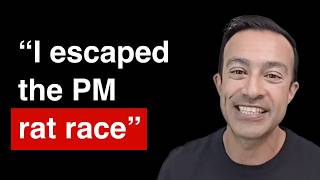
Sachin Rekhi discusses product leadership, finding product-market fit, and aligning your career with your energy. He covers customer discovery, validation techniques, and the balance between execution and strategy in building startups.
I had direct P and L responsibility for this business that was now 200 million in revenue. And I was doing this at a publicly traded company. And so on paper I was doing really well. And my boss was telling me what other products could we have you take over since you've done such a great job of this and there's a clear path to becoming a vp. And what's interesting about it was while I was doing well on paper, I found so much of it draining in terms of the work that I was doing. And what do I mean by that? Look, I got into product to talk to customers, design world class features. I didn't really talk to customers as much. I had a whole team of PMs that did that. The extent at which I was designing features was product reviews. My PMs would present to me various concepts and I'd provide a little bit of feedback. And sure I own the high level vision and strategy. But that day to day review fun that I loved about product, I actually did little of. I was a head of a product, managing and leading more so than I was creating and building. And I realized that kind of work didn't sort of energize me. And I love the way Justin Kahn puts this. He talks about this idea of a zone of excellence versus a zone of genius. He says there's this zone of excellence that some of us fall into. This is work that we're really going to good at but is actually very draining to us. And that's where I was at. And what he encourages you to do is find this zone of genius. The zone of genius is the work that energizes you that you love. And so I realized that while I was doing well, if I continued on that path, I was just going to move further and further away from the parts of product that I actually love. And so I thought about, you know, is this really the path I want to keep going down? Because I'm not sure it would really be my zone of genius.
All right, welcome everyone. My guest today is Sachin rechi. Sachin was LinkedIn's head of product for Sales Navigator. He scaled it to $200 million in annual revenue and over 500 employees. He then left it all behind to start NoJoy, a note taking app for teams. So really excited to talk to Satchin about his approach to finding product market fit, the dark side of product leadership roles and how to design work to suit your life, not vice versa. Welcome Sachin.
Thank you, Peter. I'm excited to be here today.
All right, so let's talk about finding product market fit first. Most people start by just like building an MVP and then try to get customer feedback as quickly as possible. Right. But I think you have some pretty hot takes about this topic.
Totally. You know, my take is that MVPs are largely debt. This idea of a minimum viable product where we just ship something as quickly as possible for customers and get it out there, had its time in place, but these days isn't very effective. You have to keep in mind, when we came up with this concept of MVPs and the lean startup back in 2008, there wasn't that much software out there. And so putting something out in the market and testing whether people would use it was very effective because people were hungry for solutions and options to go use. Now what's interesting is MVPs are great for new market opportunities to see if there's any demand, but for existing market opportunities, they could actually point you in the wrong direction. And the reason is today people just expect so much from their software. So if you launch an MVP and people don't retain on the product, is it because you had a bad idea or is it just because you launched too lightweight enough of functionality that people expect a lot more? And so, for example, let's say you're building in an existing category. Your MVP might be so lightweight that people liked some of the interesting concepts you're doing, but they couldn't abandon their existing tool because you didn't solve for enough of the core functionality that they need. And so you look at software like Notion, like Airtable, these companies took years before they got a product to market, very much not an MVP. And so I think that's why I believe that MVPs in fact are not the default way to go when you're building a startup. It really depends on what market you're attacking and how you're thinking about going after that market.
So how do you make sure you don't spend a year building something and nobody wants it? Like, how do you do customer discovery?
Yeah, customer discovery is incredibly important. Right. And the key is that we can leverage customer feedback, customer interviews, conversations with customers to make sure we're headed in the right direction. But here's the interesting thing. I think a lot of people even do that wrong. And I think the challenge people have with customer discovery is this whole idea of confirmation bias, right. That I'm going in kind of wanting you to like my product. And when I'm interviewing and asking you questions about my product, I'm asking you Things like, do you have this problem that my product attempts to solve? And the reality is most people can be like, yeah, sure I have the problem. But what you really want to know isn't an acute problem. Is it a top concern of them that they're willing to sort of adopt a new product for it? And just asking that question isn't very useful. Similarly, asking a question like, oh, if I built this, would you use it? People like to be nice and they're generally going to be like, yeah, sure, I'll use it. But there's no commitment there that's really going to drive them to using it. So I think we have to be smarter about how we're doing customer discovery to really drive real insights. So let me give you an example of doing it better. So let's say, for example, I want to ask someone in a B2B setting about sort of how acute the problem is that I'm trying to solve. For that, what I do is I'd start by saying, okay, in your role, whatever that role is, tell me the top five problems or challenges you face on a regular basis. And so they might list off the top five. Then I'll come in and say, hey, here's the problem we're thinking about solving for the customer. And then I'll ask them, can you rank globally the initial list of problems you gave me plus the problem I said we're solving now? What's interesting is if they're like, oh great, two of my problems I put higher, but I put your problem third. Okay, great, you've identified a top three problem. But if they keep putting the problem that you've identified on the bottom of the list, let me tell you, you have a nice to have, you have a vitamin, you don't have a painkiller. And so that gets them to really make trade offs, which is how you get to true customer insight on what in fact is actually going to move the needle on a product and service that they might actually adopt versus simply being nice and telling you, yeah, sure, I'll use it.
Yeah, like I get so many dms every day from startup founders who are like, you know, here's my product, do you want to use it or not? Do you want to give it a try? And yeah, I think that's like nobody has actually asked me, hey, what problems do you struggle with during the day or trying to do a job? Nobody has asked me that question. So it's definitely a very interesting framing, right? Yeah, totally. And you know, we both work at big companies so, you know, personally, I'm like, pretty allergic to writing 50 page business plans before building anything. But maybe the pendulum has swung too much in the MEP direction. Where do you fall on this debate?
You know, it's one of these fascinating things when you look at the history of it. Lean Startup basically convinced us. Writing a 50 page, you know, business plan and then ultimately spending a couple years building the product and then finding out whether people care after launching it was a terrible idea. And it's true, that is a terrible idea that takes years before you get something in market. But I do think that the pendulum has swung way too far. And today we talk about this as, like, execution is the only thing that matters. All we need to do is execute, put stuff out there and see what sticks. But I believe actually we should be more strategic about that. And actually, some upfront, thoughtful planning is critically important. And here's what we're all navigating this idea maze of the space that we're trying to build a product in, right. We're trying to decide what problem in particular do we solve or try to decide what target audience we go after. And when you look at that idea maze, you're like, there's so many dimensions that you can pivot on. And if you're just experimenting and executing, you're trying lots of things. But that idea maze is huge. You're never going to get a chance to test through all of it. And being thoughtful about your point of entry, about the target audience you're going after, which problem you're solving, is going to help narrow that search space. So execution still matters, but we want to be reducing the amount of experiments we have to run to actually figure out where the actual opportunity might be. Because we're all sort of limited on Runway. And so I like to think about this as, actually, strategy matters a ton of, yes, we need to execute, but in fact, we had to be strategic about what problems we're solving, what target audience we're going after, what's our unique value proposition. And in doing so, we reduce the amount of experiments we need to run and hopefully find product market fit before we run out of Runway.
Yeah, I mean, it's still much cheaper to think than to actually try to ship something. Especially since the quality bar for MEP has gone up by a lot of from consumers. Right?
That's exactly right.
And you have this really awesome. You teach this course about product market fit. You have this deliberate product market fit loop. Can you walk through the steps at a high level first?
Yeah. So the idea is that I think we've learned so much since the days of the lean Startup on how to build a product. Right. And how to find product market fit for a new product. And so this deliberate startup methodology that I teach in my course really tries to give you that more rigorous approach, a more modern approach on how we've learned to really go through this hunt for product market fit. And the idea we talk about is this. There's this core loop that you're constantly going through to find product market fit. It starts by defining a PMF narrative, which is really just a fancy way of saying your initial strategy for how you're going to win in the market you're going after and taking some time to be thoughtful about that as opposed to rushing to just build. The second part of the loop is actually validating your riskiest assumptions. Now, this is the idea that we want to be aware of all the validation techniques we could potentially leverage and pick the one that's most appropriate for what is the riskiest dimension. Third, we want to constantly be measuring, do we have product market fit or not? And we can do that in a very concrete way. And finally, we need to be thoughtful about how we're getting traction, how we're growing users both manually and scalably. And so those are the four steps of the loop that we're constantly going through until we find product market fit.
Okay, so let's walk through it step by step. So the initial product market, the narrative, right? Like when you use the big term like strategy, people are like, oh, shit, like, this is serious. Like, I gotta think through this 10 hours. But, like, what are some key questions that people should answer to write this narrative?
Yeah, I totally agree with you that oftentimes the strategy word is this very amorphous thing. But I tried to make it extremely concrete that a strategy means answering six questions for the product that you're building. The first is, what's the problem you're solving for the customer? Everything we build is solving some problem. Even entertainment products like Netflix are, you know, helping solving boredom. So you want to identify what that problem is. Second, you want to identify who's the target audience? Who are you building this for? We could be building for lots of different audiences, but we want to be thoughtful about which audience is going to resonate most with our product and service. The third is the value proposition. This idea of what is your solution? What is your unique way of solving this problem? The fourth is competitive advantage. Why are people going to pick your product relative to everything else that exists in the market. And I think that's an interesting one because oftentimes there might be competitors that are doing more interesting things and people adopt that solution instead of yours. Then we need to figure out the growth strategy, which is how are we going to acquire users? And finally, what's our business model? How are we going to actually make money from our product? Now the question I often get is why these six? Well, it turns out these six are the most common reasons that startups fail when they get it wrong. They either didn't identify a problem that it was acute enough, they didn't find a target audience that resonated with it. They built a product but they couldn't grow, or they couldn't make money from their product. So those are all examples of failure due to not getting one of these six. Right. So the idea is that you start with a perspective on all six and you don't need a lot of detail. Right. You can write this up in a one pager or a two pager. That's all you need initially. But you're starting with a hypothesis, a set of guesses for where you think the opportunity is for your product.
And is there a reason why the problem question comes before the who is the customer question? Or it can be any switched? Yeah, do you have.
It's a great question. You know, I actually go back and forth on this. What do you start with, the target audience or the problem? And the reality is I've seen different startups do different ways. Sometimes they start with a problem to solve, but ultimately they end up pivoting to a different audience that feels that problem more acutely. Other times they start with a very specific audience that they're passionate about and then they figure out which problem they want to tackle. And so you can go either way with these things. And so I don't think there's a right answer about which one you start with.
Got it. I guess one shortcut is like, you know, a lot of founders build for themselves like they are the customer. So then they think about, okay, what are some problems that I actually pay for or like that I actually want to solve? Right.
I'm a huge fan of that approach. I've done that for a lot of my own startups. My current startup, NoChoice, exactly that. Solving my own pain. I think the thing to be careful of, you got to make sure you can find an audience that's large enough that resonates with that same problem that you personally have. But as long as you can do that, building for Yourself is a great way to go.
Okay, so now let's talk about the validating the riskiest assumption step. You know, we talk about how just shipping crappy MVP is maybe not the right way to validate stuff, but like, what are some other ways we can use to validate our riskiest assumptions?
Yeah, so what I talk about is there's so many ways to validate, many of which are cheaper than building an mvp, right? So anything from customer interviews to surveys to smoke tests, to pre sales to prototypes, to growth tests and product tests. And so the key thing is we want to think about what are in fact our riskiest assumptions with our product strategy. And so what I encourage folks to do is start with broad based validation things like customer interviews that help you to assess across all of these six dimensions of your product strategy which ones might be the riskiest, and then to start picketing the right validation technique, depending on what's your riskiest assumption. So, for example, when I was building Connected, a contact management tool back in the day, what we realized was our riskiest assumption was willingness to pay. It turns out there's plenty of people who had launched products like Plaxo and Zombie that had gotten millions of users, but no one was willing to pay. And so because we knew that a willingness to pay was our riskiest assumption, we could then decide what test to go do to solve for it. And so in our case, for example, at the time, what everyone was doing was MVPs. Just launch a free version of your product and you'll worry about the business model later. We took a different approach. We actually launched the product with a price tag from day one, and we actually made our free trial very short, 14 days. And that's because we wanted to figure out very quickly, was there anyone willing to pay for this stuff? Now I'm so glad we did this, because when we launched Connected, this is back in the day where TechCrunch was the main way you launched. We launched and Connected was featured in TechCrunch. But man in the comments, on the first day, we had so many haters. They're like, who would ever pay for this? Why are they charging for this thing? This should be free. And we were really nervous. Maybe we made the wrong decision. And so we actually were really glad we only set our free trial for 14 days, because on the 15th day, we got a bunch of paid subscribers. And that was incredibly clarifying to us on who our target audience was, because there was a bunch of free users that were playing around with it. But the Ones that were paying, we quickly discovered, were up on professionals, people who are in the business of managing relationships. And so that became a clear customer segment for us to go after. And so it was a great way for us to validate this assumption of would people be willing to pay? And it turns out they would, but a very specific audience that was in the business of relationships. We then were able to tailor all the features we were building specifically around that.
Yeah, that's a great example. A lot of people will use a product for free, but when you ask them to pay, they're like, no, I don't want to pay for this. And that has a great way to answer the who is the customer? Like, if you just like, you know, like, like you said, just like make them pay and then people will self filter themselves into the segment. Right. I, I interviewed Noel Kagan, the guy who runs Appsumo, and he has this really great challenge, it's called the 48 Hour Challenge. And it's kind of like pre sales. He basically pitches ideas to his friends and he just makes them like prepay for it. Like, you know, here's my idea. Are you winning? Putting. Are you putting 100 bucks for me to build this and give it to you? If I never build it, I'll give it back to you. I'll give the 100 bucks back to you. And that is like a really great way to just like validate your idea as soon as possible. I haven't done it yet because it's a little bit like asking your friends to pay. It feels kind of weird to me, but it seems like a great way, like a great hack.
You know, I've actually done that on the B2B side with pre sales, with LinkedIn Sales Navigator. We were working on this new premium subscription for sales professionals called LinkedIn Sales Navigator. And we actually leveraged pre Sales to solve for a bunch of issues. What minimum feature set needs to be in the V1 and are people going to be willing to pay for it at the premium price point, we wanted to charge them. And so what we did was we created a sales deck and we actually went to potential customers, pitched it. The sales deck had our value proposition, it had screenshots of what the product was going to look like. It had a price tag associated with it. And so we'd go pitch it and say, hey, look, here's the product we're planning on building. Are you willing to commit to join our pilot program now? The commitment wasn't money. We were going to give it to them. For free. But we did ask them, as part of the contract they had to sign, was, you're going to Deploy this to 15 salespeople. You allow all of them to go through training and a subset of them will join us every week for feedback. And so everyone knows a sales team dedicating time from the sales team is the same as money. If they're not selling, they're not making money. And so it was a real commitment for them to go do that. And so we'd go do this. And the goal was if we got 40% of people to say yes, we felt like the product was validated and it was time to go build it. Now, initially we didn't get anywhere near that. We had a ton of folks that were just like, no, not interested. We have other priorities. So we had to keep adding features and iterating on our value prop until we got there. But we eventually did. And at that point when we were just building it, we knew we were building something that was pre validated both from a willingness to pay and as well as our V1 feature set.
Yeah, that's great. That kind of brings to that the third part of this loop about like, you know, how do you know if you have, I guess, you know, a bunch of people prepay for it and hopefully you ship a good product, maybe you have product market fit. What are some other ways to measure if you actually have product market fit?
Yeah, so I think we've gone through this evolution of how do you measure product market fit. We started with, you know, Mark Andreessen back in the day, even saying you can always feel when you have product market fit because the products fly off the shelves. You know, it's really hard to measure a feeling. So, you know, we've moved on beyond that approach. We then move to a world of surveys. People talk about using NPS survey or product market fit surveys, asking things like how disappointed would you be if this product no longer existed, for example. Now here's the problem with surveys. You have huge response bias. The people who tend to respond to your survey are the ones that are still engaged. Right. So the set of users that abandoned you months ago aren't filling out your survey and telling you whether they'd be disappointed or not whether your product exists. And so these surveys always over represent your engaged users and end up not being a great way to understand whether you have product market fit. We've now moved to a world where it's all about using metrics to assess whether you have product market fit or not. And really, it's around two metrics. The first is retention, and then the second is growth. And so with retention, the idea is you figure out the core action in your product. You then map a retention curve and you look at does that retention curve flatten over time? Because if it flattens over time, it means there's a subset of users that are staying retained and are going to keep using your product in the long term. That's what you need to have product market fit. Now, what ends up happening when you first launch a product is that trend line always trends to zero. You have to work at improving your product, either new functionality or optimizing the experience to get it to the point where it flattens. But when it does, you have some semblance of product work. Fun that I loved about product. I actually did little of. I was a head of a product, managing and leading more so than I was creating and building. And I realized that kind of work didn't sort of energize me. And I love the way Justin Kahn puts this. He talks about this idea of a zone of excellence versus a zone of genius. He says there's this zone of excellence that some of us fall into. This is work that we're really good at, but it's actually very draining to us. And that's where I was at. And what he encourages you to do is find this zone of genius. The zone of genius is the work that energizes you that you love. And so I realized that while I was doing well, if I continued on that path, I was just gonna move further and further away from the parts of product that I actually love. And so I thought about, you know, is this really the path I wanna keep going down? Because I'm not sure it would really be my zone of genius.
And how did you think about. Cause you had this realization, but at the same time, you know, you're rising up the career ladder, you're getting paid more, and, like, so how do you actually make the decision to, like, stop this path and do something else? Must have been tough.
It's super tough. And I think that part is always hard. I think for me, I often think about this idea that Jeff Bezos talks about, this framework of regret minimization and this idea that, you know, what would you regret and how do you solve for minimizing those regrets? And I think it's always easy to look at the career ladder, the more status, wealth, money that you're making and keep climbing that. But I was starting to feel this potential regret that maybe there's a more optimal career path I could be going down that was more aligned with what gave me energy that I might regret never pursuing that if I keep going down the path of the traditional career path. And so that really was a guiding force for me. And part of it was like, I kind of felt like I can always go back if it didn't work out. If I tried something else and it didn't work out, that path was available to me. But I would regret not trying to find something that was closer to my zone of genius.
Got it. You know, like, I feel like corporations should, like, I'm very much similar to you. I like to craft products and go through that iteration phase. And I feel like corporations should reward these people more.
Right.
Like, you know, it takes a lot of work to craft a really great product. It's not easy. And why only reward in the latter people who are good at, like, managing orgs or, like, trying to, like, manage up? Why not actually work people who are actually shipping really good products? I don't know if you've seen some of that happen now. It's more like an IC path. But what are your thoughts on this?
Totally. I think what was interesting is this was a real challenge doing Zerp, though.
More from Peter

Dropbox VP's Best AI Workflows to Help You Take Back Time at Work | Morgan Brown


Canva Co-Founder: The AI Playbook Behind the World's Most Popular Design Tool | Cameron Adams

How OpenAI's Head of Business Products Uses ChatGPT to Save Time at Work | Nate Gonzalez

Complete Vibe Coding Tutorial: Build a Full Stack App in 30 Min with AI | Matt Palmer (Replit)


Complete AI Course (2025): Prompting, Evals, RAG & Fine-Tuning | Adam Loving (Meta)



