Why You Should Push Yourself to Do Hard Things | Nat Eliason (Author)
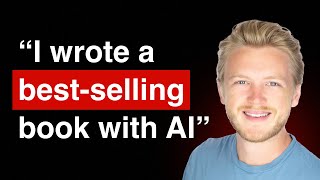
Nat Eliason talks about why pushing yourself toward difficult challenges matters. He walks through his writing process, how he uses AI tools for both nonfiction and fiction, and why storytelling beats pure information when you're trying to teach someone something.
I think the unfortunate thing is that a lot of people walk around with this mentality that they need somebody else to teach them or they need somebody else to give them permission to figure this thing out, or they're not somebody who can teach themselves new things. And that's really only because they've never tried and they've never given themselves that proof. But the sooner you just like pick something small and easy, go figure it out, do it, give yourself that proof. The more and more of that you do, the more confident you become. This, like, the theory of small wins I think is really spot on. This idea that you're going to be a lot more motivated if you have a lot of little wins along the way than one big win. I, you know, with Crypto Confidential, I just had a spreadsheet and every day in the spreadsheet I would write down how many words I wrote. And if I bring up my stats, it says like, oh, this year NATS logged 110,000 words. That's cool. Like, that's really motivating. It's like, that's a lot of progress to make in a year. You know, we're almost halfway through the year and if I keep that up, 200,000 words a year, that's like two books. It's a lot of good writing.
All right, well, today my guest is Nat Eliason, one of my favorite writers online. Nat recently wrote an amazing book about all the money that he made and lost in crypto and he also has many great tips about, you know, how to start your career journey and how to write with AI. Welcome, Nat.
Thanks, Peter. I'm excited to chat. Yeah.
All right, so why don't we start with some of this practical topic which is like, I love to learn how you use AI. Why don't we start with your non fiction writing first? So, so how do you use AI to kind of help you write a newsletter post or, you know, an article?
So I don't use it as much for my non fiction. For my nonfiction writing. The, the areas where I found it really helpful there I use Lex by Nathan Bachez and it has some really great editing tools built into it and I really like that for finding parts that are unclear, finding ideas that could be expanded. And there are certain prompts that I really like to ask Lex to, to sort to answer for me. If you don't know, Lex is kind of like a Google Docs with a really good AI suite built into it. You can plug into Claude and GPT, but you could also do this just pasting your work into GPT or Claude. And I generally like Claude a little bit more for writing stuff, but I really like it as a feedback tool. So, you know, one type of question I'll often ask is, and I got this from my friend Nathan Baugh, the question is, rate this piece on a scale of 1 to 100, identify the different components of your rating and then see what it spits out. And it'll often say like, you know, this piece, I give this piece 81 out of a hundred. It's good on these criteria and it's less good on these ones. And sometimes that ends up being good advice, sometimes it doesn't. You have to be able to interpret it because you never. You're not always going to get a fully honest or fully helpful or accurate response. But you can look at it and you can say, you know, do I agree or disagree? And a decent chunk of the time I'll look at what it's critical of and I'll say, okay, yeah, that, that part could actually be better. As one example, I published this piece recently called Traditional Publishing Is Fine, actually about how there's this, there's all this noise, especially on Twitter, about how traditional publishing is broken and you should just self publish. And there's, you know, you only work with the trad pub for the name brand and you know, for ego. And having now worked with the traditional publisher, I was just like, that's just wrong. Like traditional publishers have all of these incredible benefits and working with them is awesome. Like, it's so much deeper than how it gets characterized on Twitter. And so I wrote this post explaining what those benefits were. And at the start of the post, I tried to steel man, the anti trad. I tried to do a high level of, you know, here's all the reasons you shouldn't work with a trad pub. So I could then go through and explain why they were all wrong. And I fed the whole post into GPT and I said, hey, what part about this could be improved? And it came back and it said, it seems like you're trying to make the counter argument at the start of your post, but at a couple points in your counter argument, it feels like you're being silly or exaggerating the point to, you know, be humorous, but it makes your argument weaker. You could try changing this sentence and this sentence to be a little bit fairer so that it doesn't seem like you might be straw manning the other side. And that was actually really helpful feedback and that was really impressively specific. Feedback too. So I find that the actual generation of new content is still not very good. Sometimes it's good, especially on fiction. We'll get to that in a minute. But nonfiction, I don't get much help there, but the editing can be quite useful.
Do you just put a one line prompting, saying like, hey, give me a score and tell me why, or do you have like a fancy long prompt that you use for this?
Yeah, that one's usually just give me a score, 1 to 100 and tell me why. Let me see if I can bring up the chat on that article, because I had. I bet I have it right here. Yeah. So I asked, you know, can you give me feedback on the draft based on a few of these goals, like keeping it balanced and fair and presenting its point writing to this target audience, being very clear and well structured, being persuasive. And then I asked a follow and it didn't give me a ton of feedback based off that. And that's when I asked, does it seem like I'm being unfair at any point? And that's when I came back with the really useful feedback about mischaracterizing the other side's argument. Another thing I like to ask is, am I redundant anywhere? Because that can be helpful to see. And it's very good at pulling that out so that you're not wasting people's time asking, does anything seem unclear or need expanding on that feedback is usually pretty helpful. And then I did the scale of 1 to 100. Okay, so here's a good example though, of the good and bad of working with AI and why you need to also have some good taste and opinions yourself. The lowest score that it gave me, it basically broke it out into five sections. Clarity and organization, Relevance, target audience, persuasiveness, balance and fairness. And then writing style and engagement. It gave me the lowest score on writing style because it felt. Because there were things that it didn't like about the writing style. But then I dug into that and it was pretty clear that what it was telling me to do was to write more in a. What I would call like boring masters in fine arts style. Where, you know, it's very like, here is the argument I'm going to make in this post now. Here are all the arguments. And now like, here's. I guess it's not really mfa, that's like intro to, you know, writing or whatever, but it wanted me to make the piece more boring to hit some like, weird criteria of good writing style. And that's where I really disagree with it because then you just lose all personality. Then you sound like the AI, which you don't want to do. So you do have to know when to listen to it and when to ignore it.
Yeah, dude, I think your style is amazing. Like have you ever tried to feed it a bunch of like example posts? Do you understand your style first before you get a critique?
Yes, yes. And it can do short bits on very specific things in my style, but that's so easy for me in nonfiction that it's not really providing a useful service. Like, like I've been doing the non fiction writing for so long and you know this article style for so long that these posts I can usually get through really quickly and I'm, and I don't feel blocked on creating more of like my good writing and often really high personality fun. Yeah, the really high energy writing, it can't emulate that very well, but it can emulate the explainer stuff very well. Where I find it more useful in emulating my style is on the fiction side because there are certain types of writing within fiction that are a lot more laborious for me because I'm still not as good at them. And so sometimes having it help like get me started or fill in some gaps can be really useful there.
All right, so let's talk about this sci fi book that you're writing. Yeah, yeah, I think it's called Husk, right? Is that the name?
Yeah, that's right.
So what made you want to write a sci fi book in the first place?
You know, we were talking a little bit before we got started and you were saying that reading Crypto Confidential, it was really fun, you're really enjoying the story and it kind of a page turner. Right, right. And I didn't know how to do that before I started working on it, but I knew that if I was going to write a book about Crypto, I wanted it to be really exciting and fun to get through and the education to be a bonus. Right. I, I, I, I use this analogy. A lot of, you know, nobody ever sat down and read a textbook or a article on like the 10 spells in Harry Potter that you need to know. But they can probably name five or 10 spells. Right. And they know how they work and they might even know what color comes out of the wand and they know all this stuff about them because they read this really fun story and they downloaded knowledge along the way. And I really think that's the best way to learn things and the way that we retain the most knowledge. So I decided that if I was going to write this crypto book, I wanted it to be really fun and really exciting and kind of like a thriller pacing. And so I had to learn how to.
More from Peter

Dropbox VP's Best AI Workflows to Help You Take Back Time at Work | Morgan Brown


Canva Co-Founder: The AI Playbook Behind the World's Most Popular Design Tool | Cameron Adams

How OpenAI's Head of Business Products Uses ChatGPT to Save Time at Work | Nate Gonzalez

Complete Vibe Coding Tutorial: Build a Full Stack App in 30 Min with AI | Matt Palmer (Replit)


Complete AI Course (2025): Prompting, Evals, RAG & Fine-Tuning | Adam Loving (Meta)



