Leveraging Thought Leadership Live featuring Kelly Monahan

In this LinkedIn Live episode of the Leveraging Thought Leadership podcast, host Peter Winick interviews Kelly Monahan, PhD, a former senior HR and talent leader at Deloitte, Accenture, Meta, and Upwork, and now co‑founder of Beyond the Desk and author of Reclaim the Plot. Kelly recounts her non‑linear career path, moving from an HR business partner role in Rochester to a research institute at Upwork, and ultimately deciding to launch her own practice to speak freely about the intersection of AI, the future of work, and leadership. The conversation explores the trade‑offs between corporate resources and independent freedom, how AI (especially agentic AI tools like Codex) has transformed her productivity and business model, and the challenges of aligning HR and technology functions in AI‑driven change initiatives. They discuss ownership and legal questions around AI‑generated work, the generational impact of AI disruption—particularly on the “sandwich generation”—and the need to rebrand change management. Kelly outlines her product‑first, iterative approach to scaling a consulting practice, the emerging skill set required of future CHROs (systems thinking, AI fluency, product mindset), and ethical concerns about AI and social media as addictive technologies. The interview concludes with reflections on why she left corporate roles, the purpose of her new book, and the broader implications for HR professionals seeking strategic influence in a rapidly evolving AI landscape.
Chapters
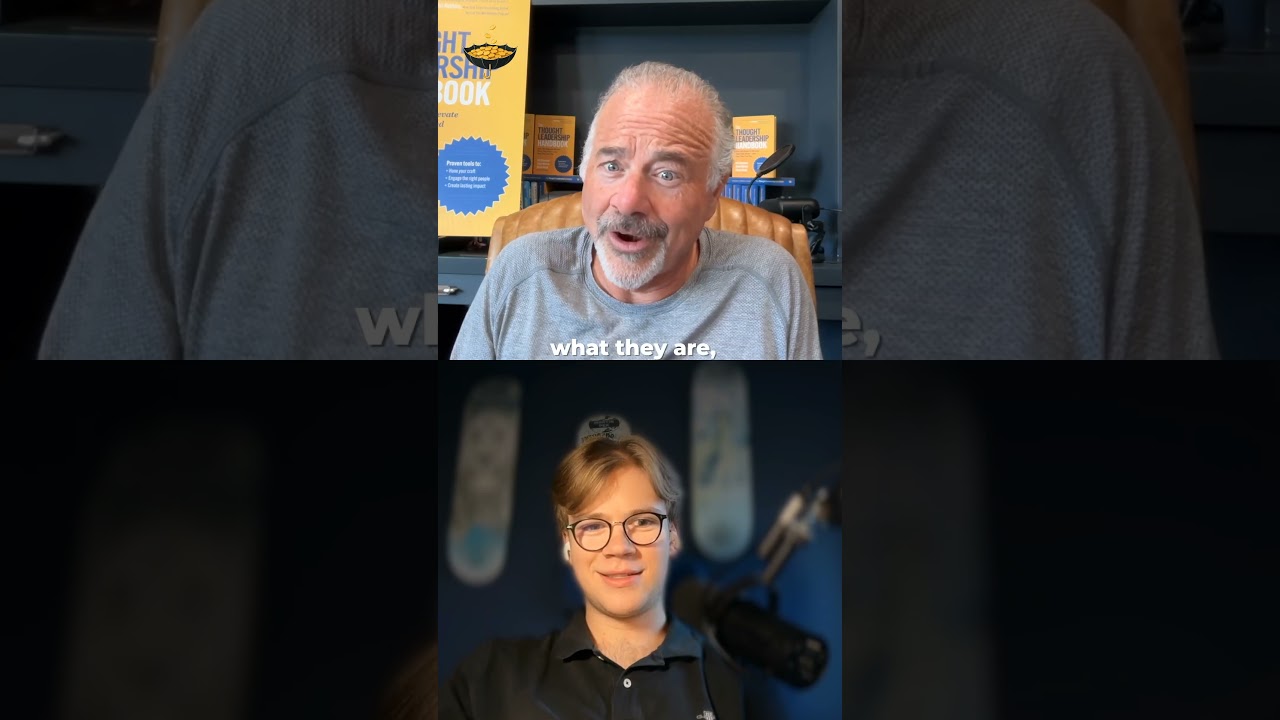
And welcome, welcome, welcome. This is Peter Winick. I'm the founder and CEO at Thought Leadership Leverage, and you're joining us on this LinkedIn Live version of the podcast, which is Leveraging Thought Leadership. Today's going to be fun. We've got Kelly Monahan, PhD, which means doctor, but not the kind where you show her a rash doctor like I mean, you could, but it probably wouldn't be cool. That's right. She is a leading voice on the future of work, AI, and the changing nature of leadership. She's had some senior roles on the talent side of the house at a couple of interesting companies like Deloitte, Accenture, and Meta. And then she was at Upwork and led the company's first-ever Upwork Research Institute. She's a bestselling author. She's got a new book out. And she is, as of late, the co-founder of Beyond the Desk, as well as a very in-demand keynote speaker. So welcome, Kelly. How are you?
Good, Peter. Thanks so much for having me.
Cool. So let's start with how the hell did you get here? Right. So this is interesting to me because when I look at the world through some of our frameworks and stuff.
Yeah.
You know, there's— you're an academic, you're an in-house expert. Now you're sort of a thought leader on the run. So give us the how we got here story.
Yes. So I actually, I thought I was going to have a much more linear career path. I'm sure we all. So I started my career in HR as an HR business partner because I grew up in Rochester, New York, saw Rochester Kodak shed 45,000 jobs. And I was like, you know what, I want to be on the right side of business. I want to go in HR and, you know, help keep people's jobs. And of course, my first assignment was reduction in workforce. Exactly. Because of robotic process automation at the time. And I thought, geez, this is, this is not at all what I actually want to do. And so that led me to go get my PhD to understand how do we make people decisions when technology becomes so disruptive? And that's essentially what I've been doing and studying for the last 15 years, some version of AI and machine learning impacting the way that people lead and show up to work in the job market. And I've just, to your point, I've had the privilege of doing a lot of really great organizations, have been exposed and seen a lot. I decided less than a year ago just to take the step out to do this on my own, though, because I think the conversations we need to have I can't be a spokesperson for a company anymore. Like, I need to have a real conversation.
So stay there for a minute, right? Because it's pretty cool that Upwork, you're developing an institute, and Deloitte, Accenture, Meta, all those sort of things give you a lot of resources and access. And there's people going to Davos, and I mean, the 400,000 consultants at Accenture and all the cool stuff and maybe some not so cool stuff that Meta does. So that goes in the plus column. Right. But in the minus column, you— not that there's compliance looking at everything you say, but you are— you do have some constraints on you as to what you can say and not say and how you say it and all that. So now this is sort of, I would say, Kelly Unplugged. Is that sort of—
Yes. Oh, I love that. That could have been a book. Podcast.
Don't write another book. Kelly Unplugged. We just named the podcast. Right. But so tell me about the difference between— because it's not It's not like one's bad and one's good, being Kelly sort of unplugged versus Kelly at big respected company X, where you have a lot of things that you don't have today.
Yeah, I mean, to your point, it's a trade-off, right? Because to your point, I had a beautiful budget at all those places I worked with. I was always in the future of workspace, which was always kind of seen as this shiny object. And so it was easy to get resources, funding, build teams, that sort of thing. And your point, People pick up the phone when you're calling on behalf of Meta or Accenture. You can get a CEO on the phone. Going out on your own, I would say the advantage is I can craft and focus on the work I want to do. I don't— I'm not answering Slack messages. I mean, half my job over time became answering Slack messages and one-on-ones and attending team meetings. And I think I'm not doing the research. I'm not adding value. And I wanted to figure out how do I craft a life and a job where I'm 90% of it is value-add driven. I'm actually on the ground adding value. And it's been remarkable, I think partly because of the places I've talked to, like people are still answering the phone, which is great. And I think in some ways right now, there's so much AI bullshit out there that a lot of these consulting companies are pushing that they're like, all right, tell me the real deal. Like, I don't, I don't have any AI product to sell you. Like, I am truly here to help you navigate change management.
So stay there for a second, right? Because not that When you're at, say, an Accenture or Deloitte or Meta, and they're bringing you in as a future of work AI, someone that has an opinion on it, underneath that, there's still a skepticism that says, well, but Accenture is trying to sell me a consulting— if I'm the CEO of Company X, a consulting gig or this gig or whatever. It doesn't mean that what you say is less valid, but there's a purity in what you're doing now. It's like, listen, all we care about is Can you come in and do this keynote for an hour? Tell us what you know, and you're beholden to nobody. And just, and because we don't know, right? So is that, is that kind of the vibe?
Totally the vibe. And I think what I'm beginning to unlock that's even more exciting is after the keynote, having conversations, getting to listen much more deeply around, oh, here's the real problem. Like you actually have a leadership misalignment issue or you have, you don't have a tech stack issue. You actually have a change management issue. And being able to either connect them to people who are really good, if it's outside my lane of experts, or be able to begin to customize and personalize, be able to actually craft that engagement. So it's a win-win on both sides.
OK. But you also now have to take on a lot of things that you didn't when you're in these big roles, right? You're responsible for sales, marketing, receivables, pricing, product, like, and the list goes on and on and on, right? So there's a learning curve there of, you know, one of the beautiful things about being a big company is Somebody's collecting the money and somebody's selling and somebody's taking care, like, whatever. So how has that been for you to say, wow, I'm the chief cook and bottle washer here?
I'll be honest with you. Do you know what has changed my life? And now I'm going to talk about AI for a second, but is Codex. So being able to vibe code and allow agentic AI to help. I write all my own things. You know, you're an author too. That's very important to me. Like, it's me. I'm the author behind it. But I don't want to spend all my life trying to figure out LinkedIn's algorithm and what time I should post, or Facebook, or all that. So just being able to automate so much of that, and it just again gives me time to focus on what I do. I don't know, Peter, if I could do what I'm doing without AI in place today at the scale I'm doing it.
So there's a moment in time—
Game changer.
So that takes me back to a question I was going to ask where you talked about you started your career 15 years ago around sort of the— and maybe I'm paraphrasing here— sort of like how tech disrupts the people side of business, right?
Yeah, no, 100%.
That's it. And I think people have probably been talking about that since the age of the buggy whip. But then we have this little thing that came along in, say, the last 5 years called AI, where it's like, uh-oh, full stop, 100 miles or 1,000 miles an hour. AI is freaking everybody out. So how have you— because you've been in the space of technology sort of disrupting people for a long time. But not at the speed and cadence and sort of headlines every day as it is today. So tell me how that has brought sort of the AI conversation to the forefront.
Totally. You know what's so interesting is when I was at Deloitte, I remember acutely, it was like 2017, 2018. We were actually in the tech industry doing consulting. And the number one thing we were focused on, there was all this fear of robots taking over. Like, I remember this slide we put together of all the headlines. And then the pandemic hit. And it's like we totally forgot this technology was about a high-speed train ready to run. this over, and no one talked about AI for about 2 and a half years or so, and it just kind of became about the pandemic. So to me, it's as much as—
But the robots were also— but, but, but I, I don't mean to interrupt, but the robots were also— I remember the video of, I think it was Boston Scientific or whatever, it had the robot that fell over, and you were thinking, oh, okay, so somebody will pack the stuff in a warehouse that's a robot, that doesn't affect me, haha, I don't care about that. So Somebody's putting boxes up or packing my things or like, oh, I'm, you know, Mr. Educated White Collar Dude. That's the head of whatever, whatever, Big Co X. So that doesn't affect me. And then—
Here we are. And what is AI so good at? Coding and software engineering and some of our highest paying knowledge work professions. We told everyone to go get a STEM coding degree. And now we're like, uh-oh, now what? Now we've got 46% of Gen Zers are underemployed. They're working in jobs that don't even require a college education.
Right.
So I think, yeah, I think we've got like a huge reckoning. And to me, like, what I love about this work right now is it's not just about the technology space, but it is about having like principled conversation decisions around like, what is business value? What do we as leaders actually want our legacy to be? And I think for so long, so much is about the P&L and moving faster, better, and cheaper with AI. I love having the bigger societal-level values-based conversation around Well, what does this actually mean for my children? Am I leaving the workplace behind better than when I inherited? And most of the time right now, the answer is no. And it's like, help me fix this.
Yeah, that's interesting. All right. I want to, I want to ask some different questions now around, okay, so now you decide I'm going to take the leap. I'm going to go out on my own, right? The moment's right. AI's right. Maybe lots of things that go into that. Now you've got to decide what the— who's going to pay you for what? What am I going to offer to the marketplace at what price point? Right. And who is that marketplace? So define the sort of the Rubik's Cube for me of that, because that's a multi— multiple variables.
Yes. So it's interesting. When I first started this a year ago, like my bread and butter, my home base is HR, like HR, CHROs, their teams. That's, that's, those are my people, you know. But what's been interesting is this year I've actually been hired more by the chief technology officer in the technology organization. Because AI transformation actually usually lives there within a company, and that's where the budgets are. And so it's interesting—
Well, even if it doesn't live there, the CEO is going AI equal tech, tech equal you, you figure that out.
Correct, 100%. And so this is— and what everyone's realizing is like, oh, this really isn't a tech issue, this is a people issue. There's all this fear, no one's adopting the technology because they think I'm employing it to take their jobs away. And this becomes this huge change management skilling initiative that's actually living with the technology group. And so I'm really trying to play this like bridge, if you will, of, hey, how do we get these 2 teams to talk to each other and figure this out? And with my people background, and I also have a tech background, how do we help play translator here? And that's really where I found my space.
That's really interesting because I could recall not that many years ago, maybe it was early COVID, when HBR came out with a study that the marketing people at Fortune 1000s were spending more money on tech than the tech people. And that scared the hell out of the CEO and the CTO. And that was only a function of, well, most marketing solutions weren't just Super Bowl ads. There's technology and all this other stuff. But if that's the case, then the marketing folks need to play nicely with the tech folks because they don't know even some of the questions to ask. Absolutely. So now I would think if you were to go back and Fortune 1000 land in the last 50 years, 2 groups that would have to interact the least would probably be HR and tech, other than the typical hiring and stuff. But just on a day-to-day, like marketing tends to work with sales and research works with, like, there's some groups that even though there's tension are, you know, CFOs, everybody's always got to deal with the CFO, but like tech and HR could have said hello in the meeting and then went their merry ways for the most part. Right. So talk about that because they're very, very— and I'll paint with a broad brush here— very, very different. You're an anomaly in that you speak both. But, you know, the typical CIO or coder or whatever versus the typical, you know, HR partner, really, really different life experiences, education. So how did— now they got to all play together. Like, what's up with that?
Oh, I think— I mean, so much of my work, Peter, is just leadership alignment. Anything else? And like, how do we communicate to one another? Which is, you know, someone Ironic. But I think for me, these roles, the way that we think about organizational design, we all have inherited an organization that existed pre-AI. We live in a pre-AI world in many ways. We determine how we create economic value, how we organize a system around that. We are in this messy middle transformation, and we are soon to be in a post-AI world where economic value is going to be driven mostly by AI-enabled ways of working and all of that. Sure. So that means HR and IT, to your point, almost become one of the same because it's no longer just human capital or people driving that value, which has always mostly been people. It's now agentic AI workforce. Who the hell owns an agentic AI workforce? It is a technology that's being deployed and making decisions next to human beings.
Well, who owns it? Who's responsible when it does something it shouldn't do? Who owns the output? Like, if I'm employee number X that created my own agents, and then I leave, who owns that output? Is that work for hire? Like, there's a whole other set of questions. And now we got to get legal involved. Like, we're, we're getting into the unknown unknown box, which is not fun for us.
Yes. No, it's very uncomfortable. And most people in corporate leadership, say in the Fortune 1000, are trying to get to retirement in the next 3 to 5 years. And so, I mean, that's a lot of my conversations. I'm like, how do I do this? And get myself out of this, but like pass the, you know, baton on.
Stay there for a minute, right? So if you're a 50 or 60-something C whatever,
yeah,
you're not saying it out loud, but you're kind of thinking it's bottom of the 8th, top of the 9th, right?
Absolutely. Where's the relief pitcher? I'm looking to exit.
Yeah, and you're also not looking at the, at the AA ball saying, oh, who's coming up in the next 5 years? Because in the next 5 years you're at the next chapter, whether that means you're on a beach or you're doing other things or you're sitting on boards or whatever. But like, uh-oh. So I think the ones that should be having that oh shit moment more are the 40-somethings that are like, you know, the high potentials, the next gen going, oh my God, what the hell are we inheriting from whom? And what does this look like? Is that, is that fair?
Oh, it's fair. And my research points to this. And this is what it's like. It's really concerning. If you were to ask me, Kelly, who are you most concerned about right now in the workforce? It is exactly who, you know, the sandwich generation where they grew up in a pre-AI world. They have to now also exist and live and survive a post-AI world. And the whole rules are changing upside down. Like Gen Z will figure this out because they are young enough and I think are going to be resilient enough and we'll figure some of this stuff out, hopefully for them. But yeah, Gen X and even elder millennials are in a really difficult spot. And all my data shows that they're most burned out. They're not optimistic about the future and very stressed about money.
Love it. Love it. So let's go back to— you're also clearly wearing the hat, not just of the keynoter, the delivery person, the smart consultant, the researcher, but the CEO. How are you making decisions? Because there's— I mean, on the one hand, you talk about change management, there's more opportunities now than ever before for a thought leader that's fairly new into this space.
Yeah.
But the paradox of choice now kicks in and go, oh my, I can't be all things to all people. So how are you coping with that or not?
Yeah, yeah, yeah. You know, I have some healthy coping mechanisms, maybe some that are questionable, but, um, you know, in
the background there is
exactly like, look, there's a tequila. Um, but, you know, I think what's so interesting is we started this business in December of last year, and I thought about it like old school way, right? Like, let me hire a website designer. Let me hire someone to come in and start building the infrastructure for me. And then this summer—
That's so quaint.
So yeah, exactly. It's just very, again, very linear. And I'm going to go out and give keynotes and we're going to do a workshop. And this is how this whole thing's going to work. And then I realized this summer when I was like, again, that was my holy shit moment with AI of I can vibe code and I now need to start thinking much more like a product, not service leader in many ways, because things are going to become— anything can now become a product. I don't have to have a $30,000, $40,000 budget. And wait for 3 months to go develop an app or go develop this experience. And so I see myself right now as I make decisions, I am rapidly iterating and prototyping and throwing some stuff out there with some core network to figure out, does this resonate? Does this work? How do I actually reimagine even the way workshops delivered virtually, in person? And so my base right now for every decision is, what can I uniquely do that I could not do before AI? And if I can't figure that out, I don't think I'm future-proofing the business in some ways.
And the scalable piece, because I mean, the other thing I think you need to think about, by the time you're figuring out now the problems that the clients want to solve and want to talk about, you have to also be thinking about, OK, well, that'll be done in 6 months, 12 months, 18 months. What's next? What's next? What's next? And then the what's next is that they'll come to me for, because there'll be plenty of other things that have nothing to do with you. Right. But like, what is the next step? concentric circle and where do you put your stake in the ground as a thought leader? Because you don't want to be a sort of fly-by-night Y2K consultant where 2001 comes along.
Oh, no.
Remember them?
Yeah, exactly. And Peter, I think that's so, so smart what you just said, because I don't know if you saw the same thing. Like 2 years ago, everyone became an AI keynote speaker or expert. And I'm like, and you could just tell right away. I'm like, guys, AI was actually invented in the 1950s. Like, let's go. Let's go through the whole history of how we actually ended up here. So to me, like home base for me to answer your question is going to— like, I'm a change management expert, like through and through. And so right now, the context of which we need to navigate change is tremendous macroeconomic pressure coupled with technology transformation. Like, and 5 years from now, God, I hope we're talking about some other change, not stuck here. But we'll see.
I like that, but I would push back slightly. Yeah. Or question slightly.
Okay.
Change management as a brand is a damaged brand. And one guy's agreed. And what I mean by that is if you talk to anybody that's seasoned enough, call them 40-plus, whatever, maybe less, that have been through a couple of change management initiatives, when you announce something as a change management initiative, they start twitching. They've got some PTSD because it wasn't pleasant. Yes, agreed. So some of the hurdle might be, What do we call this? Is it—
Yeah, good point.
I don't know the answer to that. But I think there's, you know, wording matters, right? And the world doesn't need another change management expert. What I, what I see you bringing to the table is, wait a minute, you're a, you know, you've sat on the tech side and the HR side. You've been at some of these big, like, OK, so I get all this, the secret stuff that makes the smoothie you, right? But how do we make that something that somebody's still going to order? In a year or 2 or 3. I think you have to be thoughtful there. Yeah.
Yes. Oh, absolutely. And I think part of it, too, is like so much to me is like from a trained academic perspective, too, of like, oh, well, here's the concepts and here's what they're like. But to your point, they have been so misused, and I would even almost argue abused in the consulting industry of how we've gone after this. Like so many people in the change management space don't have an IO psychology background, have never studied behavioral economics, understand how people actually make decisions. are so far and have never actually, like, you know, I'm not going to name names right now, but like one of the biggest organizational behaviorists out there has never worked a day in life in an organization. So
give us initials. Don't give us the names. Nobody's listening. Just between us.
AG. Yes, AG.
Oh, OK.
So it's just, it drives me crazy, you know, to your point. And there's, these are brilliant thinkers and thought leaders, but there's something different when you're the one who actually has to execute the change. Right. And it's like, to
your point, that's why people Without naming the name, and it probably wasn't Alexander Graham Bell, right? Of the AJ. I oh, I see this tension, and I kind of like it because I'm in the middle, right? Where you the pure academics that look at the you know you have pure academics on the one side, you have business leaders on the other, you have practitioners in the middle, and they're all going like this. So the academics go, oh, these business people don't get it because that's actually yeah, that theory is not true, and da da da da da. You know if they don't understand the variables, they don't have a PhD, whatever. And then the business people are going, bullshit, like you wouldn't know a client if they landed in your lap. And guess what? I don't live in a world where we get to control variables. Go back to your ivory tower. And the consultants like me in the middle are saying, okay, everybody stop. Like, let's listen here and figure out how do we get through this? Because it, you know, this is like the blind man and the elephant. So I'd love that.
Totally.
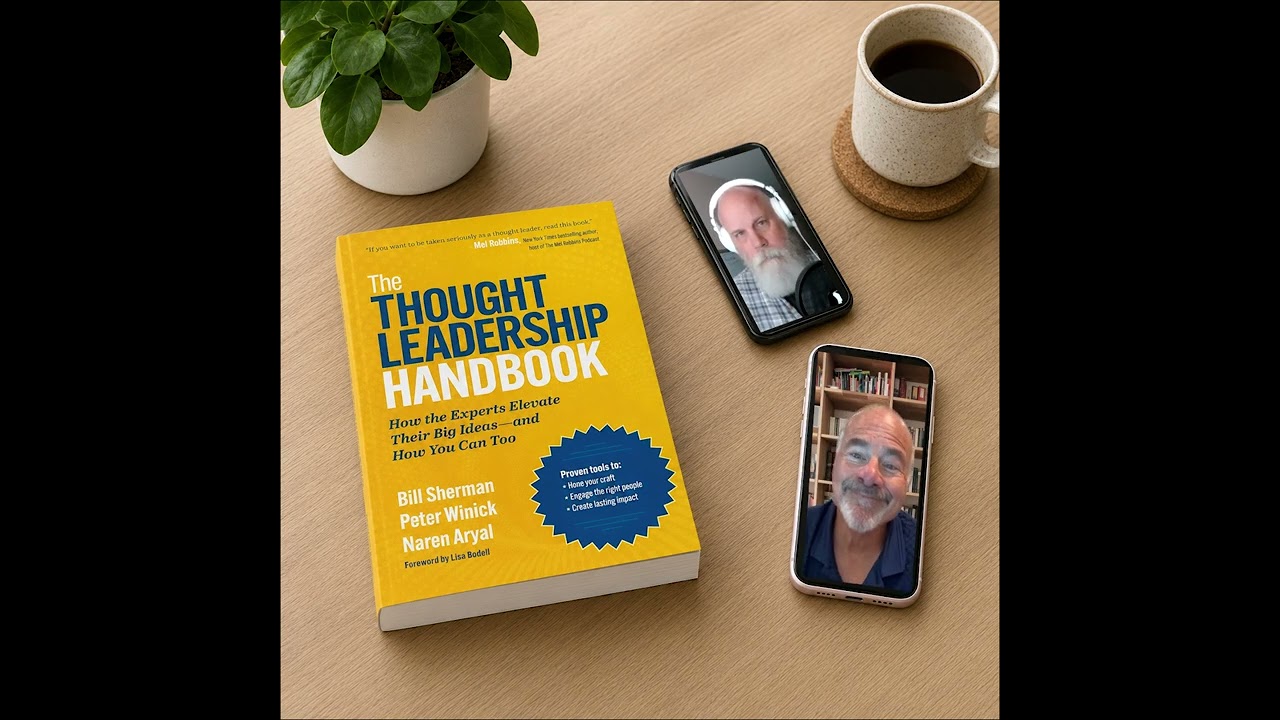
To me, sitting there just watching everybody throwing rocks at each other is kind of fun. But the reality is, what can we learn? And not to Self-promote, but I will. In our book, we talk about sort of— we have the academics, we have an in-house expert, we have a thought leader on the left. We have different types of thought leaders, and everybody brings something to the table.
So. Yeah, that's right. And listen, Peter, I'm gonna help promote your book as well. Excellent. I think everyone who's in this space needs it.
We could go an extra hour now. Just— I'm just telling— wait, hold that up again. I didn't see that. What were you holding up? Oh, oh.
What is it? Does it look familiar to you?
Wow, I like that yellow. Good choice. Yeah.
Yes. And listen, how about another big name, Mel Robbins, there endorsing right on the front cover? So I thought that was excellent.
So wait, you brought it up— were you bringing it up to tell people this is a good paperweight, or was there— what was the—
I actually had my water.
It's your favorite color, yellow? Okay, there we go. I'm glad you're—
Pages are all— but no, exactly, because you're right, because it's like There is a messy middle that I think people like you and I are kind of stuck between, and it is not getting irritated at either side, but finding there's truth to both sides and how do you take the goodness of both. But like, at the end of the day, the workforce and leaders are left holding the bag. And I just, I think there's a, there's a lot of value in having to cut your teeth.
And I think you're, you're proof that the type of thought leader and where you come at it from is not static. It's dynamic. Like, you could have stayed in academia and been a professor, you know, with initials or whatever that are just coming up with theories, right? You could have stayed on the consulting side at Accenture or whoever. You could have stayed in the business side. But now you're sort of the thought leader on the run going, wait, I want to be every— like, I see, I want to put the fires out that are to be put out and figure out my own path along the way, which will probably look different a year from now than it does now. But it does take a lot of courage. Yes. So let me, let me, I want to, Before we wrap, talk about what were the things that happened right towards the end before you decided to jump into the pool? Because you could have stayed in corporate America, which is pretty— I don't say it's comfy and cozy, but it's got its pluses, like a steady paycheck every 2 weeks and blah, blah, blah. What was the impetus to say, all right, damn it, I'm, I'm going for it?
Yeah. Well, I mean, the book I just came out with, Reclaim the Plot, originally was going to call We've Lost the Plot. Because I think that was the— I actually was entering into a period of disillusionment, if you will, of being in the tech industry for so long. I mean, it was 7 years and thinking to myself, okay, like, we're gonna figure this out as an industry. Like, we're gonna realize, like, all the damage social media has done. Like, we're bringing our best and, you know, brightest minds into an industry to go get people addicted to scrolling. Like, there's so many better use cases here of what we can be using our best and brightest with. And so—
So social media is the new tobacco.
Absolutely. And I think AI can fall down that path if we're not careful. Like, these are all very addictive technologies that we've created when, again, used appropriately with the right guardrails and governance, are unleashing amazing things. But like, no one wants to talk about that. We want more TikTok videos or more Instagram Reels. And then you've got this whole influencer culture. So I'm just looking around and I'm seeing leaders now, AI comes. And instead of saying, hey, you know what, this is our path forward, to figure out how do we create better economic opportunity. This technology democratizes expertise and intelligence. How do we do this in a way that we help underserved communities? How do we tackle these big, thorny, wicked problems that we have, whether it's around climate or macroeconomic instability? And no one's talking about that in the Bay Area. Peter, the number one thing they're talking about— Yeah. And this is what led me to Jump— is the goal is to become the first billion-dollar company with no humans. And just fully run by AI and one person. And I'm like, we've lost the plot of what this is all about.
And it's not the first, it's the fastest, or the, the, you know, how big can I get a billion-dollar market cap with 2 people, 3 people, and never—
Correct. And I'm thinking to myself that that is heading us to disaster. Like, long term, the society will not sustain on that. And what concerns me is you've got all these wonderful hospitality, retail, non-tech industries that look to the Metas, to the Netflix, to the Googles as like the holy grail of, you know, how do we do this? And I'm like, that's the wrong model. They have terrible talent practices. They are very immature when it comes to what we know to be true in the HR space. And I think so many of this, I think they're so cash rich because of our addictive behaviors. Yeah. And so it's like, how do we make sure we don't repeat this hyperloop that we seem to be in? So that's why I left. And I thought, you know what? Maybe
I need to ask one more last, last question. Okay, right about the other last question, but you got me thinking about a new one, which is there are still— and bless their little hearts— there are still lots of HR people out there that are thinking, wait, I'm not getting the seat at the strategic table. Remember that conversation that's been going on? Oh yeah. And, you know, my sort of somewhat jaded answer to that is, well, because you didn't earn it, because you don't deserve it, because people think you're a dope, because you're not acting strategically, whatever. So now maybe most of them have either figured it out or pretend how to do that or whatever, whatever. Now we're changing the game. Yeah, right, exactly. Because there's still plenty that are like, well, the dental forms you can get by this, getting this PDF.
Correct. Yeah, it's very transactional.
Purposely snarky. But now if I'm still struggling with how to be strategic as an HR professional, because that wasn't exactly what I signed up for X years ago, and now you're saying I'm actually in charge of change management, the intersection of technology that like, I have to redefine job roles, what a job is and who does it. How many are going to make that leap again? Or do we have to look to a new talent pool for the new future generation of HR leadership that's going to do these things, which are very different than what it was but 10 years ago?
Yep. There is a new research report coming out. I worked with Hendrickson Struggles on this exact question, and there is a major talent shortage when it comes to having like the The new CHRO, CPO, what they have to behave is they have to be a systems thinker. They have to have AI fluency. They have to have first principle thinking and actually think more like a product leader.
Yes.
And we've never developed or taught that. And so we have a huge shortage about ready to happen in the HR space. And so I think HR has to become, to make up for this, has to start thinking about this function as a diversified portfolio and start actively hiring people from the engineering space, product space, consulting space. To start thinking differently because, yeah, maybe HR now is a seat at the table. And James, who's the character in Reclaim the Plot, is like the CHRO and kind of, you know, quintessential. He has a seat at the table, but he doesn't have influence because he's not thinking in terms of the health of the system. He's worried about employee engagement, which sure is— don't get me wrong, employee engagement matters, but the system health matters even more right now. And I think it's just a different unit of analysis and mindset. And absolutely, I think we're going to have to— like, HR has got to—
And there's probably going to be winners and losers. So I think for some, that would probably I would read that as opportunity. And for some, you know, if you're in the bottom of the 8th inning, get to the end of the game and move on.
Correct. Exactly. Or go find a new sport.
Yeah, exactly. Right. Pickleball. Right.
Yeah, there you go.
This has been great. I appreciate your time and I appreciate it. Thanks, Peter. This is a great story. Good. Great session here. Thanks so much, Kelly.
All right. Thanks for having me.