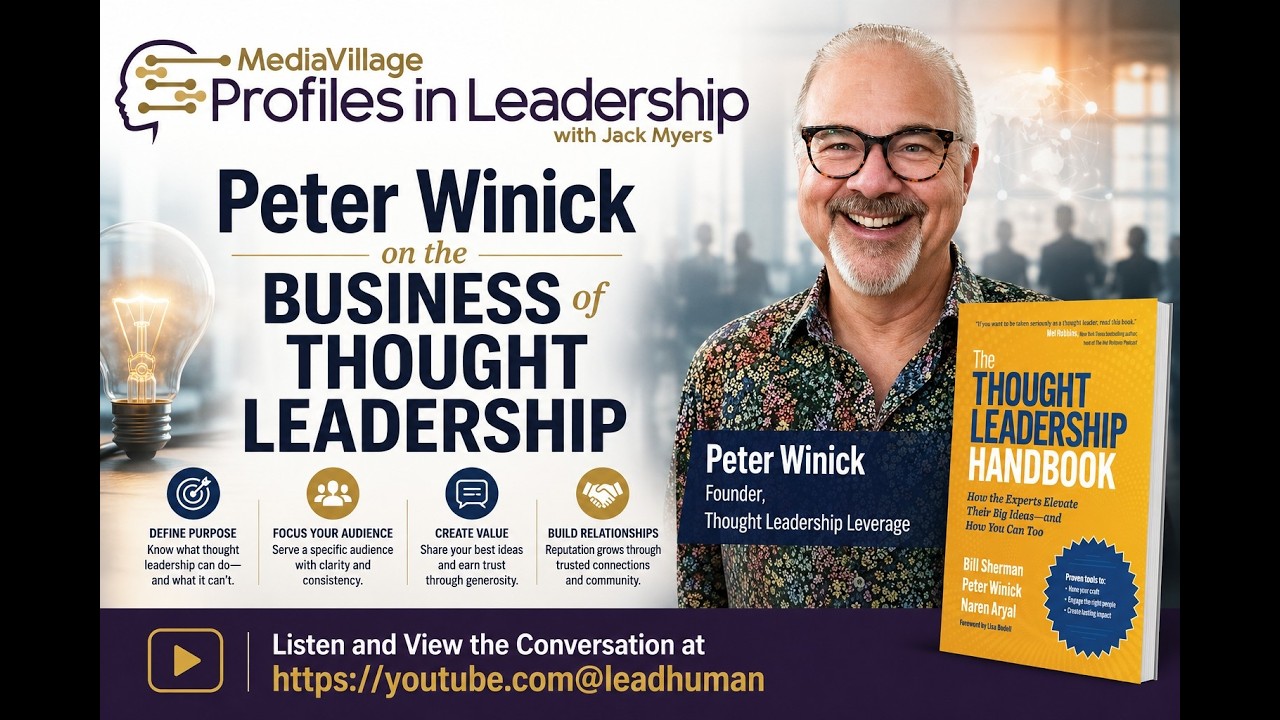
Peter Winick - Guest on The Dawn Patrol with Dave Summers

Peter Winick, founder of Thought Leadership Leverage, explains how genuine thought leadership is conferred by community respect, not self-claimed titles. He breaks down five flexible avatars for thought leaders and warns against clickbait positioning. The book draws from two decades of consulting work with hundreds of practitioners, not academic theory.
Chapters
I'm really psyched to be talking to an old friend. Let's call you a medium friend. In terms of length of friendship duration, Peter really was a, just a, like an embracing campfire for me when COVID hit. The world was a weird place and whatnot. And he sort of took me in with a whole bunch of other people who were not really knowing where we were going next. So, he and Bill Sherman ran this wonderful weekly, biweekly call that we sort of jumped on and shared some ideas and concepts. So, I want to thank him for that. But this is Peter Winick. Peter is the founder and CEO of Thought Leadership Leverage. You need to check them out. The links for the website and everything else you'll find in the comments below. He's also He's also the co-host for a super popular Leveraging Thought Leadership podcast program. Check that out as well. But the big reason we're talking to him today is because of the book that he and Bill Sherman and Naren Ariel, I hope I'm pronouncing that correctly, have authored. And that book is called The Thought Leadership Handbook. Peter, great to see you. You're sporting a nice tan. You're looking pretty good. How's it going?
Good, thank you. Good to see you. My medium friend.
Let's not push it. Okay, let's just not push it. Now, Peter, you spent years working with people around people who basically make their living from ideas. Okay. At what point did you realize that you and your co-authors weren't just collecting interesting stories, that you were actually kind of recognizing patterns?
Yeah. So there are a lot of models and methods and frameworks and such in the book. And the way we did those is sort of the reverse way that an academic does it. So an academic comes up with a model and tries to prove it. We had models that we thought were proved and then tried to come up with the words to represent them because we're practitioners, right? So Thought Leadership Leverage is a consulting firm. Bill and I are out there And the team working with real clients every day. And we didn't come up with, you know, like the growth-minded CEO one day as a type of thought leader. But over time, you know, we'd be talking to people, whatever. And then Bill and I would say, you know, there are patterns between that one, this one, this one, and this one, even though they're totally different at first blush. They actually have a lot of things in common. And that's really where we came up with all the models and methods and frameworks from getting our hands dirty and our sleeves rolled up and being in the field working with hundreds and hundreds of thought leaders over the last 20 years.
Now, the idea of a thought leader isn't really kind of a unique species of bird or whatever. It's in the book, you and again, your co-authors, you identify 5 different avatars. Did that framework emerge kind of cleanly or were there a lot of people who kind of were outliers and kind of stubbornly fell outside those? those boxes?
Yeah, so every model is imperfect. The question is, is it usable? So number one, you don't have to fit in one box, right? You could be a combination of 2 different thought leaders or 3 different thought leaders. And it's also dynamic, right? So at one point, you might be a thought leader on the run, and another point, you might be thinking about legacy. So I think with that in mind, They came up again from being practitioners and they're not meant to be definitive. It's not your blood type. Like if you identify as the wrong one and you get the wrong blood type, you can have a wrong outcome. They're just there to be helpful.
I see. Now, I'm on LinkedIn just as much as the next guy. And there's an awful lot of people out there right now. They're calling themselves thought leaders. Okay. That's, they're wearing the trucker hat. They've got the t-shirt on. Now, what separates somebody who's genuinely has an idea worth spreading from somebody who's kind of like just looking for clicks?
Well, it's a couple of things. Number one, and I, you know, I bang my hand on the table on this one, never ever, ever, ever, ever call yourself a thought leader. Anybody that does isn't, full stop. That's it. Like, so anybody that out there is, look at me, I'm a thought leader, I'm a thought leader. You know, it's the equivalent of saying, you know, we just met, trust me. Hmm. That's the first thing I'm going to do is not trust you. So first off, I think thought leader is someone that is called that by others in a community that they are held in high regards and high esteem. It's not quite like being knighted by the queen or the king, but others should refer to you as that. Now, if others do, then you can say been recognized as a thought leader as, et cetera. So I think that's really a key piece is it's really a sign of Respect, esteem, someone I admire, et cetera, et cetera. So I think that's really the first thing to think about is what is your objective in going out there saying I'm a thought leader? Usually the people that are doing that, it's clickbaity stuff. It's, it's, there's an ick factor to that.
Just a quick thought on that. It's interesting. I remember when I was teaching my kids to drive and this whole issue of kind of right of way came up, you know what I mean? And right of way is, you know, occasionally one of my kids would be like, well, I have the right of way. And I'm like, you don't. Right of way is given. You know what I mean? You don't show up as sort of being that I have the right of way. It's given to you. You know what I mean? So it's an interesting—
Well, and I like that because you can have the right of way and proceed and get into a car accident. Doesn't mean you didn't get hurt. Well, I had the right of way, you know?
Exactly. And you're going to hide behind that? Yeah, it's given.
Exactly.
This is interesting. Now, you make a distinction in the book between thought leadership as a hobby, right? I think we know some of the same people who kind of fall into that. You know, thought leaders who have a professional practice or some who are in an actual business, let's say.
Yeah.
Where do you see smart people kind of getting stuck in those definitions or slots most often? And why do they get stuck?
So the hobby practice and business framing, number one, there's no right and there's no wrong, right? You might be someone that's super busy and you dabble in thought leadership because it calls to you. There's something out there that's outside of your day job or whatever that you're intrigued with, that's intrinsically satisfying to you, that you're gifted in, that you're talented in, whatever. And that's cool. You might stay in the hobby piece forever. Practice means, you know, practice is just a business model. Doctors have practices, lawyers have practices, whatever. And the way I think about that is you need to be in the room or in the Zoom in order to exchange information. That's what we're doing right now. And in most instances, exchange dollars. So it's good and it's not good, right? You could, you could, you know, you could be an incredibly successful thought leader that only has a practice that's dependent on you, right? But a business is really where the assets of the business Are the intellectual property and the thought leadership that you and/or others have created over a period of time. And those things are configured in a portfolio, right? And portfolios by definition need to be balanced and have risk, risk adjusted, et cetera. So there's lots of different ways that people can access those ideas that aren't dependent on you to be the delivery vehicle. It's dependent on you to be the creator of those ideas, but to be the creator and the exclusive delivery vehicle, that's a lot. That's a lot of burden. carry, and it actually limits the potential for the ideas to reach the audiences and the markets that you'd like them to.
Well, I mean, we live in interesting times, heaven knows. And one of the things that I find interesting is this whole wonderful, terrible solution of self-publishing. Literally anybody can publish a book. I mean, has that been a good Or a bad thing as it relates to thought leadership net-net?
Well, first, let me just clarify one piece. There's self-publishing, there's self-publishing, right? So there's traditional publishing, there's hybrid, and then there's self. There's plenty of stuff that's self-published that's great. But I think the point that you're getting to is just because anybody can write a book doesn't mean you should, right? So I think the problem today is, and it's no different in, you know, we're sitting here doing this interview, you know, Any 2 idiots with a microphone can now call themselves podcasters. Not that we're 2 idiots and a microphone.
Good name for a book.
Hey, hey, I know what you're thinking. Right? But it's, I think what the world that we used to live in, the purpose of a, let's say a publisher was to kiss a lot of frogs and curate. So I theoretically knew 20 years ago, if Random House published a book, it had gone through this criteria and this selection and this rigor and this whatever. Now any jerk could hit send And it's total garbage. So I think, you know, on the one hand, net-net, it's probably good because there's probably stuff getting through that would not have gotten through in the past. But I don't have the time to wade through a ton of stuff. So I have to now rely on others that I respect and admire to say, you know what, you know, like if you said to me, you know what, Peter, you probably never heard of this guy, but I read a, you know, a self-published piece that he did and I think it's really cool, I would totally jump on that.
Mm-hmm. Mm-hmm. Mm-hmm. You've said that the best frameworks, they're not invented in a conference room, right? I mean, they're noticed, they're tested, and eventually recognized as something that keeps being true. Now, I'm curious here. How do you know when an observation has graduated into, you know, an idea that's truly worthy of building something around?
Yeah, I think there's a couple of ways that you know. One is when you start with the framework and break it down to someone who you believe it will resonate with and they get that aha, like, yeah, that's the thing. So like people love for some reason the hobby, the practice and the business. Simple metaphor, right? And people go, oh, I get it. I'm in a practice and I'd like to have a business, but it did start out as a hobby. Like, so they can relate to it. They can see themselves in it. They could, connect to and go, that's exactly the thing, right? So I think that's where it becomes valuable. It's only valuable if it's used to transfer information and knowledge and resonance to someone else that it matters to.
Obviously, through the podcast that's been around quite a long time between you and Bill and the work that you do with clients, I mean, you've spoken to hundreds, if not thousands of people, the conversations you've had. And these, again, these people essentially, they have these big ideas. What, because of all this, what have you changed your mind about? What did Peter Winick believe 10 years ago or 20 years ago about thought leadership that Peter today would say, now, that was wrong?
So I think about that question in a couple of ways. So one, so let me, I'll break it apart. One, there were things that were true 10 years ago that are no longer true, right? So there used to be sort of the unwritten rule in publishing where you should publish a book every 18 months. Even now, then you say, well, that seems silly because what if I have nothing to say every 18 months, right? Publish a book every 18 months. That's the way you keep on your speaking fee. That's the way you keep resonance. That's the way the speakers bureaus will keep selling you, et cetera, et cetera. That's just not true, right? There are plenty of rock stars out there that publish every 10 years or actually when they have something to say, which I actually think is the right time to publish. The other one, you know, is when and how to use social media, right? It used to be you need to be everywhere all the time. I don't know if that was a rule. I believe that anything that comes out, right? So whether, remember Clubhouse during COVID right? Like, and you know, now it's Substack and there will always be something. You don't need to be as a thought leader, And I still believe this, the first kid on your block to try the thing. You need to work backwards and say, is this where my people are? The people that matter to me most. So I'm much more fluid in terms of, because things are changing quickly, right? So like, you know, 2 or 3 years ago, even there was, oh no, thought leaders shouldn't use AI. Well, I think that's a stupid thing to say. Like, you know, maybe they shouldn't use electricity and go back to the typewriter because that's how—
Right. You know, talk to the Amish. I think they can help you out there. Listen, it's been great catching up with you. Always great following you on LinkedIn, which I recommend everybody do. I'm going to put the link to the book in the comments below. Peter, great luck and best wishes with the book. Tell Bill I said hello.
I will.
And have a great rest of the day.
Thank you, Dave.