Peter Winick, The Thought Leadership Handbook | Leadership Conversations
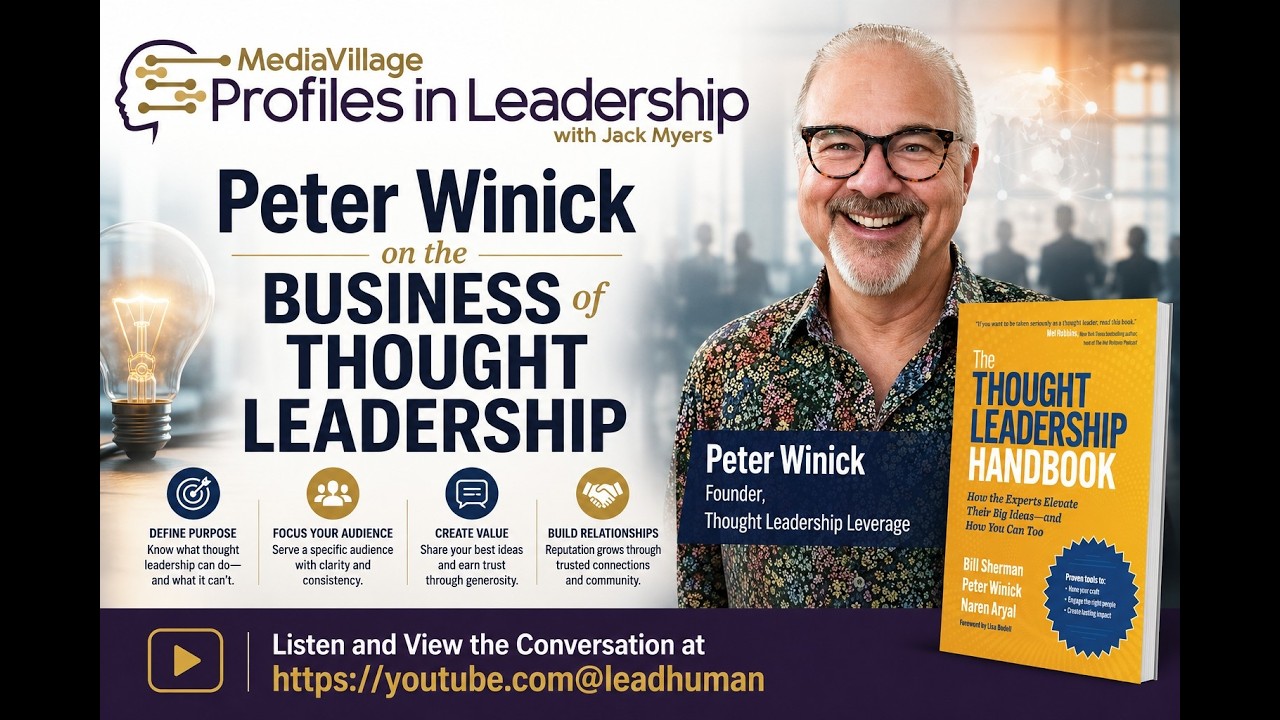
Peter Winick, founder of Thought Leadership Leverage, explains why most organizations misuse the term "thought leader" and describes the models his firm built from working with hundreds of them. He used ChatGPT to mine thousands of podcast transcripts for patterns that shaped a 50,000-word book, and breaks down publishing trade-offs: traditional offers reach, hybrid gives speed and control, self-publishing demands relentless self-promotion.
Chapters
Welcome to Leadership Conversations. Peter Winick, you and I have a long background in— yeah, just publishing with Bill Sherman The Thought Leadership Handbook. And you know, when you and I first connected, which was well over a decade ago. Yeah. One of the things we talked about was the value, importance, and opportunity of publishing thought leadership. And I had launched Media Village at the time around the concept that thought leadership was desperately needed in the media and advertising industry. And today there's so many people out of work who are writing, what they call thought leadership, right? And giving it away and then also giving away their speaking in order to get consulting gigs and then giving away their consulting in order to get variety, you know, advisory work. So where— tell me what's in your book that's different and why people should be reading it and what they can learn from it.
Yeah, so there's a lot there. So One is, you know, just to your point, everybody's calling themselves a thought leader today. That's not good. We don't even know— like, if I were to talk to a friend and the friend were to say to me, hey, I'm starting a business, um, what do you think I need to do to set up a finance function, right? And I'm not a finance guy, but I'd probably get it 90% right. Well, you need accounts receivable, you need accounts payable, you need some compliance, you need some checks and balances, you need some— so like, we would have a conversation in a half hour probably be okay. We'd want someone to bless it, but we'd be, we'd be in an okay place, right? When an organization stands up a thought leadership function, A, we don't even know what they're talking about, right? So now we have a meeting and there's 6 people. 4 of them don't know what the heck we're talking about. One of them thinks it's content marketing. One of them thinks it's their version of thought leadership. So to me, the first thing is to calibrate around what, what you as an individual or your team or your organization means when it talks about thought leadership. What you think it can do and what you know it can't do. And then that guides, that guides your thinking. So to get back to, you know, sort of the book, what I wanted to do with the book is, is I knew a couple of things, or I think I knew a couple of things. One is Bill and I, and also Naren, our co-author, have built a lot of models and methods and frameworks over the years from being in the trenches, from actually not being theoretical, but working with hundreds and hundreds and hundreds of thought leaders around the globe. So in order—
It's been your business.
Yeah.
I mean, your business has been helping individuals, companies be thought leaders and legitimizing the thought leadership model for organizations. Is that fair?
Yeah. So our— yeah. So the business is Thought Leadership Leverage. It's a consulting firm. It's on the small side. And we work with all sorts of thought leaders, be they individuals or be they legacy executives or be they academics, whatever the case may be. And they're coming to us to either figure out how to do more of what they do better or how to scale and leverage what they do, right? So in order to do that, over the years, we've just developed a lot of models and methods and frameworks. So the way the book came to be is about 2 years ago, I started playing with ChatGPT, right? Like everybody else, like whatever. And I spent a couple hours and maybe most of a weekend.. And I'm like, wow, this is pretty cool. Like this, this like, and I don't know if I had the ultimate epiphany of it's gonna change the world and oh my God, nobody's gonna have a job anymore. But I'm like, this is pretty cool. So what I knew is we had all these models and methods and frameworks, but nobody wants to read a book that reads like, you know, an, an IKEA instruction manual. Like nobody wants to read that. Right? So the other thing I knew we had is the transcripts from hundreds and hundreds and hundreds of podcast episodes that we did, which is a form of thought leadership.
Interesting.
So I said, oh, this is interesting. Maybe there's something we could do here. So I took about 30 of the episodes that were tagged in a certain way thematically. I don't even remember what the tagging was, but they all had something in common. And I popped it into ChatGPT and I started to ask it questions and, and play somewhere between a podcast host and a consultant and a journalist and started to play with it. I'm like, wow, this is really cool because it came up with things that I didn't even remember, right? Like I've, I've done 725 podcast episodes. Ask me what I had for breakfast, you're going to get a blank stare. Ask me about what you and I talked about when you were on the show, you know, 6 or 7 years ago. I couldn't tell you if my life depended on it. So it helped me find patterns and things and commonalities, etc. So then I go to Bill that Monday and Bill is— Bill's our CEO. Bill and I have been together for 20 years, but he's the guy that makes sure everything stays on the bus. He's the detail guy, he's the analytic guy, whatever. And I'm the ADD CEO, right? So I say, "Hey Bill, I got an idea," right? Which is usually not the way he wants to start a Monday, right? And he's like, "Oh, what's the idea?" I'm like, "Oh, I'm playing with Chat and I dumped a bunch of transcripts in and, you know, like maybe we could write a book. Like how, it probably can't take more than a month or two. We've got all these transcripts." And he's in, you know, he dove in and said, "Yeah, maybe we can do that." Well, lo and behold, it was 2.3 million words. And then to put that in context, you know, the average business book is somewhere between 40,000 to 60,000 words.
Yes.
So this is like a stack of business books floor to ceiling. Right? And how do you get the nuggets out of there? So what, what—
How many, how many, how many words is your book right now? Roughly?
I think it's, I think it's about 50, something like that.
Okay. So it's right in that mix.
Got it. Yeah. So we were able to take our models and methods and frameworks and then use ChatGPT and other tools and tools that Bill developed as a tool to just give us sort of these highlight reels and say, wow, here's examples of 8 CEOs of publicly traded Fortune 500 companies that went on to become thought leaders in the next chapter of their lives. And here's what we saw. And we didn't just cut and paste. Then we'd go back and say, hey, couple of follow-up questions, couple of thoughts, couple of this, couple of that. So that's really the book. So it's got the models and methods and frameworks, but what I think what gives it its its reason for being and its life is it's wrapped in real stories, many of which are people that you know or have heard of or well-known thought leaders and such. So that's the backstory on the book. The other thing I'll say—
A sample? You have a story to share with us?
Oh, there's so many. There's a great story in there from Stephen M.R. Covey. So his dad was Stephen Covey, who wrote 7 Habits of Highly Effective People. And he just talks about somewhere between a debate and an argument that they had when they were going to launch Seven Habits. Now, Seven Habits, if you don't know, has sold— and don't quote me— but something like 30 million books. So if it was a movie, it would be somewhere between Star Wars and Rocky. Like, this is like one of the all-time bestsellers. And his father was really evangelical and felt that one of the reasons he was on the planet to get these ideas out there. Now, he's also the CEO and he's got a business and all this other stuff. So there was a huge debate and they brought an outside consulting entity in. And the consulting company said, don't put all the 7 Habits in. If you do that and you put it in a book, why would anybody buy the damn book?
Everything's in there, right?
And there was an internal debate, and his father won the debate that said, no, I am not going to hold anything back. I want it out there. I want these ideas to live, etc. And lo and behold, as a result of that, the book became one of the bestsellers ever, and the company grew like fivefold or tenfold. Why? Because just because somebody reads a book doesn't mean they're not going to hire you. In fact, it's the opposite. There's a higher propensity to consume your other offering, services, etc. So that was kind of a cool story.
So my, my, when you, where do you, what advice do you give about publishing, getting the content out there? It's one thing to write it. It's one thing to have thought leadership, then to be able to write it, which ChatGPT and Claude are helping exponentially with. But the word exponential being the key one, because there are—
well, exponential is relative. So I don't know that everyone needs to be exponential. Like, for example, I am totally comfortable with the fact that to 99.9% of the world, I am completely and utterly irrelevant, right? Because my market is small, right? My market are authors and thought leaders and academics and keynoters. Most people aren't that. So therefore, I don't care about, you know, the single mom in Kansas. I don't care about the mid-level IT manager. I just don't. And they shouldn't care about me.
You care about breaking through and getting the attention of that 1% of the people you are interested in. So, so to answer the question, how has that challenge changed over the last couple years?
So it's changed and it hasn't. So the way I address that today, the variables are today, in my opinion, the tactical. So 5 years ago we weren't talking about Substack, and there was a brief period of time during COVID where we talked about Clubhouse, and now it's TikTok, Instagram, and there'll be things that come up in a year or 2 or 5 that we can't even fathom today. To me there are some foundational things that will never change. And that is exactly your point, Jack. Who's your audience? Who— and by your audience, not someone that would be forced to listen to you. Who is your target market? Right. And you have to know about them with the highest level of specificity that you can, not just demographically, but more importantly, psychographically. Do they have a growth mindset? What's their risk tolerance, etc.? Then you figure out who they are. Then the next thing you have to do is get over yourself. And what I mean by that is most thought leaders have a preferred canvas, right? And by that I mean writers write and speakers speak and people that are, you know, social media influencers love short-form video and none are right and none are wrong, right? But it's not about you. So if you're an academic that your canvas, if you will, is 50-page academic journals and that's not your target market, you lose. Right? So one of the conversations we have with our clients is, listen, you're an academic and you publish more than, you know, anybody, anywhere else we know. Your target market is this, and therefore your target market is hanging out here, there, and everywhere, right? And you're not going to meet them there. They're not going to cross over to you, right? So if you, if you said to me, oh, Peter, I'd love to have you on my podcast, but one thing, um, I only record them, uh, if you speak fluent Dutch. Okay, I'd say, sorry, Jack, I, I don't do that. So I, I would you know, next. So I think you have to get out of your comfort zone and say, how do I do that, right? And what are the other formats that matter to me, you know? And I think far too often too many people are like, uh-oh, every platform that comes out, I gotta be the first kid on my block, and I gotta do this, and I gotta do that. And it's like, no, you don't, like, actually.
When— so when I launched my Substack, uh, 4 years ago, uh, there were a few thousand. Today there are multiples of a couple thousand subsects. You're publishing a book. Amazon says that they publish 5,000+ books every day to Amazon. So how do you break through the noise level that's out there and differentiate yourself and grow that audience beyond that 0.1% to others who are out there who don't know you but should?
Yeah. So the way— here's our marketing plan, like the bulk of it. There's some other little things here, but because we've been doing this a long time and both Bill, myself, and Naren, who is not only our co-writer but the founder and CEO of our publishing house. So he's been at this a long time too, serving thought leaders from a different perspective, right? He brings that depth of, of knowledge from the, the publishing space. So one of the things that we're doing is saying, you know, this isn't a mass media piece. If you said to me tomorrow, Jack, Hey Peter, you know what? I've got a lot of media contacts. I can probably get you on the Today Show tomorrow. I would probably do it cuz hey, why not? Would it really matter for the book or the business? No, it wouldn't actually. And that's the reality. So what we did is said, well, what matters to us? We want to get what, what I care about. And my, my publishing co-author quasi cringes when I say this out loud is I wanna sell the least amount of books I need to, to grow the business the most. Right. That's what I want to do. If I could, if I could sell one book and 5x my business, that would be awesome. Probably not realistic, right? But I, I don't necessarily care about getting tens of thousands of units out there. What I do care about is getting to the right people. So how did I do that? We have 60 testimonials in the book that I'm really proud of from people that are friends, that are colleagues, former clients, people that we admire and respect. And there's about 40 people in the book that we talk about based on what, what I, what I mentioned earlier, We're going back to each and every one of them, maybe to the, the point of getting on their nerves just a touch and saying, hey, help a brother out. You know, we're launching this thing. Would you mind sharing this with your community? Would you mind putting this up on your podcast, on your newsletter, on your whatever it is? And they want to, you know, for the most part, most of them would like for us to succeed and be careful. And they, they think of that as something valuable to provide to their community. Hey, You know, you should, you should read this book that Naren and Bill and Peter wrote. And here's why I think so. I've known them for a long time. I trust them, whatever.
And many of your recommendations.
Yeah. And to me, the beauty there is that when someone comes on my podcast, there's, there's a, you know, an assumption that they're vetted and they're not trying to hawk nonsense. I wouldn't bring someone on there that I don't believe in. That's not reputable. That's not whatever. It doesn't mean I want you to hire everybody that comes on our podcast, whatever., but I think they're good people. I think they're smart. I think they're whatever, you know, make your own judgments. And so to us, for us to find those 100 people that each have an audience, and some of those audiences are massive, massive. Like we got Mel Robbins gave us a testimonial.
She's her audience. Saw that. That's impressive.
Yeah. Yeah.
Yeah.
You know, and there, you know, many other people in there, multiple New York Times bestsellers, whatever. We want them to spread the word to their communities. Because the propensity of their followers to be the type of people that would work with us is much higher than the general population.
And is this a self-published book? No, no.
Amplify is a hybrid publisher.
Hybrid. So, you know, it's interesting 'cause I've learned a lot about— there's hybrid, there's quasi-hybrid, there's self-published. I don't know Amplify. I've worked with Advantage, which is Forbes' parent. I'm working now with my book with Morgan James. It's kind of a quasi-hybrid in that you guarantee a certain number of book purchases. Yeah. But I'm finding that whatever the model, unless you get a Simon Schuster who agrees to make it one of their big books, you're funding your own marketing ultimately, and that there's not—
Yeah, let's stay there for a minute. So, so picking a publisher is as important as what you're publishing. And what do I mean by that, right? Like, so people— I feel sometimes in my job that I'm somebody telling adults that the Easter Bunny no longer exists, right? Um, hey, you know, I've got this manuscript and I've worked on it for 3 years, and I'm gonna go send it to Wiley or Simon Schuster, and then they're gonna send me a check for a million. But— and I'm like, okay, let me tell you how the world works. Like, And not because I'm a skeptic, but I'm a realist, right? So even now at the big houses, a lot of them are doing what I call the worst of both world deals, which is the traditional piece is you get a 15% royalty. Now, if I said to you, Jack, we're going to be partners in this thing, you're going to do 95% of the work and I'm taking 85% of the money, there's two words you would probably say to me, and they're not thank you, right? Like, it's just like, that's not cool, right? But that's what publishers do. That's the model, right? So now the worst of both worlds is they're going to take 85% of the profit and they're going to say, you know what, Jack, you don't have a big enough following. You know, you're not Tony Robbins. You know, there's a lot of things you're not. And you say, okay, well, so be it, right? So therefore, what we'd like you to do is just, you know, to manage the risk a little bit here, buy 3,000 copies a year for the next 3 years at wholesale. So then you take out your calculator and go, 3,000 times $12.
Wait a second. Wait a second. Yeah, yeah.
Wait, I'm funding all the cash. I'm doing all the work. I'm getting a minor piece of this. That's just not good business, right? So to me, there's a time and place for Morgan James, which is more of a traditional self-publisher. There's time and place for hybrid, and there's time and place for traditional, depending on who you are and where you are, right? Some of the variables are control, speed. You know, traditional publisher is a 2-year relationship, right?
Like, so, yeah, whatever you think.
So when I, you know, I get, I get books delivered to me daily from people promoting and stuff. And some of the stuff I look at and it's like, okay, well, that was clearly pitched 18 months ago about AI. And guess what? The world changed 3 times since then.
It's hard.
That should have been a magazine article.
It's hard to be contemporary to when it comes out. But what you're leading to is that in some ways, self-publishing is, even though it's hugely cluttered, overcluttered, it's still economically maybe the best model since you're gonna do your own marketing anyway.. And it gets out more quickly. You can do it once it's written and you can put it out in a couple days and get it out there. You can go to Spark Ingram, you know, IngramSpark and self-publish. So, and you get full distribution potential.
Yeah, for many. What I loved about the Amplify model is there is an editorial criteria. They, you know, most self-publishers, and I don't mean this in a bad way, will publish anything. Right. They're not, they're not putting their name, their brand, or anything on the IP.
No discernment or judgment in the process.
Yeah. So when you think about it now, we're living in a weird kind of cool time, right? So it used to be information was always scarce. Then Gutenberg invents the press and blah, blah, blah, blah, blah. Right. So, you know, it used to be there's a scarcity of information. So I would go to a Random House or Wiley because I'm thinking they're curating and presenting to me for every, you know, 100 frogs they kiss. This is the one. They blast, right? So there's something to that. Now it's information overload. Like you said, there's, I think, 4.5 million books that will come out this year. Like, okay, sounds right. What do you do with that? Like, now I'm drowning. So I need someone or something, whether it's the publisher or someone that I trust, to say, you know what, Peter, you should buy and read this book. Because guess what? The $20, $30, whatever a book costs, nobody cares about. You get the money back. I can never get back 6 hours of my time. And I won't waste it. So when, if you tell me, Peter, check out this book, I think it's good and you'll appreciate it. Done. I bought it. I read it. Doesn't mean we have to agree on everything. We can have totally different views, but I respect your opinion. I know that you're not gonna put something in front of me that you think is silly or whatever. At least, you know, if you're someone I admire and respect, I at least respect your opinion enough to say, oh, it's a book recommendation from Jack. I, I take that in high regard.
Peter Winick, since thought leadership has been a 40-plus, almost 50-year career for me,. And I've invested a lot in helping others have a voice to the marketplace. And frankly, with my own book coming out, another book on the horizon after that, and then self-publishing a science fiction trilogy.
Very nice.
Which I'm looking forward to and excited about. The models, the realities, the challenges of thought leadership are very different today. And I think your book is very valuable, not just to me and to others who I know, but to the marketplace as a whole. I've heard you talk about right at the beginning, make sure you have clear purpose and focus. Make sure you understand the realities of how you get not just what you write, how you write it. Be more selective about where you're publishing it, find your core audience, reach that audience maybe through more personalized recommendations and recognizing the value of your own community and how they can be supportive. A lot of good advice. I am very confident that in your 50,000 words there's a lot more good advice. So, thank you for sharing it with my audience.
And thanks for having me, Jack. I appreciate it.
I'll look forward to hopefully joining you on, you and Bill on, or you on your Thought Leaders podcast. Where do you publish your podcast?
Wherever you can find them, Apple and Spotify and all the usual, our website.
The whole other conversation about the exponential growth. There's 4 million podcasts out there today, so.
Yeah. But when you double-click on that, I, the last data that I saw was in excess of 90% of them haven't published in 90 days, which is another way of saying they're dead. So, which is, which is nothing wrong with that. Like, it's fine to think of a podcast as a fairly low-cost experiment, and it's not for everybody. Like, it's just not. Like, it's, it's a lot of work. It's a lot of effort, and it's a, talk about a crowded space. Right?
And, uh, the audience can purchase Thought Leadership Handbook wherever books are sold.
Wherever books are sold. Yes.
Great. Thank you for joining me.










