Local SEO Q&A: Strategies to Rank #1 on Google for Home Service Businesses
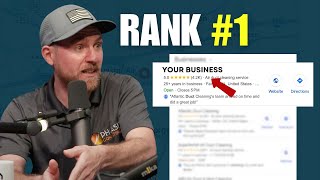
Phil Risher breaks down local SEO for home service businesses: nail your Google Business Profile with accurate hours, photos, and reviews; use title tags and H1s that name your service and city; keep your name, address, phone consistent across listings. Backlinks matter less than you think, around 5% of local rankings.
Chapters
If you have questions about local search for your home service business, in this video, we're going to be discussing the top three questions that business owners are asking. We did a poll on our YouTube channel and this was the big thing was local search. What do we need to know? So let's dive right into it. How can I get my business to rank higher in local search results? This is what everyone wants to know. Many business owners struggle with visibility in local search rankings, especially when competing against larger companies or franchises. And they may not fully understand the impact of like, what does a Google Business Profile do? What do online reviews do? What does, do I need backlinks? How do I optimize my website? So these are all things that people are feeling and I'm going to explain to you what you need to do to rank higher. I'm also going to put a link down below to literally what Google says. Google has a whole support document of how to improve your local rankings on Google, but I'm going to break it down quickly. All right, so the first thing is Google Business Profile. Your Google Business Profile is called offsite SEO. What off site SEO is is the ability for someone to search for a local product or service in your area and them define your Google Business Profile. This is that map pack thing that you see in this section. There's a couple things that Google takes in consideration. The first one is your location. So if you want to target a specific city, let's say Dallas, and you are not located in Dallas, your Google Business Profile would not be shown to because you're not in Dallas. You would be in whatever city that your Google Business profile is located in. Same thing with relevance. So that's another factor that they have is relevance. Relevance means let's say that you're an electrician, but your business name doesn't have electrician in the name. Well, Google's not going to know if you're an electrician because your name doesn't say electrician. So they're not going to show you in the results. So your distance or location from the search, the relevance and also the prominence is the other third part that they say. This is how Google determines your local ranking. Relevance, distance, prominence. Your prominence means do you have enough reviews to be shown? Do you have a higher rating than the other competitors? So if someone has 200 reviews and you have 20 reviews, they're not going to show you because you don't have the clout or the prominence that they say. So from a Google Business Profile perspective, those are really the big Three things have a business name that mentions the service that you offer, be located in the specific area that you want to be located in, and then have a great business that has good reviews that Google wants to show. Some other small things that they talk about on this that I would say are important is like make sure your hours are up to date, make sure you post photos on your Google profile, make sure you respond to reviews. Those are some of the basic things that you can do. But those other three things are really the big factors that they say are very important. The second thing is on site SEO. So down below your actual map pack is your website rankings. Your website rankings. There's really three big things as well. Here's your title tag, your meta Description, and your H1. We made videos about this before showing you exactly what to do. But on that side of things, you want to make sure that your website pages are optimized for local SEO. And the way you do that is you put your service plus your target city and your title tag, meta description in H1. As far as backlinks go, in local SEO, there are local backlinks that you can get. Let's say that you sponsor a local event, you can get a backlink in from that organization, or let's say that you do something at a local college or you post a job on a local job board. Those are all different backlinks you can get. There's another thing called citations, which is important for your Google business profile. Google doesn't really list too much of that information on here, but in the SEO space, there's a thing called nap name, address and phone number. And these are your traditional backlinks or citations where you want your name, address and phone number to match across the board. So everything's clean and it's a trigger back to Google. So that's a quick overview of what it takes from an SEO perspective. And what I can tell you is if you implement those things, we, we had a case study that we recently put out where by helping this company with SEO, in the first three months, their rankings literally doubled and they ended up doubling the number of leads that they were receiving because now they were more prominent in their search results. And then more people went to their website that was local traffic. And then more people literally doubled the number of people converted into leads because now it was local traffic going to their site, converting. So this can be done. The big thing when it comes to big competitors and franchises is that they've been doing it for so long. So when you talk about prominence. They might have a thousand reviews and you have 10. And you're up against a lot of competition from an SEO perspective, which is why it's going to be hard to rank. We recently also just made another video about why SEO won't actually grow your business. If you're in a supersaturated market and all these people have 10,000 Google reviews, and you're coming in with 10 for a digital marketing company to tell you that they're going to help you with SEO, it's just silly because it's going to be extremely hard to outrank those people that have 10,000 Google reviews. And you have 10 Google reviews. So you have to be very transparent about that. When it comes to SEO. The next thing is people always say, like, well, why isn't my Google Business listing driving enough traffic? And, you know, I set up my Google business profile correctly. I got Google reviews, I had the most Google reviews. I'm in my specific area, my business name is great, right? You might be doing all these things, but you're still not getting the traction that you want. And there's a couple of reasons why. And here they are. First, if you do not have the, you can only select one main category for your business. So if you do not have the right main category, for example, let's say you're an electrician, but you only do EV chargers. Let's say that you put your main category as EV charger, but you want electrician work. You see, if you have the wrong main category, you might not be shown. So an easy way to figure out if you have the right category is to go to Google, do a search for your top service in your top service area and see what Google puts out into the Google Business Profile pack. And you'll see the main category there that will say landscape or lawn care, sprinkler, insulation company, whatever. That thing is a big one in like lawn care spaces. Like, do you do pest control? Do you do mosquito control? There's not really one in there. So you want to go in and see what Google is saying and recommending to people and what their category is, because that's what you want to put your category as another one for. This is, let's say you're in the H Vac space. You can select H Vac contractor, you can select air conditioning contractor. You can also select heating contractor. So this is something where maybe in a seasonality, you might update your main category to whatever people are going to be searching for that's more relevant to your main category because you can only pick one. So this is a lot of times what we find is most of the times like Google business profiles are not ranking is because they're not optimized properly for the main category and you may not have enough reviews. As I mentioned before, your competitors might have thousands of reviews and you have hundreds or tens and you're not going to be shown. And that's just the brutal facts that you got to get more reviews. Last question on here is about building backlinks to improve local SEO. You you hear about this black magic and voodoo SEO type stuff and backlinks is one of those things. What I would say is from a citations perspective, building backlinks, we use a platform called yext Y, E X T and another platform called Bright Local. There's a bunch of them out there. Whitespark is another one where you can actually purchase citations, where they already have AI integrations set up and all you have to do is just put in your information and it's going to pump it out to all these different places. And then on a monthly basis you can go in and make sure that things are remaining consistent. The other thing I would say from a backlinks perspective, and I'm not discrediting backlinks, but if you look at the whole pie of SEO, especially for local SEO, most experts say that it's literally like less than 5% of your ranking is backlinks. Is there a component of helping? Yes. But is it going to, you know, do backlinks and you're going to start getting flooded with leads? No. So the backlinks thing, I don't think you should worry too much about it. So that's a quick Q and A when it comes to SEO. What other questions do you have? Drop a comment below. We love doing content like this because hopefully it just helps people and helps them improve their rankings. I'll put that link down below to the Google Doc as well, the support Doc. And if you like content like this, be sure to hit like and subscribe and we'll see you in the next video.


