The Future of Home Service Scheduling: AI, Smarter Routes & Better Appointments
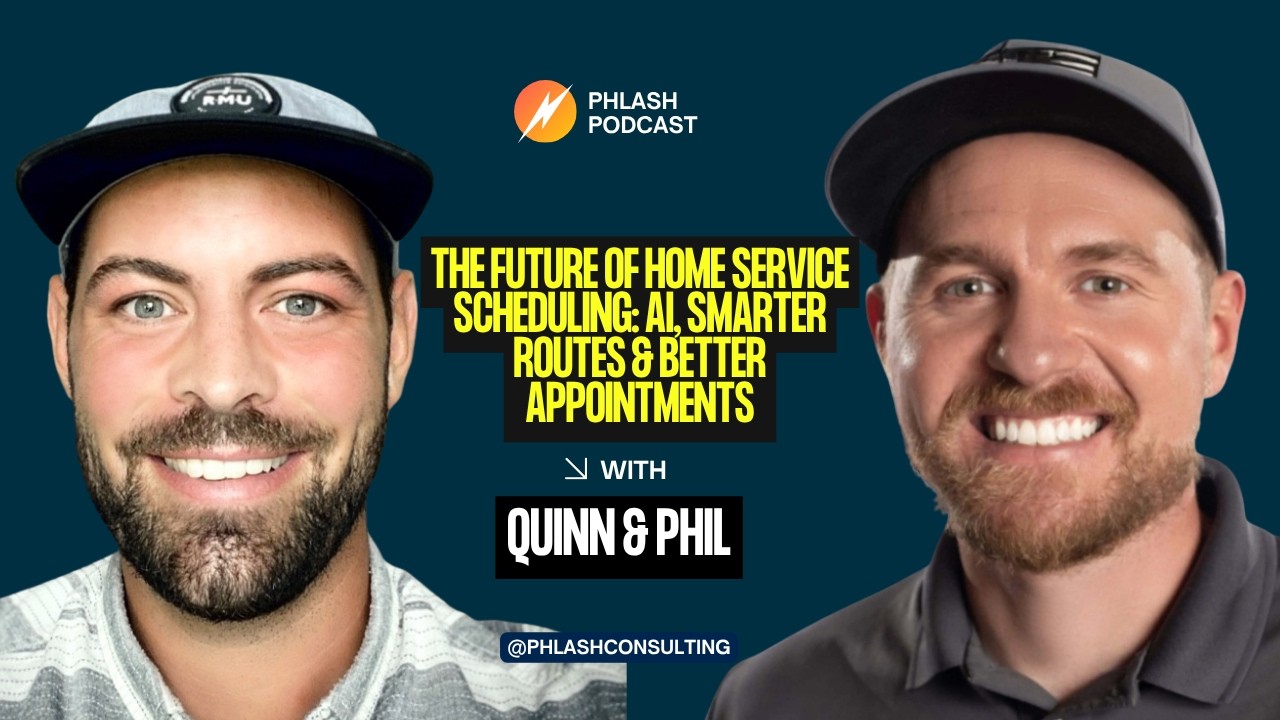
Quinn Small, CEO of Drive, explains how AI scheduling software helps home-service businesses route jobs and book appointments faster. Drive sits between lead-capture platforms and field-service tools, pre-qualifying leads and suggesting optimal appointment times. Small warns that AI dispatchers need guardrails to avoid over-booking.
Chapters
Welcome back to the show. I'm your host, Phil Risher. And on today's episode, we're talking about how home service businesses can use AI for pretty much perfect scheduling and more efficient routes with Quinn Small. Quinn, thanks so much for joining us today, man.
Yeah, thanks for having me. It's good to be here.
For sure. So can you tell us a little about Drive, maybe your background and like what you actually ended up building specifically from a home service perspective?
Yeah, absolutely. Yeah. So I come from a home services background. So when I was about 12, My mother and I launched a window covering business out of the garage. So, she was in a kind of a high-producing sales role. I wanted to figure out a way that she could have a little bit more ownership over the calendar. I have 3 other brothers, so I'm trying to help her be able to own the calendar more as a mom. And so, we decided to launch a window covering business. So, we went out, threw out door hangers, and then I would go on the weekends and help with installs. We had a rusty green Ford Windstar that we would drive out to installs on. And then, our contracted installer would show up in a Ford Probe with blinds boxes sticking out of the hatchback is where it started. But yeah, we just kind of hit the ground running and over the last 28 years built a business that we're kind of a multi-location, 100 Douglas, 200 Douglas Galleries in Lincoln and Omaha, like 35-ish employees, majority of them out in the field. Wow.
Yeah.
And so, that's kind of where I spent most of my life growing up for a little while, spent time in the Front Range of Colorado as a Motorization specialist for Hunter Douglas out in the field doing automation jobs. So motorization, like programming codes and stuff back in the day when it was all sort of like manual on a keypad, doing all that. So yeah, so spent most of my life out in the field in various capacities and then spent a little time in tech, came back into the business in 2020 as our CEO at Custom Blinds and Design. And that's where kind of What kind of set me on the path that I'm on now? So came in, and we had a really interesting situation. It was COVID. So for business like ours, especially in the home services space, like we had this huge influx of demand, which was an awesome thing. But there's also a ton of challenges that came with that, and that also converged with we were at the time in the process of expanding to the kind of the Front Range of Colorado and opening six locations in Colorado. So we're trying to figure out, okay, how do we actually scale this from you know we kind of ran and operated this day to day around like thirty-five people, a lot of institutional knowledge. Most of our team members had been there for 15, 20 years with us? And how do we actually put process and things behind this so we can actually kind of scale this up and go into more locations? And at the same time, then supply chain broke, all these things happened, material costs went off the roof. It was just kind of wild. And so essentially, I was sitting there going, okay, what are first principles? Let's go back to this. What are a few of the things that we can start to tweak so that we can one, kind of take care of this institutional knowledge and, you know, like us as like owner operators day-to-day problem when thinking about scaling. But also from kind of a bottom line perspective is like, hey, we got to shift some things because our material costs are going up. You know, we were shipping quotes where, you know, somebody come back and say, hey, you know, I want the lower patio door done, you know, like we did the upstairs patio. And we'd be looking at them like, well, our cost is more than what we sold them for the upstairs, you know, 4 years ago. Right. So we're trying to make all this work, right? And so I was trying to figure out what are some of the threads that we can start pulling to kind of keep this all together, be able to capture all that demand while just like, you know, not going out of business because of all the other stuff that was going on, to be honest with you. And then trying to scale to, you know, up to 5 more locations. And one of the big things that I kind of identified was that there's this through thread from all of our operations and everything that kind of centralized on our scheduling operations. And so I started trying to figure out, okay, how do we schedule better? And how do we do that? You know, catch this demand, grow, and how do we grow revenue and grow locations without having to equally scale up the front office? Because right now, like, that model is like, that's just, it's not working right. And especially at scale. So I think you kind of talked about that in your, you know, kind of going to the $3 to $10 million, right? So it's like us trying to figure out how do we bridge some of those gaps? And a big piece of it was scheduling. So I started going out and figuring out, you know, what tools are out there and how can we, how can we fix this. And in my naivety coming from— I had come back to the business from some time in tech. I was like, oh, we just got to throw online booking at this. Like, I'll just use Calendly, right?
Yeah.
And silly me, even though I'd been out in the field my whole life and understood how important route density was, I just kind of threw Calendly at this. And what happened was I was like, yeah, we fixed the problem in the front office and we just moved it to the field. And I was like, okay, so I'm going to need to hire 5, 10 more field techs that are hard to find. You got to get them certified. They're hard to train, right? They're expensive. And then I got to hire like 3 to 5 more salespeople because their route density is, you know, totally whack. And so I just asked myself, I was like, well, why does this have to be an either/or problem? Why can't it solve the front office problem and the field problem? And that's kind of what set me down the path of trying to figure out how to do that. And this was kind of before AI. So AI wasn't a thing.
Yeah.
So hacked together, you know, I had Calendly going to Airtable, going to Zapier and kind of made my own Frankenstein solution, split up our our service areas into like 26 different zip code regions and to cover essentially like 50% of our install scheduling where we could use some like booking links to help with that. I had like 96 Calendly event types that we were managing. So kind of doing the math on it, it was like, well, yeah, this just isn't going to— this doesn't scale. And if I ever leave, like, this is all going to fall apart. So I didn't actually solve the problem. And so that's where I set out to kind of You know, solve this problem in a way that could actually scale. Um, and that's kind of what I've— what— that's what we've been up to for about 3 years now. Um, it's become materially better and, you know, we can do a lot more because of, um, kind of the advent of AI. There's just a lot more options out there to be able to do things well.
Yeah. So this is a problem that hits home for me, um, in particular. But if you're listening to this, this is probably what it looks like is like I had 28 technicians at my home service business. And it was on my CSRs to get the call, figure out the best route, you know, density. Uh, the day before they would try to be moving routes around to like make sure that it's all clean. And then we had online scheduling, but then they had to pick the region that they were in and then it would try to put it together. Um, one of my first clients, he had, he did installs, cleaning, and he had 3 different business units. So what he would tell his CSRs, like on Tuesdays and Thursdays, we go to this area on Monday, Wednesday, Friday, we go to this area.
Yeah.
And then like, Yeah. You know, try to make it all work and have little map circles and stuff.
Yeah. Yeah. And that's like, that's what you have to do. You start hacking together these systems and they generally work. But then as you start to kind of pull back and look at them, you realize that, you know, there's kind of these processes and things you've mastered. And this is one of the hard things, right? Even it was hard for us too, is, you know, you build these processes that you put together that like make it work, right?
Yeah.
And they sort of become, you know, they become these like ritual things of like, this is how we do things, right? And you go back and you go like, why do we do it this way? It's like, well, we did it out of necessity because we had to. And then you realize there's sort of all these constraints that it's putting on your business of like, well, what's the customer experience if I can only offer service in business unit A on Tuesdays and Thursdays, but they can never do a Tuesday, Thursday, right? It's like, yeah, is there a reason why we have to do that? Is it like, well, it's different trucks and it's like we can't roll the different trucks? Or is it like, no, that's just how we schedule, right?
Yeah.
And so you start to uncover all these layers and you go, okay, how do we sort of free the business up, free our people up, free our time up, free our, you know, free our profit up. And there's a lot of things you could do in the scheduling space now because we, you know, we're not reliant as much on and don't have to be— not that we have to replace them, it's how do we augment them and help them be able to manage the calendar better.
Yeah.
And I just think it's really, really important. Yeah.
So a lot of the people listening to this, they're going to use like Jobber, Housecall Pro, ServiceTitan, something like that. And maybe they use Calendly for like, you know, estimates or something like that. But If they're using these tools, a lot of the even still issues is that you can't— you can put in your zip code and say, I don't serve that area or something, but you really rely on dispatcher or the dispatch software to then optimize your schedule, not on the booking side of things. So if I'm hearing you right, it's like—
Correct.
Wait a sec, if we fix it on the booking side of things and then have it going clean, then it's going to be much more effective to build your schedule as you go opposed to trying to like Hack it together.
100%. Yeah. Yeah.
Okay.
Yeah. Because what, what I've often said is that, you know, being like a scheduling coordinator, being a CSR, being whatever you want to call it in your business is like I said, it's sort of like being an air traffic controller without the pay. You know, it's like the amount of things they're trying to think of and it's without the pay and also without the tools. Right. So it's, yeah, it's stressful and it's impactful to the business. And so it's giving them tools to help, you know, help them make better decisions. Or can you offload those decisions either to an agent or even to the customer? Right. So like with online booking, How do you allow them, you know, how do you allow the customer to make a decision that actually works for your business? Not just, you know, capture the lead. They think they have a time and then you gotta go call and reschedule it, right? How do you actually give them an appointment that, that you wanna take?
Yeah.
And so, yeah, that's essentially what it's all about is going, okay, how do we actually, even for dispatched appointments, right? So thinking about, and this is a lot for someone to think about, right? How do we, how do we, even if we're just scheduling windows of time, you know, can we sort of be pre-building a route so that whether we're dispatching the day before or we're dispatching in real time, Right. How do we have a little bit more thought of where we're putting those dispatched appointment windows on the calendar so that when it does come time to actually dispatch somebody out to that job, you've kind of got a route prebuilt? Because I think sometimes we can, if we're running sort of dispatch-style scheduling operations, we can just go, yeah, just offer one of the windows, they take it, and then we'll figure it out, you know, tomorrow. And it's like, that's a way to do it, right?
Yeah.
But also if we can be a little bit more thoughtful, but when you're asking just someone who, you know, is trying to answer the phone, they're trying to, you know, get the calls out, they have emails coming in. They're probably also handling things like accounts payable. Like they've got all this stuff on their plate and asking them to do, you know, like context switch so fast, be able to understand all this and make really good decisions at a fast pace. Like it's just tough, right?
Yeah.
Yeah. Generally speaking, if you can, at the time of getting something on the calendar, you know, make as best of a decision and offer the best times as you can and get a customer committed to a time that is the most reasonable time upfront. Everything downline from there just gets easier.
Yeah, exactly. I always laugh because we had 4 CSRs and they were all women and they did not know anything about directions. And so like they would literally have like MapQuest open and like trying to like see all this stuff like in real time and it's like, oh my gosh. So I totally hear what you're saying.
Yeah.
So with these scheduling softwares that I mentioned, like Jobber, Housecall Pro, ServiceTime, whatever those tools, does Drive layer on top of that or is it in substitution of that?
Yeah, really, really good question. Yep. So layers on top. So essentially kind of where we fit a few places, but one of the main spots that we fit in is typically what we see for most of the businesses we talk to is they usually have like a marketing side of the business. And oftentimes that's an outsourced marketing agency, right? A lot of them are running on something like GoHighLevel. We talk to a ton of people like that's kind of their like marketing stack. Yeah. And then there's this gap in the middle and then they have their like FSM, JSM, right? So they've got Jobber over here. So they've got like GoHighLevel, Jobber over here, and in between here there's just sort of this gap that's largely, you know, someone that's sort of like getting into the system and then, right? So a lot of where Drive fits in really well is going, okay, so you've got these leads coming in instead of them just getting dropped either in, you know, GoHighLevel or in an email for the CSR just to call out and then Eventually connect with someone and try to nurture them. And then once we get an appointment, then it gets into Jobber. It's going, okay, how do we sit in the middle and go, let's take them straight from lead to booked appointment into Jobber, right? And so we can sit in there as that decision layer where basically we can do a lot of that. You know, should we take the appointment? So can it prequalify? You know, do we even want this appointment? Is it something we do? Is it in the service area? You know, is it a high enough value? Do they have urgency, intent, all that? And once we go, yep, that makes sense. Okay, well, what is the job, right? Is it business unit A, B, C? You know, is it a new sale? Is it service? So like, who actually does these things on our team?
Yeah.
And then looking at it and going, okay, we know what the job is. We know it's a job we want to get on the schedule. We know which team does it. What's the location? Then we can look at the calendar and go, okay, here's all the people that could do this job. Here's where all the jobs are currently at on the calendar of all the potential places we could schedule this appointment. Which ones are, you know, where are we already nearby in the near future? You know, and if we schedule it at 9:00 with Phil or 9:30 with Quinn, what's the ramifications of those decisions? Because if it's 9:00 with Phil, that's, you know, it's 30 minutes earlier, but you might have to come from an hour to get to that. Whereas if they can wait 30 minutes, I might be next door, right? So like, let's get them to choose that 9:30 instead of the 9:00. And then also like a 9:00 instead of a 9:30, because if we choose a 9:30, there might be a gap in there where it's like, well, I'm next door, but they're 30 minutes apart and we can't put another appointment in there. So like, you just built in time where I'm just going to be sitting in the driveway, right? So these are all the decisions that people are currently having to do. And when they're doing that, they're pulling up calendars, they're pulling up Google Maps, they're typing in all these addresses to try to figure all this out. And it's like, you know, we can help with that, right? So yes. whether it's a person trying to get it done, or it's coming in, you know, from a web form, or, you know, it's a call that's coming in, and you have an agent or our agent or your agent answering it, it's like, How do we, how do we just be the brain to help make those decisions so we can get it from, you know, something that we want to get booked to something that's actually on the calendar? And then, yeah, that pushes into Jobber.
So if I'm hearing you right, so like my company, we build GoHighLevel for clients and, you know, other things, but like we use their CRM, build GoHighLevel, different automations and stuff. So a lead comes in and then let's say someone fills out a form, they get a text, an email, and let's say they respond to the text message. Right now it's very hard for them to get scheduled through that text message with an agent or something because it doesn't connect into Jobber. What you're saying is that you can like, you like layer over top of whatever software that they use so then it can schedule, but then communicate and then add it right into their software.
Yep.
Yep.
So we'll go, okay, what's currently on their calendar? So that would be like Jobber, right? So it's on the calendar. We can see that. And then we go, okay, this is the time we wanna get it. Let's book it. And then, you know, we're gonna write it to Jobber so that it's on the, on the Jobber calendar.
Yeah.
So we'll sit right in between those. And so, you know, a lot of agencies actually are going, hey, how do we not be a lead gen agency? How do we be an appointment gen agency? You know? And so like, we're a tool that goes, yeah, we can start to go, yeah, we can, we can do more than just, you know, throw, throw a bunch of leads in Jabra that you gotta go chase down and call and nurture and, and all that. But just going, hey, we can start putting appointments on the calendar and you can trust they're appointments that you want because they're prequalified. And then we schedule it at a time that, you know, you want. So we're, you know, not messing up your, your salespeople's route density and making sure that You know, because like when we, when we threw Calendly at it, and this is what happens sometimes, is you just, you know, you throw a scheduling tool at it and it doesn't think about this stuff. And you're like, well, you know, my salespeople aren't taking 5, you know, estimates a day, they're taking 2 to 3, right? That creates a lot of problems. So it's like if we can, you know, avoid creating those problems while still just getting work on the calendar for you and hitting like the speed to lead aspect of not just how quickly can you follow up, right? That's great, right? Speed to lead. It's like even just that first touchpoint is materially impactful for the likelihood of you, you know, getting and closing that job. But even more, you know, more valuable is, you know, they're on your website Sunday at 9 PM and at 9:02 they're on your calendar for Monday morning. Like, yeah, that's, that's a pretty good win.
I'm curious about with the— so we work with some like remodeling or higher ticket companies and they say, you know, okay, if it's a $1,000 job, I'd rather do a virtual estimate or just like call them and talk to them. And if it's a $20,000 job, I'm going to go out there and do it. How would they determine that? How would you determine that?
Yeah. Yeah. So what we do, so most people like have this logic in their head. A lot of people actually find like, do you have pretty well-documented standard operating procedures? So these SOPs, right? Yeah. So they've usually already got a way that they're handling that. And so we can just map that into basically routing logic where it's like, you know, so we can ask these prequalification questions, they kind of fit in this bucket. So, In this, let's actually redirect them to, you know, book a, you know, a virtual appointment as opposed to an in-the-field appointment, or if you have like a showroom. So like, that's like us, we have a showroom. And so what we'll do is say, you know, for, you know, if they're just a totally disqualified lead, essentially what we tell them is like, you know, thanks for your request. Here's our— here's the office, or here's the showroom hours, like stop in at your convenience. If they're in this mid-tier, or there's a few questions we'll ask, like, you know, is it new construction? Is it under construction? Right. So it's under construction. What we're not going to do is go out, you know, we're window coverings.
Yeah.
We don't need to go out and see the like stick framing, right? So we can say, okay, in this scenario, like come to the showroom instead. So like, that's sort of if they're, you know, like a mid-value, like lower qualified lead kind of in that mid-space, we can direct them and go, hey, actually book a time with one of our salespeople at the showroom.
Nice.
If they like a really, really high value ticket and it makes sense, we'll go, yeah, let's just get somebody out to the house. And then in that showroom and all of those, we can say, yeah, or if you would like to meet virtually, You know, we can do that. So, and then there's great tools out there that we're, we're like, we're building integration right now with like LiveSwitch, for example. So, but right now we can, yeah, yeah, they're great. So awesome tool. Like that's such a great product. So, yeah. And that's essentially what we help folks think through is, you know, what is, if you don't already have it documented, you don't have a process, like let's get it documented, let's codify it. And then, you know, we can help just get things directed to the right place, whether it's a salesperson out on the job site or somebody at the showroom or a virtual consultation, etc. The goal is just if you want the sales appointment, let's get the sales appointment in whatever modality you want to take it and let's get it sold, right?
So yeah, of course. I want to also talk to you about— I think how we originally maybe connected was this shift to AI mode and AI search and like booking and how does that work? Yeah, I think that there's a lot of questions out there of like, Yeah. Is Jobber gonna, you know, be in AI mode and be able to, you know, communicate with clients, like have this conditional logic and then book things and all these tools and like maybe they'll get there. Yeah. But maybe there's a better system, especially like I've been talking a lot about that. Google made its biggest change in the past 25 years of instead of search on Google, now it's AI mode. And so now it's actually taking people into this platform. So like, yep. Yeah. Talk to me about that and like what the vision is or what y'all do for that.
Yeah, yeah, yeah. Great question. It's an interesting space and it's a huge opportunity that we don't know when it's coming, but it's coming. And that is that right now, yes, more people are moving to AI for search. So whether— and this has materially changed once Google did this, right?
Yeah.
Because we had already seen this shift where fewer people or more people, I'll say, were going to ChatGPT, Claude, Grok first and saying, opening up ChatGPT and saying, my thermostat's at 68. But the air coming out is warm, right? Yeah. And it's saying, okay, well, you need to go look at this, right? And this is sort of their process of arriving at like, oh, I need to have somebody come out. Like, I need to have an HVAC tech come out.
Okay.
And so if you're already in that process, instead of just starting with HVAC near me, right, they're going through this process starting with AI. And this has also changed now with Google because even folks that were going to Google, even those search terms are getting longer because they're getting these search results that are the actual AI search results. So I think there's 2 things that are important. One of them you've talked a ton about, and I think it's really important, is like today, make sure you're findable by AI. Materially important because just more and more is shifting. So that means Google Gemini and sort of in the Google search, but also all the other LLMs that people are using at a consumer level. From there, where everything is trending is at some point, and we see more and more of this happening, Where what they want to do is not leave that AI chat or that AI experience and just get it booked, right? Because more and more people are looking at ChatGPT or Claude, whatever they use as their personal assistant in the pocket. And so they're going, hey, schedule me 3 estimates for this, or help me, who should I get 3 estimates from? Can you get them scheduled? And so what'll happen right now, it's interesting, Claude will go, oh, I have access to your calendar. If you gave him access to your calendar, they'll go, yeah, I can get that scheduled for you. And it'll even say like, yeah, I've got an appointment on your calendar to meet with Custom Lines and Design for window coverings. What it didn't do is talk to me at all. So I have no idea that we supposedly like, you know, Phil's over here going, yeah, Custom Lines and Design on Saturday at 6 PM. And I'm like, I have no idea. And so, but we're seeing more and more of this happen where customers are going straight from, okay, they, you know, some long-term search thing. It helps them go, oh, you need to meet with this Custom Lines and Design. And then they're trying to actually get it on the calendar. And this is the space that is interesting that we're trying to fill in. And there's some things moving and shaking that are going to make that possible where just straight out of an agent experience that it's going to be able to book directly with us. Now, to enable that, you'll need to be on a stack or have a product that actually enables that. So what that means is something that is designed to be able to give ChatGPT, Claude, et cetera, access to their calendar and their sort of booking rules. And I think we're at Drive at the forefront of that. That's like where our vision is going, of knowing it's where it's going. And I hope for customers that others are doing that as well, right? That the Jobbers, the Housecall Pros, the Service— whoever is also thinking about this because it's the direction that consumers are moving. And I think it's a really good opportunity for all of us. So it's not— the functionality is not quite there yet, but I think setting yourselves up to be discoverable and then If you're set up to be discoverable, you're positioned well to then also be bookable if you have the right stack behind it and you're already sort of using agents to book things, whether it's a voice AI, you know, voice CSR, etc., or just a booking product that— yeah, the doors are opening from a technology standpoint to make that possible. And once they're open, it's going to be floodgates, I think.
So yeah, one of the bigger stats that I saw was like 68% of searches now end with zero clicks. And it's not— Google's not optimizing to drive traffic to websites anymore. It's just optimizing for intent and it wants to just keep that trust. And they don't care about driving people to websites anymore because they're going to make money in AI mode and keep people on those platforms.
Yeah, 100%. You had a recent episode where you talked about this, like the purpose of the website and like websites are sort of changing and dying, right? Because yeah, the more and more people are going to agents and the agent doesn't need to The agent doesn't care about the color, the style, the, like, how the page— it's like it wants to consume all this about your business and be able to understand it. And more and more people, they're like, well, why would I go read your website if, like, ChatGPT will read it for me and just tell me what to do, right?
Exactly.
And so, yeah, the website's becoming much less important. I think it is still important, but it's making sure that website has the right content and structure that you can be found and that AI can understand who you are. Does it fit the thing that this customer is wanting? So that it picks you and says, yep, this is a good fit, this is who you should be with. And yeah, and then like I said, pretty soon just being able to go straight to is your calendar actually available for them to get that, to get that lead booked onto your calendar?
Yeah, I love it. I'm curious on your thoughts on this because we have some clients, I mean, like literally $2 or $3 million businesses that run their CSRs, AI CSRs, AI booking. I'm not saying it's great. I'm not saying you have to do this. What are your thoughts on like Drive replacing a CSR dispatcher or, uh, layering on top of it for, you know, just like overflow work? Or like, how do you think about this? Or how do you, you know, approach that?
Yeah, yeah, it's a really good question. Um, I'll talk about like me as just Drive and then me personally, yeah, as a, as an operator. Okay, so, um, yes, I generally think the— there's a great opportunity there of, of either replacing or augmenting, right? And it kind of depends on where you're at in the phase of a business. So You think so? For example, for the— there's a lot of people we talked to where, you know, they're a couple years into this, they're the owner, they're the operator, they're the one that's actually in the house. And they, you know, they have like a spouse or somebody that's like working remotely that like answers the phones and man, like runs the front office while they're like doing their full-time job remotely, right?
Yeah.
And these people are going, okay, you get to a point where, you know, you outgrow your ability to manage all that on your own. But your revenue hasn't like got to the point that you're comfortable hiring a full-time person. This is where there's a great, a great spot to start putting in some of these tools to not necessarily replace, but like push off or avoid ever having to hire that person and at least kind of like bridge that gap a little bit where it's like, okay, can I take a little bit of this off of me? You know, it's kind of outgrown, you know, my wife's ability to do it while she's at home. And so like, how do we help her? How do we take some of that off the plate? Right.
Yeah.
Also, then once you get into, okay, you know, you've kind of bridged that gap and now you're at the point where like you have a full-time front office person, they're doing everything, right?
Yeah.
So the question is, do we start hiring more of those people or do we start taking more off their plate? Well, before, the only way you take something off their plate is to hire someone else, right? Where now you have this opportunity to start hiring these tools. And I think that's another good place to start investing in that. And there's a number of ways that you can do that, right? It can be just like the fallback, right? So if you're— if you don't want you know, go full AI that, you know, your customers aren't ever talking to a person. A lot of us that run these businesses are very relational. We're local, right? The kind of the human touch matters.
Yeah.
But also speed to lead matters. And your customer, you know, like a lot of times they're calling you while they're like between meetings or on their lunch break. And if you're on the other line, like it's a total pain. So, you know, for me personally, when I'm calling in, you know, I love to talk to a person, right? But if I can either talk to an AI that can actually get something done for me or talk to a voicemail and wait for someone to call me back, I would still rather talk to the AI, right? So it's sort of like I'd like to talk to a person, or I'd like to talk to some agent that can actually get me on the calendar and like take care of my problem for me. And lastly would be like, I want to talk to your voicemail and wait and play phone tag for 3 days to talk to you at some point, right?
Yeah.
And so I think that's, that's how I think about it. And we have a lot of these businesses that are going full, like full AI CSRs, etc. Make sure my one cautionary thing there is like, It can do it, and it makes sense for a lot of businesses. Make sure you're with the right provider and the right people setting it up. You know, these models are new, and their ability to like navigate conversations and like know what to say and what not to say, and without kind of the proper infrastructure beneath them, you know, you're giving them a lot of power without really, you know, like, you know, if you at least have a team member, you have, you know, you can threaten to fire them, or like, you know, you can, you know, you can have a conversation with them. They have like emotions, and they actually care, right? Like, it's a whole different thing working with a person that if You're like, hey Phil, you know, you kind of messed up, you did this thing, you know, it's all good. Like we're learning, remember, you know, this is how we do this. Like you can go have a conversation and like truly train them.
Right.
These AI models can kind of do whatever. And so you just have to be careful. So without the right structure built around them, they can be problematic. And so especially right now, there's a lot more people coming into the market that are, you know, going, hey, you know, like I'm tech savvy enough and I know how to, you know, run some Facebook ads. Like I'll just start building agents for people. And some of those are great, but some of them aren't, and they can be really risky. And so I would just do a lot of due diligence regardless of making sure that you understand sort of like how do they put guardrails on it? What's sort of like the underlying structure that's making sure that it's going to, you know, do the things you want it to do and not do the things that you don't want it to do?
Yeah.
Because it can be really hard to audit it if it's not, and it's hard to hold it accountable. I say that AI can be your worst and best employee for the same reasons. It always wants to get the job done more. It's more motivated to get the job done than any human ever has been. Every model is this way.
Yeah.
And it's going to do anything it can to get that job done. So that is great. And it could be risky if you don't have the right guardrails. Right. So we've seen this there, even Anthropic recently, one of their lead engineers so much as said this, which is how it hacked, found its way out of their sort of thing protected from the rest of the world and found its way to get out.
Right.
And it's like, because it had a job and it was like, solve this problem and it's going to do anything it can do to solve that problem. And so that is a good thing, but it can also be a bad thing because if you're just saying, hey, book me these, here's how we qualify. But at the end of the day, the goal is for you to get qualified appointments booked on the calendar. It'll just start throwing things on the calendar and find a way to get it on the calendar, even if it's not something on the calendar that you want on the calendar where you want it on the calendar.
Right.
So that's just like my domain example. But yeah, so I think there's a lot of good products out there. I think there's a lot of opportunity in it. I think it can be really valuable. Make sure that you know who you're buying it from and who built it and kind of how they're thinking about making sure that it, that you're, that it's sort of got guardrails around it so it can produce the outcomes you want and not a lot of outcomes you don't want. Yeah.
So I think the biggest thing for me is like when I think about agents and people getting AI agents. I— the reason I have this show is because I like bringing on people like you who have, one, worked at a home service business or a service business. You understand all the stuff. There's a lot of these AI champions out there who are just like building stuff, but they've never worked inside of an operation.
Yeah.
They don't understand all the stuff that goes into it. And it's like, cool, but when, when the rubber meets the road, it's not actually like going to solve the problem. It's going to make more chaos in their business because they don't know the full scope of it. And that's why, like, if you're listening to this and you're going to get these things, like exactly what Quinn's saying, like, look at the founder, look at who's actually building it. Do they have boots on the ground, real experience? And are they really solving a problem or is it just a shiny object thing? And I completely agree with you on that.
100%.
Yeah, yeah, yeah. Cool, man. Well, where should people go to learn more about Drive if you're interested? Also, before you say that, who would be like an ideal fit for Drive? Like, talk right to them. Like, hey, if you If this is you?
Yeah. So a good fit for us is anybody who, if the start of your sales cycle is you getting, you know, a salesperson in front of a customer, we're a good fit for you. So if you're looking, how do we get more of our leads converted to, you know, actual sales opportunities, you're for us. And especially I would say the people that are going, I just need more leads. If you're going, if your sales process starts with you get a salesperson in front of a customer and, you know, you do an estimate on site, you know, try to sell the job, we're for you. And especially if you're going, we just need more leads. My thing is always, you know, make sure that, you know, you talked about this last week or two, a couple weeks ago. It's like, you know, is it that you need more leads or is it that you need to get more of those leads converted to actual good sales opportunities? Because there's great ones in there, right? So, so if you fit in that camp, you're great for us. And then also from like the production side of things, if the work that you're doing that you sell in the field is appointment-based stuff. So, you know, for us, for example, you know, doing installations, we gotta get in the home. They're usually like 2 to 4 hours. If you kind of fit in that space, A lot of like service warranty work sort of things, we can be great at helping get that on the calendar as well. So if you fit in that model, we're really good for you. But for generally across kind of the sector, it's like for most of us, the job gets sold on the job site in front of a customer. And so we want to help you get those salespeople in front of that customer. So if that's you, then I think we'd be a good fit. So yeah, you can find us at GetDrive, and that's Drive with 2 I's, getdrive.com.
Awesome. Well, Quinn, thanks so much, man. I love, I love having these conversations because one, I can learn more. Yeah, same. But also it's just really cool to see People who come from home service that are building really cool things to help other people in that space. So really great job, man. Keep up the great work.
Yeah, thank you. Thank you. And I appreciate you for, yeah, for always pushing and teaching and educating. You get— you've got great insights, great content, and just appreciate you helping us all learn and grow and learn from each other. So thanks for doing this.
Yeah, man. Talk to you soon, brother.
Yeah. Awesome. Thank you.


