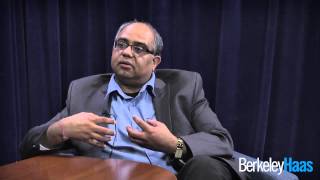
Bridging Technology, Community, and Global Perspectives: Piyush Malik on AI, Ethics, & Social Impact

In this interview, Shankar talks with technology veteran Piyush Malik about his unconventional career path from engineering in Delhi to management consulting, entrepreneurship, and nonprofit leadership in Silicon Valley. Malik reflects on the accelerating pace of innovation—from the PC and mobile revolutions to today’s GenAI, 5G/6G, and edge computing—highlighting how his experience across semiconductors, data centers, and AI gives him a unique perspective. He stresses the need for responsible AI, calling for human‑in‑the‑loop guardrails, addressing bias, and bridging the gap between privileged developers and the global majority. Malik shares concrete industry use cases, such as predictive maintenance for autonomous mining equipment and AI‑driven analytics for CPG and biopharma firms, illustrating how data can save millions. He distinguishes augmented intelligence from artificial general intelligence, arguing that current AI augments rather than replaces human creativity. The conversation moves to technology democratization, noting falling costs of compute and storage, the rise of global entrepreneurship, and the persistent haves‑have‑nots divide. Malik comments on the AR/VR hype cycle, the potential of immersive tech when combined with AI, and the importance of focusing on solutions that benefit humanity. He describes his long‑standing involvement with nonprofits, applying digital tools for donor segmentation, volunteer coordination, and community projects such as smart‑city initiatives in Greece. Finally, he offers a realistic view of blockchain’s niche applications—immutable records and digital currencies—while acknowledging the current AI‑centric pivot of many former Web3 firms. Throughout, Malik balances optimism about technology’s transformative power with caution about ethical, societal, and addictive‑design risks.
Chapters
Hi friends, welcome again to another episode of Beyond the Clouds: Edge-to-Edge Transformation. Rarely do I meet somebody who has been through multiple parts of the cloud and the edge and is very direct and honest about saying what's going on. Set aside the hype and say this is reality. And one of them is Piyush Malik. So Piyush, tell us about your story. How did you end up being the Piyush Malik I know today?
Hey Shankar, thanks for having me here. At the heart of it, I'm a normal human being. I've been through the regular hops of engineering to management to entrepreneurship to a lot of social entrepreneurship and community services. So, you know, my journey from back in Delhi, where I was born, to the US has had some stops in between. And happy to tell you more about each of these phases, or you could call it pivots in my career/life that I somehow feel it was not planned. It was serendipitous that I'm here. To be honest, I never wanted to be in the US. I never even wanted to leave India. That was the condition on which me and my wife got married, because neither she nor I wanted to leave India. And here we are, 27 years later, I'm sitting here in San Francisco. And this was my first international flight. And, you know, I've been here. And of course, in between, there have been 40 different countries that I've been to for work or pleasure, and primarily during my PwC and IBM time that I traveled a lot as a management consultant. So I've seen a lot of the world, but still a lot of the world is yet to come. A lot of technologies have changed during my life, and excited to be witnessing what this technological revolution is bringing forth.
We've seen many different revolutions, uh, the PC revolution and then the internet revolution and then the mobile revolution. Is there anything different about what we are seeing today with Gen AI, uh, uh, machine learning, 5G, 6G? Is there anything different or is it life as usual?
No, this is definitely a much, much more rapid-paced innovation that we are witnessing. During my student days, I used to see something called PCB design and chip design was something that I was very interested in, but there used to be only one company in India, SEL, that was trying to manufacture chips and that too got burned down that year that I enrolled in the chip design course. And so since only 3 persons signed up for that, that particular course was canceled. So I never got into the chip design industry directly as an engineer, but as a management consultant, yes, I have been to the fabs of Intel, GlobalFoundry, TSMC in Taiwan. And yes, from the semiconductor industry to semiconductor tool industry as well, companies like Cadence, Synopsys. So I've worked/consulted with them through various entities, and been involved with the semiconductor industry. And as an extension of that, with the PC industry as well, you know, and I've seen the pace of innovation, how while IBM compatible PC, we used to call it, at that time. And then Dell and companies like Gateway actually commoditized the PC industry in a— and you're very well aware how the Dell distribution model operating out of a university dorm and how Gateway with a box with the cow kind of hide, and that becomes a distinctive symbol. And establishing the data center for Gateway in Denver and San Diego. I felt I was part of the PC revolution as well. From that perspective, I have seen these two. Mobile revolution I skipped totally. I was not involved with any mobile company, even though I had put proposals for both Nokia and Motorola. But I've essentially been in the space of applied IT, applied technology, and data. And as the thread goes, the data and AI are now fast emerging as the hottest topics in the world. But I've been involved with that for God knows 3 decades. So I've seen each of these industries from afar.. And I feel I'm still far away since I'm not inside the data centers of Google. Even though I'm involved with Google, I'm not seeing what the latest innovations are happening at Amazon besides what we hear in the news. So excited, excited about every day I wake up and see a new technology, a new application of the technology being talked about. And a lot of lives being altered because of technology. So happy to be an applied technologist.
Exciting. And I guess this is just the golden age of engineering and siliconomy and AI with the rapid pace that we are seeing. There are also snafus, right? Every once in a while you see something's going not exactly kosher, whether it's Sam Altman and the whole OpenAI stuff, you know, offering to leave the company. And then the next thing, the board and so on. What are the risks of going at this pace? And what are the risks to people, to corporations? And how can we create AI in a kind of responsible way, in a meaningful way? Is that possible?
Yeah, Shakhar, it's a very, very pertinent question you brought up. Creating technology in a responsible way is the responsibility of every technologist and every policymaker and every everybody who's involved in governance, both at the local level as well as in strategic and national level. Again, security of a nation can be really compromised if technology is not bounded and there are state actors that are always at work. Nefarious activities always have to be detected and prevented from causing any harm to the citizenry. And that's the place where the government comes in. And typically, government doesn't have the deep tech chops. So they typically depend on the innovation companies. And whenever we talk about innovation, Silicon Valley, you and I are in Silicon Valley. So Silicon Valley does get talked about and equates to innovation. So when I see the CEOs of these top companies going and testifying in Congress and hear about their statements as to what they are doing in terms of putting the guardrails to get technology, especially AI, in place. I feel a lot more needs to be done. At the basic level, I feel tech should be human and tech should be developed for the benefit of humanity. It should ensure that no technology becomes rogue, that it just takes over and it's ready to press the destroy button. And we need to have that kind of a guardrail. And see, we need to create awareness in our society because, you know, till now technology has been developed by the people who are privileged. The— there's a gap between the haves and the have-nots. There are billions of, uh, out of the 8 billion people in the world, what percentage of people have been involved in developing these advanced technologies and are non-white? People of color are— even, even though we seem to see a lot of Indians and, and Chinese involved in technology, But think about how today's world, the AIs that have been created, how much bias is there in the datasets that have been used to train these AI models. That's an indication of the disparity between haves and have-nots. There's a disparity of the sexes as well. I mean, at one point, a few years back, my eyes were opened when I went to MIT for a conference and saw the evidence of how when a certain profession is being searched for, a particular image associated with that particular profession comes on. And for an engineer and for a doctor, it's the images of typically white males that used to come. As you know, women are everywhere now, right? So that's one small example of how discrimination has happened just because the way tech has developed over the last 50 years here. Computer science and the industry, the tech industry that you and I are familiar with, it's not that old a profession, as opposed to, let's say, mechanical engineering or civil engineering where you're building bridges. So this technology that has come in the last 50 years I think it still needs to evolve, mature. And while it is doing so, it's our duty, as I said earlier, technologists as well as the government folks, to put the guardrails in place so that it is done equitably. And, you know, it's for the benefit of the broader section of society.
What are the areas that you think are ripe for deployment today? What are the areas where there's real technology that say somebody at Procter Gamble or somebody in biopharma or in the mining field could use today that as a management consultant, you must be tracking these things?
Yeah, absolutely. And you named the industries as well as some clients that I've actually worked for as well. And having deployed both the traditional systems, the ERP systems and the data warehousing systems and also AI/ML exploratory models for some of these companies and CPG companies as well as in biopharma companies. I've seen a difference in how the executives at these companies are looking at AI and advanced technologies, and it's very promising. So, so take the example of the CPG company, or even the mining company. Think, so this is a real example from a client of mine, which is one of the largest mining companies in North America. And it's the biggest mining company in Canada. I'll leave it at that. When they were looking at deploying AML, they gave us a few ideas to work on as to what problems they were trying to solve. So using autonomous vehicles, getting data from the sensors of the components of each of these equipment that gets used in these large operations, and think of these as large capital investments where, you know, a downtime of a single day means they are losing hundreds of thousands of dollars per machine. And if this compounds across their operations, so they tend to lose millions. So what can we do to use predictive analytics, use machine learning to be able to figure out where a particular failure is going to happen and proactively order the parts ahead of time? This is a very small example of how to manage your operations and again, leverage the past data that you have as well as data of operations as to after how many runs of a particular machine does the machine fail, then predict it, and then also look at the sensorial data coming every second from the different equipment components within that huge truck and then analyze in real time and be able to predict, okay, what is the likelihood of this equipment failing? And this particular component which has a lead time of, let's say, 4 weeks to be shipped from the manufacturer to the site, what can we do to remove that latency What can we do to proactively order ahead? So variety of these kind of use cases we looked at. So it was very fascinating actually. Initially when we looked at the problem, we looked from the business perspective, then we broke it down into the data aspects of it. And then once you get into the data, then myriad of issues come in. But in the end, when you are able to produce something which is of value which can ultimately be a savior for an executive to say that, yes, you know, by use of these technologies, data and AI, we are able to save the company millions per month. It's amazing to see the overall compound effect.
I have seen similar things in the semiconductor industry and certain segments of the biotech industry. But one thing that I should point out, the process that you described requires a lot of programming, requires a lot of strategizing, requires a lot of human intervention. There is a belief now that we are at a point where artificial general intelligence will take off and you won't need humans to do most of the stuff. What's your take on that?
Are we there yet? Shankar, you know my perspective from what you heard me talk at that conference. I mean, we need to be realistic. And I've been talking about how machines will take over our jobs and the fearmongering that has been going on for the last decade plus. I mean, I've been involved with, even though AI hype is great right now, I've been involved in this field for long enough and I went through the first few waves and AI winters and AI springs interspersed each other. And during the last AI spring, I was at IBM and we were developing IBM Watson, which is the first commercialized application of AI. Even though we never used to call it AI, we used to call it cognitive computing. And the cognitive machine that Watson was, it was simply a question-answer machine. And you saw that win this Jeopardy championship. So it essentially captured people's imagination. It took us 2 years to put that into the hands of real clients. And we started with the Cancer Moonshot, trying to help in the healthcare domain, be able to predict with certain degree of accuracy what symptoms cause what disease. And especially for cancer, it became a doctor's assistant. And that's what I feel This, we are not talking about artificial general intelligence, AGI. I'm, the place where we are, it's augmented intelligence. And this augmented intelligence concept means that there's always human in the loop. A human is always needed to train this machine learning model through data. And, you know, yes, you can obviously challenge me to say that there was unsupervised learning and supervised learning, and then you have to further fine-tune. But think of it, the very first talk that I gave in my consciousness back in 2009, when robotics was beginning to take over and Amazon had acquired, I believe, a company by the name Kiwa to automate its warehouse distribution systems, it felt like they are trying to, you know, do away with humans. But if you think about it, all it did was to automate the mundane tasks to make efficiency at the core of our output. And And that is how the human species has progressed over these years. It's the application of technology and our creativity to the problem that why should humans do mundane jobs? Why should we keep on following processes that can be optimized? When technology is there for our benefit. So I fully believe in that. And at some point of time, we may get to AGI, which is the dreaded one. But then the question will still remain, what will the humans do when this technology comes in full force? So we've got to find a purpose for ourselves, and we've got to figure out what better things we can do. There's no replacement of human creativity, human ingenuity, and the emotions and EQ that we as humans bring to the table, to our workplace, to our lives. And I think our future is in combination with machines. Our future is there to help guide the development of these machines in a fashion that improves our society.
A little while ago, you mentioned the problem of the haves and the have-nots, that a majority of the world, in fact, I would say 80-90% of people in the world never got to use technology, whether it was during mainframes, minis, workstations, PCs. And now I think with cell phones, people have some cell phones or some smartphones, Do you think with the new wave of technologies that are coming on board and high-speed connectivity, is this going to democratize technology or is it going to have yet another divide?
No, you are absolutely right. There is an increasing wave of democratization happening. Think about when earlier computer came, you know, the very first PC perhaps cost $5 million to develop and and owned by, you know, there's some famous saying, company CEO said, maybe there's the need for only 5 computers in the world, right? So we are far, we've progressed from there. And what kind of innovations get enabled, we can't think 20 years ahead. Somehow the science fiction authors and movie makers have been able to guide our imagination of our technologists, but think where we would be if we did not make progress in this domain. So back to, back to the specific thing, that how technology will evolve with time. It's, it's the, there is a divide, but then there is the democratization happening with lowering cost of compute, cost of storage. And I still remember the first MB of storage device on a— and you perhaps might be able to guess, but this is— this goes way back, way back during my first job or second job in back in India, when our data center acquired its first MB of storage, it was something like a refrigerator. And we used to take our computer system used to take backups in something called tapes, magnetic tapes. And, you know, most of the audience who are listening to it would think we are coming from Jurassic Park. But yes. And we stay in Silicon Valley. And if you ever go up to Elmen Valley, you will see the prototype of that 1 MB of hard disk drive is still out there in IBM research labs. And so when it first commercially came to my client site in the year 1990, you know, we were all excited as to, oh, such a big storage unit has come. And look, today, our smartphones have how many gigs? You know, 256 gigs is nothing, right? So anyways, so democratization is through the technology, lowering cost of compute, lowering cost of storage, and being able to stir the imagination of the masses through widespread availability of these technologies, mobile technologies, will definitely— has improved a lot in such that the startups today don't need massive investments. They don't need to be in Silicon Valley to be a startup. They can be started from anywhere with very little funding. And yet can come up with groundbreaking innovations that will challenge the incumbents. So all I'm saying is, this is definitely lowering the center of gravity of innovation to wherever there are smart minds who put their attention to the problems that not many people are seeing, but there is a real need. So what is an entrepreneur? An entrepreneur is somebody who sees a perceived need for a solution, and is able to capitalize on not only developing, but firstly selling their vision, and then be able to build that product, build a moat around it, and then essentially become a unicorn. So that's where I feel all this technology world is taking us to.
Right now, as you said, AI is the rage. But just a year or two ago, it was AR, VR, metaverse. And that wave seems to have faded out. At least people are not talking about it. Tens of billions were spent on doing it. But there has been no major form factor change after the iPad or the smartphones, right? Or the tablets. Do you think there's a need? Do you think there's a need for new media? And will they come back? And will they replace what we're doing today, like laptops and flat screens?
Yeah, you're right. I mean, these cycles come. And before, before the AR/VR rage there was this crypto and Bitcoin and Web3 rage going on. And ever since last November, all these Web3 companies rebranded themselves as GenAI companies and leveraging, of course, whatever AI and whatever block investments they had done in blockchain. Nothing against it, but people tend to whitewash their products and their sayings with whatever is in vogue. And to your question, Shakir, on the form factor, I could not have imagined that I would be able to pass my entire working day with just working off of my mobile. And today, I don't need— I mean, I have a couple of devices, iPad and Mac and— but for what purposes do I really need to use when I can easily be on the road, function easily with this? And so to the form factor, I think Apple came up with something for the AR/VR device, wasn't it? In the last 6 months? Yeah, they have an operating system of it as well. I'm forgetting the name of it. But it's like a metaverse. You wear it and you are immersive in that. I know when the earlier version of Oculus, which was a company that Meta/Facebook had acquired, and I had seen that company come out of SRI. And it was a 10-person company when I first got that demo of it. I wore that headset. And again, I'm dating back more than 10 years ago. And I felt good. At the same time, I felt giddy. And so since then, I have not tried the latest thing that has come from Apple. But knowing Apple and knowing that there is a need for such kind of immersive environments, which can transform entertainment, it can transform medicine. And think about the positive benefits of these kind of technologies. You know, a doctor sitting here in anywhere in a first world country and be able to serve patients remotely in any other remote part of the world using these immersive technologies. That would be a boon right now. It can of course be used for and commercialized more for the entertainment purposes. That's where most money goes in. And that would bring down the cost of this technology to be adopted wider. And it's just a matter of time that new form factor will come in. But again, I don't have a crystal ball. And if Dean Kamen had the crystal ball saying Segway would revolutionize transportation with its— you remember we used to have something called a Segway and it would obviate the need for us owning cars and whatnot. That promise didn't come true. But as an early geek and adopter, I did ride Segways again, 10, 15 years back, 15+ years ago. In museums and in, you know, touristy spots, we use it, but it's added on to another thing, a fad thing. So let's hope something meaningful comes out of this metaverse, AR, VR as well. And combined with AI, hopefully we can deliver a solution that the market needs and actually humanity needs. And that's where I should say we as senior technologists in the industry who have seen some parts of the world, and we have seen better parts of the world as well, we should be focusing our attention towards developing technology that is doing good for humanity, good for society. And that would be my hope we all pool our resources towards and pool our energies towards.
And speaking about doing good, you mentioned earlier that besides being an engineer and management consultant, now some of your attention is towards social and community services. Have you been able to use technologies in these kinds of activities? And if so, how has it worked out for you?
Yeah, Shankar, this has been a part of my DNA. I've been involved with nonprofits for the better part of 20 years now. Been serving on various nonprofit committees and teams and with schools as well as with nonprofit bodies. Again, those, those, those, as compared to the commercial world, the nonprofit entities don't have the resources and funding to adopt technology to the level that could really make them more efficient. And so they are always lagging behind the commercial cutting-edge world. But clearly, take an example, I was on a panel just last week, and you were not at that conference. But there we talked about how we use emerging digital technologies to use technology for better customer segmentation, donor segmentation, and be able to improve the, you know, effectiveness of funds that we collect for the use of the nonprofit. So, so there we talked about what all things and what all technologies are available. 20 years back, we were not using any CRM system in any of these nonprofits. We were still using paper and pen-based systems. So as these technologies get developed, as more understanding, like customer experience management is something that we do in our commercial world. And as that has evolved, those same techniques are being applied to the nonprofit world as well. How can we make our volunteers more effective? How can we make our donors more happy and satisfied with what they are giving. Because giving gives a pleasure, a satisfaction to the donee as well as to the donor. Is the donor is getting the satisfaction that they are— they have donated something for a particular cause. And if the cycle is completed, If the information loop is completed in the sense that they know what impact their donation has made, and that completes the happiness loop with which the social cause is served as well as the donor is happy. And this is a virtuous cycle. So again, it wouldn't have been possible if these modern digital technologies were not enabled for the nonprofit world as well. And, you know, I've used this technology again at the nonprofit where I spend most of my time these days, is American Society of Engineers of Indian Origin. And there we use some of these at another nonprofit, Overseas Volunteers for Better India, where we undertaking a lot of projects for adopting villages, for Solving the water problem, soil problem, or other societal problems. We use these technologies in some way, shape, or form, but definitely much more infusion of technology can happen to take the cause much further.
Yeah, I recently heard about ASEIO thanks to your posting, so thank you. And I don't know if you know, I spent 5 years from 2016 to '21 mostly in India and 6 months in Mexico, and in rural areas. So we have a lot to connect on.
So yeah, absolutely would love to hear your experiences. And I think you visited Greece as well recently. I spent in those very ramparts of the ancient Greece a month, but that was more on a Smart Cities engagement, CSR initiative from IBM that we had gone from different parts of the world, we had converged to improve the economy and improve the situation of Greece. Again, I'm dating back by— this is a 2015 project.
I can give you some data from my visit to Greece 2 months ago. The economy is doing extremely well. The image is still that Greece is in trouble. No, The tourist economy is doing well. I think the farm economy is doing well. Overall, the whole approach is very optimistic and positive. So when you go to Greece, you feel like you're getting a very meaningful experience of something that dates back to like 2,000 years ago. So it's a wonderful experience. So you guys have done something good there.
Something has really worked. I'll tell you, Shankar, we came out of that engagement one month on site, and then 1 month preparation and then 2 months after coming back to our respective home bases. When we produced that report, it was for the— within the next 36 months, what all projects that they need to undertake to improve the various aspects of the city. How do they make use of sensors technology? How do they make use of data? And we had also used AI at that time with saying how they can use Watson for various parts of it. Of course, not using technology for the sake of using technology, but wherever it made sense. And it was to be funded by various components, United Nations as well as European Union. And I know for a fact that after we presented that report, we came on almost 400 media outlets. We gave our press releases as well as interviews at the completion of that engagement. When there were 5, 6 of us. And we felt we've done great. Good to know the firsthand report that things are getting better there and things are in good shape. Thank you for sharing that.
Yeah, I mean, it was wonderful being in Greece and so much renovation has happened so much that most places have come alive in a big way. And it's not just random industrialization. Meaningful, meaningful restoration and architecting back old relics and everything. Amazing. So that reminds me, as much as we can use technology for good, one of the challenges that I've been hearing from parents is that these immersive technologies, man, are getting them trapped already with WhatsApp and Instagram and all that. It creates nightmares. For families, the addictive part of it. And I guess developers, game developers, media developers want it to be sort of addictive so that they can get maximum utilization. Yeah. Do you think that problem will ever get solved?
No, it won't. Uh, you know, this is, this is the, again, a different kind of cycle that, you know, you, the, the objective of the developers is to develop user experiences, which make— there's something called stickiness factor. Back in my— again, I think you know about my background as a management consultant, engineer to management consultant. I've consulted in 17 different industries. So one of the industries was during the dot-com boom days was when e-com was taking its peak shape. And so I happened to be there at eBay during that time. And it was one of the poster children along with Yahoo. Now, nobody talks about Yahoo, but Yahoo at one point was there. So we always used to talk about how do we move from, you know, traction. How do we get traction? We've got to get eyeballs, and then we've got to make them click on, you know, convert them into something which will make them click to buy. So it was a virtuous cycle. And how do we improve that stickiness factor? It was through the customer journey. The user experience and design immersive. I mean, even though we never used to talk about metaverse at that time, we used to talk about how do we create enough interest that the user gets a personalized experience and he comes, he or she comes back and buys more. So showing them what all things they might like. See, earlier examples of AI were there, collaborative filtering and recommendation engines were being used in that platform as well. As we were moving from eBay Data Warehouse 1.0 to 2.0, we used to say we are moving from the Chrome magnet stage of from monkey to Cro-Magnon to a human Homo sapiens stage, and how we are progressing using the power of data and analytics. We never used to call it AI at that time. We used to call it data analytics, and advanced analytics was what we were using to predict what would be the next thing this person would be inclined to buy. So same example, same, uh, thing applied in today's world. The developers are building using Apple technologies, using whatever latest technologies are coming out of the AI labs. And again, if you look around, you'll find every day at least 100 new companies are coming up with AI at its core. And It's good for the consumer, it's good, but for economy, ultimately, you know, that's how our world has progressed. More ideas, more things get proved out, and only the best ideas survive. And it's not only the ideas, it's the implementation of those ideas. It's the execution that counts. Which, you know, of course, you as an entrepreneur and have seen yourself firsthand, I've seen as well as a one-time failed entrepreneur and onto my third entrepreneurship journey, I'm seeing the pressures are all around. And so we just need to make sure we are working on something meaningful, that will give us happiness. And it'll move the technology to a place where, which will leave society and the earth in a better place than what we found.
Very true. You mentioned earlier about how companies are pivoting. Blockchain in itself, probably the use cases didn't pan out. So now they become blockchain.ai companies or AR/VR.ai companies. Are you actually able to see real use cases where these kinds of technologies that kind of went out of glamour will come back and will be able to change the world. Specifically, like things like blockchain.
There was a time that the VCs were chasing all these companies who were in the blockchain Web3 space. Now they are standing with loads and loads of money if you have AI in your name. I'm yet to see how these will come to the commercial world. But one thing is for sure, the use of blockchain for the immutable records keeping for educational record or for the land use for establishing credentials, that's not going anywhere. And if you are able to use it for digital currency purposes, this is different from Bitcoin, but governments are adopting digital currencies. India has adopted the India Stack of technologies, which is going beyond India's borders and being adopted in Southeast Asia countries and embraced very widely. At the core of it, they are using blockchain,, and they are using AI as well. As time goes by, we'll see more examples of it. But I personally have not seen any pivoted commercial company actually on the way to becoming a unicorn. I'm sure this will evolve as more and more time and energy is spent on these technologies.
You know, Piyush, we could go on and on. We could be talking the rest of the day. You have so much to offer and so many interesting ideas and you're down to earth, honest about it. But we have to call this to a close. So thanks again. And to people listening out there, we are all being honest about saying that we don't have a crystal ball. But together we have to create this future that's ahead of us. So please come forward. I want to listen to you. What's going on? How is it impacting your life? So together we can be more responsible and create technologies that will benefit rather than hurt people. Thank you. And thanks again, Piyush.
Please continue the great work you've been doing. Thanks, Shankar. Thanks for having me here. Goodbye, everyone. Take care.
Until next time.
More from Piyush

Startup Culture, History of Silicon Valley, Unicorn Science from TiE & ASEI Veteran ft. Piyush Malik