Interview: Piyush Malik, Data Science Evangelist, IBM
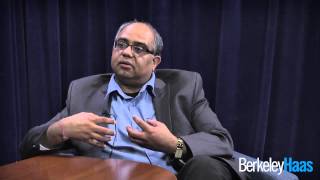
Piyush Malik, IBM's Data Science Evangelist, traces computing from tabulating machines to today's self-learning systems. Watson's 2011 Jeopardy win marked the start of commercial cognitive computing. IBM shifted from hardware and meat slicers to software and cloud, now partnering with Apple and Twitter to solve client problems with outcomes-based pricing.
Chapters
Hi, I'm here today with Piyush Malik, who is the lead of the Center of Excellence for Big Data and Analytics with IBM. Welcome, Piyush.
Thank you. Thanks for having me here.
Piyush, you said that we're entering a new era of computation, which is the cognitive computing era. Can you tell us a little bit about the extent to which that is discontinuous with previous eras around computing? Sure.
So if you look at the history of computing right from the 1900s where we had the earlier first era of tabulating machines where those machines, mechanical devices, were made for counting So those were the counting machines used for the first census in the US, right? So from that era to 1950s where Von Neumann architecture machines were created which would be programmed, which would be using 1s and 0s, the binary digits, and there would be programs written to tell them what to do. Now fast forward to, 2011, when now we are talking about cognitive era. And from 2011 to 2015 today, we have come a long way. And why I use the term cognitive computing is where machines are not to be told, but they learn by themselves. They are self-learning, self-aware, contextual, and they usher in an era which is making us smarter because these machines themselves, just by learning and by the way that they are manufactured, they are really making our lives easier. One example of that is Watson. And IBM Watson was the machine after 5, 6 years of in-research work, it was unveiled to the world. During the Jeopardy Championship in 2011. And that's why I said 2011 was the time when we unleashed the cognitive era. And since then, we've been working on commercializing that technology. We've been working with hundreds of clients in different industries around the world to make that technology available for making lives of common citizens better. For making better business decisions. And really, it is a very exciting time to be in this field.
So although we're in the era of machine learning, it's not really the machines that themselves create the differentiation for a company like IBM. I mean, IBM has its origins and its history in the manufacture and sale of, of machines. But over the years, they've moved from machines to software, and now they're, I guess, in the business of solutions or consulting. So if you follow that progression, how is it that IBM has managed to stay ahead or at least on top of these transformations?
For a 103-year-old company, IBM is definitely an innovator. In my own lifetime, I've seen a number of times signs out there that, hey, mainframe is dead, IBM is dead, and It could be far away from truth because today what we are doing at IBM is not what we were doing maybe 5 years back or 10 years back. IBM has had a history of transforming itself. As I mentioned, it led through the era of the computational machines, the tabulating machines, and there was before that, there was an era when IBM started its business. We were making meat slicers. If IBM hadn't transformed itself, we would still be doing that? Do you think? No, we would be out of business. So we have been transforming ourselves and transitioning. So in the 1980s onwards, we've been focused heavily onto software. Our software revenues have been rising, and very— after that, basically what has happened is we have really embraced the latest in the market. In fact, cloud, mobile, social— these are some of the terms we hear about, but in IBM we embrace it, and we are using it not only for internal, our own self, but for our clients. And that's where our biggest strength is. Our strength is in solutions that we create for our clients, which are replicated around the world, and of course they end up generating revenue for us as well.
But there are a lot of providers of solutions or companies that offer consulting or solution services. What differentiates IBM? Because if IBM has software and hardware on top of the solutions, how does that give them an advantage over a company when clients may want to cherry-pick or select the best in breed of the software, the hardware, the consulting?
So one of the biggest things that my division represents is the agnostic behavior. We are totally client-centric. We look at the client business problem and how best to solve it, whether it is to be solved with IBM technology or a combination of independent software vendor technologies or something that hasn't even been invented. Those technologies— we work with the client to enable them to get the outcomes that they desire. Example of that is our working with certain IBM research technologies which are not yet public and being able to create solutions leveraging those patents. I mention patents because IBM, as you know, has been the company which has been leading in terms of highest number of patents for 22 years in a running. It's by no accident. It's by a sheer focus on innovation by every member of our team on, focused on the real issues that our clients are facing and trying to come up with innovative ideas how we can solve them. So that distinguishes us from any other service provider who is looking at maybe providing a point-in-time solution. We look at innovative business models to go with the clients. We look at, for example, outcomes-based pricing for our solutions. We look at leveraging our innovative partnerships with, be it Apple-IBM partnership or Twitter-IBM partnership or the latest announced Weather Channel partnership in the, all in the sphere of data and analytics to give a better value solution to our clients. So I would say this is the most exciting time to be in the solution space and as we are moving from the traditional era of hardware and software into the cloud, we are very well positioned to help our clients.
Thanks, Piyush.
Thank you. Thanks for having me here.
More from Piyush
Bridging Technology, Community, and Global Perspectives: Piyush Malik on AI, Ethics, & Social Impact

Startup Culture, History of Silicon Valley, Unicorn Science from TiE & ASEI Veteran ft. Piyush Malik