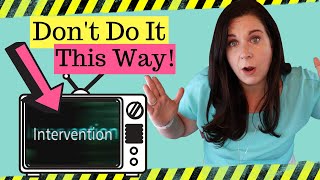
Amber Hollingsworth (YouTube, Feb 6, 2019) warns families not to attempt unsupervised, TV-inspired confrontational interventions for addiction because such "Johnson-model" approaches require extensive scripted planning and full-system buy-in and can produce shame, distrust, and poor family reconnection. She recommends a safer alternative — an "invisible intervention" that coaches families behind the scenes to use empathy and system-change to help the person decide to enter treatment, and stresses the practical requirement of having treatment placement, insurance, and logistics arranged before acting.
Chapters
So before you or your family attempts to do an intervention with a loved one that has an addiction to drugs or alcohol, you must watch this video. Because in this video, we're going to be covering how old school interventions can cause more harm than good. Okay? So I know you've all seen the show Intervention on A and E. It's a really good show. I like it. It makes for good drama. You're like, are they gonna go? Are they not? Are they gonna get sober? Are they not? And it's a really cool show and I like it. But you gotta remember that it's TV and it's sensationalized and it's cut and it's edited and it's made to get views, but it's not the most accurate picture of an intervention. They do have some things, right. One of the really important things that that show does do, right, is that all of the families that do an intervention are under and guidance of a trained interventionist. That's a pretty key component. I can't tell you how many families have watched a few episodes of intervention and they think they can pull this off on their own. Well, what they don't show on the television show is that for three days leading up to the big circle in the room with the letters, there's a whole bunch of education and training and planning and where the interventionist says to certain family members, if he gets up and runs out, I want you to go after him and I want you to say this and I want you to do this. I mean, it's like coaching a football game in an old school intervention. Things really are very scripted and purposeful and planned out, and there are all kinds of plans. A, B, C, what are we gonna do if this happens? So what you see on that show really is just the smallest part of what actually goes down in intervention. So the most important piece of advice I'm gonna give you is do not under any circumstances, attempt to do an intervention on your own with no help. You are very likely to have a really bad situation on your hands. And, and most of all, definitely never try to intervene on someone by yourself. I can promise you an addict can overcome any one person that tries to intervene on them. It's going to take more than just one person, no matter who you are, to have a successful intervention on an active addict or alcoholic. Now, there are a few ways that doing these old school interventions. They're actually. These are called the Johnson model, because the first guy that sort of came up with this model, his name was Vernon Johnson. I've read his books, they're good books, but they've been out a long time and we have other methods now. So one of the really important things if you're going to do one of these old school, get in a circle and read the letters type interventions, is that everybody in the whole family and friends have to be on board. If the addicted person has an ally out there somewhere, a friend who has the power and ability to go pick them up from treatment, somebody else's couch that they can go stay on, it's just not going to work. That type of intervention only works if, you know, you have the person cornered up and there's nowhere else to run. You got all the friends, all the family, everybody that they're likely to go to has to be on board to get that to work. And sometimes even if you can talk to all of those people, it's really hard to get everybody on board and on board to the point that they actually stick to it, because that's key. You can't put it out there. There's no bluffing. If you say, if you don't go to treatment, I'm not going to talk to you again, or I'm not going to give you any more money, or I'm not going to give you a place to live or whatever it is that they say, you got to be really ready to back that up. And it's very infrequent that everyone in a system gets to that point at the same time. Usually you might have some people to that point and other people not so much. So be very careful if you've got sort of a loose end out there because I guarantee you, the addict, the alcoholic, they can sniff that out. They'll press that point because they know exactly where the crack in the armor is and they will go down that route. Everybody has to be on board and ready to completely back up what they say they're going to do. Now the other thing to think about when you're considering an old school Vernon model intervention is the fact that many addicts and alcoholics, when they're confronted in this way by everyone and they realize that everyone that they know has been talking about them behind their back and everyone sort of conspired against them, they feel really hurt and really betrayed and hugely shameful and embarrassed. And you may be thinking, yeah, but they've done a lot worse to us, and you're probably right and it's totally okay. If this is the only thing you're going to be able to do to Save this person's life. Well, you just go ahead and hurt the feelings because that's a better option than losing your loved one to addiction. But be mindful. I have seen a lot of people come out of treatment after one of these interventions and have a really, really hard time reconnecting back in with their family because there's such a level of distrust, the family distrust, where they don't trust the addict or the alcoholic. But when you've had one of these sort of behind the scenes intervention type things going on, the addict or the alcoholic is very leery of the family as well. And sometimes they just don't get over that hurt, shame and embarrassment. You know, they actually sometimes feel really betrayed in these types of situations. So I'm not telling you to never do one of those type of interventions. I do think that the model works, especially under the right circumstances and in the right situations. I'm just telling you to approach this situation with caution and be aware of the pros and cons and of the negative things that can occur. Like I said, some of those negative things, it's worth the risk to save a life. But there are other ways to do interventions these days. It helped for families. We do it in a way that we call the invisible intervention. So what we do is we work with families behind the scenes to coach them on how to interact with the person in a way that will facilitate the person making the decision on their own to go to treatment this way takes a little bit longer. It's not like this one big planned event, it's a process. But when that person goes to treatment, they're so much more likely to stick and stay sober because they've come to terms with the fact that they need to go. They decide that they're willing and ready. And we've already helped fix the family system in such a way that will actually support the recovery process. That's what we call an invisible intervention because it's behind the scenes and you can't see it. And it's a real non confrontational way to go about it. In fact, it takes a much more I'm going to align with you approach and I'm going to have some empathy for you. Because guess what? When you express and show empathy for someone, the learning part of their brain actually kicks in. And when you're mad at someone or you're punishing them, or you're yelling at them or nagging them, the emotional part of their brain kicks in. So we know that does not work. You've got to Come at them in a way that actually creates conditions favorable to them making the decision to go to treatment, get better, and stay better. But regardless of how you plan to intervene on your loved one, make sure that you have treatment lined up. Because the moment they say yes and they're willing, you need to be ready to go. You don't want to be scrambling on the phone calling treatment centers, trying to figure out what kind of treatment you need. And do they take insurance? You got to have all your ducks in a row sitting already. Maybe even a secret bag packed in the back of the closet that they don't even know about. First step is actually to start making all those phone calls and plans and arrangements. Because the worst thing is to have someone with their sort of moment of clarity. They're ready, they're willing, and there's no place to go. Because guess what? That window will close somewhere between a few hours and a few days. You don't have long to act, so you need to be ready to learn more about addiction treatment options and levels of care and insurance and all those complicated logistics. I've got several videos on this channel to help you understand treatment options and cost and insurance and logistics, so make sure to check those out. And there's also a written treatment options guide written specifically for families. I'll put the link in the description below. You can click it and download that immediately. So you can start getting those ducks in a row right now. For tons more information on all things addiction and recovery and lots of free expert advice, make sure and subscribe and hit the bell so you don't miss a thing.