Do I Really Need to Quit Drinking? How to Know When It’s Time
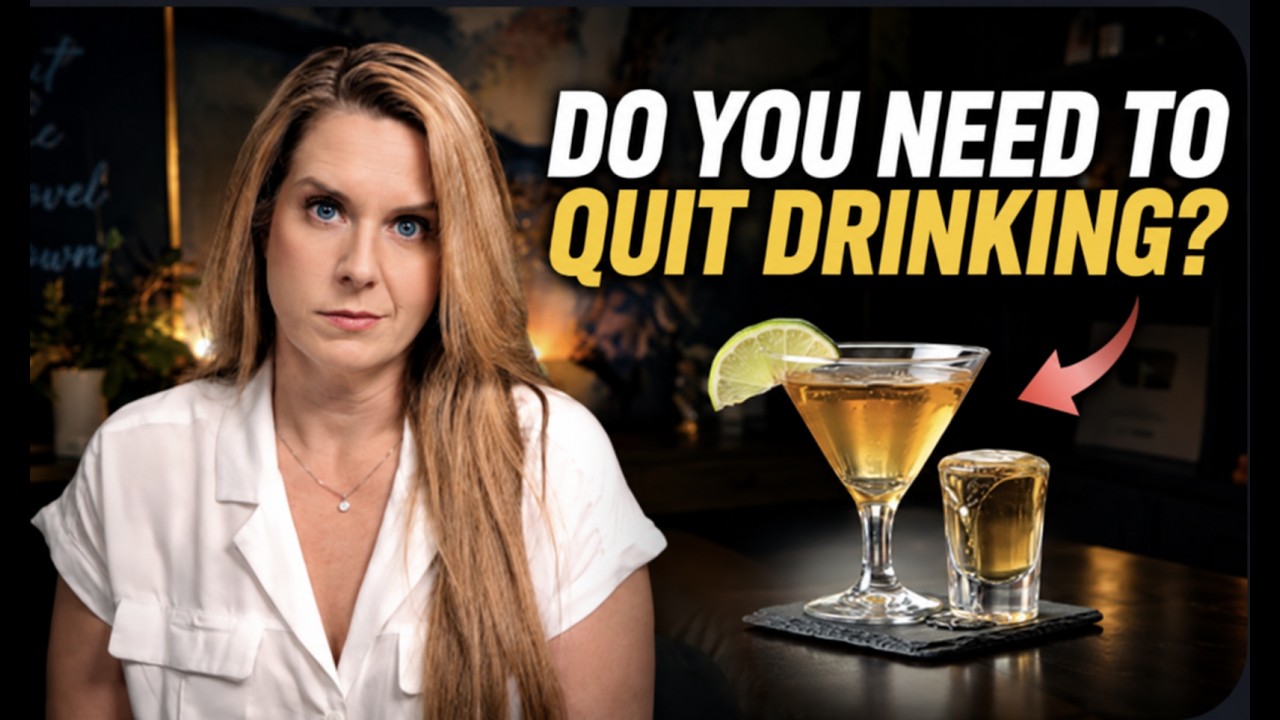
Amber Hollingsworth offers a five-question self-assessment to evaluate your drinking without shame or labels. Instead of asking if you're an alcoholic, ask what's actually happening: Are you minimizing? Have trust or mood shifted? How much mental energy does drinking take? Does it fit who you want to be? Can you keep your own limits?
Chapters
When most people are trying to figure out whether or not they need to quit drinking, they go down this long path of trying to figure out whether or not they're an alcoholic. Like there's some sort of invisible courtroom somewhere that you can just gather enough evidence and eventually somebody bangs the gavel and says, guilty, you're an alcoholic. Hand over that wine glass and you're sentenced to a lifetime of AA meetings. I actually think that whole way of trying to figure it out is backward. If you're already asking yourself, do I need to quit drinking? The better question isn't necessarily, am I an alcoholic? The better question is what's actually happening here? You can waste years trying to figure out whether or not you're technically bad enough to deserve a particular label. Meanwhile, your relationship with alcohol is sitting over there getting weirder and weirder. Oh, and by the way, everything I'm talking about here applies to all the other substances as well. I'm just going to say the word alcohol because it's easier than saying alcohol and other substances like every 14 seconds. And take some pressure off. You don't have to decide today that you're never going to drink again. You don't have to call yourself an alcoholic. You don't have to make any kind of big announcement. For the next few minutes, I just want you to take alcohol off trial and let's look at the evidence a little differently because most people do it like this. They say, I drank too much. I said I wasn't drinking during the week and then I did. My spouse is irritated. And immediately when they think those thoughts, this defense attorney in their mind jumps up and says, objection. But I went to work on Monday. But I don't drink every day. Everybody drinks on Saturday. I never had a DUI. I stopped for 30 days in October. And now you got a whole episode of Law and Order happening inside your head. And somehow alcohol keeps getting acquitted. So instead of trying to prove beyond a reasonable doubt whether you're an alcoholic, I want you to ask yourself these 5 questions. Now, I actually have a whole video that gives you the official criteria of alcohol use disorder. I'll link it up here at the end. You can totally look at it. Those are like the official diagnostic ones. But these 5 questions, they're not whether or not you're an alcoholic. These 5 questions are designed to help you sort through what's going on with your drinking. All right. So question number 1 is, am I minimizing my drinking? One of the ways that we minimize is we do this whole comparison game. We say things like, well, I've never gotten a DUI, or I don't drink in the morning. Or I never miss work, or my marriage isn't falling apart, or I went to a meeting once and I'm nothing like those people. Okay. Every single one of these things may be true, but notice what you're actually doing here. You're asking yourself, how's alcohol affecting my life? But notice what you're actually doing here. You're not asking, how's alcohol affecting my life? You're asking, can I find somebody whose drinking is worse than mine? You can do this with anything. My finances aren't that bad. Some people go bankrupt. My marriage isn't that bad. Some people throw plates. My health isn't that bad. Some people are in the ICU. It's a really low bar. And this gets especially tricky if you're a high-functioning, successful type person because you've got a lot of evidence for the defense. You have a career, you pay the bills, people respect you, you're taking care of your family. That's great. All those things are real, but none of them actually answers the question, how is alcohol affecting me? Which brings me to question Number 2. That question is, what has actually changed? And don't set the bar so low that it's like, has alcohol completely made my life fall apart? That's ridiculous. Let's raise the bar a little bit here. Like, do you trust yourself around alcohol as much as you used to? Do other people trust you as much? Are you making promises to yourself that you don't keep? Has your tolerance gone up? Are you losing mornings? Are weekends disappearing? Are you showing up tired and foggy and irritable? Do you feel embarrassed or regretful about the things that happen when you drink? Do you ever wake up and have to piece together what you did or said yesterday? Are you becoming less relatable? Are you skipping things because staying home and drinking sounds better? None of these things have to be catastrophic to matter. A lot of times people are waiting for one giant flashing red sign when they've already driven past 47 little yellow ones. And you don't have to wait until the engine falls out of the car to admit that noise probably deserves some attention. Moving on to question number 3, how much work is drinking taking? And I don't mean how many hours you're actually drinking. I'm talking about mental real estate here. Are you constantly making rules like only on weekends, never 2 nights in a row, no liquor, only 2, nothing in the house? I'm taking off in January. And then you got the rules. Are you constantly renegotiating the rules? How much time do you spend thinking about when you can drink, whether you should drink, how much you're going to drink, recovering from drinking, or explaining something that happened while you were drinking? Do you plan social events around alcohol, vacations, restaurants, your route home from work? And here's an even bigger one. Are you spending time hiding it? Maybe you're hiding the fact That you're drinking at all, right? Or, but maybe you're just hiding how much you're drinking. The reason this one's really tricky is because it's easy to explain it away. You say to yourself, well, I'm only hiding it because she's judgmental or he's uptight or they always overreact, or I just don't want to upset anybody. Maybe that's the truth, but if something's supposedly not a problem and it requires its own set of rules and policies and a scheduling department, secrecy protocol, and a whole entire legal defense team, You should probably pay attention. At some point in there, you're not casually having a drink anymore. You're managing a whole operation and pay attention to how much energy you're spending defending it. If every concern immediately jumps to an explanation, if every incident has a reason why it doesn't count, if you're constantly gathering evidence that everything is fine, that's an important piece of information. That by itself doesn't prove that you're an alcoholic, but maybe something that's supposedly a problem shouldn't require this much legal representation. All right, question number 4. This one's really important. I want you to be honest with yourself here. Does your drinking fit with the person and the life that you actually want? I think this one gets overlooked all the time because everybody wants to measure alcohol problems by the amount of destruction. Did I lose a job? Did my spouse leave? Did I get arrested? Did my life implode? But what if alcohol's not destroying your life? What if it's just making your life Smaller? What if you're 15% less present, a little less ambitious, a little less patient with your kids, a little less connected to your spouse, a little more likely to blow off a workout, a little more likely to spend Saturday recovering instead of doing the thing that you said you were going to do? Maybe alcohol isn't taking everything. Maybe it's just quietly taking pieces. So ask yourself, do I like who I am when I'm drinking? Do I like who I am the next day? Am I showing up in my relationships? The way I want to show up? Am I taking care of my body the way I want to? Am I building the life that I say I really want? And probably the biggest question, can I keep drinking the way I'm drinking and still become the person I want to become? Because maybe the question isn't only, is my drinking bad enough that I need to quit? Maybe another question is, is my drinking good enough that I actually want to keep it? That's a totally different question. All right. And here's the last question. And I intentionally saved this one for last. Okay. What happens when I try to limit my drinking? Now notice that I didn't say, can you stop for a while? Because lots of people can stop for a week, a month, Dry January, Lent, a fitness competition. And then they'll say, see, obviously I don't have a problem. I stopped for 30 days. Okay, maybe, but I'm more interested in something else. Can you consistently drink the way you keep telling yourself you're going to drink? When you say you're having 2, do you usually have 2? When you say weekends only, does that hold? When you decide no drinking alone, does that rule last? Do you set a limit and then once you get close to the limit, suddenly your brain develops 6 extremely compelling reasons why tonight should be an exception? Breaking your rule once doesn't really mean anything, right? I'm talking about the pattern here. If you keep having to move the fence because alcohol keeps ending up on the wrong side of it, pay attention to that. Are your limits actually holding? Consistently, or are they mostly like suggestions that keep getting renegotiated once you want to drink? Because being able to stop for 30 days and being able to consistently control your drinking are not necessarily the same thing. Now I know what some of you are thinking. Okay, Amber, but you still haven't told me whether I need to quit. Yes, that's right. That's correct. Because I can't make that decision for you from a YouTube video. What I want is for you to make a clean decision, not a shame decision, not a panic decision after a bad night, not a decision because somebody's mad at you, and definitely not a decision written entirely by your internal defense attorney. Ask yourself, am I minimizing this? What has actually changed? How much work does drinking take? Does this fit with the person and the life I want? And can I consistently drink within the limits I keep setting for myself? Maybe you decide to stop. Maybe you decide to experiment with sobriety and see what happens. Maybe you're not ready to stop at all, but hopefully you're at least ready to stop bullshitting yourself about what's happening. That's a big one because change doesn't always start to some dramatic rock bottom moment. It usually starts much quieter. It's like, okay, I think I've been minimizing this. And if that's where you are, that's exactly what this video series is for. In the next video, We're going to go deeper into one of the sneakiest ways we minimize our drinking, the comparison trap. Because as long as your definition of a real drinking problem is somebody whose life is much worse than yours, you'll stay in the not that bad category for a very, very long time. And not that bad is not the same thing as good. And if you already know the answer to all those questions, you know you're ready to make a change. I've got a lot of resources for you listed in the description of this video.
More from Amber








Addiction Turns “Me vs. Drinking” Into “Me vs. You” #addictionrecovery #addictionawareness

They Admit Everything Except the Addiction #addictionrecovery #addictionawareness

Stop Trying to Make Them Admit the Truth #addictionrecovery #addictionawareness