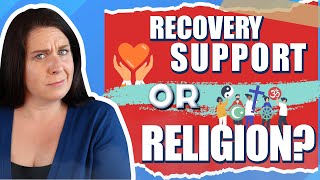
YouTube video by Amber Hollingsworth that asks whether Alcoholics Anonymous (and related 12‑step ‘Anonymous’ groups) qualify as a religion. The host walks through six common criteria of religion—authority, ritual, explanations, tradition, grace, and mystery—and argues AA meets each one (noting sponsors/boards for authority; ritualized meetings; explanatory language like the ‘allergy to alcohol’ and the 12 steps; explicit traditions; the Higher Power concept; and the element of mystery). She concludes AA functions as a religious group but says individuals can still work the 12 steps while rejecting or reinterpreting religious elements.
Questions this video answers
Amber Hollingsworth
December 4, 2021
12
12
Chapters
Is Alcoholics Anonymous really just a religion? Can you work the steps without the religious part? Well, in this video we're going to explore those exact questions. For those of you who are new here, welcome to Put the shovel down. This YouTube channel is all about helping you understand the science and psychology of addiction so you can get your life and your family back on track. And this is the only channel that explains addiction from every single angle. And today we're going to be looking at the Alcoholics Anonymous angle. And when I say Alcoholics Anonymous, I really mean like all the anonymouses, like Cocaine Anonymous and Narcotics Anonymous, you know, all the Anonymouses, because they pretty much work the same way. Alcoholics Anonymous was just the original one. So the program of AA claims to not really be religious, but spiritual in nature. I thought we'd take a closer look at that to figure out the does it really meet the criteria of a religion and where does that come into play in the recovery process? Now, there are six primary characteristics of a religion that basically make a religion a religion. So let's go through each one of those and decide whether or not AA meets those criteria or not. And as we do this, if you have experience with any of the Anonymouses, I definitely want you to weigh in about this in the comments. So in any religion there is an aspect of authority. And what that means is there are persons within the religious community that are kind of like in a leadership position. They're in some kind of ranking above others. Like in a regular church you have a priest and you have deacons, or you might have nuns. You have some kind of ranking or authority system. Now AA is ran by volunteers, strictly ran by volunteers. And so you don't really have like a head guy in charge sort of thing, although the organization does have boards and committees and other types of people that make decisions. But you definitely have the idea of a sponsor and a sponsee, which I do think delineates a little bit of authority within the ranking system. Secondly, a religion has to have ritual things you do a certain way every time. I don't really think there's any question at all about whether or not AA has ritual. If you've ever been to an AA meeting or NA or any of those other Anonymouses, you know, there's a lot of ritual. And the funny thing about it is when people first start going to any kind of 12 step group, they usually are kind of put off by these rituals, like the readings and the way people say things a certain way. But eventually it's almost like you Become so used to it, the tradition of it, you really begin to sort of love and like, and look forward to kind of annoying at first, but then you kind of adopt it, but then most people kind of grow a little bit fond of it. Examples of ritual would be the readings or picking up a chip or calling your sponsor or the way you introduce yourself in a meeting. Like, for example, you usually would introduce yourself with your first name and say, I'm an alcoholic, or I'm an addict, or sometimes people will say, I'm a grateful recovering alcoholic. Things like that. But there's definitely tradition and ritual. Now, the third thing that every religion has is explanations, as in from whence we come and where we go kind of explanations. And I'm gonna say that I definitely think Alcoholics Anonymous and all the Anonymous have explanations. In the original big book text, they called alcoholism an allergy to alcohol. And actually, now that we have a lot more science, it's not that far off. It's actually pretty close to what's going on with the whole issue biologically. So they have sort of an explanation about why the problem happens, and they definitely have an explanation about how to get out of the problem. In fact, they have 12 very specific steps for how to find the solution to the problem. Now, the fourth thing that all religions have is tradition. And to me, this one ties closely in with rituals, like rituals and traditions. And there are definitely traditions. In fact, in the 12 step group, they have the 12 steps and they have the 12 traditions. They have them named out, 12 of them. So I don't think we can really deny that there are traditions. The fifth thing that all religions have is a concept of grace. And what I mean by that is that there's this idea or belief or assurance that there is something out there, some bigger force that can be relied upon that's on your side and that you can count on it. And I definitely think Alcoholics Anonymous has this. They have this with their higher power concept. Now, Alcoholics Anonymous can be pretty flexible about naming that higher power. At least they say so in some of the parts. But in other parts, parts, they call that higher power God. Either which way, it is definitely outlined in their steps that you must come to terms with the fact that there is a higher power and that the higher power can restore you to sanity. So I'm definitely going to say that Alcoholics Anonymous meets criteria number five. And then there's criteria number six, which is all religions have some amount of mystery. And by mystery, I mean some kind of concept of the infinite of a higher power, something bigger than yourself. And I think we can probably all agree that Alcoholics Anonymous definitely has this component. There's this idea that your higher power can take the urge away, that your higher power is the only thing that can help you fight this addiction because you are powerless over it otherwise. So when we look at all six of these criteria about what makes a religion, I'm going to say that Alcoholics Anonymous meets every single one of these criteria. So in my personal opinion, I do think that Alcoholics Anonymous is a religious group. Now, that being said, I realize that the whole concept of higher power and religion really turns some people off from the idea of working a 12 step program. So the next question is, can you work a 12 step program without buying into like the higher power part of the mystery part? And I'm gonna say yes. In fact, I made a whole video about how to look at a 12 step program through a non relig lens. Because some of you may feel like you're not religious, but you're interested in working the 12 step program or you feel like it could help you. In my personal opinion, it's just like most other things. There may be parts about it that you really like and you really feel like are helpful and you accept. And there are some parts maybe that aren't for you. And that's okay. It doesn't mean that the whole program isn't helpful. So check out this video next. If you're in that dilemma and you want to know, can you work a 12 step program without the religious part? And don't forget, as always, there is a link in the description to lots of other additional free recovery resources.