Small Boundary Violations That Lead to Big Relationship Problems
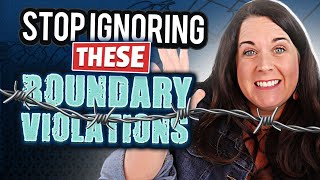
Amber Hollingsworth (YouTube, Sep 8, 2023) explains how small, often-hidden boundary violations — frequently committed by well-intentioned "nice guys" or family members — damage relationships. The video emphasizes self-awareness: many boundary problems come from our own tone, passive-aggressive behaviors, punitive actions disguised as "boundaries," unsolicited advice, and avoidance. Amber uses a personal email anecdote, gives examples (e.g., withholding sex as punishment, rude behavior toward service workers, withholding help), answers live questions about safety and intent (police, hiding keys, rides), and directs viewers to further resources.
Chapters
Today we're going to be talking about how to, like, spot and counteract those little hidden, tiny boundary crossings or boundary violations that actually they don't feel big when they happen, but they ruin relationships. And sometimes you don't even know that they're happening. Now, when you clicked on this video and you saw that, you saw the title, you saw the thumbnail, you probably are thinking, yeah, I gotta stop letting people run over me. I gotta stop letting people treat me bad. Well, guess what? That's not the way that it works. So it's a good thing you're watching this video. The boundary violations that I'm going to teach you to notice are your own boundary violations. And so a lot of what I'm going to talk about today might be a little hard to hear. And that's okay. You can argue with me if you want to, you can counter my points. But I want you to take a deep look. Let's get honest with ourselves and see where we actually cross other people's boundaries. And to make it fair, I'm going to start out with my own bad boundary story. But one of the things I want. This is probably going to get me in trouble, Bri. Probably going to lose all subscribers right now. Get ready. Who do you think crosses the most boundaries? The addicted person or the family member? The family member is the most likely to be the bigger boundary crosser because they get in a zone where they want to control, yell, remind, nag, lecture, all of those things we're going to be talking about today. And it's easy to get in our head when we feel like someone's done something wrong, made a mistake, or maybe even wronged us, what happens to us is we instinctually, we get upset or we want to fix it, or we get really scared. And when we do that, we actually begin to cross boundaries and we don't even realize it. And even when we do realize it, we excuse it away or say, well, they had it coming or something, or they made me mad or whatever. But if. If. If you're watching this and you're a family member and you're thinking to yourself, like, this person needs to get in control of themselves, it's got to start with you. If you're watching this and you're a person who struggle with addiction and you're. And you're worried because your family member can't get control of themselves because they're emotional and reactive and they always bring up your past and all that kind of stuff. You got to get control of you. So Today's boundary crossings and violations that we're going to begin to notice are about our own boundaries. It's when we do things that cross over other people's boundaries. So let's be honest, let's take a look at it. And what I want you to start to notice is when you're doing this, you're going to. After we get this list, you're going to notice you're doing it, but I want you to stop justifying it and try to do better. Let me start with my own bad boundary example. Earlier this, earlier this week, I got an email from someone. And before I tell you about this email, I'll tell you, like, this probably happens 10 times a week, like all the time. So it's really not about this specific incident, but this specific incident was just an example of a larger thing. So I got this email earlier this week where this person, they. They sent me an email. They said, hey, I've been watching your videos. They're super helpful. I really appreciate all your advice and help and a lot of nice things. And then they said, but I'm in this situation with my loved one. And they kind of went on to explain all the details of that situation. There was, you know, there was a lot of complicating factors and a long history there. And then they were like, what do I do? And I get this kind of email all the time and I get in this, like, dilemma and this uncomfortableness and I don't always handle it correctly. So I'm going to tell you what I did and how I didn't handle it correctly. So I got this email earlier this week and on the. The time when I saw it, I think that's important too, because the time when I saw it was like, on one of my days that I see clients all day. On Tuesdays and Wednesdays, I see clients all day. Like, like, I don't even get breaks. I get lunch and that's it. No breaks, no nothing. So that I can have the other days off to make content for you guys. So I really cram a lot in on those days. So it's like super busy. And I also had to make my video to release to my. To the people in our membership program that morning. So I was like, really busy. So I got this person's email and I read it and honestly, the situation they were telling me about, I really did have empathy for them. I've been in a similar situation myself. So I really did get it. And I responded back to them. I said, hey, I'M really, I'm really sorry you're in this situation. I can tell you really love this person a lot. And that's all I said. And then I just sent the email. And in my mind I was doing the right thing because I responded to the email, I expressed empathy, which was genuine, but I didn't answer their question. And I did see the question. Well, pretty quickly I got an email back and it said, it said something about I'm not sure if you got the context or you read all that because your answer, your response didn't answer my question. So basically they called me out and they're like, I told you all this stuff and you just said, hey, I'm sorry you're in that situation. Which was true. And in my mind I was doing the right thing because I was answering back. And it's kind of, it's way more than I could possibly answer in an email. And it wasn't like an email consultation someone filled out or anything. It was just a random email that someone sent me. And I get this even in like comments and stuff on videos a lot too. And, and so I didn't respond back. I just said, hey, I got your email, sorry about it. But I didn't answer the question because it was way more than anyone could possibly answer in an email. It was literally probably like 10 therapy sessions worth, honestly, like, for real. But I also didn't want to say, like, well, you're gonna have to pay to book a session for me to answer that, because that doesn't feel right. And it's honestly not how I felt. But also in my mind, I was keeping my own boundaries. Look, I'm not gonna get into like, doing all this, like, back and forth counseling. It' than I can handle. Plus, it's not really fair. And I knew if I did that I'd be mad at myself. But I got called out on the not answering the question. So it may look like a good boundary on the surface, but it's really not because what I really did was just avoid the issue. I tried to get out of an uncomfortable conversation by just bypassing it. And that's actually a boundary infringement. It's not a healthy boundary. Right. I probably didn't cross the other person's boundaries, but. But ignoring someone's question is not very polite. Right? And so I had to sit with it for a minute. You know, when you get called out on something, it takes you a minute to like, digest that. I was like, you know what? They're right. I didn't And I saw the question, I purposely ignored the question, I didn't address it, I didn't mention it or anything. And so I calmed myself down, give myself a little therapy talk. And I finally responded back and I said, hey, I'm glad you called me on that. I did see your question. I didn't answer your question. And it's. And I run into this kind of situation all the time. And honestly when I'm in this situation, here's what happens. And I explained it. I said, you know, it's way more than I can answer on the email. But I don't want to say like you're going to have to pay for therapy for that or something like that because that feels rude. And I don't want to not answer the email. So I just, so I just wanted, so I just said what I said and that probably wasn't the best thing to do and I'm open to feedback. So that was the whole thing. The point of this story is sometimes even when you feel like you're being the nice guy, you're not being the nice guy. And we gotta be willing to look at our own behavior to analyze. You know, we're always upset, we immediately realize when someone's putting us in a bad position, but we don't always realize when we put other people in bad position. And I want us to start doing a better job of that nice guy. Trying to play nice guy will actually set you up to be a major boundary crosser. Because when you play nice guy, usually what that means is you're not doing a good job of getting your own needs met. And then you build up resentments and you build up attitude and that negative energy is going to go somewhere. And when that negative energy goes out, however it goes out, whether it's in little tiny passive aggressive statements or big explosions of anger, when that happens, you're going to be the boundary crosser and at the time you're going to feel justified in it. But two wrongs don't make a right and it's not productive. You're no more closer to getting your need met when you do it that way. So let's take a look at the most common boundary crossing things that nice guys do. Right tone and yelling. It's easy when you're married and you're the wife, maybe for the husband too, but I think us wives are probably more guilty about. This is to be short tempered, irritable. You know, our husbands, maybe they try to be playful or they try to interact with us and we're tired and we're exhausted and we've already overdone things and so we're just short and we're just kind of rude to them, Right? And we're definitely not overly empathetic or kind or caring. If we don't watch our tone. And you may think, well, that's really no big deal, like, I've had a hard day, I didn't do anything mean. But that tone, it's kind of rude, right? And you got to be honest with yourself about what kind of tone you're talking to people in. And that tone usually will happen when you built up a lot of resentment or when you've let yourself get to a point where you're overworked, maybe you're not even resentful to that person. But you've taken on and taken on and taken on till you're exhausted and then you're grumpy and they're just trying to interact with you. And then you're just being all attitude, like, and sassy. And not in a fun. I like sassy, but not in a fun, sassy way. In a bad, sassy way. Or when you feel like someone has wronged you in some way and then you want them to be punished. Now, a lot of times we do this and we call it consequences because it makes us feel self righteous and it makes us feel like we're doing the right thing. But a lot of what I've seen lately when I've worked with people who have addictions is they're getting a lot of punishments. And those punishments are usually disguised as healthy boundaries, but they're really punishments. Let's be for real, you know, if it's like, I don't know what it is. If it's like, I'm not going, you can't come back home until X, Y or Z. You got to ask yourself, is that really a healthy boundary? It could be. Or are you doing that as a punishment? When you're doling out something and you're telling somebody else what they can and can't do, it's more likely to be a punishment. And sometimes even worse, it can get to the point of revenge. Now, sometimes that revenge is like big revenge, like, like you would see like on a Netflix show or something. And sometimes that revenge is little revenge and it comes in the form of passive aggressive. So, for example, let's say, I don't know, you're mad at your spouse because they leave the toothpaste all over the sink or something like that, right? And you're just frustrated and they're just not, you know, you've asked them to not do that and they just keep doing it. And so you decide that you're just going to leave your smelly socks all over their side of the bed. That's passive aggressiveness. That's punishment. It's a little form of revenge. And it never get you what you want to get. You think, well, I'm just going to give them a taste of their medicine. Like, dude, that never works. All that happens then is they're going to then behave more passive aggressively or aggressively with you. And now we get into this power struggle of punishing each other. It's easy to find yourself in situations like this. It's not because you're a bad person usually it's because you're trying too hard to be nice and you're not being assertive enough. You're not managing your own self well. And when we do that, we end up crossing other people's boundaries. What are some passive aggressive things that you find yourself doing? What are some ways that you excuse when you cross other people's boundaries or when you at least are not the nicest or most pleasant? You don't realize that that can be a boundary crossing. You know, if we're, if we're at the checkout line and the cashier rings our price up wrong or something, and then we throw a fit and we say the sign says, and then we're just yelling, we're so mad because it happens every time we go into the store or something like that. Guess what? That's a boundary crossing. Yes, it is. I see one up here. Bri hadn't even put it up here yet, but I saw it just caught my eye. Somebody put no sex. Yes, that's a punishment. Now that's probably gonna get me in trouble. And people are not gonna like to hear that I'm saying no. Like, if you're married, okay? That's what we're talking about, if you're married. So if you're upset with your spouse and you're like, no sex until you know you're sober 90 days or something like that, you're gonna try to convince yourself that that's some kind of healthy boundary you're setting for yourself. But probably that's a punishment. Now if you're saying, like, I need to feel more connected to you, I need for us to repair our relationship for those kind of fun things to happen, then that can be a healthy boundary. But you gotta be real. Are you really setting that and you mean it, and you're open to fixing things and you're open to make letting that happen? Or are you really just saying that so that you're following the Amber rules, but you really just holding out because it's a punishment? These are. These are. This is where it gets hard and it gets complicated. And it's difficult sometimes to see that we can be boundary crossers, too. Every time I do a video about boundaries, it's all about, like, deciding what you'll put up with and what you won't put up with. But we miss this part. We miss the part that we can be nasty too. It just looks a little different, and we're less likely to get called out on it. And so it goes on longer and longer. And when that happens, you do damage to your relationships. These little attitudes, these little tone, this little passive aggressiveness, lecturing, reminding, giving people unsolicited advice. That's boundary crossing. No matter where your heart is, no matter if you meant to be nice or just meant to be helpful, you can't hide boundary crossing under, though. Well, I meant to be helpful. If what you're saying is hurtful and difficult, it was probably a boundary crossing. Now sometimes we have to tell people something that's difficult for them to hear, but you know when you're crossing that line. And this is just about being honest with ourselves. Bre. Let's see if we have any good comments or questions here. This is a hard topic, so I'd like to hear what you guys have to say on it. Do you have any examples of it? Are you like me? Are you guilty of it? Everything I said on this list, I'm guilty of. So there's no judgment here. I've done all these things. That's why I could talk about them. If addiction is a disease, is having no boundaries also a disease? It feels like it. No, having no boundaries is not a disease. And in fact, I don't feel like addiction is a disease either. I got other videos on that, and you can watch that too. But I don't think either one of them are really a disease. Marie says it's so hard to be consistent with healthy boundaries. I relapse when I get frustrated. I get confused at times with punishment or boundaries. I appreciate you being honest with that, Mary. If my. I think it's like, addicted husband or alcoholic or it must be alcoholic husband is drunk driving and was arrested with three DUIs. Can I call the police again? Or hide his keys? Ooh, this is a hard one. We get this all the time. This is tough. If you are concerned about safety and you're, you're really concerned, you can call the police. But it could also be a punishment. You gotta, this is about. Some of it's about intention. It just requires a lot of self honesty to figure this out. I can tell you what would definitely be boundary crossing in a situation like this. Trying to wrestle the keys out of someone's hand, trying to gaslight someone about it. All of those things, even though maybe intentions were good, are probably boundary crossing. So good question. And that's one of those dilemmas that we run into all the time. Steph says. So boundaries can be something that is just common human courtesy. Yeah, Bingo. I like it. You're getting a, like being rude to the cashier is crossing a boundary. Cuz in general it's not good to be rude, right? You're, you're taking your hostility and aggression because of something you're going through and you're crossing it over into someone's lane. And so yeah, that is a boundary issue. And people don't recognize those small little boundaries like that. They don't realize that that's a boundary issue. We only kind of recognize like boundaries as like I will watch your kids or I won't watch your kids or I'll give you money or won't give you money. But these tiny little attitudes and way we interact with people, those are boundary issues too. Debbie says, do you have to announce to someone when you have decided to implement a new boundary with them? If not, won't it hurt their feelings when you suddenly act differently? This is another really good question. No, I don't recommend that you announce it because when you announce it, you're really just going to start an argument. And probably if you think about it hard enough when you announce it. Let's be real. You're really not trying to be healthy with your boundaries. You're really using that as a way to tell them that they're doing something wrong, that they're crossing a boundary. But you are right, Debbie, when you say if you start behaving differently, like if they're like really intoxicated and they come home and then you always like go in your room and read a book, they may call you out on that. They may say like, why are you doing that? Or something like that. And you, you can answer though, you can say, you know what? Because sometimes I find myself grumpy or irritable or thinking negative thoughts and I just don't think it's fair to Take it out on you. So I'm not gonna do that. So if they ask you about it, you can answer it, but answer it in a kind but truthful way. Sometimes that boundary announcement is really like a criticism, and it. It's not helpful to announce it anyways. Any tips for not being passive aggressive with the addicted person? Disappears for a day? I think. I think it's. It's tough because you gotta decide, like, do you want to stay in a relationship with someone? And I don't. I guess I don't know what the context is because that's why it's hard to answer. Is this like a spouse, a boyfriend or girlfriend? Is this like a kid? Is this like your parent or something like that? You can say to the person, hey, you know, it. It really causes a lot of distress when you just go, MIA and you don't answer my calls. You can. You can express yourself, but don't express yourself in a crazy, screaming way. The thing of it is, is if it just keeps happening, keeps happening, you scream about it all day long. Everybody knows that going MIA from people you talk to, every. Not communicating, everybody knows that's messed up. You don't have to tell, but you can decide, hey, I'm done. If this is your boyfriend or girlfriend, spouse, you can say, you know what? This is messing with my head. It's turning me into, like a not nice person. I don't like it, so I'm going to take a break. But you got to be meaning that and saying that from a real truth or place. Not if you don't stop. I'm going to do this or that or the other, because then we're in a punishment situation. Steph says, I have really been working on this. For me, it's tone and facial expressions. When I know I've crossed a boundary, I apologize. Here's the weird part. My husband tells me not to apologize. He scolds me, oh, when I first read that stuff, I thought you were saying, like. He was like, don't apologize. It's okay. But he's saying, like, don't apologize. Don't apologize for you. He's scolding you. Okay. He says he wants me to just let it all out. Just express my emotions without thinking. I don't really get it. I'm not sure why he does that stuff. I could think of a few reasons why he might be saying that to you. I mean, might be saying that to you. Because in his mind, it's unhealthy to keep negative emotions in and that you have to get them out, otherwise they turn into bad things. But I disagree. I do think you need to pay attention to your emotions. I don't think you should ignore your emotions, but I definitely don't think you need to express every emotion you had. So it could just be a flawed thinking that he has or there could be other ulterior motives, like he likes it when you act crazy because then he can act crazy back. Or then he, then he has an excuse to go do what he's going to do and be bad. So he could be letting you do bad things because that he makes him feel like he do bad things. I don't know why he does that. You have to sort of think that through. But regardless, expressing all your emotions without thinking is a bad plan. And I don't think you should do. Doesn't make you feel better, but it will probably start an argument, it will make someone else feel worse. And actually what happens is you feel worse after because you really regret it. So if he, if you do that and you say, hey, I'm sorry for that, maybe if that word sorry upsets him, you can say, you know what? Now that I've thought about it, what I was really trying to say is this. And I said it all wrong. So maybe just leave the word sorry out, but just go back and retract and say, can I do a word on that? I didn't say that. Just right. And do it again. Nancy, how to set a boundary when an alcoholic harasses and insults me, particularly in the car when I give her a ride to work and she needs a job. Stop giving her a ride to work. And I know what you might. Well, I shouldn't say, I know what you're thinking, Nancy, because that's the boundary crossing to say, I know what you're thinking. I'm gonna guess what you're thinking, Nancy. And you might be thinking, but she needs a job. How else is she gonna get there? That's you crossing into her lane, that if this is a grown up person, then it is her job to figure that out. And if she can't figure out how to get a ride, then maybe she should figure out how to be nice to the person that's giving her a ride. If you continue to do that, give someone a ride, go out of to make their life work and you get yelled at, guess what? You're gonna end up doing something really nasty with that. Because who wouldn't? Yeah, No more right now. Is that the last question? Dang. Thank. All right, well we're gonna wind it up then. And as always, I've put resources for you in the descriptions. In fact, I have a whole list on boundaries, and there's actually a video called Consequences versus Punishment, Boundaries versus Enabling. So if this is a topic you struggle with, because we all kind of struggle with it, then definitely check those videos out. I will put them. I'll put the link in the comments to that playlist, and I'll put it up here at the end. One more. Bess says it's my responsibility, ability to bring up alternate living arrangements to my husband living with friends and family versus his own apartment. Would that affect. That would affect our finances together. Is it my what you're saying? I think what you're saying, Beth, is like, should you be coming up with options about where he should stay when he's not going to stay in Yalls house because it's going to affect finances? No, not unless he asked you. That's sort of that unsolicited advice thing. It kind of goes back to his territory or your territory. If you're saying, I need you to be out of the house because I can't live with you, but then you're saying, and you can't go here and there and there, and you got to stay there, you might be crossing out into the other person's lane a little bit. You can say, hey, I need this much in the joint checking account to pay the bills. But you can't say you have to live here, there, or wherever. Is that the last one, Bri? Oh, one more. My husband's in denial and he's abusive during a blackout. The next day he is happy. And I am mean. If I try to hold him accountable, I try to hold him accountable. And I mean, it's just called the anger train. I don't know what you do. When you say, I try to hold him accountable, what do you. What do you. When you're saying, I try to hold him accountable, what do you do? What does that mean? I'm gonna give you a second put up there because I'm interested. I want to know. I see a couple other comments up here. Irma says, which is your. Which is your live videos? We go live every Thursday at 1 Eastern. And if you go to the channel page, it actually has tabs at the top. You can see videos. Those are the videos. Usually they come out on Tuesdays. They're the regular videos. And then lives are on Thursdays. But it'll say a tab that says live and you can see all the live videos. If you're asking if the boundary videos are live videos, some of them are and some of them aren't. But I have playlists, so you can just click the playlist for boundary and you'll get all the ones in that. In that list. Okay. Would it be possible to do more shorts on YouTube about boundaries and figuring out what our side of the street is as the significant other? Sure. Yeah. I will put that on my list. More boundaries shorts. As you can tell, I'm kind of long winded. I have a hard time saying something in less than 60 seconds. It's probably a boundary issue. Okay. All right. We're going to end it up now. I will see you guys next week. Thanks for hanging out. It's been fun. Bye, everybody.
More from Amber








Addiction Turns “Me vs. Drinking” Into “Me vs. You” #addictionrecovery #addictionawareness

They Admit Everything Except the Addiction #addictionrecovery #addictionawareness

Stop Trying to Make Them Admit the Truth #addictionrecovery #addictionawareness