Climate Hot Topic Episode 4: What Happens if Greenland Melts? Even if just some of it melts?
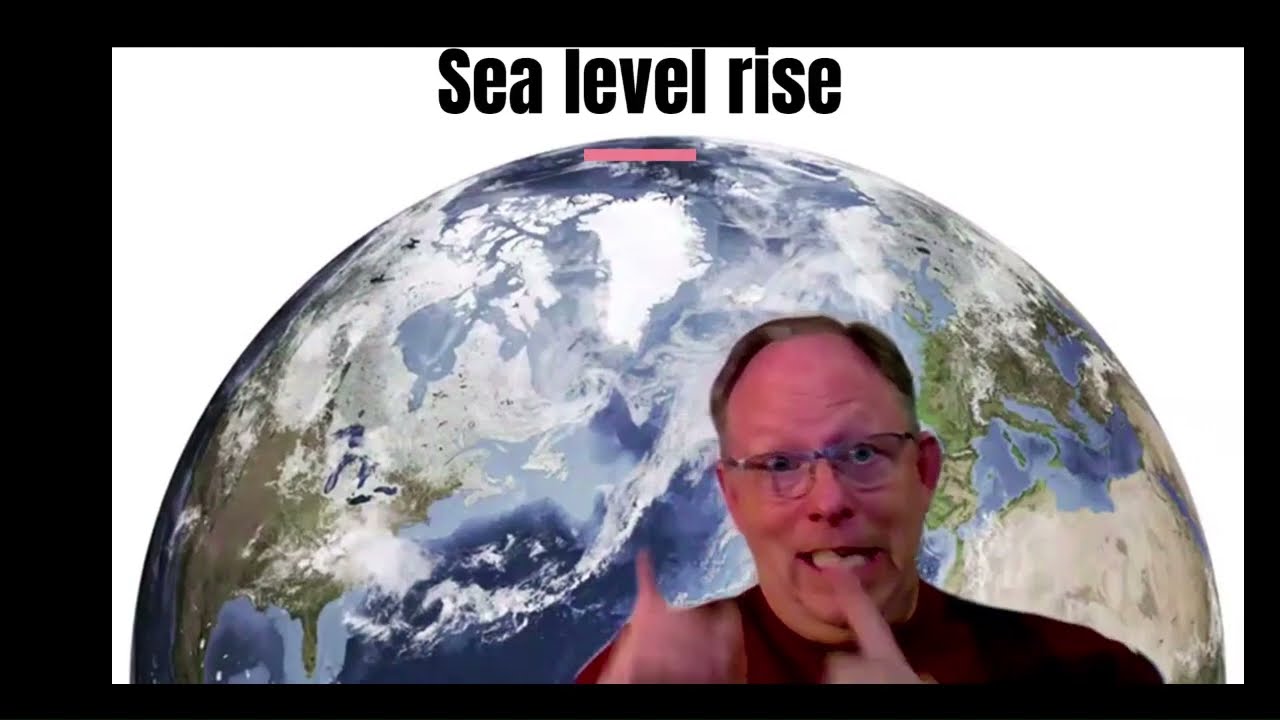
This content was created by Randall F. Dean. This content was uploaded by Randall F. Dean. This is a YouTube presentation titled "Climate Hot Topic Episode 4: What Happens if Greenland Melts? Even if just some of it melts?" (published 2022-12-25). A single presenter (monologue) explains the science and risks of rapid Greenland ice melt — sea level rise and coastal flooding, effects on storms and the U.S. East Coast, potential slowdown or collapse of the Gulf Stream and its global climate impacts, NASA/GRACE melt statistics, post‑glacial rebound and earthquake/tsunami research, and speculative mega‑engineering responses (ice capture/towing, covering ice, redistributing meltwater). The speaker frames these as urgent, partly uncertain outcomes and closes with a call to educate, advocate, and push for mitigation.
Chapters
Hi everybody. Today we're going to talk about this right here, Greenland, world's largest island. It's actually about one quarter the size of the Australian continent, so it is huge, and it is nearly completely covered in ice, in some places more than a mile thick. I created a teaser a couple weeks ago about all of that melting ice in Greenland, and a couple of the somewhat crazy outcomes that might occur if a huge amount of that ice melts. A couple of these crazy outcomes you have likely already heard of. The first is sea level rise. Because all of that ice is actually on the land mass, uh, pretty much every bit of it that melts and flows into the ocean raises sea levels. A recent report, linked in the comments below, found that even if we made drastic reductions In our emissions, we are pretty much locked into at least 10 inches of additional sea level rise by the turn of the next century, if not much sooner. NOAA released a study showing that we can expect 10 to 12 inches of additional sea level rise on the U.S. coasts within the next 30 years, and that's on top of the 8 to 9 inches of sea level rise measured since 1880, with the rate of increase going up dramatically in the last 2 to 3 decades. Now, of course, Greenland isn't the only place that's responsible for all the sea level rise. Antarctica also contributes, as do the melting mountain glaciers around the world, and the vast majority of the world's glaciers have been in decline for at least the last 3 decades also. But Greenland is estimated to be the largest contributor simply due to how fast it is melting, and the impacts are already obvious. High tide flooding in many major coastal cities, the increasing effects of ocean storms causing storm surge flooding, not just from tropical cyclones and hurricanes, but also high latitude storms, like the massive windstorm that hit the Bering Sea this summer, as well as the so-called hybrid storms, like Superstorm Sandy, as well as the massive extratropical cyclones that have been hitting coastal Europe in recent years. If this ice keeps melting at an increasing rate, these flooding and storm surge problems will only amplify, as will just natural flooding due to the higher global sea level. And nearly 3/4 of a billion humans live at or below 30 feet above sea level. Think about pretty much every coastal town or city on the planet. Millions of people will be displaced if seas rise a foot or more in coming decades, and millions more will be increasingly likely to sustain damage or injury from tidal and storm storm flooding. It's already happening, and that sea level rise is happening at an increasing rate. It may end up causing the governments around the world to have to spend trillions of dollars to construct sea and storm barriers to help protect those major cities, while poorer areas will likely have a sea level induced refugee crisis. Millions of people will lose their homes if seas rise a foot or more within the coming decades. What's bitterly ironic is that one of the worst-hit locations might be the eastern seaboard of the United States of America. Why? Well, all of that cold water from the melting ice in Greenland is going to have a face-off with the warm salty water from the Gulf Stream current, and it will likely effectively block a large pool of very warm water off the east coast of the United States. And through simple physics, warm water expands and takes up more space than colder water, so sea levels and tides can be expected to be even higher here than in other parts of the globe. That warm ocean water might also make tropical and subtropical storms, as well as nor'easters, both stronger and more frequent. Superstorm Sandy might just be a harbinger of even worse things to come. Why did I say this is ironic? Well, on a per-person basis, the United States is by far the largest emitter of greenhouse gases. Our payment for our fossil fuel consumption might be regularly flooded major cities on the East Coast of the United United States. A third and somewhat crazy possibility is the slowdown or even collapse of the same Gulf Stream current. Here's how that scenario works. The ice melts in Greenland, releasing massive amounts of cold freshwater into the North Atlantic and crossing the traditional northeasterly flow of the warm salty Gulf Stream up the Atlantic coast of North America past Greenland toward Europe. This Gulf Stream is critically important for the livability for many in northern Europe. It keeps places that are pretty high latitudes, like Iceland, the British Isles, and the Nordic countries, quite a bit warmer than they otherwise might be. If the Gulf Stream slows or even cuts off completely, northern Europe could become quite a bit colder, but the effects won't only be felt there. A massive change to a major global ocean current system will affect weather patterns worldwide, possibly causing massive droughts in some areas while causing massive flooding in others.. It could throw off many of our traditional weather patterns, leading to misplaced droughts, floods, and storms, and possibly contribute to even more food insecurity, a big topic I covered in my last video. And a recent study by Niklas Bohrs of the Potsdam Institute in Germany found that the flow rate of the Gulf Stream right now is at the lowest it has been in 1,600 years. If you'd like to learn even more about the possibility of a Gulf Stream collapse, I found an excellent video on this topic on the outstanding Just Have a Think YouTube channel. I've linked to that video above and in the comments below. It will help you understand both how massive these systems are and also how interconnected they are globally. The ice melt in Greenland can absolutely affect the climate on the other side of the planet in very unexpected ways. Now, you might be rightly asking, but hasn't Greenland been melting at least some since the last ice age? The answer is pretty much yes, but the rates were much slower before the Industrial Revolution, which led to the massive rise in the use of fossil fuels and related emissions of greenhouse gases. However, the ice melt has been rapidly increasing over the last few decades, and the numbers are staggering. NASA has been tracking the Greenland Ice Sheet with their GRACE satellites since 2002., and the number is almost unbelievable. The Greenland Ice Sheet has lost an average of 277 gigatons of ice, not in 20 years, that's each year for the last 20 years. That's 5,500 gigatons of ice that have melted in 20 years, and when you consider that a gigaton is a billion tons, that means then more than 5 trillion tons of ice has melted in the last 20 years. This roughly translates to 11 quadrillion pounds. That's how much fresh water has flowed into the North Atlantic from Greenland in just the last two decades, a mind-boggling number. It's actually a bit more fresh water than is contained in all of Lake Michigan. We're putting a Lake Michigan's amount of cold fresh water into the North Atlantic every two decades now, and the rate of that ice melt is accelerating as the Arctic it continues to warm far faster than the rest of the globe. I might argue that numbers that huge might have an impact on something like the Gulf Stream, which is also massive. It moves an estimated 5.2 billion gallons of water per second, or 100 times the flow of the Mississippi River. All of these are kind of numbers that most humans can't even grasp. If you've watched my previous videos, you know we are talking about crazy big numbers here. Crazy big amounts of CO2 and other greenhouse gas emissions by humans every year, leading to surprisingly fast temperature and climate changes on a global scale, with even bigger changes recorded in the Arctic regions. And this is leading directly to the massive melting not only of Greenland's ice, but also the vast majority of mountain glaciers around the planet. And that will likely directly lead to another foot or so of sea level rise in the next 30 years, but might also have a crazy impact on global weather patterns and climate by slowing or collapsing of the Gulf Stream. And now here's the fourth and even more crazy possible outcome of all of this fast melting of Greenland ice. I'd like to give you a bit of a visual here with this slightly underinflated basketball representing planet Earth and this ice pack representing the Greenland Ice Sheet. What happens if you take a big weight and suddenly remove it? Take a look. Did you see that? Did you see that? That's called post-glacial rebound. The surface of the Earth effectively rebounds, just like this basketball here, when that weight is removed quickly. And remember something interesting about Greenland: it's not that far away from the major plate boundary between the North American plate and the Eurasian plate. I came across this paper, uh, from Earth and Planetary Science Letters that showed that a massive amount of ice loss, but frankly maybe not as much as we're having today, in the early Holocene triggered earthquakes and a tsunami. And if you look at this, this author was— lead author was Rebecca Steffen. They found evidence for a fairly large earthquake that may have hit in southwestern Greenland offshore, and that earthquake may have released a tsunami that was possibly as much as 7.2 meters. That's like 25 feet high. Hitting the British Isles and 30 feet high along the Canadian coast. And what's sort of interesting about this is not only could that happen, but you have to remember that Greenland has close proximity to the continental boundary and the Iceland hotspot. Could we be setting off a huge wave of climate melt-induced earthquakes and/or volcanism? Who knows? Of course, we don't know if either of these doomsday scenarios will happen if Greenland's ice keeps melting as fast as it is, but we also don't know they won't happen either. We're basically conducting a global-scale science experiment with no controls and no certainty of what the outcomes will be. Pretty much anyone living on or near the North Atlantic Ocean should at least be a little concerned by all of these possibilities, and some of these possibilities will affect people globally. Since we're talking a little bit crazy, I'd like to throw out a bit of a crazy idea right here. Should we be seriously working to maybe capture some of that ice and fresh water as it's melting before it even gets into the ocean? Now, I understand this would likely require maybe the biggest mega engineering project in human history, but imagine what we might be able to do if we just captured 5 to 10% of that meltwater and either redistributed it for drinking water or agriculture, or possibly used it to hydrolyze hydrogen for power or fuel. It would help in a couple critical areas, but it might also help offset at least a little bit of that sea level rise. Right now, all that's happening are a few entrepreneurs are basically going and trying to capture icebergs to melt them for premium drinking water, and they're probably actually making the problem worse through their emissions. And there was even an article about a company that was considering towing icebergs that have calved off of Antarctica all the way up to, like, Saudi Arabia to help use that water in another place. So, so this— it's a little crazy, but it's been discussed. And, you know, one of the things that I'm wondering is if we could maybe at some point even consider possibly a solar and/or thorium-powered ship that would have almost no emissions, towing icebergs to major northern Atlantic ports and cities to then melt them for redistribution through pipelines. You know, we've sort of got to get ourselves thinking like this because We put ourselves in a box here. I mean, I understand how crazy what I just suggested is, but I also think we've sort of put ourselves into a place where our continuing activities have made crazy maybe the only chance we'll have. Something to think about. Another crazy option might be to actually consider putting a cover over the top of all that ice in Greenland, an insulation layer to help basically keep the cold in and keep the warm out so it melts at a slower rate. There's actually been some discussion of putting like a giant plastic tarp, white tarp, over the top of the planet on the Arctic Ocean, uh, to help increase the planet's albedo. You know, that's the reflectivity, so we don't hold in as much heat. Well, maybe we should make a tarp to put on the top of Greenland and Antarctica too. You know, I understand how crazy that is. Maybe I should get in touch with Isaac Arthur and have him do a mega engineering video on these ideas, not for outer space, but for right here on planet Earth dealing with climate stuff. And, you know, I understand how crazy this might sound, But let's consider the other option. We've basically put ourselves in a situation where we're going to have to spend trillions of dollars in order to basically build 20-foot-high barriers and pumping stations around every coastal city on the planet, and we're going to basically be dealing with all of the costs of a climate-induced refugee crisis due to these rising seas. I know that the ideas that I just shared are a little bit nuts, but, you know, when you think about all 8 billion of us and how much emissions we're putting into the atmosphere— 80 trillion pounds of CO2 in the atmosphere last year alone, 11 quadrillion pounds of Greenland's ice cap melted in 20 years, basically a Lake Michigan into the North Atlantic every 20 years now at a rate that's accelerating. Flooding our coastal communities and maybe putting some of the Micronesian island places completely underwater, messing with the ocean circulation systems, which will directly affect the livability of major parts of this planet, and possibly setting our planet on a path of increased tectonic and volcanic activity that's going to affect millions if not billions? That's crazy too. That's truly crazy. But that's the box we put ourselves in. We have to acknowledge that our normal daily lives, fueled by fossil fuels and their corresponding emissions, are setting us on a path to climate disaster. Staying on this path of inaction is also crazy. We're the lemmings running full speed towards the cliff, but instead we're doing it and driving our gas-guzzling SUVs at full speed instead. So what do we do? Well, educate, advocate, and work for positive change.
More from Randall

This simple #ADHD #hack might end your #tasklist paralysis called #executivedysfuntion #productivity

Have #ADHD? Do you make a daily #tasklist ? This might help. #tasks #productivity #procrastination

Found too many cool Petoskey Stones and “Greens” on vacation. Had to do something!


Another free #pallet project: I built a heavy duty #ladder stand for #housepainting

Quick Windows Tip: Organizing Multiple Windows on One Monitor or Screen for Faster Multi-Tasking!

Classic Outlook (New Screen): Converting an Email to Task, Calendar, or Contact Using Drag & Drop

Email Sanity Expert Tests SaneBox: Is This AI Email Tool Worth It? Might be for overloaded inbox!

Taming the Outlook Email Beast: 3 Flexible Learning Paths to Master Your Inbox (Video Course Intro)

#workspace #productivity multiscreen setup #email #calendar #pdf #outlook #gmail #microsoft #google
