
Climate Hot Topic Episode 2: The Carbon Cycle and Why CO2 is Too Much of a Good Thing
The carbon cycle naturally balances Earth's temperature, but burning fossil fuels since the Industrial Revolution has dumped 36.3 gigatons of CO2 into the atmosphere yearly, raising it to 421 ppm. Without action, warming could hit 2 to 6 degrees Celsius by 2100, threatening food production and ecosystems worldwide.
Chapters
Hi everybody, time for a new episode of Climate: It's a Hot Topic. And in the second episode, what I'd like to do is talk about my friend here and how she and I have had this long-standing contract, not just me but the rest of humanity and even all animal kind along with all of her cousins, to create this thing called the carbon cycle and why maybe we've been violating our contract. Let's talk about it.
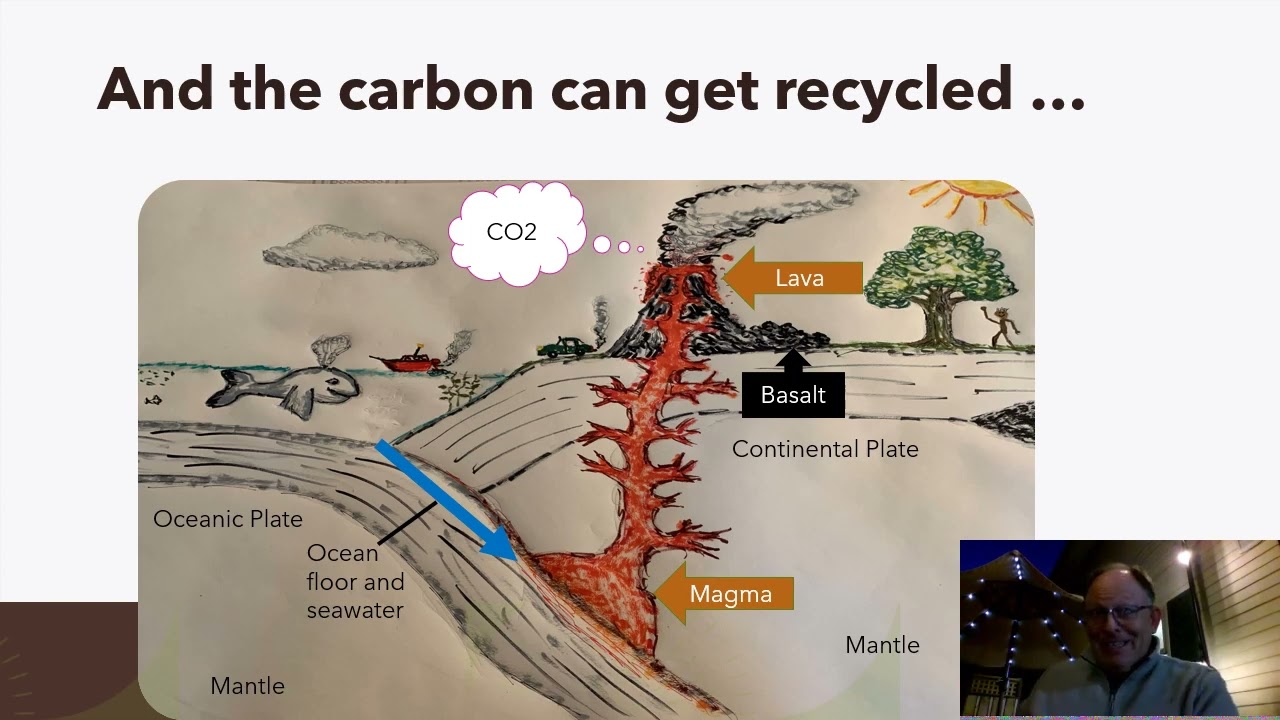
As I mentioned in the intro, we've sort of broken our contract with our friends the plants, the atmosphere, and the oceans. We need each other, but if we don't honor our end of the contract, we can hurt them too. This contract is called the carbon cycle, and once you understand how it works, you will see how our immense greenhouse gas emissions are in drastic violation of the contract. I will also explain why carbon dioxide, CO2, an odorless, colorless gas, is both essential for both plant and animal life, but could also potentially be the end of us. The first thing that you need to understand is that CO2 isn't bad in and of itself. It is actually a critically essential chemical compound for nearly all life on Earth. As a greenhouse gas, not only has it allowed me to sit outside to film this video tonight, if our atmosphere had no CO2, the planet would most likely freeze up and end all surface-based life. Additionally, the plants need CO2 for photosynthesis. That's where they take in carbon dioxide water, and sunlight to create glucose, a plant sugar, for their energy, and then they release oxygen as their waste product. Of course, we need that oxygen to breathe and complete our cellular respiration. That is how the cell uses oxygen and glucose to create cellular energy, and our byproduct from cellular respiration is carbon dioxide. Which we breathe out into the air as our waste product. This is a really basic version of the carbon cycle. How we breathe out carbon dioxide, the plants breathe it in, the plants use it to create oxygen, which we breathe in, and we're working together with each other. But there's quite a bit more to it. The oceans really matter too. They of course have animals— whales, dolphins, seals, but also fish and invertebrates, including microscopic forms of plankton that use oxygen just like us and create CO2 as the waste product. However, the ocean also has plants, not just seaweed, but microscopic phytoplankton. They are basically a super tiny free-floating plant that can use photosynthesis to create energy by utilizing CO2, sunlight, and water and create oxygen as a byproduct. These plankton and phytoplankton create the base of the ocean food web. They also take in huge amounts of CO2 every day, month, and year, and provide a huge amount of the free oxygen that's in our atmosphere right now. We need each other to survive, and most living creatures, both plant and animal, when they die, take the carbon that's in their body when they die, back into the soil on land and the ocean floor at sea. And that, over time, traps that carbon underground, helping to remove some of it permanently, or at least semi-permanently, from the atmosphere. Through the process of plate tectonics, ocean plates often subduct below continental plates, taking down deposited sea floor and sea water when that happens. That mixes with the rock below the surface, and then the heat of the mantle melts that rock, that taken-down ocean floor, and that taken-down seawater to create magma pockets. That magma can then rise up to the surface to create volcanoes. This is why so many of the Earth's volcanoes are close to the ocean and continental plate boundaries. I'm sure you've heard of the Ring of Fire. When these volcanoes erupt, they can re-release some of that carbon that was trapped underground and in the ocean floor in the form of CO2 back into the atmosphere. But interestingly, the same lava that comes out of these volcanoes can cool and become basalt, and basalt is a kind of rock, as well as several other kinds of rocks, that can take in and store excess CO2. And amazingly, some would even say miraculously, all of this comes together to create the natural carbon cycle. The plants both on land and in the ocean use carbon dioxide, CO2, and sunlight to create energy and expel oxygen. The animals on land and in the sea use oxygen for cellular energy and expel carbon dioxide. Dead matter traps some of that carbon underground where plate tectonics can take it deep and turn it into magma and And then volcanoes can release some of that CO2 back into the atmosphere when they erupt, but when the lava cools into basalt, it can take some of that carbon back in. And when it's all working together and properly, it can keep the levels of atmospheric CO2 in a relative long-term balance. A balance that puts just enough CO2 into the atmosphere and enough oxygen into the atmosphere and the oceans for both the plants and the animals to survive and thrive, including us. It's also a balance that helps keep the Earth's natural atmospheric thermostat at a temperature that's conducive to life. That's why we have water and not ice. It's a so-called Goldilocks Zone, It's not too hot, it's not too cold. And interestingly, in eons past, there have been times where that thermostat has been thrown off kilter, where there was either too little CO2 in the atmosphere or too much CO2 in the atmosphere, leading to cold periods and ice ages, and warm, if not hot, spells where oceans were much higher and there were no ice caps. There have even been a couple mass extinctions in the fossil record due to extreme cold as well as extreme warmth in the Earth's deep history. It really is a thermostat we don't want to play with too much. But as I mentioned in the first episode of Climate: A Hot Topic, link in the comments below, In 1765, Scottish engineer and inventor James Watt greatly improved the steam engine, beginning the Industrial Revolution, and we started using coal, one of the three major fossil fuels, to create power and force. Fast forward another 150 years and Henry Ford invented the modern assembly line, and now we also use oil, petroleum, to create gasoline and run our smaller engines. And we also learned that we could burn natural gas, methane, to heat our homes and run our appliances and generators, as well as power segments of industry. But they are called fossil fuels for a reason. They are the remains of long-dead plants and animals compressed over the eons into carbon-based fuels. And when they are combusted to create power, they re-release that trapped carbon in the form of excess CO2 back into the atmosphere. And that is not a natural process. That's a human process. We are taking trapped carbon and unnaturally adding it back into our atmosphere in the form of CO2. And it's for nearly everything we do: energy production, electricity generation for home and business, transportation—yes, trains, planes, and automobiles—heating and cooling, industrial production, cement and concrete production, home and commercial construction, mining, agriculture, shipping, trade. And so everything we do in our modern economy and our modern society likely is ultimately releasing excess CO2 into our atmosphere. This is where we're breaking the natural contract. This is where we're breaking the carbon cycle. And the amounts are utterly staggering. As I mentioned in the first episode, just last year, just last year, we emitted 36.3 metric gigatons. That is 36.3 billion metric tons of CO2. And when you consider that each metric ton weighs more than 2,200 pounds. Just last year, all of humankind across the entire planet Earth, through all of their activities, emitted more than 80 trillion pounds of CO2. Let that number sink in. Unnatural human emissions of trapped carbon. That's the amount from our global economic activities and society. We have taken a system that was in an effective but delicate balance, a balance that was ideal for human, animal, plant and ocean life, and we are now adding 80 trillion extra pounds of a greenhouse gas to that atmospheric and oceanic system each and every year. And the carbon dioxide chemical compound is quite stable. When excess amounts of it enter the atmosphere, a recent NASA article I read said it will take anywhere from 300 to 1,000 years for it to be naturally pulled from the atmosphere. So if we are putting too much of it into the natural— in for the natural process to handle, it just stays there, builds up both in the atmosphere and in the oceans. Earlier this year, we hit 421 parts per million of carbon dioxide, CO2, in our atmosphere. To give you a frame of reference, at the start of the Industrial Revolution, it was 280 parts per million. And get this, it had been between 260 and 280 parts per million for the previous 10,000 years, basically since the end of the last ice age and for most of the rise of human civilization. 421 parts per million is likely the highest it has been in millions of years. It is also an unsustainable long-term number. It is building up, and it's building up rapidly. I was looking at the climate.gov website, and they said that the level of increase of CO2 in the atmosphere over the last 60 years is 100 times faster than the natural rate in previous periods of CO2 increase. And it is our emissions that are doing this. We are already up 1.1 degrees Celsius, or about 2 degrees Fahrenheit, since the year 1880. We've also added 8 to 9 inches to global sea levels since 1880. I am now seeing estimates of anywhere from 2 to 6 degrees of total warming by the year 2100, depending on how well we curb our emissions, and 1 to 3 feet of sea level rise by 2100. That could both devastate food productivity and displace millions of people that live near the coasts. In the last video, I discussed my fears of a likely global food productivity crisis in the next 20 to 50 years due to rising temperatures and related damage to crops due to heat, floods, drought, infestation, and extreme weather. But that is only one likely bad outcome if we don't get this under control and fast. In future videos, I will cover some of the other likely bad outcomes, not just for humanity, but for all animal and plant life if we can't get back to some form of natural balance in our atmosphere and our oceans. That includes my likely next video, a possible climate doom cycle that could happen due to not just excess CO2, but related rises to two other very prominent greenhouse gases. Watch for that video soon. Our delicate carbon cycle A system that creates the environment that allows for all life to survive and thrive is being thrown completely out of healthy natural balance due to our extraordinary emissions from burning fossil fuels. We have changed the carbon cycle in a way that is fundamentally unsustainable and will lead to catastrophe if we don't change. That's not an if, that's a when. It could even be existential. We've broken the natural contract with the other life on planet Earth and the planet itself by unnaturally modifying the life-critical carbon cycle. We are emitting way too much of a good thing—carbon dioxide, CO2—and it will break the system if we keep doing it. But more importantly, we've broken the contract with ourselves and especially our children and grandchildren. Hope is not lost. There are tech options that could still just save us. But without smart and effective change at a massive scale, we are taking away their future and their options right now. We could literally put our children and grandchildren into lives of utter desperation. We need to change yesterday. Like I said in my last video, I can't change your mind. That's up to you. I'm hoping that these videos and my new ebook will prompt you to start doing your own research on climate science and the climate crisis. Find out the facts for yourself and make up your own mind. But remember my warning and advice from the first video: be very skeptical of people telling you that there is nothing to worry about. I question their motives. There is an awful lot of greed, evil, and ignorance in this world right now. If you do agree with me that this is a big problem that is getting much worse right now, be informed, educate, advocate, and make positive personal change starting today. Go to my website for more info. Climatehottopic.info. I've also created a Facebook group. I'll put that link in the comments below, but you can also get to it from that website. A rough draft of Part 1 of my new ebook on this topic, 8 Billion Little Volcanoes, can be found and downloaded on that Facebook group page at no cost to you. Read it, share it, and start doing something positive yesterday. And please like and subscribe. We all need to be students and activists on this hot topic for now and for the future. It might be the only thing that can save us. And thanks for your help and continuing support.
More from Randy

This simple #ADHD #hack might end your #tasklist paralysis called #executivedysfuntion #productivity

Have #ADHD? Do you make a daily #tasklist ? This might help. #tasks #productivity #procrastination

Found too many cool Petoskey Stones and “Greens” on vacation. Had to do something!


Another free #pallet project: I built a heavy duty #ladder stand for #housepainting

Quick Windows Tip: Organizing Multiple Windows on One Monitor or Screen for Faster Multi-Tasking!

Classic Outlook (New Screen): Converting an Email to Task, Calendar, or Contact Using Drag & Drop

Email Sanity Expert Tests SaneBox: Is This AI Email Tool Worth It? Might be for overloaded inbox!

Taming the Outlook Email Beast: 3 Flexible Learning Paths to Master Your Inbox (Video Course Intro)

#workspace #productivity multiscreen setup #email #calendar #pdf #outlook #gmail #microsoft #google