Ep 134: Better Relationships, Better Life with Judy Herman
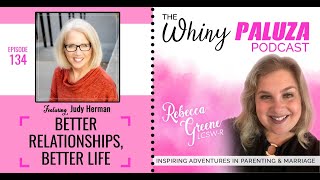
In this episode of the Whiny Palooza (Better Relationships, Better Life) podcast, host Rebecca Greene interviews therapist, author, and executive coach Judy Herman. The conversation begins with introductions and an overview of Judy’s extensive credentials, including her work as a licensed professional counselor, Imago relationship therapist, and speaker for executive women. Judy discusses her memoir Beyond Messy Relationships and the accompanying resources, explaining how the book reflects her own intense, dramatic life story rather than client case studies. She shares pivotal personal experiences: a secret abortion kept from her first husband, the spiritual awakening that led her to disclose it, and the subsequent healing journey that propelled her into pro‑life ministry, further education, and licensure. Judy recounts her second marriage to a man with bipolar‑1 disorder and psychosis, describing the challenges of supporting a partner with severe mental illness, the importance of boundaries, and the eventual loss of that marriage. Throughout, she emphasizes concepts such as “Divine Invitations,” the A‑I‑R framework (Awareness, Intentionality, Risk), shame resilience, and therapeutic interventions like the “child‑picture” exercise to foster empathy. The dialogue also touches on guilt, isolation (a proposed fifth Gottman horseman), the role of faith, and the need for self‑compassion. Judy promotes her various offerings – a free relationship stress quiz, coaching program “Show Up and Be You,” the Better Relationships, Better Life podcast, and speaking services – encouraging listeners to seek support rather than face challenges alone. The episode concludes with mutual appreciation and an invitation for the audience to explore Judy’s books, podcasts, and resources.
Chapters
No need to whine, it's Whiny Palooza! Have some wine and join us on the Whiny Palooza Podcast with Rebecca Green.
Welcome to the Whiny Palooza Podcast. I'm your host, Rebecca Green. I'm a wife, mother of 3, and licensed clinical social worker. I also have 3 fur babies at home too. My passion has always been to help children and their families. I always dreamed of being a wife and a mother. Parents are always learning through their struggles, failures, and successes and joys. I am no stranger to this wild ride of parenting, and I know behind every great parent lies a team of supportive friends and family. I want to be part of your support system. I want you to know that you are not alone. We are in this parenting world together. Join me every week for insightful discussions with experts on parenting and marriage, as well as other parents who have found the secret to successes in parenthood. You'll learn tips and tricks to make life with your family better than ever. I hope you will follow along with me while we dive into what it takes to achieve a happy family. Hello everyone. This is Rebecca Green for the Winey Palooza podcast. And I am very excited today because I have Judy Herman with us. Today. Judy, thank you so much for being here with me.
I am so pleased to join you, Rebecca. This is amazing. You're doing great work, and I'm glad to be part of it.
Oh my gosh, thank you so much, and so are you. And Seth and I had the honor of being guests on Judy's podcast, which we will talk about her podcast too. And I told my husband, I'm like, oh, I loved talking to Judy, I need to interview her.
So here we are. Here we are. Here we are. Y'all are great interviewees and interviewers. We're going back and forth.
I love it so much. So I want to tell you about Judy because Judy is so fantastic and so experienced. Um, she is, oh, Judy, I don't know where to start here. There's lists and lists and lists. Judy inspires executive women with resistant spouses to unlock the power of their authentic selves in order to live peaceful, purposeful, and positive lives without regret. She provides keynote addresses, seminars, workshops, workshops for companies who support women in leadership while honoring authentic work relationships and cultures. Her clinical and personal experience enhance her work as an executive coach, providing skills and resources that change organizations and family trees. Judy is a counselor, speaker, and author. Her credentials are endless. Oh my gosh, she's a national certified counselor. She's a licensed professional counselor, mental health service provider, approved supervisor, licensed professional counselor in Georgia, Imago relationship therapist, and she's trained with world-renowned marriage and relationship experts. Judy, I think I read that you had over 40 years of experience. Is that right?
Okay, let me, let me clarify. 40 years, 40 years of marital experiences, married to two separate husbands, not at the same time. One a 3-decade-old marriage, the other one a 10-year. And, uh, so I include all of that. So I have been a therapist, uh, since— I mean, officially, uh, since 2006. I did a lot of volunteer work, but I tell people my, my first career was raising 4 kids in that first marriage, and they're now grown adults, and I have, I have 5 grandchildren. So yes, I just kind of accumulate all of this, uh, together.
Yeah, well, that, that is definitely all experience.
You can say I got married when I was 12. How about that?
I think that I was gonna say, how the heck have you been married that long? You could not be married that long. You know, you have had—
I read—
I'm going to show you, for those of you watching on YouTube, this is, um, Beyond, Beyond Messy Relationships. This is her book, if you can see it. If you can't see it, you can look it up. Judy, where can they get your book?
They can get it wherever books are sold. I must tell you, there should be on your book— yeah, this. Okay. Oh, Academy, I don't know why yours didn't have that.
Maybe I have— maybe I have Seth's first copy. Maybe you sent me this copy, didn't you?
I should have put— yeah, one— my sticker on here. But anyway, uh, that was after they were printed, then they got— that's okay though. I mean, the content's still the same. But yes, you can get it in all formats: Audible, Kindle. And also print version. If you want an author-signed copy, you can go to my website judycounselor.com. I actually have a book bundle too, Rebecca, so people can get the book plus they can get some, uh, questions to ponder, uh, because it will make you ponder the storyline. I show up as a therapist at the beginning of each of the chapters, but it is an intense and dramatic memoir, and most therapists who write books will write about the intense and dramatic stories of their clients and not themselves, so I decided to write it my intense and dramatic story, but it illustrates something bigger. And so yes, there's other resources that you can get, a book bundle and an author-signed copy. Yeah.
Um, it was fantastic. I got to talk to Judy a little bit before we started recording, and I told her, you know that a book is good when I read it in 3 days. I mean, I, I just, I didn't want to put it down. Um, Seth and my kids, my husband and my kids were trying to talk to me, and I'm like, will you let me finish this book? It was So good. I promise you, you will love it. You will be inspired. You will learn things. And I got to learn about Judy's journey, which is amazing. Judy, oh my gosh, I didn't know where to start with this question, but I really want to know your journey to become a therapist. Like, what inspired you to get there? Can you tell us?
Yes. And there is a deep story, and it goes deeper into the book about how I got started. So yeah, I got married at 22, had my 4 kids, and it seemed like there for a while that you might look at fertile in the dictionary and see my name there. I was either birthing babies or nursing, and just one— they're like 2 and 3 years apart. So anyway, I love my children, and I really resonate too with you. Rebecca, you love your motherhood and, and that role in your life, and it is very joyful, and then it can be very challenging and all of that. So yeah, and there was, there was a secret and a place of shame that I was holding in my, in my life for quite some time. And it wasn't until 9 years into the marriage when I had my two daughters, and they were toddlers And this is where there was a deep spiritual experience that I had. I woke up one day, and, and it was like almost, Rebecca, it was like almost like an out-of-body experience. I thought, what am I doing here? It's kind of like I was looking down on my life. And I saw that I had these two beautiful daughters, and this wonderful husband in this marriage. And I just, there was this separateness. I thought, I don't belong here. And I was keeping a secret. I was keeping a shame secret that didn't come out until later. And it was a huge risk for me to reveal that because my— well, my, my former husband in my first marriage thought that I was a virgin. We grew up in a very conservative Christian— I mean, I live in the belt buckle of the Bible Belt South, so, so, uh, but very conservative. And, you know, you gotta be pure. And, you know, I was keeping that secret, but there was, there was something even much deeper than that. And so we went out to eat one day, and, and it's amazing how much you can, you can live your life. I want to speak to listeners because, you know, we do a lot of, um, we do a, we have our own addictions, right? I mean, some people may not have alcohol or, I'm, or, or drug addictions, but we work, we work really hard, and then, then we kind of miss our lives or a deeper place. But anyway, I say all that to say, um, yeah, I took a risk of faith and and, um, huge, huge risk because I didn't know if I would— my family— I would still have my family and my daughters. But my husband and I went out to eat, and I said, there's something that I need to tell you. And he looked at me, and, um, and, you know, he knew there was something seriously wrong, thought I was having an affair or something. And I said, no, it's not that. And I said, I, you know— and I was very emotional— I said, I, you know, I wasn't a virgin when we got married. And he said First thing he said was, how did you keep from getting pregnant? And I, in that instant, I said, I, I said, I didn't. I had an abortion. So, and I know maybe even some of your listeners hearing this story, it might be a real gut punch for you. I want to let you know that if you're holding a secret, and whether that is an abortion, whether that is you know, being molested as a child, whatever, um, whatever that place of shame is, go to a therapist, go to someone you can trust. And especially because this energetic place of like heal— this energetic— it, it, it's kind of like a beach ball, Rebecca. It's kind of like having— like going out and being, um, you know, in the ocean and this big beach ball, and you're holding it down. Nobody sees it, but as time goes on, it's going to bubble up. So, so whatever that is, let's get it out of the way. Let's— and so that was a real turning point for me faith-wise, where I just felt the presence of Christ around me. And, uh, my, my husband at the— he, there was just such grace and love and forgiveness. It was amazing. And that— so I say, going back to— you probably didn't— I'm probably giving you more information that you—
I love this.
I love this. And I—
yeah, I just want to say that in the book, it really showed me that when we release secrets, I mean, the difference in you after you got that out was just amazing. You could tell how much better you felt just getting it out.
Yes. And that's the thing. It's like it was a huge turning point for me. And so since that time— and there's more to the story, but I count that moment as being so transitional and transformational for me. So that's when I got involved in, um, pro-life ministry. I got involved in— I went through my own post-abortion healing, actually had a memorial service for the child that I lost. And, and I know people are of different faiths and different— but this is my journey, and sure, every— everybody's healing is different. I really want to honor that. Because sometimes when you hear somebody's story, you think, oh, I need to do this or that or whatever, or think of it this way or that way. But anyway, I say that I got involved in not just— so on a volunteer level, like leading post-abortion Bible studies and having, um, you know, and then seeing not just what, what God had done in my life, but seeing it in others. And so that's when, after a few years of that and then doing some public speaking on Sanctity of Life Sunday, But, um, that's when I realized, well, um, you know, this abortion healing doesn't come in this neat little package wrapped up in a bow. There's all kinds of deeper issues, um, such as, you know, other things I won't even name because I, I don't know who might be listening and little kids might be listening or whatever. But, but what I'm saying is, is that, um, that was at a time when I thought I need more training. And then that was the catalyst for me to get my degrees and jump through the hoops to become licensed and so on and forth. And so that's why I'm here. That's why, like, that's why I'm a therapist today. And I have had, I think, this journey throughout, at different stages of my life, a journey of risk-taking, like, like awakening awareness, and then being intentional, and then taking, like, risks. And that's, and that's the acronym that I use in my book, as you already know. Take a deep breath in, of fresh air because air is everything that we need to live, right? And, and you fill up your lungs with air, it really slows down the nervous system. But if you can get used to the A— that's awareness— and the I— intentionality— and the R, which sometimes we equate as a negative thing to take a risk. No, we're taking a risk of growth based upon the awareness and the intentionality.
I love that so much. I'm going to remember air forever now. You taught me that, and I love it so much. And I want to give your husband kudos. I was actually, I was actually just at coffee with my girlfriends telling them about your book, and I was telling them all about your husband and your journey with him. And I, you know, want to give him kudos for allowing you to heal and educate others. You know, I felt it was healing you And it was like an awesome coping strategy to get all of that out. But I also felt like, wow, she is really educating people. And thank you to him for allowing you to share all of that.
Absolutely. It was, it was huge. And, and for several years. So here's, here's the thing. We will experience some transitional moments. I— everybody has them. It's a matter of going back in your timeline and identifying and raising our level of awareness. But, but we're all on this human journey, and we all have points that we can identify that have been turning points. To me, I call them divine invitations.
Oh, I love that.
Yes, and that's the, that's the subtitle of my book, Divine Invitations to Your Authentic Self. By the way, I know you're Jewish, and, and, um, Rabbi Rami Shapiro is also one of my endorsers. So anyway, it's very ecumenical as well, my book. So I just want to let folks know that, even though I come from Christian background. So, um, yes, what I'm saying is we all as human beings have choices, and we don't even realize sometimes how the magnitude of even very small choices might be in your life. So I know that my first husband, yes, at that moment It was so— it was a divine moment I'll never forget. And it, like, it was the most— I don't know, maybe even to this day, the most transformational for me. So we all have these moments, and then we all have choices after those moments. And what direction are you going to be heading into? And this is where I think, you know, some people that are like— if you, if you were to— if we were to make it really simple and have right on one side and wrong on the other. Like, what— which direction are we heading into? You know, some people live with chronic guilt. Well, what's the purpose of guilt? In my opinion, I think it is to get our attention. Yes. Head in the correct direction that we're to be in, in our path and our journey in life. And when we're heading in the other direction, it's an opportunity. Like, we're not really designed to live with chronic guilt. We are designed like guilt. Okay, here it is. Well, let's, uh, where are we going and where do I need to go? And then let that guilt go. And otherwise, it really is very damaging.
Agree, agree. Well, your story of your relationships is inspiring, and, um, your faith is inspiring. And I know that there's listeners who are married to, um, people with a mental illness. You know, and I know what you have gone through. Can we give some advice to them?
Yes, absolutely. So, so yes, uh, my second husband, we met through ballroom dancing. Extremely brilliant man, had awesome rhythm too, by the way.
That's a good sign.
And we could just like move. There was, you know, some people that you meet You just flow like you flow. And you know what that's like, right?
Yes.
And so, um, but, and he was very— I, and I was attracted to him because he— yes, he, he told me right away. I mean, just as it is like we had a friendship for quite some time before actually getting even romantically involved with each other. But he said up front, you know, I've got bipolar disorder. He found out as a mental health therapist. I tell people that— no, he did not used to be my client.
That's funny.
I mean, that was him though, that he, we could joke around like that. But he was extremely brilliant and had bipolar 1, which, you know, you and I know about, but maybe the audience doesn't. But it's, that's the more severe form of bipolar and also psychotic features. Well, it had been like 16 years or 13 or something like that, many, many years since he had ever, that he had had an episode. But he was religious about his doctor appointments, his therapy appointments. He was a mental health advocate. So those that are living with someone who has a mental illness, that person needs to take responsibility for their own healing, wellness, their own journey. Like, if you're policing your spouse to take their medication or nagging them to go to the doctor or their therapist, like, that's not a good scenario. Okay, so, so there we all have responsibility, whether it's a mental illness, whether it's a physical illness. You know, if we've got something and we need to go to the doctor for, nobody can do that for you except the per— the person. Okay, so that's one thing I've learned in my journey, even as a therapist. You know, I think you pro— you know, you probably relate to this, I'm thinking, Rebecca. But we are people helpers.
Yes.
But there is this separation. We cannot do— this is what I've learned— you cannot do for another human being what only they can do for themselves. Like, you cannot think another person's thoughts. You you know, feel another person's emotions or, or make another person's choice for them.
That is the perfect advice. And you were really trying to do the work in your book for both of you. Like, we all, you know, everyone who reads your book takes the journey with you where you're realizing in your book that you're trying to do marital work for both of you, which isn't possible.
Well, I'm telling you, okay, and my, and my, um, Better Relationships, Better Life podcast, episode 10. Yeah, no, episode 9 and 10— 9, 8 and 9. Stan Tatkin, he says it's like one hand clapping, it's the sound of one hand clapping. Oh my gosh, that's brilliant.
I just, I just listened to him, I just listened to him with you, I just listened to you interviewing him. That was an excellent interview and Yeah, we need two hands to clap.
Exactly, exactly. And you and Seth are using your two hands, aren't you, to clap in your marriage?
You— yes, you know, you're right. Yes. Um, I went to a, um— you probably don't believe in psychics. I don't want to offend you.
No, no, that's okay.
I went to a ground.
That's okay.
I went to a psychic.
I'm open these days. I have— I'm telling you, I've gone from a very conservative Christian, maybe black and white thinking, to— I have definitely evolved. I'm telling you, I'm not the same person that I grew up because I— oh my gosh, yeah, yeah, okay, there you go.
So, okay, so I went to a psychic many, many years ago when I was in a different relationship, and she told me— I will never forget this line— she said, you are going to scrub out the scum in your bathtub And once the scrub— once the scum is scrubbed out, you are going to meet your partner for life. And he is a real partner.
Oh, wow.
And I left her and I was like, she's right. Like, she's right. Like, I'm dating scum. I'm sorry. I'm sorry. That's so offensive. I shouldn't say that. But I was like, that was a good way to explain it to me. And that's exactly what I did. And Seth came along and he is my partner. You know, I feel like I have someone who I'm in love with to do life with. And that's, that's the goal, right?
Yes, yes, yes, that is the goal. And here's the thing, it might have been a shadow part too, because we, we do marry— we either pick, project, or provoke. We, we will pick someone who has similar, um, positives and negative characteristics of our caregivers, or we will provoke some of the things that happen in childhood, you know, in our adult relationships. Or we— let's see, pick, project, or provoke. What did I miss? Pick, project, provoke. Yeah, project. You will project onto this, and this is, this is where chemistry comes, Rebecca. So, and this is why it's so important to be aware and to grow, because— so I know Seth is not like those other guys that you dated, but at the same time, there's like likely some growth that Seth has done and you had done in order to to the place of that, you know. So, so, you know, we can say thank you to those people. Yes, we were in relationship with, and that's how I see my ex. Or I'm not gonna even say ex. I don't like referring to anybody's ex. I don't want to be an ex myself.
I know, I know, I know.
I refer to as former, former husband, or for, you know, because I needed, I needed both of these men in my life to bring me to my level of awareness and what my purpose— getting crystal clear on what your purpose is, that's a lifelong journey. Anyway, I could go off on it.
So no, they were, they were gifts. And I want to tell everyone, they were gifts. We're given these gifts, and even if they're not great relationships, um, it brings us I'm, I'm so thankful. I'm so thankful for where it brought me to be able to meet Seth, appreciate Seth, be a different person for Seth. I mean, it's all gifts for sure. It is.
He had to go through his journey. You went through yours. You came together, and then, and then this agreement really to grow and grow up together. Yeah, that's what I loved about, um, Sam's, um, Stan— Dr. Stan Tatkin's interview.
Yes, it was a great interview. Yes, they need to go find your podcast. We're gonna make sure they do that too. Um, let's talk about your relationships and how— so you had, you had your first marriage and, um, now you're with your second husband and you're a fabulous therapist. Can we talk about how your relationships impact your therapy?
Well, I'm going to be very— because I, I so believe in being vibrantly authentic. Okay, so I'm gonna be vibrantly authentic and, and very gut-level authentic. So the epilogue of my book is, um, yes, my husband was at a place of recovering, and, and, um, so the epilogue— and he was my biggest cheerleader. I wrote the book not knowing if my marriage was viable or not.
Absolutely.
And, and I'm telling you, in 2020, because— so the book came out in 2019 We had a, um, a launch, a book launch in Chattanooga, and it was called Beyond Messy Experience. And it was, it was really cool. I, anyway, he was my biggest cheerleader in writing and reading the book. Um, and it, and he, he had read it manuscript because my, um, anyway, he read the manuscript after the manuscript was already written because my, my writing coach said, Judy, don't let anybody that you live under the same roof with or read anything because you don't want to be influenced. You want to, you want to speak your truth, right? So anyway, he read it and I thought, oh my gosh. So, but he read it and with tears in his eyes and we hugged each other and he said, maybe this will keep me from getting sick again. Because my catalyst for writing the book, I want your audience to know, is his psychosis that happened in 2014 was the first one in which he was out of tune with reality. I didn't know whether I was going to be a widow because he had had a horrible car accident, almost died. Or whether I was going to be a quote-unquote twice-divorced relationship therapist. I was fearful. So, so anyway, to make a long story short, he recovered to a certain extent. He had another episode in 2017, and that was the time I thought I cannot not write this book. And I needed, I needed a holistic view of, of— it was very transformational to write. Okay, going back to your original question and my current relationships. I lost my husband in 2020 to his mental illness, not to death, but to his mental illness. So I know this might be a gut punch even for you right now, Rebecca, and— but sorry, but well, it, you know, when— so there was— he, he learned to hide it well. Uh, I thought he was recovering. His brother passed away like in February. There was all this outward stressors— COVID, his brother passing away suddenly. And, um, and he said on Mother's Day, actually, he said, Judy, I, I need to have sit down with you. And I said, yeah, um, I need to go to the hospital. And so he went to the hospital. It was much worse. And, um, anyway, I'm not going to go into a whole lot of detail, but I'm saying the epilogue right now is different than the epilogue now in the book. Okay, so I right now And I know probably most of your audience is women or moms, so I'm going to just say this out loud. I'm an uncoupled woman, and this has been a journey for me to get myself adjusted after— like I said, after 40 years of marriage. I've never known what it's like to not have a partner as an adult woman ever.
Yeah.
So, so that's where I'm at. And I know this is probably like— this is news to you because you didn't know this. You read the book and thought maybe I was still married, but that's not the case.
Well, and I was going to ask you how he was doing. That was on list.
Okay.
Um, I was, I was hopeful.
Yeah, yeah, yeah.
I was hopeful.
Joe is a very lovable man, and when he is well, oh my goodness, he's, he's a wonderful man. I think he is on the road to recovery at this point, but I have purposely, just for my own mental health.
Yes.
And well-being. And this is where maybe I need to speak also to those who are living with someone who has a severe mental illness. And if it's not your child, And if it's your spouse, there needs to be some boundaries here. And I'm, I'm so, you know, I'm so for marriage until death do you part and, and growing together. I am so not for toxic marriages. And if you're, if you're in a toxic marriage and, and, and you have stress day in and day out, and, and Stan Tatkin will also testify this and others do stress is going to kill you. Yeah, stress is going to shorten your life. And so I'm saying, if you are in a situation and, and you're trying to do this alone, number one, don't do it alone. Get yourself a therapist, get yourself a, you know, a support group. Let people know that you are going through difficulty. Okay, don't do it alone. Actually, I talk about that in the book. John— you, you and I are familiar with John, um, Gottman's Four Horsemen. Well, I think there's a fifth horseman. And that is isolation. Yeah, isolation is one of the worst things you can do in your marriage. And that's why I love you and how you and Seth are out there, you're letting people know your real life, right? And, uh, but, but so many of us that are living in— because I had to struggle with this. I mean, here I've got all these initials by my name, I am, you know, this therapist, and people are looking to me for wisdom, and, and I'm meeting in front of people and I'm thinking, oh my gosh, if they only knew. So that called imposter syndrome. We put it— yes, on that. I had to go through that. And so when I knew that my, my now former husband— when I knew Joe wasn't coming back and I knew that it was— the marriage was totally not viable, I had to go out on my back deck. I looked up at the sky, and here I am, all— I wrote— you wrote my book. You know, divine invitations to your authentic self. Lord, I just had to look up and I said, Lord, here I am, here I am. So I'm, I'm open about this. It's been quite a journey. It's been a hellish of a journey that last time, you know, this. But it was— I knew what my limits were as a human being. And so that's why today I, I can do these interviews. I'm gonna write more books.
Yes, yes, please.
I'm, I'm getting my voice out there. Because, uh, your life is valuable. And that's a real core message of my book, Rebecca, is like, you are so worthy. You are so worthy and lovable, and you are a person of dignity. And what we need— this is my passion— is to create relationships in such a way that your human dignity, value, and worthiness comes out. And that's, that's my mission.
Oh my goodness gracious, you are doing such good work in this universe. I hope that you know that.
Well, you know what, it's like, like I said, here I am. I'm just like, this is a story, like, what am I going to do with it? This is my life, what am I going to do with it? And, um, it's not me, it's something much bigger.
And I think that your experiences have made you a better therapist?
Well, yeah, better therapist, and, um, but I guess a better human being.
I was just gonna say better person, better therapist, right?
Hey, Rebecca, I, I know that, like, okay, years ago I'd gotten spiritual direction, and my spiritual director— and I went up, it's in the book, it's in the book, um, how I went up to Canada with Dr. David G. Benner, and he said, Judy, you really are a mother at the core of your being, aren't you? I said yes. So here's the thing, um, and maybe some, maybe some of your audiences is ready to hear this and maybe not. I get it if you're not. But yes, I woke up on Mother's Day last Mother's Day, and I've got 4 beautiful grown adults and they've got wonderful families. I love them to death. But I will— again, I went out on my back porch again, or my back deck, and I looked up at the clouds and it was Mother's Day. I said, thank God I'm more than a mother. And so I say that too about being a therapist. Thank God that my— I'm more than a therapist. Like, you are, you know. And that's the thing, we have to get our— we have to get over ourselves. We have to get over the roles that we play, as deep as they are, and as much as we identify and over-identify with our roles. The initials behind my name, so what? I'm a human being. If all of that were stripped away, you know, my— I am my, my life and, and my soul matters. And my— and so that's kind of how I see it. Anyway, that's kind of— that might be too philosophical or—
no, more than you know. I'm following you.
You know, I had it—
I have a girlfriend who asked me what the meaning of life is, and I said to her— it just came out, you know, it was like sometimes you don't even think it's you answering. Like, you— it was like it just came out.
I didn't even think. Yeah.
And it was to be the best version of ourselves, to just keep— right? And as I'm reading your journey, it's like you just keep getting better. It's like everything that we go through just keeps making us better.
And, and we have a choice with that too, Rebecca, right? Things come at us in life and they are our teachers. I, I've recently read, uh, I, I love following Oprah, by the way. So she said that Gary Zukav is a person that has really made an impact on her. And so I thought, well, I haven't read that. I hadn't read book. So I read Seed of the Soul. That was a— and I don't know if you've read that or not, but anyway, making you think beyond, you know, the theology boxes or culture or roles. And, um, you know, I, I believe— oh yeah, he calls it Earth School. Gary Zukav calls it Earth School. Like, we have these things that happen, and it is— he's all about awareness. So that's like, that's why I'm drawn to his writing as well, because that's why I think that it— that, that was the writing. There was something transcendent in my writing, Rebecca. I— it wasn't just me writing my story. There was like transformation and, and things coming to me. It's kind of like what you said to your friend, you know, you don't know where that came from, but you know that there's, there's this divine— these divine invitations. Yes, yes, yes. So it's awareness and intentionality, but he calls it the Earth School. Like, so in other words, we have, we have a choice with whether we're going to raise our awareness and be intentional and take risks of growth and take that deep breath and live our fullness of our humanity, or we can choose not to. You know, it's kind of like riding a bicycle. You know, you're gonna go— you're gonna move one way or the other. You're gonna fall down, and— or you can be bitter. You know, that's choices we have. But our lives are so much bigger than our past They're so much bigger than the people we've been in relationship with in the past. They're bigger than our roles in life. And that's a message I want to get out to the world as well.
I can't wait to see what's next.
I can't either. I don't know what it is yet.
It's, it's very exciting. New, new chapters in our life. I feel like we get these new chapters.
Yeah, absolutely. Yeah, I wanted, you know, I mean, there's some people that will read my book and say, you know, Judy, why didn't you get out much sooner? But I, I had some lessons to learn here. And, um, and people might criticize, but, you know, how could you? Um, you know, uh, I don't know, I— you put yourself out there and you are open to criticism, whatever. Not everybody's— not everybody's gonna love you, and that's not the point. Uh, but you need to speak your truth and the journey that you've been on and, and, um, yeah, grow through it. And you will attract people that, that resonate with that, for sure.
I loved it. I— yeah, it was, it was very impactful to me. I was trying to think what to tell you my biggest takeaway was, and I was like, okay, so if Judy was asking you— I mean, I think I so touched by your faith and your dancing. I mean, there were so many messages. I don't want to take it down to one message, but I, I don't want anyone to minimize their, their stuff, their coping skills, the stuff that they love, the stuff that they're passionate about. I could feel your passion for dancing and how that helped you through, and your faith. I mean, so, so much goodness in that book.
Well, you know, I really— one of my messages that I want people also to take away from that is, um, and I don't even know, maybe I didn't write— what, maybe I didn't write this one in this book, maybe it's in my next book. Yes, yes. But the message that I want to get is that your, your pain is never in vain, and God uses that pain. And also the stuff that you're dealing with, because I had some chapters on really knowing your own history, because that's why, you know, I don't know the chapter 2 or 3 or whatever, these early experiences that I've had that, um, that everybody has. And then that gets seeped into your, your subconscious, unconscious. And so when we have issues in our marriages and conflicts that come up, likely they are the result of unfinished business from the past, like 90-some-odd percent of it is. And so if we can separate, okay, what's— and what's been passed down for me, and it's not just past relationships, in your adult life or early adult life, it's not just your family of origin, but it goes back like generations, hundreds of years, probably a whole lot more than that. But science, neuroscience has affirmed we have this thing called neurogenesis. So what, whatever great-great-great-great-great-great-grandmother dealt with, let's say there was a famine in the land, and, and so you as the great-great-great-great-granddaughter or grandson, and you might have, you know, um, either, you know, an eating disorder as a result of whatever the tension was going on then. So who knows? I mean, in other words, give grace for yourself. Let's get out of the shame and the guilt. I mean, it's normal to be— to have shame, and Brené Brown has been wonderful at educating us about this and how to become shame resilient. And but there's 3 things that keep shame intact, and that is secrecy, silence, and judgment. So that's why therapy is so good, and you can get your story out and, and, and have grace for yourself. Have a, have a narrative that is more accurately truthful, that defines you as worthy and a person of dignity, value. And love.
Yes. Well, and what I tell women, the pattern that I see is that we give so much grace to other people, right?
Yeah. Yeah. What would your good girlfriend tell you, right?
I'm like, why do they deserve it but I don't? Why do we do that to ourselves? It's not right. We deserve the grace just as much as your best friend does.
Mm, you know, and here's the thing, I mean, the older you get, then the more memory we have built up, the more data we have in our brains, right? One of the exercises that I give to my couples, especially if there's the Four Horsemen that's roaming around there and they, they don't have really very much goodwill for each other, I asked them to get a picture of themselves when they were like 5 and to frame it in a like a 5x7 or something like that. So to be able to see that adult adult, maybe mean-looking body. See it as— see your spouse as a child. Not that you want to enable them to be childish, but—
right, right.
You love your kids. You know what that's like, to love your kids and to be able to see them and to realize, oh, there's a scared child inside of here. How can I— how can I, um— and I'm scared too. Like, maybe even seeing yourself that way, but realizing, okay, what does this child need? And how can I put that past in the past and live my adult life compassionately and empathically?
That's an awesome intervention because, you know, we have seen people not so nice to each other, haven't we?
We have, we have, and we've shown up. I know I have. I mean, I would love to just tell you, Rebecca, that, um, yeah, my, my first marriage was toxic. And, you know, and it wasn't all that in that 3 decades, but I wasn't aware of how I co-created that, like what I wasn't aware of in myself and how I inadvertently invited the stuff that I was getting. So, you know, it's a journey of growth and awareness.
Well, and as much as there were negative patterns I felt the love, you know. I felt the love between you and your first husband. He, you know, I wanted him to be more emotionally available for you, but, but I could tell that he loved you, you know. Yes, it was definitely obvious.
I, and I want to say something too, because, and this isn't in that, in the book I wrote, but it's probably going to be in a future one. But I, you know, the divorce word, it's such a— it's— it holds so much meaning and power and, um, conflict. The D word does, doesn't it? And so too, but a friend of mine, another therapist friend, she, she talks about a marriage being a natural completion. So, so if I, I like to look at that first marriage and even the second one as I've had two remarkable, successful marriages. And that first one, I, you know, I've got 5 beautiful grandchildren. That wouldn't happen. And these 4 grown adults that I'm so proud of. And, and then the second one, really, I birthed the baby in that second marriage, and that was my book. It was like, yes, and a baby. So, you know, that wouldn't have happened either. So I have so much gratitude in my heart for the 2 men that have made that have been my husband's and have made an impact in my life. And so if we can again go back to the narrative, and if you have just a narrative, oh, failed marriage, fail this, fail that, you know, that's, that's going to set you up to, you know, to do that. But, but you want to change that narrative. And it can— it's true, it's equally true. Those were both successful, remarkable. Actually, to me, I I think even on this end, it was remarkable that Joe and I were able to be married for 10 years with the level of illness that he had and have the partnership that we had. That, that's a miracle. That is a total miracle. And I look at it with gratitude in my heart.
That's amazing. I met Judy before I read her book, so I didn't know any of her story. I told her all I got from her was like this peace and this love and this openness, and I wouldn't, I wouldn't have guessed any of the stuff that you've been through, which to me is like, holy cow, how did she do that? And, and you can tell them your answer to me when I ask this.
Yes. Um, yeah, it's not like I'm trying to do anything here, and I'm telling you, I'm kind of going into new territory, Rebecca, to be very I mean, I want to be very transparent here because when I did write the book and I thought, and I was thinking, okay, write this book, and then now it's published, but I didn't really connect the dots. Oh my God, my, my clients are going to read it. Oh my gosh, if they read this book, they're going to think, and why are we seeing her as our therapist? But recently, okay, I'm working with a new couple and I'm actually offering, and I do work with entrepreneurial couples in transition. So if any of your listeners, I kind of migrated just, you know, from working with, uh, women with resistant husbands. It's basically couples, but obviously you can migrate into working with couples anyway. But, um, but a couple that I'm working with, uh, part of the package that they get before going on the retreat that I provide for them is that they get the book, and they, they've read it, and, and they said that's never happened to them with a therapist. Never before ever in their past therapy did they know therapists. And they— and so this is one— so I'm— this is new territory for me to see how the book impacts the therapeutic relationship. And, um, but they were so filled with gratitude. They said, oh, you know, it was a relief to them. And so that's been a beautiful thing.
Yes.
And I wasn't anticipating that.
That's awesome. I— yeah, I just had more love and, um, inspiration from you after reading it. I just had all good feelings after reading it. It was not like anything like you're thinking of any imposter type syndromes. It was, wow, she is inspiring, and I want to read more. So I hope that there's more.
I hope— yeah, there is, there is more. And, and there— I mean, I— you're inspiring me. I need to just do it. Uh, but I— there were times writing this book I knew it was— it needed to be written, and I would wake up early in the morning. I would probably put in, you know, 4 hours in morning and, and another several hours in the afternoon. I was drawn to it. It was like— and, and I did have some good writing, um, coaching along the way too, so, so that helped. Because I wanted it to be— even though it's my first book, I mean, I have a booklet that I wrote, uh, digital, but I wanted it to be a good, uh, quality book. First book, first read.
Well, it is success. It was a success. Can you tell everyone you have free resources, you have a podcast? Tell everyone about all your stuff.
Yes, you can go to judycounselor.com and take a free relationship stress quiz if you want to just kind of see where you are in your relationship and answer it according to how you're experiencing the relationship. And, and then that'll kind of give you, um, some grounding and clarity on where you need to go next. And of course, I have, um, I do offer consultations for those who are— and a complimentary discovery call for those that are interested in working with me further. I have, in addition to my counseling, I also provide coaching as well. I've got a remarkable coaching program. It's my own proprietary methodology called Show Up and Be You: Stop Walking on Eggshells and Live Your True Life. I love that. I'm excited about that. And so, and then yes, of course, I am so energized by my podcast called Better Relationships, Better Life. So it is for entrepreneurial couples that are in transition, and I have marriage experts and I have, uh, couples such as you and Seth, but those who have a track record of growth and resilience and that can show up real, as is who I am interviewing. So yes, I would love to meet you there. And I'm on LinkedIn, I'm on Facebook and all of that too. I can have you put those in the show notes if you want.
Absolutely. The book is awesome. Go get the book. The podcast is awesome. I've been enjoying her podcast. Go listen to the podcast. Go find her everywhere. Judy, I can't thank you enough. This has been so wonderful. So wonderful.
I forgot to mention one other thing that I'm developing in this year. To do more of, and that is you can go to judyspeaker.com and get information. If you are a company owner and you would like, um, you would like more, you know, speaking and facilitating of your organization, I'd be glad to show up and we can have a talk.
That's awesome. Well, I appreciate you sharing your story, your wisdom, your inspiration. I appreciate all of it.
Oh, thank you so much. And Rebecca, you are just a beautiful soul yourself, I can tell. And I just, you know, when I first met you on, on my podcast interview, I thought, oh, I just love the energy that, that and the work that you're doing. I love it how you are showing up for your listeners as, as a mom and, and being real. Like, I'm so attracted to that for sure.
Me too, me too. Our energies go well together.
They do. They do. I feel like you're a soul sister here.
I know.
Oh my gosh.
Thank you so much. Oh, you're welcome. I've loved this. Thank you. So this is, this is Rebecca Green reminding everybody to spend every day laughing, learning, and loving. Thank you for tuning in to the Winey Palooza podcast. If you like what you heard, please be sure to subscribe so you never miss an episode. While you are there, leave a review. I love to hear your feedback. Thank you so much for listening. Until next time. This show has been produced by Market Domination LLC. To discover how you can have your own show completely done for you and turn it into a real published book and become the authority in your marketplace, go to www.marketdominationllc.com/podcastoffer.










