Episode 050 Creativity and Learning, The Whinypaluza Podcast with Rebecca Greene
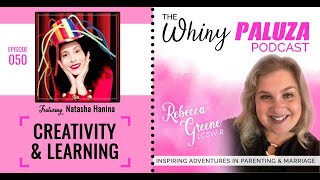
Rebecca Greene talks with Natasha Hanina, creator of Tashi Nonstop, a sketch comedy series for kids 4-8. They discuss how to make learning fun through character-driven skits, turn screen time into offline creative play, and embed moral lessons like respect and self-control into entertainment. Hanina shares low-cost play ideas like bubble-wrap runways and cotton-ball snowstorms.
Chapters
No need to whine, it's Whiny Palooza! Have some wine and join us on the Whiny Palooza Podcast with Rebecca Greene.
Welcome to the Whiny Palooza Podcast. I'm your host, Rebecca Greene. I'm a wife, mother of 3, and licensed clinical social worker. I also have 3 fur babies at home too. My passion has always been to help children and their families. I always dreamed of being a wife and a mother. Parents are always learning through their struggles, failures, and successes and joys. I am no stranger to this wild ride of parenting, and I know behind every great parent lies a team of supportive friends and family. I want to be part of your support system. I want you to know that you are not alone. We are in this parenting world together. Join me every week for insightful discussions with experts on parenting and marriage, as well as other parents who have found the secret to successes in parenthood. You'll learn tips and tricks to make life with your family better than ever. I hope you will follow along with me while we dive into what it takes to achieve a happy family.
Hello everyone, this is Rebecca Greene for the Whiny Palooza podcast, and I am so excited to have such a fun, interesting, wonderful guest today. We have Natasha, known as Tashi. Hanina is an English comedian, actress, writer, and producer based in New York. She is the creator and star of the popular sketch comedy web series and entertainment platform Tashi Nonstop, which features a vast collection of colorful and original characters and serves up an array of educational and entertaining themes for children aged 4 to 8. Tashi was born to entertain. Possessing a natural love for people paired with an extensive background as a professional performer and teacher, the Tashi Nonstop web series was born. Tashi Nonstop has managed to really stand out for its commitment to entertain children while stimulating their imagination and creativity. Tashi received a BA from Sarah Lawrence College and holds a master's degree in art education from Columbia University. Thank you so much for being here with me today, Tashi.
Thank you so much for having me.
This is, this is like such a fun thing that you have going and we need more fun in our lives.
Oh, definitely. We're all too serious now, aren't we?
I, yeah, I am guilty. I get way too serious and I want to start with asking you, this is like the key right here. You say when it's fun to learn, it's easy to learn. How can we make learning more fun?
Well, I think it's really about, you know, we have the curriculum that's very formatted, and yes, that's important, but we also need to be unconventional and more loose with things. And that's what I'm doing with my web series is creating this unconventional, unstructured environment that allows kids to be themselves, use their imaginations, have fun, play. And that's why I created this web series, partly because there's so much technology right now and kids are too wrapped up in it, I think, in a way, especially with COVID and parents as well. So we need to give their brains a break. And that's where Tashi Non-Stop comes in. Because I created this really over-the-top characters that are so imaginative that each have different life lessons to teach the children. And yes, you may say, okay, well, you know, this series is on the computer, they're going to be watching on their iPad, on the computer. But my argument is, yes, they're going to be watching on the computer. But my hope is that they're going to watch on the computer, see my passion for creative play and the silly stuff I'm doing and the skits and the heart I have behind that. And they're going to say, "Hey, that's so cool. I want to create my own fun. I want to create my own pretend play. I want to, you know, dress up and I want to be a different character. I want to write a story." So awesome.
So they can watch it on the technology, which the parents might complain about, but it will then inspire them to go play off of technology.
Exactly.
Perfect. That's perfect. You know what, I'm going to encourage that because I see them on, on the iPad way too often. They need to take what they're seeing and then go play.
Yes, exactly. And I've read a bit about this. This is more of the analytical side of things that there's— it's a real problem because family time is being cut into. I mean, these iPads, these tech devices, they're using them at the dinner table, you know. Yes, parents too are guilty, right? And it's kind of like an addiction really when you think about it. So what's happening is, is that Parents, children aren't interacting, they're not communicating, there's no eye contact. So how are they going to use their imagination if they're so stuck in their devices? And of course, devices and computers and technology could be amazing, right? Like, you can learn so much. Like, in my day, I had encyclopedias where we looked up— that's how old I am. We had to look through the encyclopedias and find information. Now you just Google it.
You know, right, right.
I mean, you can get a whole education on YouTube. Uh, you don't even need to go to college anymore. Everything— the other day my husband, he forgot how to tie his tie. Like, it's— I don't know, I'm like, let's go Google it, look on YouTube.
And they had like a video on how to tie your tie, you know, on everything. And everything— my husband was Googling how to fix our sink.
Perfect. I could build a house from scratch. There you go. Oh my gosh.
You know, my kids complain because they feel like school is like a box and they have to fit inside this box and they feel stifled. And one of the things you talked about is thinking, helping our kids to think outside of the box. How can we do that? How can we help our kids do that?
Come watch my web series. There's different skits on there. I mean, I have amazing, kind of unique. Well, I'm biased, so amazing. Oh, thank you. But they're kooky, you know, like I'm trying to bring back the nostalgia of Pee-wee's Playhouse and Mr. Rogers. Yeah, you know, the, the values of Mr. Rogers and the fun of Pee-wee's Playhouse, you know, which you don't see much now. You see a lot of animation, but, um, yeah, so I'm trying to bring that up. Like, I have these spooky skits. I have a kiddie cocktail called Dance Party where a chef, my French chef character, he starts to make a water cocktail for kids. And what happens is he puts these ice cubes that light up in the cocktail and he shakes it around and then it becomes a dance party. And the cubes in the cup are like people in the dance party, you know. So it's like—
How do you come up with this stuff?
I don't know. The aliens, they like come from the aliens. I, I don't know, you know. I'm like, people say that to me, how do you come up with this stuff? I'm like, it just comes. Like, thank you God for giving me this gift, if it is a gift.
Yes, you know.
Yeah, I just feel it's me. I just feel like it's coming from somewhere else because, I mean, there are times when I'm like trying to think up a skit, and it's murder, it's murder. And I'm like, fine, when I let go, when I release that pressure, you know, that I'll be walking around or shopping or something, I'll be like, oh, something comes, and inspiration comes to me, you know.
Yes, yes.
And I think also that's, that's true with, you know, starting from an early age. I think, you know, we're putting too much pressure on children. We really are. I remember, to succeed, and that cramps creativity, that stifles creativity. That's what I think. I remember I had a kid a long time ago in the classroom. A child looked up at me at pre-K, and he said to me, like, with such angst in his face, and he said to me, "I've got to get into the best kindergarten." And I was like, my heart was breaking, you know, absolutely breaking. Because I was like, my goodness, what has our society come to that this kid has to feel this pressure? And this kindergarten was like one of the top, like the Harvard of kindergartens. And they only like take 100 out of 10,000 or something like that. And this kid was brilliant. He's really smart. I'm sure he got in. I don't know what happened. But I could just, I just, my heart was breaking. And I wanted to bring my Queen character in.
[Speaker:REBECCA GREENE] Yes.
[Speaker:AMANDA] To tell you her opinion about this. This. Let's do it. Please give your little darlings time to relax and recharge. Do you think I'm on duty 24/7? Of course not. I take a break. I go into my living room, put on my slippers, and have a nice cup of tea and play with my dogs Winston and Churchill. Now the vampire character also is coming in, flying in, and he wants to say something. Enough with all the extracurricular activities! Enough with the taekwondo, the chess, and the knitting! Let your children chillax! So that's their opinion. Thank you for allowing them to come in here to this podcast.
I love you so much. We overschedule our children. Yeah, overschedule, right?
Yes, totally.
Excellent. You talk about restoring old-fashioned values while having fun, right? Can you give us an example of this?
Yeah, for example, I have a skit. I like to get back to my skits because I love your skits. I have one that's not up there yet. It's called Mr. Garbage Can, and it— the good thing about my skits is that they have they have different levels. They're not just like one level, like one message. A lot of times they have several layers to them and they have several messages because I don't want to talk down to the kids. I think they're very sophisticated and I don't just need to like, you know, baby them or like I said, talk down to them. So this skit I have is called Mr. Cargocan, and not only does it teach the kids how the importance of not polluting and throwing out the garbage after you're finished, not throwing it on the floor, whatever. It teaches kids respect because one of the lines in Mr. Garbage Can is, "Just because I'm a garbage can doesn't mean you need to treat me like garbage." So it teaches kids to have respect for everyone, you know, no matter what ethnicity, religion, socioeconomic status. The message, of course, it's not a person, it's a garbage can saying this, but saying, you know, not to be snooty, you know, if you meet, if a child meets a garbage, someone throwing out the garbage, you know, to be respectful to them because we need those guys too, don't we? As well as the doctors and the lawyers and all that, you know, so yeah, so that is another one and I think, you know, saying please and thank you, Yeah, saying please and thank you is really, really important. Tidying up after yourself. I have a skit called Putting on Mummy's Makeup, and a kid basically goes into her mom's handbag and puts on the makeup without asking her. So the lesson there is, of course, don't take something without asking permission, even if you feel like you want to do it. You know, controlling ourselves, having some self-control, you know, emotional regulation. That's another thing I'm trying to help kids with. With, you know, manage their emotions. Because we can't just have a tantrum all the time because if we want something, you know, and there's another skit I have called How Not to Be a Sore Loser, which shows children, I'm playing Connect Four and I have a little dolly next to me and Dolly, the dolly won Connect Four and I was really grumpy about it. And I was like, you know, didn't want, was so unhappy that she lost. Basically, Dolly told me, taught me a lesson that, you know, it's no biggie. So next time you'll win, you'll have another chance. It's not such a big deal. And that we can't like hold on to this anger and, and, and sense of like, um, we always have to win, win, win, win, because sometimes, um, we will lose and we have to be accepting of that and be happy for Dolly who did win. Like, be happy for Dolly. And in the end, I give Dolly a high five.
So I love the messages you're teaching the kids in, in the best way that you can, because it's not lecturing, it's creative, and it's fun, and it's engaging.
Exactly, exactly. And, um, the other thing about imagination is that, um, they've done studies that when kids use their imagination from an early age they're better able to later in life problem solve, they're better able to have divergent thinking, they're better able to deal with relationships and build relationships because a lot of times with these games it's instant gratification, you know, they win the game and it's like, so they expect that once they start grow up, they're like, okay, this isn't easy, I'm gonna leave, I'm not gonna bother working for it anymore, I'm not gonna bother trying, you know, so You know, it's really important. This thing that I'm trying to do with imagination and social values and life skills, I think it's as important as the curriculum, to be honest.
I think it's more important.
Well, thank you. Well, I don't want to, you know, step, tread on anyone's toes.
You know, I have to tell you, I'm a social worker and I see what my kids are learning. We talk about school every day, and I will tell you, there needs to be a shift, and there needs to be classes where people like you, people like me, um, social workers, educators who have a more creative style are in the classroom teaching these kids about coping skills, problem-solving skills, creativity. I think it's so much more important than some of the things that they're learning right now.
I do too. I mean, I remember growing up in school and I, to be honest, I was bored out of my mind. Yeah, I mean, I really was. I was like, it was like every teacher sounded like this, wah wah wah wah wah, and I would look out the window and I'd just be like daydreaming. And it was miserable, miserable, completely miserable. And I hate to say that, you know, I wish that wasn't the case. And I actually didn't like learning I hated school. I hated the tests. I hated the exams. I felt so much pressure. And the only place I really felt like I could express myself was in acting class and art class. And that's why I really found my passion for performing. So, you know, we need the arts. We need creativity.
Yes. I just sent— Ella and I, my daughter and I, just sent her chorus teacher a card thanking her because that's something that she— that's a place in school where Ella can do one of her passions. So I'm so thankful for that. And it's not math and it's not, you know, science. It's singing.
Right, right, right. She gets to sing. Right, right. Exactly, exactly. And those— it's a great also stress relief, the arts, you know. You get to play an instrument and it's just it's healing actually. Yes, quite healing. I find performing these skits in my apartment and I'm creating my own playhouse here in my apartment, you know, I find it healing. I really do. And it's not, of course, all for me, it's for the children. There were times where I was like, you know what, how do I know that I'm getting to the kids? How do I know I'm reaching them? And I, you know, I'm a little bit worried about that sometimes, but I mean, I've been great getting great feedback even though I haven't reached tons of people or kids or parents yet, but some. I had someone, a parent, call me up and they said, um, I just want you to know, um, my daughter watched the skit Conversations with Armchairs, which is very like Pee-wee's Playhouse style, and, uh, the armchairs are talking to each other, having a discussion, and, uh, with me also. They're talking to me, the host, and it's kind of like all three of them are having a talk. And she goes, I just want you to know that she just watched that and she just after she watched it, she went and she wrote her own story. I'm like, I was like, yes, yes, yes! That's exactly what I wanted to accomplish, you know.
You're, you're doing it, and you're just going to keep reaching more and more people as you do stuff like this.
From your mouth to God's ears. Exactly.
I wanted to ask you about assemblies. Are you doing any assemblies in school? I think that would be magical.
Really?
Yeah.
No, no, I'm not. I, I'm right now in my own a little house apartment doing my skits.
I just had this vision of you on stage in front of the elementary school doing—
Oh really? Yeah, yeah, it's a thought, it's a thought.
So I will be honest with you, I am not talented at playing with my kids.
It's like a lot of bubbly and fun though, I'm sure.
I have I have a lot of fun with them, but I will say my husband is better at, you know, like getting down and playing with them.
Right.
I mean, any advice to me and other parents like me who don't think they're the best at playing with their kids?
Right, right. Um, I think it's just to begin, you know, I don't think you need a lot to play with. I mean, board games, right? You can read books to them. I mean, it's really— reading is really important, you know, and I think, you know, do you read books to your kids?
You know, I love books.
Yeah. And even like pretend, like getting involved with them in like creating your own little story skit. Like watch my skit and then maybe create it with your kids. Like I have this skit called 'How to Make a Snowstorm in Your Own Apartment,' in your home or your bedroom, I think it is. And what I do is I pretend that it's a cold day. I'm just like freak adult doing these crazy things, right? I love it! So I lay on, I sit on my bed and I have cotton balls and I take a shawl or a sheet and I put my hat on. I say it's very cold, let's put our gloves on, you know, you get into the feel of it. And then I throw the cotton balls up in the air and it makes like, it looks like a snowstorm. Like snowing, like it's snowing. That's so fun. And you could do that with your kids. It's so silly, right? But it's fun.
See, that's what I'm missing. That right there is what I'm missing, the creativity with the play and having fun with my kids. I love what you're doing.
Amazing. Thank you. I have a skit where another thing you can do, which is really fun, and these are things adults like too, I think. Like, you would dig it, right, doing that? Yes, it would be fun. It would be fun all round, right?
Yeah.
I have this other skit where bubble wrap— I make a bubble, it's called the Bubble Wrap Runway, and I say to the children if they're feeling stressed or angry, they just need to jump on it and stamp down it and stamp out all their anger on the runway. Yes. So you could do it too. Maybe you're angry too or upset about something, you know, it doesn't have to just be the kids.
It's, you know what, it's a really good coping skill, coping strategy, you know, for when they get angry and they don't know what to do with themselves. They can stomp on bubble wrap, right?
Exactly, exactly. And that doesn't cost a lot of money. So imagination doesn't have to cost a lot of money. That's another point I mean, I want to make. It's all up here. It's all up here.
Yes.
Um, the imagination is incredible thing. Like, you don't need much to, you know, a hat, a scarf, you know, the cotton balls, bubble wrap, you know, these are things that you can find anywhere, right? So—
Yes, well, and to the parents listening, I think one of the things that I have learned through talking to so many parents is they think they have to fill their children's time with things. And if we give them maybe what kids would call boredom time, I'm bored, they will use their imagination and go find something to do. We don't have to fill all their time. I think sometimes we think that.
No, exactly, exactly. And sometimes, you know, it's like I was mentioning, it's the downtime. It's the downtime when we process things and we could really stew on things and really like we can get the best ideas. You know, we need time. We need that time to— yes, to like in that time where they're free, they'll think about something that they can create in that moment or play or You know, because they're not having their heads filled with all these facts and curriculum, you know.
So true. You say something that sounds magical to me. You said, "Turn your learning disability into your biggest superpower." How can we do that? That sounds amazing.
Well, I have a learning disability and I have ADHD. So I think I've been able to somewhat do that because at first you can feel very— when I first found out, I felt kind of ashamed about it, you know, like, oh boy, I have this issue, you know, maybe I'm less than, you know. But you know what it is? It's really our brains work a different way. You know, it's our brains work a different way. Justin Timberlake said, I want to quote him, he said, 'If you're different, you can only make a difference if you're different,' or something like that. When you're different— no, 'When you're different, you can make a difference.' I'm sorry. Yeah, because he also has, I think, learning disabilities, so he feels very kind of— I guess he feels ashamed at some point. But yeah, I think that I honed in on what I'm good at. I think kids— I'm not an expert in this area, but I think we need to hone in. Each child needs to focus on what they're good at, you know, not what they're not good at. Not focus on the weaknesses, focus on the strengths and build upon those. And try, if you can, to help get help with the areas that you aren't so good at, if you can, if it's possible. To get by, you know, to get through school doesn't mean you have to be the best at it, you know. My theory is you can always find people to help you at things you're not good at. There's always going to be someone who's good at something you're not good at, you know. So for me at school, it was note-taking. I couldn't, I couldn't, I couldn't take notes. Actually, it was in grad school. I couldn't take notes. I just couldn't. I couldn't process everything. All the information seemed important to me. So, um, I had, I had someone who had helped me take notes, you know. The school provided that for me. And colleges, I, I don't know if they do, but the colleges I went to, they provided support and they had a special office for people who had disabilities of any kind.
That's awesome.
I didn't know that.
That's great. Can you tell us what you like best about what you do?
Just, I get to play. I mean, I get to play all day long. Well, not really, not all day long, but I get to, to do something that I'm so honored and blessed to do, to think up things, these imaginative skits that maybe not everyone will think of thinking, you know, and thinking these characters— these characters are my friends.
Yeah.
They're my friends. I love these characters so much. They're like the best teachers you could ever have. That's what I feel. I would love to have a teacher like Agnes McMonigle, the workout instructor, you know. Come on, my little poppets, let's do the eye workout now.
So you didn't love school, so you have created a school that you love.
Exactly. I created my own school, my own teachers, you know. And it's funny, when I— sometimes I not talk to myself, it will start to get worried. But we all do that.
We all do that to ourselves.
Right. Right, well, if we can't talk to ourselves, who can we talk to? You know, so I, I, I talk, I, when I'm trying to think of the skit, I just start improvising and I start talking as the character, you know, and then it just kind of come, comes out and I'm like, my goodness, this really isn't me, this is, well, it's a part of me, but this is the character that this this so suits the character. And I'm like, well, what would the character say? You know, what do the characters say? And then it comes out when I act it out as the character. In fact, if you don't mind, I'd like to do another impersonation.
Absolutely.
The vampire character does a skit on how not to be afraid of the dark. And he shows the kids that you can bring a nightlight into your bedroom. And he kind of does like an exposure therapy exercise where he goes into his closet because he doesn't have a cave, or another kid's closet, and he starts closing the door little by little so he gets used to the darkness. So the vampire character, "Can you believe it? I'm afraid of the dark and I don't drink blood, I drink tomato juice!" Which is true. So she's not the conventional vampire. That's another thing. These characters all have flaws, you know, they're not conventional, and I think the kids can relate to them because who wants to see perfection anyway? That's boring. No one.
No, it's boring and you can't relate to it, right?
Yeah.
So what action step would you tell a parent right now to start doing with their kids? That we're not doing?
Start playing with them more, you know, put a time limit. Yeah, okay, look at the computer, the iPad, the devices, you know, set a time for that. That's fine. We can't take that completely away, right? Right. But let's set time for play, you know, go in the garden, go run around, you know, go on your bicycle, you know, go as a family even, you know, go outside, take a little trip. Go to the zoo, you know, watch my web series, start like on a rainy day doing some of these skits, you know.
Yes, yes. What else would you like to share that I didn't ask you?
Um, trying to think. Um, I think you asked me Nearly everything. You asked a lot of good questions.
I tried. I didn't even cover all of my questions. The time just goes so fast.
It really did. It really did.
Can you tell everyone where to go find you?
Yes, look for Tashi Nonstop, and once you find my website, you will see there's a video section, and you can sign up, and your kids can get some free colouring pages if you sign up. Oh, have fun!
Well, I love what you're doing. I think you are so special and so talented and providing content that is so needed, especially right now.
Thank you.
Yes, I love that you're developing characters that the kids can learn from and relate to. Thank you so much for being here with me today.
Thank you so much for having me. It was a real joy.
This is Rebecca Greene reminding everyone to spend every day laughing, learning, and loving. And now we're gonna go play with our kids.
Thank you for tuning in to the Whiny Palooza podcast. If you like what you heard, please be sure to subscribe so you never miss an episode. While you are there, leave a review. I love to hear your feedback. Thank you so much for listening. Until next time.
This show has been produced by Market Domination LLC. To discover how you can have your own show completely done for you and turn it into a real published book and become the authority in your marketplace, go to www.marketdominationllc.com/podcastoffer.










