Episode 151 Mindfulness and Meditation With an Expert and Mom of Seven with Josephine Atluri
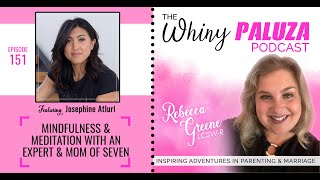
In this Whiny Palooza podcast episode, host Rebecca Greene interviews Josephine Atluri, a certified meditation and mindfulness coach, author, and mother of seven children created through IVF, international adoption, and surrogacy. Josephine shares how the chaos of raising a large, blended family led her to discover mindfulness as a way to find inner calm. She clarifies the difference between mindfulness (an ongoing awareness of self, body, emotions, and environment) and meditation (one modality under the mindfulness umbrella). She offers practical, low‑barrier techniques for busy parents, focusing on a simple breath‑counting exercise (inhale 4 seconds, exhale 6 seconds) and explains the physiological benefits of slower breathing. Josephine advises starting with a few minutes a day, tying the practice to existing routines, and gradually increasing duration. The conversation moves to the value of mindfulness in schools, how it empowers children with coping tools, and the importance of modeling calm behavior for kids. Josephine provides twin‑parenting tips, emphasizing treating each child as an individual, using organization, and leveraging partner support. She discusses the emotional challenges of IVF, adoption, and surrogacy, highlighting the need for open communication, acknowledging feelings like jealousy or guilt, and building relationships with surrogates and agencies. Throughout, she stresses self‑compassion, letting go of perfection, and giving oneself grace. The episode concludes with Josephine sharing her website (jatluri.com), books (Mindfulness Journal for Parents; 5‑Minute Mindfulness for Pregnancy), an online course, her podcast "Responding to Life," and Instagram presence, inviting listeners to access her resources.
Chapters
No need to whine, it's whiny palooza. Have some wine and join us on the whiny palooza podcast with Rebecca Green.
Welcome to the whiny palooza podcast. I'm your host, Rebecca Green. I'm a wife, mother of 3, and licensed clinical social worker. I also have 3 fur babies at home too. My passion has always been to help children and their families. I always dreamed of being a wife and a mother. Parents are always learning through their struggles, failures, and successes and joys. I am no stranger to this wild ride of parenting, and I know behind every great parent lies a team of supportive friends and family. I want to be part of your support system. I want you to know that you are not alone. We are in this parenting world together. Join me every week for insightful discussions with experts on parenting and marriage, as well as other parents who have found the secret to successes in parenthood. You'll learn tips and tricks to make life with your family better than ever. I hope you will follow along with me while we dive into what it takes to achieve a happy family.
Hello everyone. This is Rebecca Green for the Whiny Palooza podcast, and I am very excited today to have Josephine Atlery with us. Today. Thank you, Josephine, for being here.
Thanks so much for having me on your show. I'm so excited to be here.
I'm so excited to have you, and your topic is so needed. Um, she is an expert in meditation and mindfulness, helping thousands of people overcome adversity to find joy. A graduate of the University of Chicago, Josephine coupled her consulting background with her passion for total wellness to become certified as a meditation coach and teach corporate mindfulness. Plus, her experience creating her modern-day family of 7 children— oh my goodness— via in vitro fertilization, international adoption, and surrogacy inspires her work as a highly sought-after fertility and parenting mindfulness coach. Atlery hosts a popular podcast, Responding to Life, talking health, fertility, and parenthood, where she interviews guests on their inspiring responses to life's challenges. Her parenting mindfulness expertise and fertility advocacy work has been featured in the LA Times, Motherly, MindBodyGreen, The Bump, Prevention, Well+Good, and Women's Day. She is the author of Mindfulness Journal for Parents and the forthcoming 5-Minute Mindfulness for Pregnancy: Simple Practices to Feel Calm, Present, and Connected to Your Baby, coming in the spring of 2022. Well, that is very impressive.
Thank you.
This, this is a topic we all can benefit from. Everybody needs to be more mindful in their life and practice meditation. But I would love to start with finding out what inspired you to become an expert in mindfulness and meditation.
Mm-hmm. Yeah, no, that's a great question. I joke about it, but it's actually pretty true. I joke that it's because of the children that it led me to try and seek some inner calm because I felt like I was in the eye of the storm, or I felt like I was constantly surrounded by chaos. Yeah, it was pulling me in. And so if you think of the eye of a storm, it's pretty calm and quiet in it inside that funnel. And so that was what I wanted to be like. And that is definitely what I achieved once I started to, to dabble in mindfulness and meditation for myself. And then once I took it a step further and received my certification and training, it definitely did become that on a day-to-day basis. And after I saw how it was working for me, I just felt called to try and help other parents, especially as I increased number of children and people kept asking me like, how do you do it? How do you do it? Well, This is definitely one of the ways.
Well, that, that sounds like a fabulous answer and makes so much sense because every mom I talk to is so stressed out. And, you know, it's such a busy time of year. We're all juggling so much. Can you help parents build mindfulness and meditation into our days? What can we do?
Yeah. That, you know, I just— let me backtrack a little bit in terms of what mindfulness is. And yes, I think that it, it just means meditation, but it doesn't. Meditation is one of the modalities under this big umbrella of mindfulness. And so mindfulness is awareness. It's an awareness of yourself, your body, your mind, your emotions. It then extends to an awareness of your environment, and then, and awareness of your interactions with other people, like how the people are coming towards you, what their feelings are, and just being present to them, right? And that extends to being present for your family, for your children. And so when you think about it in that regard, then it can be applied to so many things in our, in our lives. It doesn't have to be just, um, like a time where you go off and sit in silence and meditate. Mindfulness can then be a way of life, which is how I like to advise it to be, where you incorporate into everything that you do so that it makes you— enriches your life, because now you're being present to it, and you're aware of everything that's happening versus as moms, instead of running on autopilot, multitasking, and not really being present for each thing that's happening. That's, you know, one of the, like, one of the big aha moments for me before I started meditation and mindfulness was when I found myself with my newborn boys who are now 6. And I was working at the time. And I remember being with them, like taking care of them in the morning. But as I thought about it in the evening, I couldn't remember what happened. Like, I could not remember what I said to them, like exactly what we did. I remember being there, but not the details. And that's because I was working on my phone, sending emails, thinking about all the other things. I wasn't present. And for me, that was that moment where I knew I needed to change something. And so to try and work it as busy into our lives as busy parents, um, you can do a number of things. So it doesn't have to be meditation, but we can certainly talk about that. It can also be other mindfulness strategies like journaling, mindful movement, breathwork, like breathing techniques, visualization, and so many different things. And I like to bring that up because I'd hate for someone to think that mindfulness wasn't within their reach, just because they had tried meditation once and it didn't work out, or they tried journaling and they just didn't have the time time for it. You know, that's the common— that's a common concern that I have from parents is that they just don't have the time to add something new, no matter how beneficial it is for them, right? It's like eating chia seeds or like working out and all this. Why have the capacity to add this new thing or add more time to an already packed schedule? So what I like to advise, and this is coming, I feel like having the 7 kiddos gives me a little bit of street cred because then I can say, listen, I tried it and you can do it in this way. So one thing that I like to advise in terms of if you're— especially if you're new to mindfulness, is to try out a breathing technique because we all have to breathe. We all do it automatically anyway. So why not turn it into something that can really be beneficial for us? I mean, it already is beneficial for us, but as a calming strategy to help us move through life and help us tap into that inner calm so we can be more present and have more clarity in what we're doing. So an example of a breathing technique is just counting your breath. So counting your inhale, say, for 4 seconds, and then exhaling, say, for 6 seconds. And hopefully you were counting on your own, and you can keep doing this as we're talking. When you have to keep count of your breath and you manipulate your breath in a certain way, uh, two things are happening. One is that now you're— you've shifted your focus to yourself and into, um, how that breath is moving in and out of your body. So you're becoming more aware right? And it's a little hard to think about, you know, the grocery list or the work list when you're trying to count your breath, right? That's especially if you're new to it, you're counting so that you don't mess it up. And, you know, the other thing that's happening as you're doing that though is that you're telling your brain that you're calming yourself down, that because your breath is slowing down, you may not be in that triggered state anymore. You know, when we're breathing shallowly, when we're breathing really fast, or even holding our breath, when we're trying to do so many things at once, that sends a signal to our brain that we might be in a state of, um, of danger, right? Back in the day, that's what was happening to us. Um, but we're now living in the present day. We're not cavemen anymore, but our bodies still think we're in a state of fight or flight. And so it's trying to prioritize our survival. But when that happens, lots of other things shut down, like our immune system, our reproductive system, our digestive system, because it's trying to prioritize our survival. And so we don't know those things are happening, but they are. And so once you start to slow down that breath, maybe you'll notice after a couple repetitions that your heartbeat is slowing down. Maybe you notice that you were hot before, you were sweating, and now your body is cooling. Um, if you took your blood pressure, maybe you'll notice, or if you're wearing one of those Apple Watches or something that monitors your heart rate and your blood pressure, then maybe you'll see that it's also going down. And that was all in your control. That was all something that you did by utilizing a breathing technique. And so For me, when I try to introduce mindfulness to parents, that's kind of my number one go-to because it doesn't force a parent to try to ascribe to something that's completely different that they may not understand fully or be intimidated by. Breathing is something we all know and can do. And the beauty of this is that you can take it a step further and turn it into a meditation if you wanted. You can close your eyes. You can sit somewhere maybe a little bit quieter and do it for 2 to 3 minutes. And your point of focus is your breath. And you're just sitting there and you're breathing and you're counting. And that's a great way to start. And you can do this anywhere, right? It doesn't require you to have any tools or any apps or anything like that. You're just counting your breath. So you can do it when you're sitting and waiting for your child coming out from school or in between activities or Or when you're sitting at work and you need to kind of refresh yourself, gives you a big boost, right? So that would be a long answer to your question.
Great answer. I guess so. I guess what I'm wondering as I'm listening to you is, you know, my eyes opened at 5:45 this morning and I'll probably go to sleep at like 11 tonight. Okay, so within that span of time, like, what is your recommendation of how often we should be practicing something like this?
Yep. So if you're new to it, I— or maybe you tried it before and then you haven't kept up regularly with it, I would just try it once a day. So try something for a few minutes a day because the last thing that you want to do is to try to overachieve and not be able to meet your expectations and your goals, and then you feel like you're a failure and that it's not working, and then you don't want to do it, right? So baby steps with anything, much like we tell our children. So, yes, laugh for a couple of minutes each day, and then once you get the hang of it, then add another minute. Um, and then to that point of trying to incorporate it into your day, be honest with yourself and realistic. Every day is different too, by the way. So if you know that today would be— or like, you know, that tomorrow, for example, looking forward, that, you know, the morning is a little bit easier for you. So then plan to do your mindful activity in the morning, even taking that extra step of putting it in your calendar so that it's in there, right? And you don't have to think about it. And even tying it to something that's already an existing ritual. So if you put it in your morning routine next to something you already do very regularly, then there's greater chance of success. So put it in your calendar, be honest with yourself about when it can actually happen on that given day, and, um, tying it to something that's already consistent, those will help you ensure success and keeping it short and simple. At the very beginning are all great ways to try and build this new habit, this new routine that make it feel more approachable and accessible and realistic.
That's real— really, really good advice because I think a lot of us jump in too big when we're starting something new and set ourselves up for failure. So that's really good advice.
Yeah.
I talked to my 13-year-old about you, and I said, I'm so excited to talk to her, and I'm wondering if you have any questions for her. And she said, well, I do.
Oh, okay.
She said, what do you think of meditation and mindfulness being practiced in schools?
Oh, okay. Okay. I love this question. And I love that you had your— asked your 13-year-old. I have 13-year-old twins. A boy and a girl twin, and I just, I love talking to them. Anyway, so there's, they, they come from a completely different perspective and it just, I always get fascinated by the things that they bring up. So what do I think? I love it. Obviously I love it. I think I started to see it in my children's school pre-pandemic. I know that it's, it has increased definitely. Now that we're like post or in like past the beginning years of the pandemic. And so schools are trying to find ways to help children sort of have calming strategies and things like that. But I was seeing it before and I was so happy to see it. And I think it's a great way to introduce to children that they have an ability to, to handle any overwhelming feelings, any situations themselves, like in that moment, right? I mean, obviously, if it's a big thing, you need to go to an adult. But to have coping strategies is really empowering, right? And it also opens up a conversation about mental health and stress that I don't remember having that discussion when I was growing up. And I think that was a disservice to people back then because it was all sort of hush-hush, like, but I didn't understand how I could take care of myself. But empowering our children to be able to do so and having that, at least that open conversation of like, well, here's one tool for you. There are many other tools. We're not saying that this is the only way to do it, but here's one thing that you can try to do while you're in school or while you're doing your homework that may work for you, you know, and then, and then opening it up to a wider, wider range of things, especially as children start to get older. You know, I also have a 15-year-old, so in high school it's a huge thing to have to try and incorporate sort of mental health strategies for the kiddos, especially as they're nearing towards college application time. I mean, it's a big deal and they go through so much stress. I don't remember, like, I was stressed out in high school and stuff and college, but I feel like it's a whole different world now for them. And they, it needs to be a part of their daily lives. To be able to introduce some intercom so that they can feel like they have some agency in their lives and that they can feel like things aren't as overwhelming as they may feel in the moment. So I love that question. Please tell your child. Thank you.
I asked her on purpose because I wish that you could see her. Like I wish I could send you to school. I dropped her off this morning and like she was like off, like, you know, you just saw the mind racing and the breathing racing and I've seen her at school racing through the hallway and I'm like, just like slow yourself down. And I saw this morning that I have made like zero progress. So I definitely need to work on this for her to like slow herself down. What, like whether she's in in the hallway or about to take a test, like, I would love to see her have more of an inner calm.
Yeah, yeah, no, it, you know, I totally understand where you're coming from. I feel like it just keeps getting worse, right, with age. And one, one thing that at least for the, for any age, really, one thing I tell parents is that our children are always looking to us and kind of take cues from us, whether we realize it or not. Doesn't matter the age of the child. I have children from like, they're almost 1 to 15. And all of them, all of them are really watching what me and my partner do. And so for example, like my 6-year-olds, they will see me meditating You know, they used to walk in and see me, and then it just would be like this normal thing, right? And they would see me— perhaps the other older kids would see me in a very frustrating situation, LA traffic, I'm driving, I'm really stressed— and they'll see me utilize a breathing strategy right there in the moment, like deep breathing. Like, it's very noticeable because I'm like, the exhale is loud and it's really long and like all this stuff. And so it becomes normalized for them. And they get to see that this is how mom is, this is how she's coping. This is how she is trying to calm herself down. And it's working for her. And so this may be something that I can do, or I can try. And it's not, doesn't become so taboo or so weird or like woo woo, as people call it. You know, it's within their reach. And it's a way that has worked for their own parents. And so now I see it, I see them in various capacities and degrees using those same strategies, which every time I see it happening, I'm like, yes!
I know, it's such a success as a parent when you see your children do something that you've been like hoping for and trying to model for them. So I will model this. I'm on it. This is so good for me because I'm going to slow myself down and I hope that it's going to ripple to Ella.
Yeah. Yeah. And not to put pressure on yourself, right? I think that's a huge piece of it is just the weight of expectations for parents is that we carry so much of like, we're supposed to be doing this, we should be doing this. Do it for yourself and then it'll start to feel good and it will ripple out. Hopefully.
For sure, for sure. Now you have 7 children. You've mentioned some of them. Can you tell us all of their ages and then tell us how on earth you are balancing all of this?
Yep, so my eldest is, um, 15. Uh, we adopted him from Kazakhstan. And then I have— my next ones are, um, boy-girl twins who are 13. And then I carried them through IVF. And then the next set are twin boys who are 6, and that was our first time partnering with a surrogate. And then my very last set of twins, so 3 sets of twins, one of each kind, are girls, and they're turning 1 on Friday. And we partnered with a different surrogate to bring them into what I call our modern-day family. So it is a little crazy over here. I don't know if you noticed I was huffing and puffing when I came onto, onto the Zoom because it's 7:30 here and it was like I had to get everyone out of the door except for the babies. And so it's a little chaotic. But to answer your question, because I get it all the time, like, how do you do it? Because I'm working and I'm raising all these kiddos. And I mean, one of them is it takes a village. So I'm fortunate that I have a a lot of help, and I think that shouldn't be sort of like looked over because that's a huge reason why I'm able to do what I'm able to do. And I am a huge planner. I used to like before, like a Renaissance woman, because I've had so many different careers. Like, I just love to try different things. So at one point in my life, I did have an event planning company. And so I'm very meticulous about. Yeah, which is why actually I thought I never could meditate. So I hear this from people all the time. Oh, I can't meditate. I can't shut off my mind. Like, I'm the queen of lists, and I'll stop them right there. I'm like, you are not the queen of lists. I am, because I used to plan weddings down to 5-minute increments. And so like, that's just how my brain works, but I'm able to do it. So you can do it too, right? But yeah, so, you know, help— like, it takes a village. A lot of organization, a lot of mindfulness, and a lot of letting things go. I think that was a big hang-up for me, like, early on in marriage and also in being a parent, was that everything just had to be perfect and just so. And with the more children I added and with my mindfulness meditation practice growing, I just realized that there are just some things that I can't hold on to. It just will drive me crazy, and that's not to my benefit. So I've had to learn how to triage things. Um, so that's kind of my short answer for—
no, it's really— no, it's really good. And, um, you said something so important that I've learned, um, is letting things go. Because with, you know, with my first child, my house had to be perfect. And by the third child, I was going to bed and I didn't even look at what the house looked like. I was so tired. So I mean, is that an example? Like, what kind of things are you learning to let go of?
Yes, exactly. And see, that is really being mindful, right? You, by, by that third child, you're tuning into like how you're feeling. And so that's, that's kind of how mindfulness works is like if you take that time to pause, like take a few breaths, and then you can sort of process what's happening, like, okay, well, this is all that's happening, XYZ. But this is also how I'm feeling. And then from there, you can like pivot and make a decision. Alright, I could stay up and clean this house, because it is a mess. If I really take a look. Turn on all the lights and just mess, or I can honor how I'm feeling right now, which is exhausted, and I need rest, and make that choice. But you are doing so from a place of clarity and awareness, um, versus reverting to that autopilot state of where you're just trying to like do everything, you're just doing everything and trying to also live up to these expectations. But yeah, to answer your question, like, that's how, that's, you know, how it kind of unfolds for me as well. It's, it's deciding, do I really need to clean that up or not? Do I really need to do this extra thing with my child or for my child? Do they even really want to do it? Am I like forcing it? So it's a constant conversation in my head of like asking myself, do I need to do this? Do I need to do that? Is this serving me? Am I being truthful to myself in terms of how I'm feeling? What am I feeling in this moment? How is this making me feel? Like a ton of questions, right? But that's really leading you into just to be aware. Like, that's you being aware of what's happening and trying to get at the root of like what that situation is. If it's based on expectations or need, and what is really important in that moment.
So I really appreciate you explaining that because I had no idea that that was an example of mindfulness. So I'm feeling proud of myself right now because I didn't know that.
Well, you were tuning— hopefully you were like really witnessing, right? And it was in that moment you thought to yourself, I am feeling tired. I'm exhausted. I don't want to do this right now. And so imagine taking that a step further and always living in that capacity of awareness. I mean, it would just benefit you and your family so much.
I know. I'm laughing because the eye doctor was like, have you been noticing that your contacts were bothering you? And I was like, well, yeah. And she was like, can you start listening to your body a little bit more. Like your body was saying, give yourself a break and you weren't listening. So that I could have been more mindful with my content. So you have 3 sets of twins. I mean, we have to talk about this. I'm sure you have tips for mothers with twins. How on earth, like give us some twin tips. That's amazing.
Oh yeah, twin tips. It's so weird because now it just seems like that's how you're supposed to have kids.
Wow, I can't imagine.
Like, um, that's how my husband and I operate. I think one big thing is to take into account that they are, um, they're different. Yeah, so with twins it's really easy to kind of rope them as a unit Um, and I'm not talking just about like having two separate birthday cakes, which I've read is like a huge thing. Like, oh, growing up we always only had one cake but we're two people. But you can extend that out further into not roping them together even though it's so much easier. It takes a moment of that, just that pause to remember, okay, this person has these specific needs and be aware of that and operate from that point of view, and this twin has their own set of needs, and it's different. It takes a little bit more time, um, obviously, and it takes some juggling because you kind of need to separate and take time for each. So that's something that I would always keep in mind, especially if you have the benefit of having a partner so that you can kind of tag team, so that one person can really give undivided attention to that one child with whatever it is that they need instead of sort of addressing them together, especially as they get older. I mean, it's easier to do it with same-sex. You can fall into that trap so much easier. For us, with our older ones, it was, it was boy and girl. So after they got to a certain age, more recently because of adolescence, is that their needs and situations have started to just really shift. Teen boy, teen girl, just a little different. And so just naturally, we've had to sort of tackle them separately. But I can see myself already falling into that trap with the 6-year-old. So I constantly have to just, you know, stop and do a check-in and remember, okay, well, they're very different. So address them differently. So that's Perhaps my biggest, my biggest tip for twin parents, especially new twin parents, and I just— organization is really, really key with the 3 sets of twins.
Yeah, organization, I think, is the key to a lot of success in life is what I am figuring out along the way. Yeah, even though I resist it sometimes. Well, and you know, I'm so fascinated by this because, you know, through adoption and IVF, um, I mean, you talk about, you talk about being connected, how you can be connected through these experiences, the surrogacy, the adoption. How can parents stay connected through these processes?
Yeah, that it's hard because I, you know, I liken my experience with adoption and surrogacy to what my partner probably and most likely felt like.
Yes.
My, my own pregnancy and throughout the whole IVF process. You know, you're, you're so well-intentioned, you want to help out, you, you're a part of the process, but you're not really a part of like the inner workings, the physical part of the process. So it's really hard to know what to do, and you kind of are left, um, you know, you're just waiting for the other person, the one who's physically going through it, or maybe just the agency that you're working with, to let you know what it is that needs to happen. So a lot of that is, um, kind of navigating whatever issues come up. That's a big piece because you don't think that a lot of these issues will, will happen for you, like feelings of jealousy or like shame or guilt or sadness, but they're there. And then we try— a lot of times people don't want to face those things because they're trying to focus on like the happiness of it. But I think it's a big, big piece to be able to acknowledge those feelings or even to just sit with them and to know that they're there and, and tell yourself that it's okay to feel these things, that it's normal so that you don't have them in the back of your mind and that it's just weighing on you and really coloring your experience. So that was something I definitely learned throughout the IVF, the adoption process and both surrogacy processes. Like it just, I had to keep instilling that in myself. And then in terms of actual connection, once you are able to realize that, all those feelings that you have around it, then to stay as much communication as you can with the agency, with the person who is carrying your child, and trying to find sort of a connection that works for both parties, right? Like, I was able to forge quite a very, like, a very personal relationship with our surrogates, but it was hard because we didn't have any guidelines for how to forge this relationship. I mean, um, but it, you know, it took some time and definitely Once they became pregnant, it was a lot easier to do because we had something to talk about and something to sort of monitor and all this stuff. But it definitely does take some effort, much like you hear the adage of like marriage takes work. Well, forging these like connections and these relationships when it involves a third party to create your family also requires that same amount of communication and work.
That makes so much sense. It's, it's another relationship.
Yeah.
Right. It's another relationship that you're staying connected to and putting the work into. I mean, your whole journey is so fascinating to me. I can't believe everything you've been through. I can't believe that you're raising 7 kids because I find 3 kids to be a lot.
Oh, it's a lot. When we went from 1 to 3, I was like, ah, I know.
It's like going from 1 to anything is like you're trying to learn how to like juggle it. But, um, I mean, I could talk to you all day, but, um, tell us what— if there's anything else that you would like to share that I didn't think to ask you.
Uh, you know, just one thing is especially with May's like maternal mental health awareness and all this stuff, just to give yourself some grace. And a tenet of a big pillar of mindfulness is about judgment and not judging yourself or the experience as you're trying it. So when you are able to sort of push the judgment aside, you can really allow the experience to unfold. And the same can be said for just motherhood in general, and parenting in general. If we are able to give ourselves some grace and compassion, just like we're telling our own children, then we can really just be open to whatever happens, be vulnerable to whatever happens, and beauty comes out of that.
I love that so much. Can you please tell everyone where to find you and your books?
Yeah, yeah. So my website is jatluri.com, J-A-T-L-U-R-I. You can find my books, Mindfulness Journal for Parents, and the new one, which is 5 Minute Mindfulness for Pregnancy, both on Amazon. But if you wanted to purchase the online companion course, you can do that on my website. And that's for people if they feel intimidated by trying out any of the practices in my book. A lot of them um, on the online self-paced course, I'll guide you on it and in like a video format. So, um, you're not just out there trying to do it by yourself. And then you can also, um, connect with me on my podcast, Responding to Life, talking health, fertility, and parenthood. And then on Instagram, I'm on there daily offering mindfulness tips, um, parenting inspo, you name it. So I'd love it.
Well, I'm going to go find you right now because I need mindfulness and parenting inspiration every day. And I can't thank you enough for joining me. I absolutely loved talking to you.
Oh, same here. Thank you so much for this opportunity.
I feel so much more peaceful than when I started. When I started, I was like, let's go! And now I'm like, okay, I'm calm.
Oh, great. You can model it for your daughter.
I'm going to go model it because I'm going to go pick her up for the orthodontist.
Oh, that's right. Yeah, that's right.
Yes.
Yeah, you can practice. So thank you so much.
This is Rebecca Green reminding everyone to spend every day laughing, learning, and loving.
Thank you for tuning in to the Winey Palooza podcast. If you like what you heard, please be sure to subscribe so you never miss an episode. While you are there, leave a review. I love to hear your feedback. Thank you so much for listening. Until next time.
This show has been produced by Market Domination LLC. To discover how you can have your own show completely done for you and turn it into a real published book and become the authority in your marketplace, go to www.marketdominationllc.com/podcastoffer.










