Episode 153 No Longer Burned Out On Busy
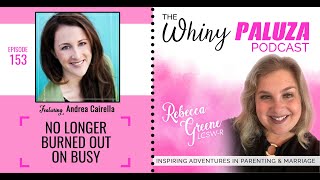
In this episode of the Whiny Palooza podcast, host Rebecca Greene (a licensed clinical social worker, mother of three) interviews Andrea Carella, an LPCC, psychotherapist, speaker, and author of the bestseller No Longer Burned Out on Busy. The conversation begins with Carella’s personal journey into therapy, sparked by a supportive high‑school counselor, and moves into a deep exploration of why many women, especially mothers, feel chronically over‑busy. Carella explains that modern patriarchal structures prioritize linear, masculine productivity, which clashes with women’s natural, cyclical rhythms tied to lunar cycles, seasons, and the body’s four‑quarter (including the “fourth trimester”) patterns. She introduces her CARE Approach and Feminine Freedom Method, which aim to help women harmonize ambition with flow rather than striving for balance. Practical, micro‑step strategies are discussed: pausing to breathe, setting boundaries, using “tuning‑fork” moments, and integrating small, intentional actions throughout the day. Carella describes her book’s format—short “drops” of insight, exercises, and reflection questions designed for busy readers—and promotes its availability on Amazon and Audible. She also shares information about her upcoming women’s retreat and the broader vision of building a supportive sisterhood. Throughout, the dialogue emphasizes spirituality as an internal source, the importance of honoring one’s own cycles, and reclaiming power through self‑care and boundary‑setting. The episode closes with gratitude, a reminder to laugh, learn, and love, and a call to subscribe.
Chapters
No need to whine, it's whiny palooza. Have some wine and join us on the whiny palooza podcast with Rebecca Green.
Welcome to the whiny palooza podcast. I'm your host, Rebecca Green. I'm a wife, mother of 3, and licensed clinical social worker. I also have 3 fur babies at home too. My passion has always been to help children and their families. I always dreamed of being a wife and a mother. Parents are always learning through their struggles, failures, and successes and joys. I am no stranger to this wild ride of parenting, and I know behind every great parent lies a team of supportive friends and family. I want to be part of your support system. I want you to know that you are not alone. We are in this parenting world together. Join me every week for insightful discussions with experts on parenting and marriage, as well as other parents who have found the secret to successes in parenthood. You'll learn tips and tricks to make life with your family better than ever. I hope you will follow along with me while we dive into what it takes to achieve a happy family.
Hello everyone. This is Rebecca Green for the Whining Palooza podcast, and I am very excited today to have Andrea Carella on my podcast today. Andrea, thank you so much for being here with us.
Thank you so much for having me. I'm so excited to be here.
I've been so excited to talk to you. I told you before I started that I've been reading about you and watching you on YouTube, and she's doing so much good stuff. Andrea is a psychotherapist. Well, what is LPCC? Let me ask you that.
Licensed Professional Clinical Counselor. So I got my master's in counseling and specialized license.
Yeah, I love it. Okay, so she's an LPCC. Is a psychotherapist, consultant, speaker, and international bestselling author of No Longer Burned Out on Busy. I mean, how better of a title can you get than that? Andrea is founder and CEO of Andrea Carella International and has served as an advisor to inter— innovative entrepreneurs, CEOs, Fortune 500 leaders, corporate professionals, and mothers seeking a thrive thriving life-work balance. She is the creator of the CARE Approach and the Feminine Freedom Method, two methodologies— if I could talk today— two methodologies which support women leaders in all dimensions of life. Well, all of that certainly sounds amazing to me. Sign me up, Andrea.
Yes, let's do it. Let's do it. Let's talk about all of it. Open up the hood.
There, there's so— I have so many questions for you, but I want to start with what inspired you to become a therapist?
Oh gosh, that's a good question. I, I knew when I was 15 years old after going to see a counselor myself when I was in high school, and I went to the school counselor and I just kind of started opening up, and she— I felt so supported and safe and understood and guided. In a way that I hadn't felt really fully, like fully seen, fully heard, fully understood, respected, somebody present with me leaning into areas that I was trying to figure out. And just to have that level of support and receive that, and just her like compassionate, loving eyes and patience. I just looked at her and I said, wow, she gets paid to do this all day long and does so, so much good. And I said, that's what I want to do. Like, it felt like my soul and my heart knew that's my calling. Oh, that's what I meant to do.
I love that story. That's a good experience to lead you to doing therapy.
Totally. Yeah. And I've, I've just had a lot of mentors since then and other therapists and and mentors and, you know, guides that have really helped continue to nurture that and deepen that and enrich that even further. And then the more that you do that as a, as a clinician, the more capacity you have, the more skills you have, the more tools, the more resources you have to share and to give and to teach and pay it forward so that more people get this medicine, you know, this soul medicine, this heart medicine. That we also desperately need. Really, everyone needs to be seen and heard and known and loved, really truly understood.
You're already touching my heart and we just started.
We both might cry, it's okay.
I am a crier, I will tell you.
You know, it's, yeah, it's, you know, it's just, I don't know, I like to speak from the heart and authentically and So it's just, that's the real truth of my journey, my starting point of the journey. Well, actually, maybe not the starting point, but one of the key ones that started me on the path of my career and my calling.
Well, that is wonderful. And it sounds like you landed exactly where you were supposed to land and you are helping so many people. And I, I tend to talk to a lot of mothers. And the mothers are struggling. They're struggling with their work-life balance. Why do you think that is? Why do we all struggle so much with that?
Oh, this is a really, really important, and it may seem like a simple answer, but I'm going to go into a little bit of history. Yeah. Okay. Now we as women are nurturers, maternal, relational. We're, we're built to, to care. We're built to love at a great level, just like Mother Earth. You know, she is so generous with all the beauty and prosperity. And we as women have that wired and that fires inside of us. Now, I think when you have this power this beauty, this love, this generosity. You want everyone to, to be in collaborative connection with that, to, to share, reciprocate, give and receive this beautiful energy. However, in our society, the structure, the system that, that we live in, for lack of a better term, the patriarchy is— has been built with a very masculine energy. Now, there's nothing wrong with that. I love men. I love my husband, you know. So please keep your ears open, you know. I'm not— I'm not here to bash anybody or bash another gender. I'm talking more about a system and a structure and a way of operating that has more of a linear, more of a mission, goal, uh, driver kind of energy, like a hunter. So I, I'm just using as a point of reference, not as a, this is better than that, because they're both necessary, they're both important for our system and our society to function. However, I think that there are some voices that are missing at the table in creating and building that structure, and the voices that have been missing in building that structure have been women. With all their gifts and their beauty and their offerings that may not just be objective, goal, drive, push, a 24-hour, you know, schedule to operate within that schedule. That— and so I think a lot of women, you know, not knowing this, may be in this system. And just like anybody that is of a minority group, feels a little bit like I operate a little bit different, or I have a different language, or I have a different rhythm, or I have a different way. And sometimes when we bump up against that system that is really strong and really powerful, that's been here for thousands of years, we can look at that system and not see that there is a system. That's, that's the reality, is that we think that there's not that structure that is working in it against our natural way and natural rhythm and our natural gifts. And so that's the rub, that's the challenge. I think if we're not conscious of it, we're not talking about it, like I'm kind of shining a light on it, that it's like we don't know what we don't know. But I really think that that's really the starting point of that. And so if we can start there and say, okay, I'm not wrong, it's not that I'm not enough, because I can't keep up with this intensity. We have to actually have a different conversation with ourselves and have a different exploration of how, how does, how is my natural rhythm, which is the natural rhythm of the moon cycle, which is a 28-day cycle, not a 24-hour cycle. 24-hour cycle is very, very fast. That gets us into the sympathetic nervous system that we have to operate at the set of sympathetic nervous system and all this. I don't know. We operate on the lunar cycle. We operate on the, the rhythm of the seasons. So if you think about the season is not a day, it's 365 days. So women's rhythm naturally is about more integration. We integrate, we, we, we settle, we sit, we, we percolate. We just like when we birth a baby, right? It's not like we decide that we want to have a baby and boom, the baby arrives. That would be a very masculine way of birthing a child in our system. And so the expectation is that level of tenacity, that level of drive, that level of output. However, the natural rhythm of a woman is like conceiving, the first trimester, even as I'm talking, right? When I change the rhythm of how I'm talking, women's nervous systems start settling in a different way. We're able to land somewhere. We're not a butterfly, but we operate in this system in order to survive the system or thrive or function, or, and we get positive reinforcement for it, by the way.
Yeah.
To try to be more, to be everything, to be who we are. At this natural pace and add to our plate, operate at this high level of intensity on top of it. And so part of it as women is learning and knowing and trusting who we innately really are and creating time and space for that natural rhythm to be nurtured by us first, because the system is not built to do it for us, or going to change anytime soon because we're not at the table yet fully. I mean, there's some people at the table, there's some women leaders at the table in businesses, you know, and in, in politics, but until it's equitable, 50/50, really, we're not— even men need this, need this shift in their nervous system, by the way. Okay. So the medicine that women have to offer is not just medicine for women. The medicine of this shift of this. And this pandemic has really activated us to— not activated us, slowed us down to sit in a parasympathetic nervous system. Now, we don't like if we're in a parasympathetic nervous system. We're not used to being in a parasympathetic nervous system. We're going to try to do anything that we can to get back to familiar. But familiar, just like family, isn't always normal, right? Familiar doesn't have— isn't always— it may feel familiar, but it may not be right or comfortable. And so part of it is we have to learn how to dance both in the movement in an integrated, healthy way, not in a sporadic, panicked, stress way, but in a, in a, in like, there can be movement, forward movement still, but it needs to be intentional for it to be functional. It needs to be fluid for it to be functional. It needs to be conscious in order to be functional. So we need to channel that energy in a rhythm, in a way, and the women and men can benefit from this, this moon cycle energy, this you know, the, the entire process of the entire season of a year, the seasons, every single season. It's not just perpetual spring and perpetual summer that are the only ones that are significant, important, or valuable. Fall of shedding and sorting and letting go is just as important. As creation of flowers, of planting seeds and seeing them realize. And the wintertime that may feel uncomfortable to some of us to be in this still fertile void where we think that nothing's happening, where we question ourselves. This might— we might, you know, when we override, we get depressed actually. When we override the fall and we override the winter, the body says, no, I'm going to force you to be in the fall and the winter. You know, like, I'm forcing you to slow down. So if we don't honor it, we need to honor where we're at so we can, so we can ultimately honor where we're going. And so part of it is like being able to expand our capacity and our comfort to be in the season of fall, where things are shedding, to be in the season of, you know, winter, which menstruation is like, but it's necessary. To clean and clear. It's necessary to get really prepared. And to prepare the body, just to, like, to prepare our heart and prepare our soul and prepare to execute a project, it means intentionality. It needs stillness. It needs to turn. We need to be able to turn within and discern in the noise of this busy, loud mind of ours and the busy, loud world of ours To discern, we have to kind of come within, not just to our mind, but to our heart and to our sacral area, which is where we birth a child. That sacral— say, which comes from sacred, by the way. The sacrum is a very sacred place, and we're so disconnected, men and women, from this place. And so we operate in this agitated, anxious panicked, stressed out, burnt out alternative. And guess what? It can be so much juicier than that. It can be so much freer than that. It can be so much more beautiful than that. It can be so much more— not faux aliveness from the, the activity of like panic attack, but like true authentic vitality aliveness from the battery charge within our womb space, within our— and although men don't have wombs, they do have a sacred place, they have a sacrum as well. And so we all need to kind of slow down because the mind is a lot faster than the body. We need to slow down and start to expand our capacity to be with ourselves, to expand our capacity to enjoy. We have to slow down enough so we can actually not be outside of our body, but Settle in. Breathe in to our body, to the sacredness within, to the temple that's in our heart. And when we do that, insight and wisdom and discoveries and direction is found, not from the running and the chasing and the getting, anxious energy, because we could be like running towards something and it may totally not be for us. Right. Maybe it may, and it also might be too much, too fast, not right, and not now. Like it, so the timing is also important. And so if we don't tune into that sacred vessel or don't allow ourselves to slow down because we're uncomfortable in the uncertainty, in the, in the sorting out phase, in the fertile void place, if we don't get, expand our capacity to be comfortable, we'll never arrive to clarity. We'll think we're clear, but it'll be like a faux clarity. It'll be like a quick butterfly clarity, and then I run, and then we're like running in 3 different directions trying to cram a gallon of water into a Dixie cup. That's not a way to live. We can do so much better, and it can be so much more peaceful, and then we can share that in the world.
I, I just, that is the most beautiful answer I have ever received. Not anything that I thought that you were gonna say, and so beautiful and wise. And like, I can picture myself running around how you're describing.
I've been there too, right?
Like, just like consciously slowing myself down all day and being more present and mindful and peaceful. Like, we deserve that.
Everyone does, men and women. But the system isn't built for that. And either we need to transcend the system, start becoming a tuning fork within ourselves that reclaims our power and says, no, I choose my boundaries, what's, what's okay, what's not okay. I choose my boundaries around my time and my space and my energy. That's where we need to start. Before we start advocating for changing it out there, before we try to help other people. We first have to like make sure that we're really embodied in the medicine of living it, that it's not a lifestyle, it's a way of life. And we can start small. It doesn't have to be like, oh my gosh, now I need to sit in meditation for like 20 hours. No, we're still doing— you're still doing it the old way, right? We start with, as I'm talking to you, And as you're talking to me, we just take a breath before we say our next thought, that we pause and we feel into the question and into the answer. Maybe as we're answering the questions, we take our time with it. Maybe we slow down and we pause and we stop talking. We just listen. It could be like a pattern inter— it could be a simple pattern interruption in that moment. It's in those little moments, those little drops over time that lead to the bucket. If we're so focused on filling the bucket, we're gonna not do the drop part. Like, we're not gonna focus on the moments, the beautiful present of the present moments where we can actually integrate. We can start making it our way of being. That's what we need to do. It's in those micro moments, in those micro movements. And if we don't make it so complicated or so much that we're like so far away from it, but we realize we're, we're just there, we just, we just need to tweak and pivot a little, then we're actually going to do it. Then we're actually going to feel like we're capable of, of changing a little bit. And that's really all we need. We just need a little We just need to move the needle forward just a little. It doesn't need to be a macro movement. It can be a micro movement, and that is enough. And we're enough. What we're doing is enough. That action step is enough. And then we remember, we remember, remember that we are enough. And when we know that, we get out of the busy. Get out of the busy, and we reconnect with the gift that we already are. And we, we know, we, we tune into it, that we know what it is, we know what our medicine is. And then we start living from that place, being that person in the world, being more of that rather than the frantic faux self. We're the true self with a capital T. True self.
I like that.
And then we live there more and more every day. And then we're more— I get more of a gift in the world to our families, to our husbands, and our businesses, and our communities, and hopefully a better world that we're leaving for our children.
Really, if I am truly honest with myself, as I'm listening to you talk and I'm thinking about all of this, I didn't know how to slow down. I didn't know how. And I was in full throttle all day and started to realize that it wasn't working for me. So it's like, right, so, so it's like a little bit each day I'm trying to slow myself down a little. And it's, you know, it's nowhere near where I would like it to be, but I'm learning. And to go from full throttle to slowing yourself down is a process.
It's totally a process. Yes. And the book that I wrote, No Longer Burnt Out and Busy, which is kind of to segue, is like the tagline is a woman's guide to harmonizing ambition and flow. And I love the word harmony because I could have said the word balance. And I actually sat in meditation for a while, like, is it balance or is it harmony? I'm like, it's not about balancing. You can't balance. I mean, and do I want to be, right? But do I want to harmonize like music? Do I want to allow myself to still be the fullness of my battery charge? And but do I want to make it elegant and graceful and easy and beautiful, just like a beautiful song, right? A song has spaces in between the notes to integrate. It has space, so it's harmony, right? There's a harmony. And so if we can actually live our life like a song and we can like be at a rhythm, like create a rhythm that allows us, then now we have a visual for that, that we can actually start doing, right? And hopefully, I don't know if the, the example that I used that was kind of simple, do you feel that that's like something that you could do and then you can actually be in the, in the harmonious song a little bit? Like that you can actually feel it and know like I'm I'm already there. It's not somewhere I need to get. It's like something I'm letting occur, inviting, welcoming. It's so simple, right?
Yeah. It's a lot simpler than we— I certainly make it more complicated.
We all do because the world is so busy and we're just responding. We're reacting rather than, no, I'm going to just take a breath first. Your crisis is not my emergency. Whether it's the kid, the husband, the task, the, the boss, that, right? It's like your crisis is not your energy. You are not the tuning fork in this, in this environment. I'm feeling, especially if you're an empath, I'm an empath, so I feel people's energy. So I have to consciously ask myself, is this my energy or their energy? And do I like the energy that I'm feeling in this environment? Is this helping to support my natural rhythm of the four seasons, the rhythm of the moon, uh, the whole, you know, first trimester, third, second, third trimester, and actually fourth trimester, which is when the baby arrives, which is also a settling and integration. Am I in that rhythm? And if I'm not, then I get to decide in that moment. We all get to decide. This is, this is like boundary time. This is boundary conversation for us women, which we really, really struggle with. This is like, I think if we can master our boundaries, we reclaim our power. When a woman honors her time, this is a quote from me. When a woman honors her time and her boundaries, she reclaims her power. And the only— I'll just sit with that for a second. Because we need to breathe that in for a second. And how do we do that, Andrea? How we do that is it's in those micro moments where we remind— we remember, okay, their crisis is not my emergency. Their energy is not my problem. Their, their desire, their need is not my responsibility. Like, they are totally capable. They have the— they have light and love and wisdom and power and gifts residing and abiding inside of them too, not just me. They'll figure it out. I have confidence and trust in them. Even if it's not okay for them, maybe they're— that's their spiritual assignment. Maybe they're supposed to work through whatever that not okay is, and that's okay. It's not me to fix it and solve it and take it out of their hands and not trust them and disempower them and think it's mine to— no, let them be in the struggle because there's strength in them. Trust that there's also strength in them while they're in the struggle. And we also need to trust that within ourselves, that although I'm in a struggle, I also have strength. And so it's in those moments with ourselves and with others that we get to choose. We get to choose. Slow down, sister. This is what I tell myself. All these things that I'm telling you, all these things that I'm, I'm sharing with you, I practice. And it's— I'm not just a talking head here. Like, I am in the living, walking practice, devotion, and embodiment of this on a day-to-day, moment-to-moment basis. And it's not about perfection, it's about progress. It's like I catch myself and I'm like, I go back into that panic and I'm like, Okay, recenter, reconnect. Remember, slow down, sister. Take a breath. Now connect with my sacred vessel, my heart space. How do I want to— how do I want to show up in this moment? Who am I and how do I want to be? How do I want to respond? Do I need to respond? Maybe, maybe no response is the response. And knowing that that's also an option, right? It's in those moments. And it just takes just a moment just to kind of do what I just walked us through. And then you get to decide. You act, you don't act, you say something, you don't say something, you check in, you're like, you know what, I don't want to work on that project anymore. That project actually wasn't for me. Or it's not now, or it's too much, or I need to break it down, or I need support. When you check in, you get access. It's like the, the matriarchy and Mother Earth is so abundantly generous, right? But we deprive it, that generosity that it extends to us too, in the moments, right? We think it needs to just come from us and we just have to be an offerer of that. That that's just our only purpose. No, but Mother Earth also receives. Mother Earth receives the joy of the flower. Mother Earth receives the beauty of Yosemite and that beautiful mountain and gets to bask in the sunshine. Mother Earth also doesn't just get to give, like a masculine way of being a woman, but to embody the true feminine, we actually allow ourselves to also receive the generosity that is abundantly available to us. And it starts with the generous abundance and offering of our breath, the sacredness that resides and abides inside of us. And so we can lean into that within ourselves. We're never alone. We always have that available to us. We just need to practice in a devoted way and know that she is holding us within ourselves. And if we trust her and lean into her and foster a real relationship with her, like a friendship, like a love, like, I'm not here just to get something from you because I'm in a panic, like, no, like, I want to be, I want to be embodied with you, like that part in you, then you are always going to be okay. You're always going to know what to do when there's a challenge. You're always going to know what to say because you're leaning into that divinity, life source, life force, and you're connecting with the right place, not the just the surface activity of the, of the, not just the waves on the surface, but you're going deep into the abyss of the ocean and the depth of the ocean because we as women are deep, like we have such rich depth and beauty. And when we allow ourselves to go into that beauty and know that there's a lot there to, to offer to us first, whether it's the clarity, the direction, and the knowing, then we're not going to know exactly how to be and what steps to take and when to take a break and when to— how to, how to structure the project even. And to even know if that's even really the project meant for us right here, right now, or if maybe we're meant to do something else first, or maybe meant to make it a little bit smaller than that big project, right? Maybe like, or maybe it's meant to be bigger, or maybe it's meant to— for us to ask other people to participate and co-create that experience so that it's not all on our shoulders. We might get access to that wisdom inside of our sacred vessel and inside of our heart that says you need a little bit of help, and it's actually going to be more joyful and pleasurable and fun and abundant. And Mother Earth is all about like, oh, abundance, okay, more to join, more to, more to share, more beauty to have, more connection, more prosperity, right? So I, I think that I, I'll just leave it at that because I think that there's a lot of— I think all this needs to kind of percolate and land and, and integrate because we, we know this on a soul level, like what I'm saying, like as I'm As you're listening, you know this deeply and already, like you don't need, but sometimes we need a reminder and a remembrance. And then we can be like, yeah, I forgot about her. I have really abandoned her. I've really been ignoring her. I haven't really been fostering a relationship with her. No wonder she's so exhausted. No wonder she needs to like, you know, go on a retreat. Like she needs to like remember and find and reconnect with, with the truth, that divinity, that truth, that knowing within herself. She's to slow down and find her, listen to her own voice, not all the voices of the social scape, the noise. Of other people's expectations, the noise of our own expectations. She needs to like go deep into the abyss, abyss of the ocean, not the surface of the hurricane and the waves and the rockiness. That's not who she is. No, she's so much more. She has so much more to receive within herself. And then from that place first, then, then if she hasn't done that first, she's not ready to give to anybody else. Not ready. Not ready. Please, no thank you. Do not give me anything from your empty cup. No, no, no thank you. No, don't do that. I don't want your empty cup. You're just going to be spinning around all frantic, stressing me out, or, or, or like, do you want this? Do you need this? Do you have that? No, I've been there too.
We don't—
and we think that we're helping people. But we're, we're coming from an empty cup. Fill your cup first, sister. Not just you. I say this to my— this is me.
We need this lesson before we give birth. I'm getting this lesson very, you know, better late than never. But, um, we need this lesson before we have children.
We need this before— we need this as little girls in kindergarten.
Yes, that's better.
We need this before we venture out into the world. That's— and so we have each of us, and we can— and the thing is, the cool thing about the divine feminine is that she can bend time and space, totally bend time and space, because she's cyclical, not linear. Masculine is very linear, point A, point B. The feminine is about the seasons and the cycles and the rhythms and the moon. And so she's cyclical, she's circular. And so with that ability, energetically— and men can access this too, by the way. It's not like, oh, sorry, you're, you're an outcast like we've been an outcast. No, we're going to be much more generous to you than you were to us, men allies. And there are a lot of male allies out there. And, you know, the men that are like, no, I got this, I, you know, soldier on alone, they'll take a little bit more time to percolate. That's okay. But let's start with the allies, the men that are like, you know what, I'm on board, like, I want to, I want a piece of that, like, I want to, and we're not talking about that piece, you know, like, I want a piece of that, like, way of operating, not in a sexual way, like, I want a piece of that, like, I know, I want a piece of the divinity and the sacredness of that beautiful woman, and all that, that rhythm that she exudes, and that rhythm that she operates on, I need to find that within myself, because men have that. They don't need to obtain that of a woman. Okay, now I have it. No, that's the patriarchy. That's the old paradigm. No, men can have that medicine for themselves and they have that same access point and capability if they devote and practice. But women, actually, we have to start this, this ripple. We have to be— we are the drop and it starts with how we are our relationship with ourselves. It's the— it's the— it's not going to start with being focusing on the ripple and giving from an empty cup. No thank you, you're not ready. It's a premature offering. Go into the temple within you, root yourself like a tree in that space. Remember the beauty and the gift and the sacredness that you already truly are. Know that in your mind, in your heart, in your body, in your soul. Breathe that knowingness in and practice every day to remember when you forget. And over time, you will remember, and you— the other one will be a memory. The other way of, of identifying will be a memory, and you will You will be this. You'll be offering this, and people will feel it, and people will remember it within that. You become the tuning fork. The chaos is not the— we're not reacting to the tuning fork of the chaos. No, we are the tuning fork that is the drop and the ripple that is anchored and rooted. And it's from that place that, just like a tree, the branches come. And then it's a gift, and then everyone else gets to see and tune into that tuning fork vibration. And this pandemic, this pandemic, just like the Black Plague, the— this, it was a renaissance then and it's an awakening now.
Hmm, I like that. That's a great way to put it.
We're just in a new awakening, and it's unfamiliar, and it's scary, and we don't know because we're in the fertile void. But we have to percolate and sit, and we need to really get clear. Like, we can be in fear, like we can be in the nervous system of, of survival, or we can create a new Earth. Because in Chinese medicine— in, or not in the Chinese language, not in Chinese medicine— in the Chinese language The symbol for crisis or for, um, for danger— no, no, for crisis, for crisis— is danger and opportunity. It's actually a combination of the two symbols. So danger, let's take this, the pandemic, danger. The symbol for crisis, sorry, is danger. So we can go there, you can go to danger and panic and stress and create more of survival. And panic and more of the same old drama, stress, us versus me versus you, you know, egoic, you know, or opportunity. We can sit in the crisis, breathe, and realize there's an opportunity because everything is changing. It's always chaos and order, chaos and order. That's actually the true thing. There's nothing ever constant. Although we think that things are constant because this table is moving, but We're evolving, and honestly, everything's evolving and moving. So everything is expanding and contracting, expanding and contracting. And so if we can actually start getting comfortable with the discomfort that things are not permanent, that things are ebbing and flowing just like the ocean, just like Mother, Mother Earth, and things are expanding and contracting just like the seasons. And we actually trust it just like You know, there's things ebbing and flowing and changing, just like conception is happening so quick, right? They're so quick. We're not like, oh my gosh, just like a seed, right? It's not like we're like, oh my gosh, is something happening? Is it? We could be in that energy, but we can also trust. We can also trust that everything is working out for our greatest good, even if it doesn't feel so good in the moment. Maybe, maybe that struggle is part of like everything's working out for our greatest good so we can grow, so we can learn, so we can so we can, we can learn a deep lesson. Like I learned, I mean, this book, I mean, honestly, like everything that I'm talking about, like, I was burnt out on busy. I was stressed out. I was going in 18 different directions. I was feeling not enough. I was feeling like I needed to push and prove, like, I was in that, that space. Yeah. But I actually tuned within, like I'm telling you, and I started small. I started simple. I listened, and then I followed the breadcrumbs, and then I followed the breadcrumbs some more, and I tuned in some more, and then I followed some of the breadcrumbs. The static on the line was a little bit less— it was gone, and I could hear a little bit clearer. And then, you know, and I could tune in a little bit more, and I could trust it a little bit more, and then I could— and then I wrote this book because I got in those whispers, in those moments, was, you know, do this: slow down, focus on your spirituality. Spirituality, not religion, because spirituality and religion are two totally different things. So spirituality— there's spirituality in religion, right? But there's not always religion in spirituality. Like, religion— like, spirituality doesn't need religion to be in it. Like, spirituality can be in religion, but you don't need religion in spirituality, like, to be Spiritual— like, spirituality is that— is the— the— actually, it's the mothership, and religion's like one of those boats on the ship that you put in the ocean, like, and then there's many of them. They all go in different directions, but spirituality is the mothership of all. And so we don't— we don't need, um, there's not a middleman, you know, like, we're going wholesale here, you know, like, we're going to Costco. We're not going to like a mom-and-pop shop. Like, you know what I mean? Does this metaphor make sense?
I know exactly what you're saying. Yes.
Yeah, we don't need like a, a distributor. We're just going to the producer, the source, right? So, and we have that within ourselves. It's not outside of ourselves. It actually abides and resides inside of us too. Like, it's not like God or Divine Source said, okay, everywhere but inside of you. You know what I mean? It's like, no, me too, God. I— and it's not arrogant to see that. It's like, it's, it's actually more arrogant to deny that. Actually, it's more arrogant to deny that and think that you're so— this outfit that we have, that's, you know, our body for our soul here on planet Earth, like, that's the real us. Like, no, no, sorry, we're We're something more than that. And we need to connect to that because that's the medicine that the world needs. And we are in a great awakening now, just like the Renaissance, which was so beautiful. So we're all going through our own internal, like, opportunity to be caught up in thinking that we are at the effect of cause. You know, danger. Or we get to choose a different choice. We have a choice to actually turn within and be like, okay, it's natural for there to be ebb and flow, chaos and disorder, or chaos and order. Okay, if that's true, if what Andrea is saying, that there's chaos and order, chaos and order, and that's all the only constant, then I can like— and then I've seen it in Mother Earth, and and the moon cycle and in birthing a baby, like, okay, you know, there's things ebb and flow and things, and we learn from pain and we learn from, but we're also strength and we're also struggle and we're in pain, but we're also in expansion. We're in contraction, we're in expansion. Okay, if that's, all those things are true, then okay, I can handle that. Like that's, I can tolerate that. I can expand my capacity and then turn within. And know that I got this. Like, I'll be able to face anything. I got, I got everything I need to face, whether it's, it's, you know, danger or an opportunity. I can recycle it if I want. If it's danger and I'm like, okay, learn the lesson, but then let's recycle it. Okay, maybe that's what needed to happen.
Well, and I love that you said that you had that flow and that spirituality coming right through you when you wrote your book. Like, that is so That is a— you know that that's a good book when that happens.
Totally. Yeah, because I, I needed to integrate all that. Like, I needed— it needed to be embodied within me for it to be authentically communicated and to land on the pages for it to actually be of service to others. Like, to actually be— like, I needed to know it. I needed to be in this, my own struggle, my own challenge, my own dark places, my own shadow places. And I had to not be in denial of it. I had to acknowledge it, come to peace with it, come to terms with it, and also remember who I actually am underneath that. And then also foster a relationship with that. And so the book is actually— it's a journey for you too, in a, in a way that's broken down into bite-sized pieces because it has busy women in mind. That you literally— it's like 2 to 3 pages each little piece. It's like a little, like a bite that you can like, and it's going to be very tempting for you busy people out there to just read the whole book.
Oh yeah.
And it's not designed for that. So it's designed to help you titrate. It's actually how it's helping you to take a bite read, read the story that I share that's very relevant, that will feel like I'm talking in your head, like, oh my gosh, is she in my head? Like, oh, I've experienced that, or, right? Or it's going to be a story that really is, is touching or meaningful. And then I'm going to give you some sort of mini tool that you can use, that you can actually embody that integration and tighter integrate that the struggle, the relevance, and turn it— making it your own, a tool to embody it. And then at the end, I have a little mini reflection question that you can journal. So those are two different things that every day, it's just like one drop, one drop. And I don't know how many drops there are in the book, I need to count. But after 65 drops, let's just say you're a different person.
Oh, I wish I would have read it before I met you, but I'm gonna go get it. So tell me and everyone else where we can go get it.
Yes, so it's on Amazon, uh, and it's also on Audible. So if you have Audible, like a pile of Audibles that you need to use, you can hear my voice. Um, and, and if you want to just read it and have it so you can actually like look at the exercise and look at the reflection questions. I actually think I'm thinking of creating a journal that, that goes through like the, like a mini sentence of the exercise and then you to like reflect on what happened. I love that idea.
Yes, please do that.
And then the reflection questions that I have at the end of each chapter so that you have like a book where you can like, like actually take the time and space to really embody the work because the book is rich. But it's designed for you to take bite-sized pieces. And it's not complex. It's very simple in a very complex reality that we're living.
And it's called No Longer Burned Out on Busy.
No longer.
That's what it's called. Go get it and tell everyone where to find you. Where can everyone find Andrea?
Yes. So andreacarella.com. Uh, you can find resources there. You can find out about my women's retreats. That I run. I'm running actually a women's retreat in California. We haven't finalized the date, but it'll be June, July, or August of 2022, where we're really going to get this container, not just on an individual level, but in a collective among other women level. So it's just like, it deepens the work even more. It embodies the work. In even more in the individual level, but also in the collective. And women are very relational. It's part of our medicine in the world. And so, but women have had this history where there's like, you know, insecurities and doubts and jealousy, and, and we're gonna like, we're gonna create a safe container where we're gonna like clear all that out and create a sacred space where a new, a new relationship, a new sisterhood paradigm can be felt and met and experienced. And we're going to build a kind of community and expand from there. So we have women that have already gone on the retreats that are going to return back as ambassadors, as, as, as big sisters, so to speak, that are going to like shepherd in the youngins that it's their first retreat so that everyone feels held and safe and loved and supported and seen and heard and understood.
That's so Beautiful that you do that. I love that so much. I hope that some of the women listening will attend and get your book. And I can't tell you how much I have just loved learning from you and talking to you today.
Well, thank you so much for creating this, this time and this space to do it. I, I literally, I felt like whatever needed to come through did. And I— well, and you're gonna laugh.
It was so meaningful. I have— I don't know, I'm not going to count. Let's say I had 10 to 15 questions and I didn't need to ask them because you answered all of them.
Did I really?
You answered— I went through my questions as you were talking. I was like, is there anything that you want covered that Andrea didn't cover? You covered everything. It's just amazing to me.
Oh, that's so good. Good. I'm glad. I know I was wanting to give you time and space to ask. I'm sorry if I kind of took it, but I just was in the flow, and I—
we were in the flow.
I just felt like whatever was coming through, like wherever I segued, it was another place that we needed to land that could be rich for people to, to, to take in.
So I think it was— I think it was absolutely beautiful and meaningful, and we will all learn from it. I'm gonna— I always listen to it, you know, because I love being here with you, but I think when I sit with it and listen to it, I always take in more. So I will listen to you again.
Awesome. Sounds good.
But thank you so much for your time and expertise. I really appreciate it.
Wonderful. Thank you so much for having me. It was a pleasure.
This is Rebecca Greene reminding everyone to spend every day laughing, learning, and loving.
Thank you for tuning in to the Winey Palooza podcast. If you like what you heard, please be sure to subscribe so you never miss an episode. While you are there, leave a review. I love to hear your feedback. Thank you so much for listening. Until next time.
This show has been produced by Market Domination LLC. To discover how you can have your own show completely done for you and turn it into a real published book and become the authority in your marketplace, go to www.marketdominationllc.com/podcastoffer.










