Episode 166 Giving Children Resilience
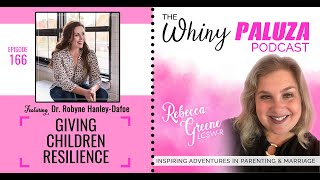
In this episode of the Whiny Palooza podcast, host Rebecca Greene, a licensed clinical social worker and mother of three, interviews Dr. Robin Hanley Defoe, a resiliency researcher, educator, and author of Calm Within the Storm: A Pathway to Everyday Resiliency. The conversation begins with Dr. Defoe’s personal back‑story—a tumultuous adolescence marked by school dropout, mental‑health crises, addiction, and a life‑changing accident at age 16—that sparked her curiosity about why some people bounce back while others stay stuck. She describes resilience as the set of traits, behaviors, and mind‑sets that enable people to recover from hardship and keep moving forward. The bulk of the interview offers concrete, parent‑focused strategies: (1) consistently tell children they can “do hard things” and nurture stick‑to‑it‑ness; (2) normalize all emotions and avoid labeling feelings as good or bad; (3) create psychological safety by avoiding perfectionism, allowing children to pursue activities that match their interests, and exposing them to varied experiences without over‑committing; (4) model resilience by verbalizing problem‑solving processes instead of silently fixing things; (5) adopt daily coping habits such as a purposeful morning routine and gentle self‑compassion in the evening; (6) differentiate between support (listening, advising, intervening) and rescue, using a three‑question check‑in with teens. Dr. Defoe also shares the most impactful advice she’s received—knowing one’s worth and recognizing life’s seasonal nature. The episode concludes with a brief promotion of her book and where listeners can find her resources online.
Chapters
No need to whine, it's Whiny Palooza! Have some wine and join us on the Whiny Palooza podcast with Rebecca Green.
Welcome to the Whiny Palooza podcast. I'm your host, Rebecca Green. I'm a wife, mother of 3, and licensed clinical social worker. I also have 3 fur babies at home too. My passion has always been to help children and their families. I always dreamed of being a wife and a mother. Parents are always learning through their struggles failures and successes and joys. I am no stranger to this wild ride of parenting, and I know behind every great parent lies a team of supportive friends and family. I want to be part of your support system. I want you to know that you are not alone. We are in this parenting world together. Join me every week for insightful discussions with experts on parenting and marriage, as well as other parents who have found the secret to successes in parenthood. You'll learn tips and tricks to make life with your family better than ever. I hope you will follow along with me while we dive into what it takes to achieve a happy family.
Hello everyone, this is Rebecca Green for the Whiny Palooza podcast, and I am so excited that Dr. Robin and I are connecting today. I have Dr. Robin Hanley Defoe with us. Robin, thank you so much for being here with me today.
Rebecca, it's my pleasure. I'm excited to spend time with you.
Me too. Me too. You have such a great topic that we all need. And I want to tell everyone a little bit about you. Dr. Robin is described as one of the most sought-after, engaging, thought-provoking, and truly transformative international speakers and scholars in her field. Dr. Robin is a multi-award-winning education and psychology instructor author, and resiliency expert. What sets Dr. Robin apart is how she learned resiliency from the ground up. As a person who has experienced significant obstacles yet forged her comeback, Dr. Robin has over 16 years of university teaching and research experience and brings a refreshing and research-informed perspective to our understanding and practices of resiliency and wellness. Dr. Robbins' work is accessible and relatable while offering practical strategies that are realistic and sustainable. Dr. Robbins' maiden book, Calm Within the Storm: A Pathway to Everyday Resiliency, released in March 2021. It's now in its third print as it makes its way into the hearts and practices of people around the globe. I love this intro. I love the work you do. Resiliency is like so needed right now, as you know. So let's jump in. And I really like to start with what inspired you to become a resiliency expert?
Oh my goodness. What a great question to start us off. So the reason I became really curious about studying human resiliency was I was somebody who very much had a really bumpy adolescence. Um, I really got off track and it started quite early, like like in retrospect, realizing there were some signs even before things got pretty dark that I was off, off course, Rebecca. And I ended up having a very tumultuous time, especially between about, you know, 14 to 17, which I think a lot of listeners can relate to, that their adolescents seem to get lost in those seasons. And for me, it became very complex. I had dropped outta school. I was suffering some major mental health episodes, addictions, a lot of risk-taking behavior. Year. So a lot of things went pretty off course quickly. Now, what was quite kind of interesting, I guess you can say, is that I did experience quite a catastrophic accident when I was 16. And that very much was this kind of catalyst, this turning point in my recovery. And I decided very much with the support of my family and my community that I, I really wanted to, to try and have a comeback. I didn't want this to define me and this be basically the trajectory I was on was not good. So after my accident, that was a really significant turning point for me where I was able to go back to school, get support, really start addressing some of the issues. And then I was, again, when I got to that university level, I was just so curious, like wondering why is it that some people can bounce back? How come some people can recover from addictions and mental health episodes and other people unfortunately get stuck and they don't seem to be able to find a path out of it? So And that's what I became really curious about is how do I be able to, how can I help other persons find their own path to a recovery, to a comeback? You know, how can they bounce back into a life they're meant to live?
Well, I love that so much. And I love that you have personal experiences that led you in that direction. I think that makes it so much more meaningful, right?
Yeah. Well, I think you can learn things. And again, I did go to university for many years afterwards and you can learn a lot about this in textbooks and theory, but there is something very unique about the lived experience. And one of the things I've tried to do in my work, uh, is to braid that together because there's a place for the research. There's a place for the scholarship, and there's also a place for our own story. So bringing those together and creating a bridge and making it accessible for other people was really important to me in the work that I do.
Awesome that you have all of those components. And I know that some of the listeners are probably going, what? Is resiliency. Can you define it for us and tell us what it means?
Oh, absolutely. And again, another great question to start with. So when we think about resiliency, it essentially isn't, you know, resiliency for resiliency's sake. It's the idea of what skills and behaviors and even kind of personalities contribute to helping people get through hard times, get through difficult situations, setbacks, disappointments, all of the kind of the bumpy, messy parts of our lives, which inevitably, we will all come upon. So the question is, is how do we bounce back? How do we let that not define us? How do we move forward, especially when it hurts and especially when it's hard? So resiliency by definition are the traits and the behaviors that we use to get back to a place of okay, get back to a place of that things will be all right.
This is a hard one. This is like a huge question. And all the parents listening are gonna say, okay, how can I help my child be more resilient? Can you give us some tips? Because I even want to know.
100%. Yes. Um, so I can tell you probably one of the most like instrumental things that we can do as parents and supporters and caregivers is to communicate to a child very, very early on, but it's also never too late that they can do hard things. And that very much is this like heart of my research, Rebecca, is helping people realize that we can actually do hard things. There's this tendency in our culture that we want to avoid pain or discomfort, or we don't want our kids to, you know, be cut from a team or not do well in school and get a bad grade. Like, we want to protect them from all of those things. And every time we do that protecting and that rescuing, we send our children the message that these are things that we should be avoiding at all costs, that mistakes are bad, or failure means that there's something wrong with us versus that we're part in that learning. So really communicating to children that they can do hard things and really encouraging that sense of what we call— it's not really an academic term, but Rebecca, with my children, we talk about it as like stick-to-it-ness, right? Like encouraging them to stick with it, trusting the process. Again, so often we're just looking at outcomes, right? Report cards, um, success, what we see on social media, but recognizing that effort and that hard work. And again, those kind of bumps and bruises and lessons learned to get us to some of those achievements, I think is where we can start. So telling children every day that they can do hard things and encouraging them to stick to it.
That is fantastic advice.
Thank you.
And as an emotional woman, as an emotional lady over here, I feel all the emotions and my husband is like, whoa. And I have had, I feel like I've had to teach him that myself and our kids are gonna experience so many emotions and that they're all like a normal part of life. We're not gonna always have the easy, good emotions.
Absolutely. Yeah. And it's interesting you say that because I, so I have 3 teenagers. My oldest is 18, 16, and 14. So I'm, I'm in the season. And, you know, I was recently talking to our daughter who was 16, and I was working on an article for another parenting report. And I said to Ava, I said, okay, so here you are, you're 16, smack in the middle of teenagerhood. What advice have I given you that you have found the most useful? Right? Like, in your 16 years of wisdom, like, what is it that's really stuck to it? And I was so— I was just so inspired by Ava's response. As she said to me, she goes, Mom, obviously I can do hard things, right? That's something that's been kind of grilled in those little ones since they were toddlers. But she said, the second piece is that, that I— I— to honor my feelings, that there's no right or wrong way to feel, and that my feelings are part of the lived experience. Like, feelings are part of nature. So trying not to feel angry, for example, is like saying not to stop the rain, right? Like, it's just so natural. And she said one of the things that she said was so helpful for her is just the fact that we destigmatize emotion, that there aren't good ones and bad ones, that essentially it's just part of what makes us who we are.
Yes. And, and that was probably a very proud mother moment for you because that's impressive that she's taking that all in.
Yeah, well, thank you for that. Yes, I, I drop the ball often in parenting. My children keep me very humble. But there are those moments when you, you know, and we, we talk a lot about our house about like, you know, operating and living within our values, like knowing what matters most and making it matter most. And there's a lot of noise and there's a lot of pressure and so much uncertainty all around us. But when you have that really solid home base, that home team philosophy, and you all, you know, show up and, you know, respect one another and respect the and again, what it is like to be that person, because we're all different, though we have a common goal, which is our house to be in a place where we're able to serve, we're able to look after ourselves and one another, and we can have some fun in the process.
Yes, 100% to all of that. And I find that even as I observe my kids and their friends, you see how some kids, they never give up. They stick with things, they never give up, they move forward. And some kids are like, I'm out. I'm out. So like, why are some kids doing that and some kids aren't?
You see what I mean? Yeah, go ahead.
Sorry. No, go ahead.
So I, I, the way I take that, um, Rebecca, is I subscribe to this idea that very much it's, it's resiliency. It's taught, it's learned. It's something that could be acquired. It's something that can be cultivated and fostered in our family systems. And why I say that is because I truly don't believe you're like born that way or you're not born that way. It's just what you've been exposed to and what your conditions are. And I think what really differentiates that child who gives up versus the child who will get up, right, and will keep trying and keep persisting even in the hard part, very much has this idea to do with their sense of what we call psychological safety. What happens in my world when I take risks? Is it something where I'm scared to make mistakes? So, you know, for example, mistakes aren't, you know, we're, you know, for example, there are some families that very much hold this line that, you know, we finish first, right? Like you're supposed to get it the first time. And so we unfortunately create that, that belief system in children that you can't make a mistake, you can't fail, you can't screw up. And when you operate in the world afraid of making mistakes, we're going to avoid situations that we can't master quickly. So I think there's some children that just bow out quickly because there's that perfectionism that some of us have been kind of been conditioned to work towards. On the other side of it, I think sometimes it's just not in alignment with their skill sets and their traits. And what I mean by that is, you know, I've seen a lot of families who have encouraged their children to participate in some activities that are just not what the child's interested in. And when you love something and you have passion, whether it be for music or arts or sports or community, you don't have to push as hard because it's intrinsic. Like they feel it, that they want to be doing those things. So sometimes I think it's that perfectionism piece, but then other times it's whether or not it's just not a good fit. And if it's not a good fit, I don't think, you know, well, for example, I can just share with you, I overheard a parent recently say, you know, we signed up for the season, so you are going to finish the season because we're not quitters. I appreciate the philosophy and the intention. But if we're— we don't want to be putting children in places where they start to not really feel as though that the gifts and skills and talents that they do have aren't valued compared to some other skills, talents, and gifts. And I believe every child Even every grownup, we have skills, talents, and gifts. And when we find it, that stick-to-itiveness becomes a lot easier.
I really have never exactly thought about it that way. It's so easy when they have the passion and the oomph for it. Yeah, it's so true. My daughter ran to theater camp today.
Yeah, she ran.
She couldn't get there quick enough. And I was like, she knows she loves this. And it feels good when your kids find that.
Yeah, you know, I often joke that again, that same kind of conversation about they signed up for the season, they have to finish. You know, I said to— given that these, these children were very young, um, I did say to the parent, I said, well, you know, let's just say, for example, we tried to eat a food that we didn't like. Would you like make us eat all of it for like 7 months because like we want to like, maybe you will like it one day, versus just recognizing there's some things that we just don't have a taste for. There's some things that we just don't have an interest in. And We want to expose children to a lot, but that's where I kind of encourage parents to do a lot of exposure versus like overcommitting, right? So, you know, doing a few drop-in sessions, getting a sense of whether or not this is a fit for them versus that power struggle that unfortunately happens when we kind of get a little bit rigid with the, this is how we do things.
Really good advice. And I know us as parents can model this for our kids. Can you give us an example of what we can do to model resilience for our kids?
100%. So one of the things that I often talk to grown-ups and parents and supporters about is being really explicit about like what it is we're actually doing. And what I mean is so often is, especially I think as moms, we are these like all-knowing oracles who like know where everything is in the house, we know everyone's schedule, we know all of the moving parts, But we do all of that work, Rebecca, like in our head. We don't talk about it out loud. We just kind of orchestrate and shepherd people through their lives. So one of the things I think we can do is actually be more explicit and talk about it more. So for example, let's say you got to camp this morning and you realize we forgot a lunch or we forgot something. Instead of just like, okay, as mom, I'm gonna problem solve that in my head and figure it out, actually talking it out to say, okay, so we forgot the lunch, but you know what? I do have an interview this morning, so I'm gonna have to find a way to still make sure you get your lunch, but I still have to meet my work commitment. So being, again, overly kind of explicit about it actually shows children that piece around problem solving on your feet, and that is what really serves them well when it comes to resiliency. Just understanding that resiliency very much is problem solving in the moment.
Well, and my husband pointed this out to me too, because I do it with him too, where I've already had the whole conversation in my head and gotten to the result He's like, can you talk out loud with me so I know what's going on?
Yes, 100%. Yes. And that's the thing, especially when we're fixers and busy and we're problem solvers, it's quicker for us just to kind of go on autopilot. But it does a disservice sometimes to the people in our families if we don't bring them along for the ride.
Yes. And I'm so glad you brought that up because I needed that reminder.
We all do. We all do, for sure.
So you have your own personal obstacles that you overcame and really got to a better place.
Yes.
Can you tell us what factors helped you overcome your own obstacles?
Yeah, it's a, it's a really lovely question. Um, so I, again, I very much am very fortunate in the sense that I grew up with parents who really stuck by me. My parents didn't give up on me, um, even though I was putting them very much in situations that were quite precarious. And this is— I wasn't raised like this. Yes. I really honor the fact that my mom and my dad, they held the line. They didn't give up that unconditional knowing that I had people in my corner that recognized what was behavior and what was me. And so they recognized the behavior and the things that were maladaptive. That wasn't me. That's things that I had gotten kind of caught up in. So my family was absolutely crucial. The other piece for me was, again, this, this idea. And again, I appreciate it's different for everyone, but very much that, that deep sense of faith and being able to trust that we all, we all have our kind of our journeys, and realizing that this was a very particular chapter in my life, but it wasn't my whole story. And really very much holding that hope and being hopeful that better days were ahead. And I often in the book, actually, I write about how very— when I talk about like deep depression, the way I could describe it when I was 16 was it was almost as if like my body couldn't hold hope anymore. I didn't— it was like if you imagine like a little pilot light and it just, it just went out. I couldn't, I couldn't connect to the future. I couldn't see it anymore, Rebecca. I couldn't feel it or imagine it. And I recall actually being in the hospital at one point and my mother sitting there and saying, let me tell you what I see your future could look like. And she told me what she thought what my life would be like once I got back on track and told me that she was confident I would be able to finish school, that I'd be able to take my lived experience and be able to help others who hurt and who are struggling. She even told me that, you know, she imagined one day, you know, what kind of mom I would be like and what was possible. And when you can't hold hope and you can't see a future, but then you have somebody who helps you rebuild what is possible, that was so significant. So my family, my faith, and very much just recognizing that it was, it was just one day at a time, that it wasn't something that I could all of a sudden flip a switch and everything would be better. It was, it was a process. It was a journey. And being patient with myself in the recovery was important.
And the fact that you took all of that to help others and become an expert in this is just like, I'm so emotional over here listening to you. It's, it's beautiful. It's absolutely beautiful.
Thank you.
You're inspiring.
Thank you.
You've done so much research and so much work. And I'm curious today, what are you doing every day? What are your best coping skills for you today?
Oh, I like, I love this question. Um, so one of the things that I have learned, and again, I'm, I'm now in, I'm 43 years old now. And as I said, with 3 teenagers and a busy life, one of the things that I've learned is the, the how important it is for me to have a morning routine. And for me, I, I've learned that I need a few minutes in the morning to just collect my thoughts, to set the intention for the day, to have that hot cup of coffee, to just have that little bit of stillness in the day, first thing in the morning, to really just remind myself what matters most. How do I want to show up for my family today? Who needs me? Me today. Because I see that, you know, with our children, it ebbs and flows in terms of who needs you and just knowing who do I need to connect with and where can I best be of service in my work and with my relationships. So for me, having that morning routine, getting outside, going for a walk, even like I'm in Canada, so in the winter, it's— you're putting on snow pants. But you do that just because I've learned that I need that little bit to set my tone of my day. The morning is so crucial. When I don't do it, I miss it. And I feel like the day gets away from me. So So what I do to cope very much is that morning piece. The second one I can share with you that I've learned is that I, again, I'm a feeler. So I echo your sentiments of that we feel all of the feels. I also have ADHD and learning disabilities. So one of the things that I've also come to is recognizing that as the day goes on, so as the day, like as I get into evening, I just become a lot more patient with myself and especially with my thoughts and my feelings. I kind of joke that I don't really trust anything I think or feel after 8 o'clock. Um, just because I feel that at that point, um, in the day, there's just so much stress is built up in my body, even though I, you know, try my best to mitigate it throughout the day, that I'm just really gentle with myself at nighttime. And before, that used to be a kind of a time where sometimes I would get really worried or a little bit anxious and kind of all those thoughts swirl around. So I've just learned tend to just be very gentle with myself, uh, in the evening. So those are the two things: morning practices dialed in, having a good morning set, and then evening I tend to be quite gentle with myself.
Oh, that's really great advice. And I will tell you, I have heard about these morning routines from so many women, and I literally jump out of bed and go, ready, set, go.
Yeah.
And I don't do any of those things. So maybe this is a sign. There you go.
Or just a gentle invitation to try, right? To try, because they're— just give it a try.
Gentle invitation. I'm going to use that. That's wonderful. So you talk about support and rescue.
Yes.
Can you explain the difference to us and tell us how we can best support our kids?
And so one of the things that we talk about in my research, especially around parenting, is that there's this propensity as parents that we rescue children from things. Now, I always have to to put a caveat. We're not talking about danger. Like, obviously, if your child's in harm's way, yes, we intervene. But I feel that there's this tendency in our culture that we pull our children out of situations really quickly because we don't want them to experience discomfort. We don't want them to experience any unpleasantness. So we rescue them from it versus supporting them through it. And I often talk to families about when they're little, the stakes are lower and the risks are lower when they're little to help them learn to manage discomfort versus when they're, uh, you know, college and university age. And that's the first time they've ever experienced rejection. The stakes are a lot higher than if it happened when they were, you know, on the yard in kindergarten, right? In kindergarten where the stakes are much lower. So the principle behind this is that to, be paying attention, I think, and be aware enough when we recognize when do we need to like sit with them and maybe help them like work through the emotions, work through the feelings, or even deciding how do I problem solve this versus me jumping in just fixing it for them. Now I can share with you one of my favorite pieces of kind of, I guess, I don't want to say advice, but like one of my favorite tips for families that I like to share, especially as children get older, when the— when our teenagers come home, and let's say they've had a bad day, Rebecca, or something's wrong, before they tell me what's going on, I always ask them 3 questions. I said, right now in this moment, do you need me to listen? Do you need me to offer you advice? Or do you need me to intervene? Like, I need to know what my role is right now. Because often what would happen is the children would tell me about their day or their disappointment or something that went wrong. And I would jump into fix-it mode, problem-solving mode, But what I've learned is that often, more often than not, Rebecca, they, they just want me to listen. They don't want me to fix it or intervene. So asking, especially your teenagers, hey, do you want me to listen, intervene, or do you actually want some— offer some guidance, advice? Um, that has been a game changer in our family. And I can share with you again, 9 times out of 10, they just want us to listen. Uh, and that's how we support and walk with them versus problem solving everything for them.
That is so good. And I want to tell you that I interviewed my 13-year-old. She actually came and I had a list of questions for her and I said to her, like, what advice do you have for parents? And she was like, we need you to listen. Like, we really just need you to listen. You know, like, you think you need— I need more than that, but I'm really just looking for you to listen. And I was floored. It took an interview with her for me to figure that out.
It's amazing. But how insightful is that for her that she recognized that that's what it is? And, you know, the second piece that I could add to that as well, um, especially with teenagers who might be having a hard time, like let's say there's something going on in their lives that's tricky. The second kind of gentle invitation on that one is we don't have to talk about it all the time. And when, when you're in a crisis or you're navigating something really hard, there's a tendency that's all we talk about in the house. The kindest thing I think we can do for our family member who's struggling is to still have conversations and include them without that always coming up. Like, let them actually have like time with you to just be without always having to talk about the problems. Because I think we kind of, we have a tendency of doing that too.
Obsessing. Yes. Yes. I'm very good at that.
We all are.
Yes. Thank you for that advice. That's really good advice. And you give so much good advice. And I'm curious, what is the best advice you've ever gotten?
Oh, wow. What a big, gigantic question. I think it, I think it just again depends on, on the season or the circumstance, because I think I've been inspired in different, different places. I can share with you on a professional front, the best advice that I was ever given by a woman entrepreneur. She she really reinforced this idea, Rebecca, of know your worth, um, that your worth is not determined by someone else or their inability to see it. Uh, know your worth, um, and that it's innate. The fact that we are here, that we are innately entitled to, to be who we are, to be safe, to be successful, to be healthy and happy, right? So know your worth professionally was so significant for a turning point for me in my career, um, because I was in situations where my my worth was being determined by other people, right? I was letting bosses and jobs and situations determine whether or not I was, you know, worthy, which that ought not to be the case. Um, and I think the other piece of advice I can share with you that was, was so significant is, um, you very much, you know, my mother growing up, um, you know, just this idea that there's, there's a, there's a season to everything. Um, you know, nothing stays lost forever. You know, nothing, uh, if it's meant for you, it will find you. Um, but just recognizing that there's, there's an ebb and a flow and a season to everything. And there's going to be bright seasons, there's going to be hard seasons. But at the end of the day, you're very well equipped for whatever comes your way. So those would be the, I think, the two big ones for me professionally, know your worth, and then personally, holistically, just recognizing that everything, there's a season to it.
Fabulous advice. I'm sitting here thinking about how I do not make my children listen to my podcast, but they may have to make them listen to this. So can you tell everyone about your book?
Of course. So the book is called Calm Within the Storm: A Pathway to Everyday Resiliency. And it is my first book. And the intention behind that book was to take the, like, the scientific research about resiliency and wellness and also braid in those personal stories, ways and tools that people can bring this into practice. So the book is very much that blend of research and practice, but also personal story. And it's meant to be a conversation between me and the reader. And it's, it's very gentle, it's very accessible. And my hope is at the end of the day that that book is, that book is a beacon for hope for others to know that all will be well and that we can do hard things and that we can, we can be resilient when we need to be.
I wish I knew at 14 years old, I wish I was telling myself that I could do hard hard things, but I can learn from this and give it to my kids.
Yes. Oh, of course, Rebecca, we all can. And I can share with you some of the most, um, remarkable moments in my career have been— I do a lot of work with teachers and educators, and when I hear little 3 or 4-year-olds, kindergarten, grade 1, grade 2, um, when I see, you know, "I can do hard things" on the front of their notebooks and posters in their classrooms that they've drawn, um, because I do believe the world would look a lot different if we trusted that we can do hard things and that all will be well. And so yes, I echo your sentiment. For me, I was fortunate. I did have a mom who told me I could do hard things. That was significant in saving my life, actually, in that accident I had, which I write about in the book. My mom was the one who told me that I could do hard things, and that did end up saving my life as a teenager. And then to be able to share that with, with families and community now, that very much feels like my, my calling. I Feels really good to know what you're meant to do, and I very much feel like that's what I'm meant to do, is to make this conversation more accessible for more people.
We all appreciate it, and kudos to your parents for getting you through the, you know, the very— it gives us all advice that we can get our kids through the very hard times. So, um, I mean, I can't thank you enough. Can you tell everyone where to find you and your book?
Absolutely. So the book is available anywhere. If you have a local bookstore, that would be my gentle invitation to support your local bookstore in your community. But you can get it at the larger sites as well. And all my material is available at my website, which is RobinHD, Robin Hanley Defoe. So it's just robinhd.ca and all my materials there. And also on social, so Dr. Robin on social as well has access to all the information too.
I knew I was gonna love connecting with you. Oh, It was so, so great. I felt this pull to you and I told you between our schedules, I was like, we will connect, we will get there. And we did. And I can't thank you enough.
Oh, thank you for what you are doing and these important conversations and creating spaces where we can talk about the messy middle and the vulnerable pieces as we're all trying to do our best to raise healthy humans. So thank you, Rebecca, for what you're doing.
Thank you so much. This is Rebecca Green reminding everyone to spend every day laughing, learning, and loving.
Thank you for tuning in to the Winey Palooza podcast. If you like what you heard, please be sure to subscribe so you never miss an episode. While you are there, leave a review. I love to hear your feedback. Thank you so much for listening. Until next time.
This show has been produced by Market Domination. LLC. To discover how you can have your own show completely done for you and turn it into a real published book and become the authority in your marketplace, go to www.marketdominationllc.com/podcastoffer.










